Williamsburg, Brooklyn has never been shy about reinvention. One decade it smells like factory grease and river wind; the next it smells like espresso, sourdough, and a very serious candle called “Rain on Concrete.” Somewhere in that deliciously complicated transformation, a rare restaurant idea emerged: farm-to-table food served in a room inspired by Quaker simplicity. That idea came to life in Parish Hall, a Williamsburg restaurant connected to the beloved Egg family and shaped by designer Joseph Foglia’s restrained, honest approach to space.
The result was not rustic in the fake-barn-door way. It was not minimalism that makes you afraid to move your fork. It was a thoughtful meeting of two values: food with a visible relationship to the farm, and design that refused to shout over the meal. In a neighborhood often associated with visual noise, Parish Hall suggested something almost radical: maybe the best dining room is the one that knows when to be quiet.
This article explores how farm-to-table dining, Quaker-inspired design, and Williamsburg’s creative restaurant culture came togetherand why the idea still feels relevant for chefs, designers, home cooks, and anyone who has ever paid $19 for vegetables and thought, “Honestly, worth it.”
What Does “Farm-to-Table Meets Quaker Simplicity” Really Mean?
At first, the phrase sounds like a riddle from a very polite design magazine. Farm-to-table is about sourcing ingredients close to the land: vegetables, fruits, grains, eggs, meat, and dairy chosen for freshness, seasonality, and a relationship with growers. Quaker simplicity, meanwhile, is rooted in restraint, purpose, humility, and the belief that beauty does not need to wear a feathered hat and tap dance on the table.
Put the two together and you get a dining philosophy that values honesty. The food should taste like what it is. The room should feel like what it is. The chairs should be useful, the lighting gentle, the materials natural, and the menu connected to real farms instead of vague adjectives like “artisanal-ish.”
The Farm-to-Table Side
Farm-to-table dining works best when it is more than a marketing phrase. In its strongest form, it means chefs build menus around what local farms can actually grow, not what a spreadsheet demands. That often means a plate changes with the weather. Tomatoes arrive when tomatoes are ready. Corn gets its brief, golden spotlight. Greens, roots, berries, squash, herbs, and grains move through the menu like chapters in a seasonal novelexcept you can eat the plot.
In the Williamsburg story, the farm connection was especially direct. George Weld, known for Egg, developed Goatfell Farm in the Catskills and Hudson Valley region to supply produce for his Brooklyn restaurants. That relationship gave the kitchen a practical link to soil, harvests, and seasonal reality. The food was not simply “inspired by farms.” It was, in many cases, shaped by one.
The Quaker Simplicity Side
Quaker meeting houses are historically known for plainness, function, equality, and a lack of ornamental drama. Their architecture often avoids flashy religious decoration in favor of proportion, light, wood, benches, and human presence. The point is not emptiness for emptiness’s sake. The point is attention.
In restaurant design, that translates beautifully. A simple room can make conversation easier. Natural materials can soften a meal. A restrained interior can let a plate of seasonal food become the star instead of forcing it to compete with neon signs, velvet walls, and a chandelier that appears to have unresolved childhood issues.
Parish Hall: A Williamsburg Case Study in Quiet Confidence
Parish Hall opened in Williamsburg as a sister restaurant to Egg, the breakfast spot that became a neighborhood favorite for its comforting food and unpretentious spirit. While Egg leaned into the warmth of brunch culture, Parish Hall moved toward a more mature seasonal American menu. It was designed as a place for dinner, conversation, wine, vegetables, grains, and dishes that felt connected to the region rather than imported from a trend lab.
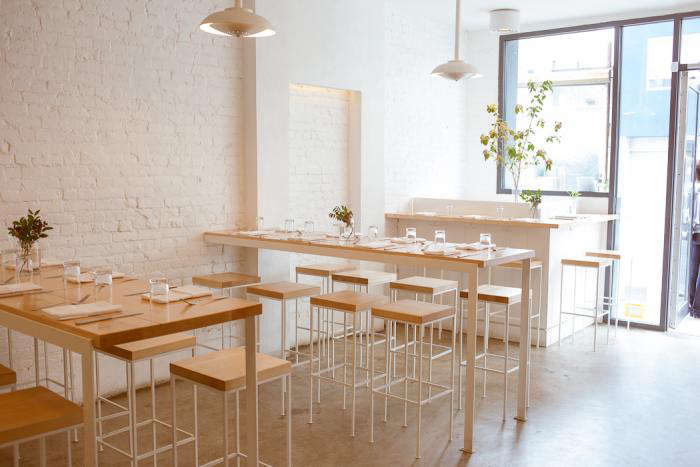
Designer Joseph Foglia approached the space with inspiration from Quaker meeting houses. The goal was not to build a religious room, but to borrow the principles: restraint, modesty, natural materials, and a sense that design should support the people inside it. The interior used maple throughout, custom furniture, and architectural fixtures that felt considered rather than decorative for decoration’s sake.
One memorable detail was the lighting: fixtures sourced from an old passenger train car and adapted for the restaurant. That choice captured the whole mood. It was practical, historical, and slightly romantic without becoming theatrical. The lights did not scream, “Look at me, I am vintage!” They simply glowed, which is what lights should do when they are emotionally stable.
Why Williamsburg Was the Right Place for This Experiment
Williamsburg has long been a neighborhood of layers. Industrial buildings, artist studios, waterfront development, independent restaurants, boutiques, and residential towers all exist in conversationsometimes gracefully, sometimes like a group chat with too many opinions. Against that backdrop, a restaurant like Parish Hall made sense because Williamsburg diners were already interested in food with identity.
By the early 2000s and 2010s, Brooklyn’s dining scene had become a major force in American food culture. Chefs and restaurateurs were experimenting with local sourcing, handmade ingredients, small farms, nose-to-tail cooking, natural wine, and casual dining rooms that still took food seriously. Williamsburg was one of the places where these ideas became visible to a wider audience.
Parish Hall fit into that moment while also resisting some of its excesses. It did not rely on visual clutter or ironic décor. It did not need a wall of reclaimed objects arranged like a museum of someone’s attic. Instead, it used simplicity as a design language. That made the farm-to-table message feel more believable. When the room is honest, the food has a better chance of being believed too.
The Design Lesson: Let Materials Tell the Truth
A major reason Quaker-inspired simplicity works in hospitality design is that it encourages material honesty. Wood should look like wood. Light should feel like light. Furniture should invite sitting, not punish it. The dining room should be beautiful, but it should not behave like the main character in a musical.
At Parish Hall, maple helped create warmth without heaviness. The pale, natural quality of the wood worked with the bright interior to make the restaurant feel open and calm. In a large industrial building, that mattered. Industrial spaces can easily feel cold or echoey. The use of wood and simple custom elements helped bring the scale down to human level.
This is a useful lesson for restaurant owners and homeowners alike. Simplicity is not the same as cheapness. A plain room can be deeply luxurious when the proportions are right, the materials are durable, and every element has been chosen with care. In fact, simple design often exposes quality more than ornate design does. There is nowhere for bad details to hide. A wobbly chair in a simple room is not “rustic.” It is just a chair asking for help.
The Menu Lesson: Seasonality Creates Its Own Drama
Farm-to-table restaurants do not need to manufacture excitement when the ingredients are genuinely seasonal. A chilled corn soup in late summer can be more memorable than a complicated dish with twelve sauces and a garnish that requires tweezers, a magnifying glass, and emotional support.
Parish Hall’s menu leaned toward seasonal American cooking with vegetables, fruits, grains, and meats prepared in ways that respected their origin. Dishes highlighted produce from Goatfell Farm and other farmers in the Northeast. That meant the menu could shift naturally: berries giving way to other fruits, summer vegetables replaced by autumn roots, and grains adding texture without trying to become the entire personality of the plate.
This kind of cooking asks diners to pay attention. It also asks kitchens to be flexible. A chef working closely with farms cannot simply demand perfect strawberries in February and pretend the planet is a room-service menu. The best farm-driven cooking accepts limits and turns them into creativity.
Quaker Simplicity as a Modern Restaurant Strategy
Restaurant trends move quickly. One year every dining room has subway tile. The next year everyone is eating in a jungle of hanging plants. Then comes the moody walnut-and-brass era, followed by the beige era, followed by the “Is this a café or a ceramics store?” era. Through all of it, simplicity remains useful because it is not really a trend. It is a discipline.
Quaker simplicity, translated into a secular design context, offers several practical advantages. First, it reduces distraction. Diners can focus on food, conversation, and the people across the table. Second, it supports longevity. A simple space ages better than a room built entirely around a trend. Third, it aligns with sustainable thinking. Fewer unnecessary materials, better craftsmanship, and durable furniture can reduce waste over time.
Most importantly, simplicity creates trust. When a restaurant claims to care about farms, seasons, and community, the design should not feel like a luxury costume party. A restrained dining room says, “We are not trying to overwhelm you. We are trying to feed you well.” That message is surprisingly powerful.
The Egg Connection: From Breakfast Comfort to Seasonal Ambition
Egg began as a Williamsburg breakfast project and grew into a neighborhood institution. Its appeal came from a combination of Southern-influenced comfort food, straightforward hospitality, and the kind of morning menu that makes people forgive long waits. Egg proved that a restaurant could be beloved without being fussy.
Parish Hall built on that foundation but expanded the idea. It took the farm relationship more deeply into lunch and dinner and gave the food a more refined setting. The connection to Goatfell Farm gave both restaurants a narrative that felt grounded. This was not farm-to-table as decorative language. It was a working relationship between city dining and rural growing.
That connection matters because urban restaurants can feel detached from the realities of food production. Guests see the plate, not the weather, soil, irrigation, labor, pests, harvest timing, transportation, or farmer’s nerves during a late frost. A restaurant with its own farm relationship brings at least part of that hidden story closer to the table.
Why This Idea Still Matters Today
Even though Parish Hall was short-lived, its concept still feels current. In fact, it may feel more current now than when it opened. Diners today are more interested in where food comes from, how restaurants treat workers, whether ingredients are responsibly sourced, and whether the design of a space supports comfort rather than just Instagram performance.
The best modern restaurants understand that a meal is an ecosystem. The farm matters. The kitchen matters. The dining room matters. The furniture, acoustics, lighting, service style, and menu language all shape the experience. When these pieces align, the restaurant feels calm and inevitable, like it could not have been anything else.
Farm-to-table meets Quaker simplicity is not just a description of one Williamsburg restaurant. It is a blueprint for hospitality with a conscience: cook with what is near, design with what is necessary, and leave room for people to actually enjoy themselves.
How to Bring the Idea Home
You do not need to own a Brooklyn restaurant or a Catskills farm to borrow this philosophy. A home kitchen can also combine farm-to-table thinking with Quaker-inspired restraint. Start with ingredients that are seasonal and local when possible. Buy from farmers markets, community-supported agriculture programs, small grocers, or regional producers. Let the produce guide the meal instead of forcing the meal to obey a recipe that ignores the calendar.
Then look at the room. Does the kitchen support cooking, or does it mostly support the storage of gadgets you used once during a smoothie phase? Do the dining chairs invite people to linger? Is the table clear enough for food, elbows, and conversation? Simplicity begins with removing what competes for attention.
A Quaker-inspired home dining space does not need to be austere. It can include flowers, candles, handmade ceramics, linen napkins, a wooden table, and warm light. The key is intention. Choose fewer things and let them be better. A bowl of peaches on a plain table can do more for a room than a complicated centerpiece that looks like it requires its own insurance policy.
Experiences Inspired by Farm-to-Table and Quaker Simplicity in Williamsburg
Imagine arriving in Williamsburg on a cool evening when the sidewalks still hold the heat of the day. The neighborhood is busy, but not frantic. You pass old industrial façades, sleek storefronts, bicycles chained to signposts, and restaurants glowing like small theaters. Somewhere nearby, someone is explaining natural wine with the seriousness usually reserved for medical results. You keep walking.
The experience of a farm-to-table, Quaker-inspired restaurant begins before the first bite. It begins with the relief of entering a room that does not attack your senses. The light is warm. The wood has grain. The tables are close enough to feel social but not so close that you become emotionally involved in a stranger’s first date. There is no giant television, no unnecessary spectacle, no design feature begging to become a selfie backdrop. The room gives you permission to exhale.
Then the menu arrives, and it reads like a conversation with the season. Maybe there is a soup built around sweet corn, herbs, and late-summer fruit. Maybe greens are paired with nuts, grains, or a sharp cheese. Maybe duck, pork, eggs, or beans appear alongside vegetables that taste like they were chosen for flavor rather than symmetry. The food does not need to perform acrobatics. It simply needs to be awake.
One of the pleasures of this style of dining is that it makes you notice small things. The snap of a bean. The sweetness of a roasted carrot. The way a grain can add chew and warmth. The difference between a tomato that has traveled across the country and one that seems to remember the sun personally. Farm-to-table cooking can make a diner feel less like a consumer and more like a participant in a regional cycle.
The Quaker simplicity side changes the emotional pace of the meal. In a quieter room, conversation becomes part of the flavor. You hear the scrape of cutlery, the low rhythm of voices, the server explaining a farm name without turning it into a TED Talk. You notice the table, the chair, the light, the plate. Nothing is accidental, but nothing is desperate for applause.
That experience is especially meaningful in Williamsburg because the neighborhood itself is so visually and culturally intense. A simple dining room becomes a pause button. It says that refinement does not have to mean extravagance, and comfort does not have to mean clutter. It also reminds diners that sustainability is not only about sourcing; it is about appetite, design, pace, and respect.
A home version of the experience might begin on a Saturday morning at a farmers market. Buy what looks alive: radishes with greens still attached, apples with honest blemishes, herbs that perfume the bag, bread with a crust that crackles like tiny applause. Do not over-plan. Let the market edit the menu for you. That is one of the secret joys of seasonal cooking: fewer decisions, better outcomes.
Back home, keep the preparation simple. Roast the vegetables. Dress the greens. Slice the bread. Put good butter or olive oil on the table. Use plates that feel good in the hand. Turn down the lights. Put your phone somewhere boring. Invite people who can enjoy a meal without reviewing it like a federal inspection. Suddenly, the spirit of farm-to-table and Quaker simplicity is not an abstract design idea. It is dinner.
The deeper experience is this: when food is connected to place and design is connected to purpose, a meal becomes easier to trust. You do not need excess. You need care. You need ingredients with a story, a room with patience, and enough quiet to taste what is in front of you. Williamsburg offered one memorable version of that idea through Parish Hall, but the lesson travels well. Wherever there is a table, a season, and a willingness to let simplicity do its work, the concept can live again.
Conclusion
Farm-to-Table Meets Quaker Simplicity in Williamsburg is more than a stylish phrase. It captures a rare balance between culinary integrity and architectural restraint. Parish Hall showed how a restaurant could connect Brooklyn diners to regional farms while using design inspired by plain, purposeful Quaker meeting houses. Its lesson remains valuable: the best spaces do not compete with the meal, and the best meals do not hide their origins.
In an age of loud branding and faster trends, this Williamsburg story feels refreshingly grounded. It asks restaurants, designers, and home cooks to consider what really matters: honest ingredients, durable materials, thoughtful light, humane hospitality, and enough restraint to let beauty arrive quietly. Sometimes the simplest table is the one that stays with us longest.
Note: This original article is based on publicly available real-world context about Parish Hall in Williamsburg, Brooklyn; Egg; Goatfell Farm; Joseph Foglia’s restaurant design approach; Quaker meetinghouse principles; and the broader farm-to-table movement in New York dining culture.