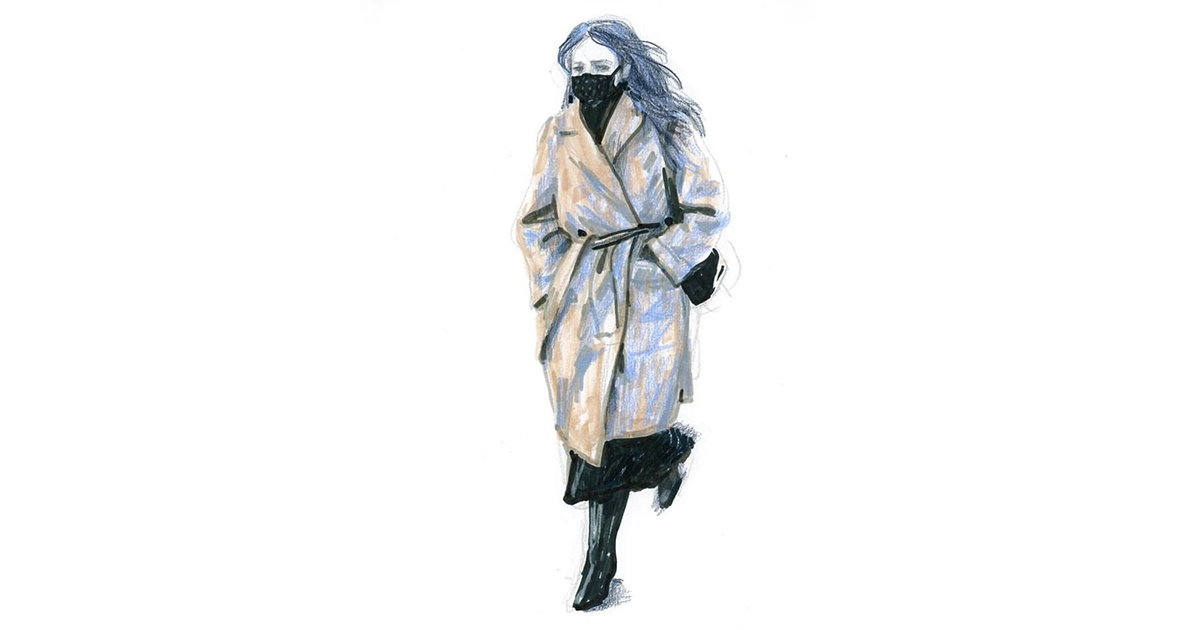
Some cities introduce themselves with postcards. Bucharest, being Bucharest, prefers to arrive wearing an old velvet coat, carrying a plastic shopping bag, walking past an Art Deco facade, and somehow making the whole scene look like a movie still. That is exactly why quick drawings of women on the streets of Bucharest feel so alive: they do not freeze the city; they catch it mid-step.
The project behind this title, Les Dames de Bucarest, was created by Bucharest-based illustrator Georgiana Chițac. It began as a daily drawing challenge on January 1, 2021: one woman observed in Bucharest, drawn every day. The idea grew into a full visual diary of 365 illustrations, using watercolor, colored pencil, ink, graphite, gouache, and the most underrated art supply of all: patience in public places.
At first glance, the concept sounds simple. See a woman. Draw her quickly. Repeat. But simplicity is sneaky. In art, as in cooking eggs, the fewer ingredients you use, the more obvious your skill becomes. These quick street drawings are not just portraits. They are tiny reports from the sidewalks, trams, stores, parks, and everyday corners of Romania’s capital.
Why Bucharest Is the Perfect Stage for Street Sketching
Bucharest is a city of visual contradictions, which is another way of saying it is a dream for illustrators and a mild cardio workout for anyone trying to describe it in one sentence. Its streets mix Belle Époque elegance, Neo-Romanian details, communist-era blocks, modern glass, old churches, patched sidewalks, leafy boulevards, and storefronts that look as if three different decades are arguing over rent.
That layered backdrop gives street sketching a natural rhythm. A woman waiting for the bus is not just a figure; she is a shape against signage, traffic, tree shadows, and architecture. A woman carrying flowers becomes a moving color study. A woman reading on public transportation becomes a quiet rebellion against the sacred modern ritual of staring into a phone until the soul asks for Wi-Fi.
The city’s old nickname, “Little Paris,” still floats around because of its grand boulevards and French-inspired architecture. But modern Bucharest is not a museum version of Paris. It is more restless, more patched together, more surprising. That is what makes the drawings interesting. They do not polish the city until it becomes generic. They let Bucharest remain Bucharest: elegant, chaotic, tender, and occasionally parked on the sidewalk.
The Power of Quick Drawings
Quick drawings work because they choose energy over perfection. A polished portrait can tell us what someone looks like. A fast street sketch often tells us how someone moves, waits, worries, balances grocery bags, adjusts a scarf, or occupies a tiny square of public space as if it belongs to her for exactly 14 seconds.
In observational drawing, speed is not laziness. It is a filter. When the artist has only a few moments, every line has to earn its seat at the table. There is no time to lovingly render every shoelace. The brain must decide: What matters here? The tilt of the head? The curve of the coat? The rectangle of a tote bag? The heroic posture of someone who has clearly survived both Monday morning and public transportation?
This is why the best quick sketches feel strangely complete even when they are visibly unfinished. A few marks can suggest a whole personality. A wash of color can imply weather. A dark line under a shoe can make the figure stand firmly on the page. The white space is not empty; it is breathing room.
Women as the Living Archive of a City
One of the strongest aspects of Les Dames de Bucarest is that it treats ordinary women as worthy subjects. Not celebrities. Not staged models. Not fantasy characters with hair behaving in defiance of basic physics. Just women seen in daily life: walking, sitting, shopping, working, commuting, waiting, carrying, reading, talking, resting.
That matters because public life is full of small stories that rarely get framed. A city is not only built by architects, mayors, investors, and dramatic historical plaques. It is also shaped by the people who cross it every day. Women’s clothing, posture, bags, hairstyles, shoes, gestures, and routines become a kind of informal archive. The drawings preserve those details without turning them into a lecture.
There is also a refreshing range in the project. The women are not reduced to one ideal body, age, or mood. Some look stylish. Some look tired. Some look busy. Some look wonderfully unbothered. A few appear as if they could win an argument with a tram schedule. Together, they create a richer image of urban womanhood than a glossy fashion campaign ever could.
Street Style Without the Snobbery
Fashion illustration has a long history of recording how people dress, dream, and present themselves. But street drawing has a different flavor from runway illustration. It is less “Here is a perfect outfit under perfect lighting” and more “Here is a coat doing its best in real weather.” That difference is delicious.
In Bucharest, style is practical and expressive at the same time. You might see a structured handbag next to sneakers, a vintage-looking coat beside a modern phone, a scarf wrapped with absolute confidence, or a shopping bag that has been promoted to main character status. Quick drawings capture these combinations before they vanish into the crowd.
The charm is in the lack of overproduction. Nobody has arranged the street like a set. Nobody has called for a wind machine. The tram does not care about the composition. The pavement is not waiting for approval from an art director. Yet somehow, the scene works. That is the magic of drawing from life: reality keeps ruining the plan, and the artist keeps turning the ruins into rhythm.
Why the Project Feels Human in a Digital World
We live in a time when images are endless. Scroll for five minutes and you can see more faces than a medieval village saw in a decade. But quantity does not equal attention. A sketch slows the eye down. It says, “This person was here. I noticed.”
That is the quiet emotional center of these quick drawings. They are not loud. They do not chase shock value. They do not need a dramatic caption written in capital letters. Their strength comes from attention. In a world where everyone is photographed constantly but rarely observed carefully, drawing feels almost radical.
The hand-drawn mark also carries vulnerability. A photograph can pretend to be instant truth, even when framing changes everything. A drawing openly admits: this is what the artist saw, selected, remembered, and translated. It has personality baked into the line. You can feel the choices. You can feel the time pressure. Sometimes you can practically hear the pencil saying, “Please, dear subject, do not walk away yet.”
The Ethics of Drawing Strangers
Any project about people in public space should think about respect. Street photography and street illustration both raise questions about privacy, dignity, and consent. A sketch can feel gentler than a close-up photograph, but it still represents a real person. The most thoughtful street artists avoid cruelty, ridicule, or turning strangers into props.
The best approach is simple: draw with curiosity, not entitlement. Focus on gesture, mood, clothing, and atmosphere rather than invasive detail. Avoid making people vulnerable for entertainment. Do not mock bodies, age, disability, poverty, or fatigue. Public life offers plenty of humor without punching down. A woman running after a bus can be funny because the bus is the villain, not because she is.
In this sense, Les Dames de Bucarest succeeds because it feels affectionate. The drawings celebrate presence. They show variety. They give everyday women the dignity of being seen as part of the city’s beauty, not as decoration around it.
What Artists Can Learn From These 39 Pics
1. Make the project simple enough to repeat
“One drawing a day” is clear. That clarity matters. A daily art project should not require a committee meeting, three mood boards, and a dramatic candlelit vow. The easier the rule is to understand, the easier it is to continue when inspiration has gone out for coffee and forgotten to return.
2. Let materials create variety
Using watercolor, colored pencil, ink, graphite, and gouache gives the series movement. Some days call for soft color. Some need a sharp line. Some demand a scribble with the confidence of a taxi driver changing lanes. Changing materials keeps repetition from becoming mechanical.
3. Draw the whole attitude, not every detail
A strong street sketch does not need to document every button. It needs to catch the attitude. Is the figure leaning forward? Guarded? Relaxed? Distracted? Floating through the city like she owns the crosswalk? Gesture is often more memorable than accuracy.
4. Use the city as a silent character
The women are the focus, but Bucharest is always nearby. Even when the background is minimal, the city’s rhythm shows up in clothing, posture, bags, transit, and the tiny compromises of urban movement. A good street drawing lets the location whisper through the subject.
Why Viewers Respond to These Drawings
People respond to this kind of project because it feels both specific and universal. The women are from Bucharest, yet the gestures are familiar everywhere. Waiting with one hand in a pocket. Carrying too much. Looking into the middle distance. Wearing a coat like emotional armor. Protecting a small dog from the nonsense of the world. These are international languages.
The project also invites viewers to pay better attention to their own streets. After looking at these drawings, you may start noticing the woman who always reads on the bus, the florist arranging buckets outside a shop, the grandmother with excellent posture, the student balancing coffee and deadlines, or the office worker whose scarf deserves its own fan club.
That is the quiet success of urban illustration: it changes the way we look. The artwork does not stay politely inside the screen. It follows us outside and taps us on the shoulder. “Look,” it says. “There is a whole gallery walking past you.”
Experience Notes: What It Feels Like to Draw Women on the Streets of Bucharest
Drawing strangers in Bucharest would probably begin with confidence and immediately become a negotiation with reality. You open the sketchbook, choose a subject, place the first line, and thenbecause cities are mischievousthe subject moves. She turns her head. She gets on the tram. She answers her phone. She disappears behind a man carrying a box large enough to contain either office supplies or a small piano.
That is the first lesson: street drawing is not about control. It is about response. You learn to begin with the largest shapes because the details may escape. Coat first. Head angle second. Bag third. Shoes only if destiny is generous. The hand becomes faster because it must. The eyes become sharper because they have no choice. After a while, you stop trying to “finish” people and start trying to understand the moment.
Bucharest adds its own personality to the experience. The city gives you backgrounds that refuse to be boring. A woman in a red coat near a pale building. A commuter framed by bus windows. Someone standing beside a kiosk with colors louder than the traffic. Old facades, modern signs, tangled wires, tree shadows, and uneven pavement all compete for attention. The challenge is deciding what to leave out. The temptation is to draw everything. The wise artist says, “No, dear beautiful chaos, today you get three lines and a hint.”
There is also the social comedy of being seen while seeing. People notice sketchbooks. Some become curious. Some pretend not to look while absolutely looking. Some may ask questions. Others may smile, which is lovely unless you were drawing their serious expression and now the whole emotional weather has changed. Public drawing teaches flexibility, humility, and the ancient survival skill of looking casual while internally screaming, “Please hold that pose for two more seconds.”
Over time, the practice becomes less about collecting images and more about building attention. You notice how women carry the city differently depending on the hour. Morning figures move with purpose and coffee-related urgency. Afternoon figures have errands, children, bags, conversations, and the occasional bouquet. Evening figures seem softer around the edges, lit by shop windows and fatigue. The same street becomes many streets because the people keep rewriting it.
The emotional reward is surprising. A quick drawing can make an ordinary day feel witnessed. It turns a commute into a composition, a waiting room into a character study, a sidewalk into a stage. You begin to respect the small choreography of daily life: the hand adjusting a sleeve, the careful step around a puddle, the glance before crossing, the way a person holds flowers as if transporting weather.
By the end, the sketchbook is more than a stack of drawings. It is a record of attention. Not perfect attention, not complete attention, but human attentionthe kind that says cities are made of moments, and moments are made of people who may never know they became art for a few minutes.
Conclusion
I Do Quick Drawings Of Women On The Streets Of Bucharest (39 Pics) is more than a catchy gallery title. It points to a larger truth about art: sometimes the most meaningful subjects are already walking past us. Georgiana Chițac’s daily project shows how quick sketches can preserve fashion, gesture, personality, and urban atmosphere without overexplaining them.
In an age of polished feeds and instant images, these drawings remind us that observation is still powerful. A line can be enough. A wash of color can hold a season. A woman waiting for the bus can become part of a city’s visual memory. And Bucharest, with all its layered charm and beautiful disorder, offers the perfect sidewalk gallery.