There are events where people walk around politely, nod at displays, accept a brochure, and go home with exactly the same number of questions they arrived with. Then there is the Omaha Mini Maker Faire: a place where a chicken, a robot, a spinning wheel, a garden in a pickup truck, and a laser-cut cardboard marvel can all appear in the same day without anyone calling security.
Hackaday’s Omaha Mini Maker Faire Roundup captures the exact flavor of what makes a local maker event so memorable. It was not just about gadgets, although there were plenty. It was not only about crafts, although the fiber arts were strong. It was not simply a science fair, a county fair, or a technology expo. It was a glorious collision of invention, education, sustainability, robotics, woodworking, food craft, and community curiosity.
Held at the Omaha Children’s Museum, the second annual Omaha Mini Maker Faire brought together local makers, educators, families, hobbyists, engineers, artists, and kids who were still young enough to ask the best engineering question of all: “What happens if I push this button?” The result was a hands-on celebration of the maker movement in Omaha, Nebraska, with enough creative energy to make a soldering iron feel under-caffeinated.
What Was the Omaha Mini Maker Faire?
The Omaha Mini Maker Faire was part of the broader Maker Faire movement, a family-friendly celebration of invention, creativity, resourcefulness, and hands-on learning. While flagship Maker Faires have drawn huge crowds in major cities, Mini Maker Faires are designed to spotlight local creativity. They give communities a stage for the people building robots in garages, weaving fiber in guild halls, growing food in unexpected places, and turning “I wonder if…” into “Look, it works!”
In Omaha, that spirit fit naturally. The city has a practical, Midwestern maker DNA: fix what is broken, build what is missing, teach your neighbor, and maybe bring snacks. The event’s location at Omaha Children’s Museum also made sense. The museum’s learning-through-play environment turned the Faire into a playground for curiosity, where parents could watch children discover robotics, agriculture, fabrication, animation, and old-school craft without needing to decode a college engineering syllabus first.
Hackaday’s Roundup: Why It Still Matters
Hackaday’s coverage of the Omaha Mini Maker Faire stood out because it did what good maker journalism should do: it noticed the charming weirdness. The roundup did not treat technology as something locked behind glass. Instead, it highlighted the messy, lively, highly human side of making. A Transylvanian Naked Neck chicken appeared before the writer even got inside. That is not a typical lead for a tech article, but at a Maker Faire, it is practically a handshake.
The Hackaday roundup showed that maker culture is bigger than microcontrollers, 3D printers, and blinking LEDs. It includes urban farming, meat curing, weaving, toy boxes, robotics, stop-motion animation, laser cutting, music projects, and educational exhibits. In other words, making is not a single hobby. It is a mindset: learn by doing, improve by failing, and explain your project to anyone willing to listen for three minutes longer than planned.
A Roundup of the Standout Exhibits
City Sprouts and the Sustainability Theme
One of the first memorable moments came from City Sprouts, an Omaha community gardening organization focused on healthy communities, urban growing, education, and youth engagement. Their presence helped set a sustainability theme for the Faire. A maker event can easily become a parade of circuit boards and plastic filament, but Omaha’s version made room for soil, food, and living systems.
The chicken at the outdoor booth was more than a funny detail. It was a reminder that making includes agriculture and food literacy. Raising animals, growing vegetables, composting, preserving food, and teaching children where dinner actually comes from are all forms of applied knowledge. They may not beep, but they are still technology in the oldest sense of the word: tools and techniques used to solve real problems.
Truck Farm Omaha: A Garden on Wheels
Nearby, Truck Farm Omaha brought one of the most photogenic ideas of the day: a 1975 Chevy pickup converted into a mobile garden. The concept is simple enough for a child to understand and clever enough for an adult to wish they had thought of it first. Plant a garden in the bed of a truck, drive it where kids can see it, and start conversations about healthy eating, urban agriculture, local food, and environmental sustainability.
That is exactly the kind of exhibit that makes a Mini Maker Faire work. It is visual, practical, funny, and educational. It also quietly demolishes the excuse that there is “no space” to grow food. If a garden can thrive in an old pickup truck, the average windowsill has officially run out of excuses.
Cure Cooking and the Science of Food
The roundup also mentioned Cure Cooking, where traditional dry-curing techniques entered the maker conversation. Food craft belongs at a Maker Faire because cooking is chemistry wearing an apron. Curing meat involves salt, moisture control, time, airflow, temperature, and patience. That is science. It just happens to be science that can end up on a sandwich.
This kind of exhibit broadens the meaning of “STEM.” It reminds visitors that experimentation does not only happen in laboratories. It happens in kitchens, gardens, garages, workshops, and community spaces. The same curiosity that drives someone to tune a robot can drive someone else to perfect a recipe, age a cheese, ferment vegetables, or build a smoker from spare parts.
Omaha Weavers and Spinners: Fiber Arts as Engineering
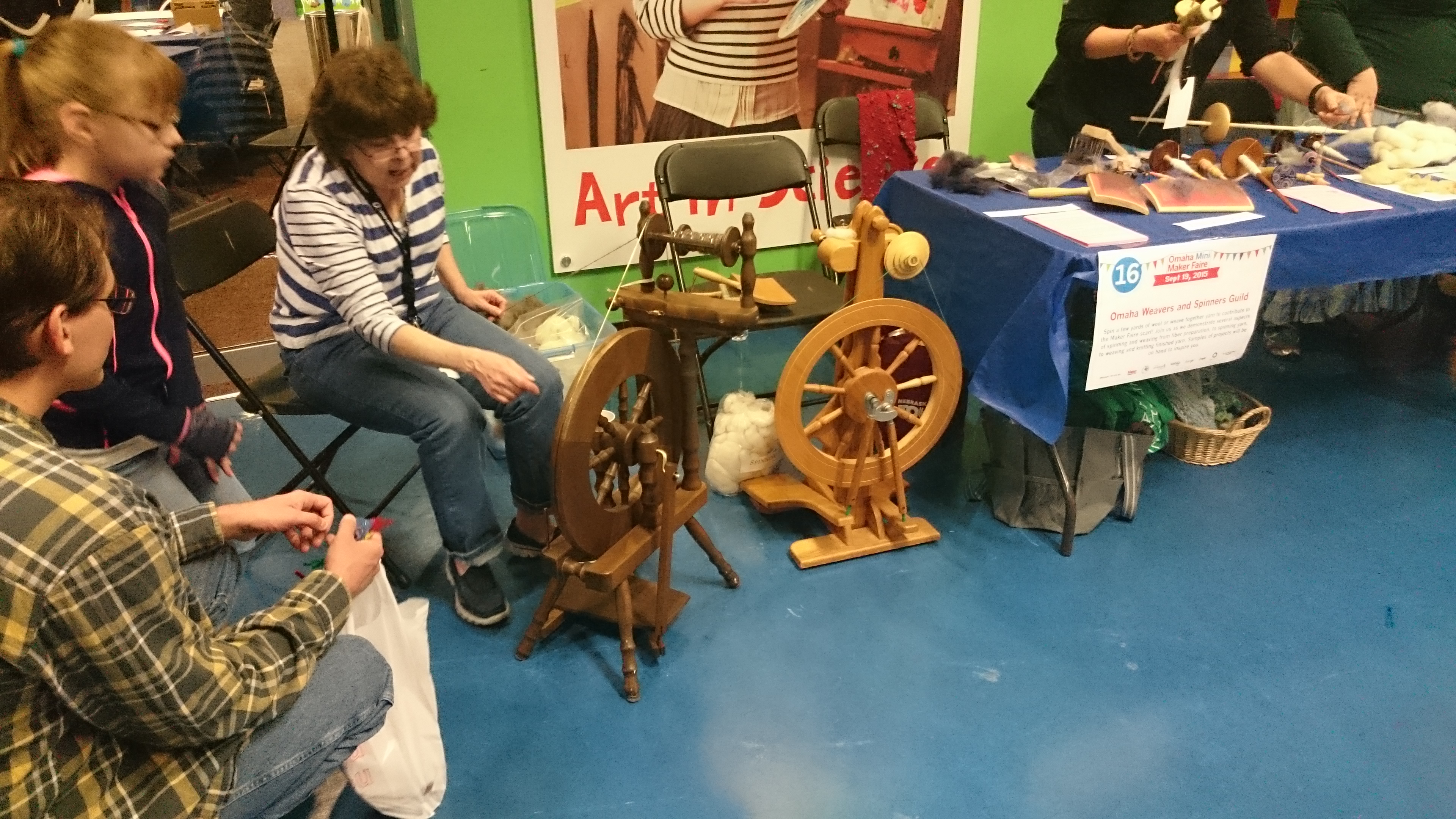
Inside the museum, the Omaha Weavers and Spinners Guild represented another essential maker tradition: fiber arts. Watching a spinning wheel in action can feel almost hypnotic. There is rhythm, tension, material science, hand skill, and mechanical logic all working together. A young visitor listening to an explanation of a spinning wheel was not just seeing a craft demonstration. She was watching engineering with wool.
Modern maker culture sometimes gets so excited about digital fabrication that it forgets how advanced traditional crafts really are. Weaving involves pattern systems, structural design, material behavior, and tool mastery. Spinning fiber requires touch, control, and a deep understanding of how raw material becomes useful. Long before desktop 3D printers, makers were already turning loose fibers into clothing, blankets, and art.
Grandpa Irv’s Handmade Toy Boxes
The handmade toy boxes and hope chests from Grandpa Irv added a woodworking note to the event. These pieces offered a different pace from robotics and electronics. Woodworking rewards precision, patience, planning, and finishing work. A toy box may look simple, but anyone who has tried to make a square box that is actually square knows the truth: wood has opinions.
Displays like this are valuable because they connect making to family life. A custom toy box is not just an object. It is furniture, storage, memory, craftsmanship, and often a future heirloom. At an event for families, that matters. It shows children that making can produce useful, beautiful things that last longer than a weekend project.
Robots Roll In: Mecanum Wheels and a Ball Balancer
Of course, no Hackaday-worthy Maker Faire roundup would feel complete without robots. The University of Nebraska robotics group appeared with machines rolling on mecanum wheels, the wonderful sideways-moving wheels that make robots look like they have discovered a loophole in physics. For visitors, mecanum drive systems are instantly captivating because they move in ways ordinary vehicles do not. Forward, backward, sideways, diagonal, rotating in place: it is robot ballet, but with more battery packs.
The standout robot, however, was a ball-balancing bot. A ball-balancing robot is a beautiful engineering headache. It must constantly sense position, adjust motion, and correct instability. It is not enough to move; it has to keep itself under control while balancing on a sphere. That means sensors, motors, control loops, mechanical design, and lots of testing. Also, probably a few moments where the builder stared at it and whispered, “Please don’t fall over again.”
For kids and adults alike, a balancing robot is a perfect demonstration project. It turns abstract ideas like feedback control, stability, and motion planning into something visible. You do not need to understand every equation to appreciate the magic of a machine fighting gravity in real time.
MCC Fab Lab and the Power of “Make Almost Anything”
The Metropolitan Community College Fab Lab was another major presence, taking up a significant part of the museum’s performing arts theater. Fab labs and prototype design spaces are central to the maker ecosystem because they give people access to tools that would otherwise be too expensive, too large, or too intimidating to own at home. Laser cutters, CNC routers, 3D printers, vinyl cutters, plasma cutters, and other fabrication tools turn ideas into objects with startling speed.
MCC’s maker resources have supported students, artists, inventors, entrepreneurs, educators, and curious community members. The concept is powerful: you do not need to own an industrial workshop to prototype a product, build a guitar, cut a sign, engrave a design, or test a mechanical idea. You need access, training, and a place where mistakes are treated as part of the process instead of evidence that you should go home and take up accounting.
Stop-Motion Animation and Creative Technology
One exhibit returned from the previous year with a popular stop-motion animation booth. Stop-motion is a perfect maker activity because it sits at the intersection of art, patience, storytelling, and technology. Visitors can move objects frame by frame, capture images, and watch still scenes come alive. It is accessible enough for children and deep enough for serious creators.
Animation also teaches sequencing, planning, and cause-and-effect thinking. Move the figure too far and the motion looks jumpy. Move it too little and production takes approximately until the heat death of the universe. Somewhere in between is the sweet spot, and discovering it is part of the fun.
Drum Machines, Electric Guitars, and Musical Making
The Hackaday roundup mentioned projects from a “How to Make Almost Anything” style class, including a 16-pad drum machine and an electric guitar. These projects are excellent examples of why maker education works. They combine design, electronics, fabrication, sound, aesthetics, and personal motivation. A student building a guitar is not just completing an assignment. They are making something they want to hold, play, improve, and show off.
Musical projects also bring emotion into engineering. A laser-cut bracket may be impressive, but a handmade instrument makes noise, invites performance, and creates a direct connection between maker and audience. When technology sings, people pay attention.
Omaha Maker Group and the Local Maker Ecosystem
Behind events like this is a larger community infrastructure. Omaha Maker Group has been an important part of the local maker scene, offering access to tools, shared knowledge, and a community of people interested in science, art, and technology. Makerspaces matter because they turn solitary hobbies into shared learning. One person knows welding. Another knows Arduino. Someone else knows sewing, CAD, woodworking, lock picking, or how to convince a 3D printer to behave before lunch.
A strong makerspace culture helps events like the Omaha Mini Maker Faire grow. It gives exhibitors a place to prepare projects, recruit volunteers, test demos, and trade ideas. It also helps beginners find a doorway into making. Not everyone starts with a garage full of tools. Many people start by walking into a makerspace and asking, “So, what can I do here?” The best answer is: “A lot. Wear safety glasses.”
Why Mini Maker Faires Are Good for Communities
Mini Maker Faires are more than entertaining weekends. They are community development in disguise. They connect students with mentors, hobbyists with collaborators, small businesses with audiences, and families with hands-on learning. They also make local talent visible. In every city, people are building strange, useful, beautiful, and educational things at kitchen tables, in basements, at schools, and in workshops. A Maker Faire brings those hidden projects into public view.
For children, the impact can be especially powerful. Seeing a robot move or a laser cutter produce a design can turn technology from something consumed into something created. That shift matters. A child who realizes “someone made this” is only one step away from “maybe I can make something too.”
For adults, these events can be equally refreshing. They restore the sense that learning is not limited to school and creativity is not limited to professional artists. You can start a garden, repair a device, sew a bag, build a lamp, design a toy, prototype a business idea, or finally learn what all those mysterious tools at the makerspace are for.
SEO-Friendly Takeaways from Hackaday’s Omaha Mini Maker Faire Roundup
For readers searching for “Hackaday’s Omaha Mini Maker Faire Roundup,” the key takeaway is simple: the event was a snapshot of Omaha’s maker culture at its best. It blended robotics, sustainability, fiber arts, woodworking, food craft, digital fabrication, animation, and family learning into one lively day. It also showed why Hackaday’s community-focused reporting has lasting value. The article preserved the small details that make local maker events memorable: the chicken, the truck farm, the balancing robot, the handmade toy boxes, and the joy of seeing people explain what they built.
The roundup also reminds us that the maker movement is not only about advanced technology. It is about agency. Makers look at the world and see materials, systems, and possibilities. They ask how things work, how they fail, how they can be repaired, and how they might be made better. That attitude is as useful in a garden as it is in a robotics lab.
500-Word Experience Section: What It Feels Like to Attend a Mini Maker Faire
Attending an event like the Omaha Mini Maker Faire feels a little like walking through someone’s imagination after it has been given a folding table, an extension cord, and permission to be enthusiastic. The first thing you notice is the noise. Not unpleasant noise, but the layered soundtrack of curiosity: motors whining, children asking questions, adults saying “careful, that part is hot,” and someone in the corner explaining a project with the intensity of a person who has slept four hours but finally got the firmware working.
The best way to experience a Maker Faire is not to rush. If you treat it like a checklist, you miss the magic. The real value comes from lingering at booths, asking makers why they built something, and listening for the story behind the object. A robot is interesting. A robot built because someone wanted to learn control systems, reused parts from an old toy, redesigned the chassis three times, and nearly gave up before breakfast is much more interesting.
At a Mini Maker Faire, the barrier between exhibitor and visitor is thin. You are not staring at polished products under retail lighting. You are often looking at prototypes, experiments, first versions, half-finished ideas, and beloved contraptions held together by cleverness and possibly zip ties. That is part of the charm. A maker will happily tell you what worked, what failed, and what they plan to change next. In a world obsessed with perfect launches, it is deeply encouraging to see people celebrate version 0.7.
Families get a special kind of value from these events. Children can move from a spinning wheel to a robot to a garden display to a fabrication demo and discover that learning is not divided into neat school subjects. Science touches food. Art touches engineering. Math hides inside music. Design matters in furniture, animation, electronics, and agriculture. A child may arrive for the robots and leave fascinated by weaving. That is not a detour; that is the point.
For adults, the experience can be pleasantly dangerous. You may enter thinking you are “just browsing” and leave mentally pricing a soldering station, a 3D printer, a sewing machine, or a raised garden bed. Maker events have a way of waking up dormant hobbies. They remind you that curiosity did not expire when you got a job, bought a calendar, or learned how expensive lumber can be.
The Omaha Mini Maker Faire, as captured by Hackaday, had that quality. It was not a sterile technology showcase. It felt alive, local, and slightly unpredictable. The mixture of sustainability, robotics, craft, food, and fabrication created a full picture of what making can mean. It can be high-tech, low-tech, old-tech, or no-tech. It can involve code, fiber, wood, soil, metal, cardboard, or meat. The common ingredient is the human urge to make something, share it, and invite someone else to try.
That is why events like this stick in memory. You may forget the exact specs of a robot or the name of a tool, but you remember the feeling: the sense that ideas are not distant things reserved for experts. They are right there on the table, waiting for a hand, a question, and maybe a little courage.
Conclusion: Omaha’s Maker Spirit in One Delightfully Odd Day
Hackaday’s Omaha Mini Maker Faire Roundup remains a fun and useful record of a community doing what maker communities do best: showing up, showing how, and making curiosity contagious. From City Sprouts and Truck Farm Omaha to robotics demos, fiber arts, handmade woodworking, stop-motion animation, and MCC Fab Lab projects, the event proved that making is not a niche. It is a wide-open invitation.
The Omaha Mini Maker Faire celebrated practical creativity in all its forms. It welcomed children, hobbyists, educators, engineers, artists, gardeners, cooks, and tinkerers into the same space. That blend is what makes the maker movement durable. Tools change. Platforms change. Microcontrollers get smaller, software gets smarter, and someone will always find a new way to make LEDs blink. But the core idea remains the same: learn by doing, share what you learn, and never underestimate the educational power of a weird chicken near the entrance.