Note: HTML body only. SEO tags appear at the end in JSON format.
Modern texting has its own little jungle of shortcuts, and if you have ever stared at a message that says “wdym?” and felt your brain do a tiny Windows restart, you are not alone. Internet slang moves fast, vowels disappear without notice, and somehow everybody is expected to keep up. One minute you are writing complete sentences like a responsible adult, and the next minute someone hits you with WDYM, IDK, and TBH like they are speed-running the English language.
The good news is that WDYM meaning is actually simple. The better news is that once you understand it, you will start noticing it everywhere: in texts, group chats, Instagram comments, TikTok replies, Snapchat messages, and the occasional dramatic late-night conversation where tone suddenly matters a lot more than spelling. This guide breaks down what WDYM means, where it fits in online slang, when to use it, when not to use it, and how to avoid sounding accidentally annoyed when all you wanted was a little clarification.
What Does WDYM Mean?
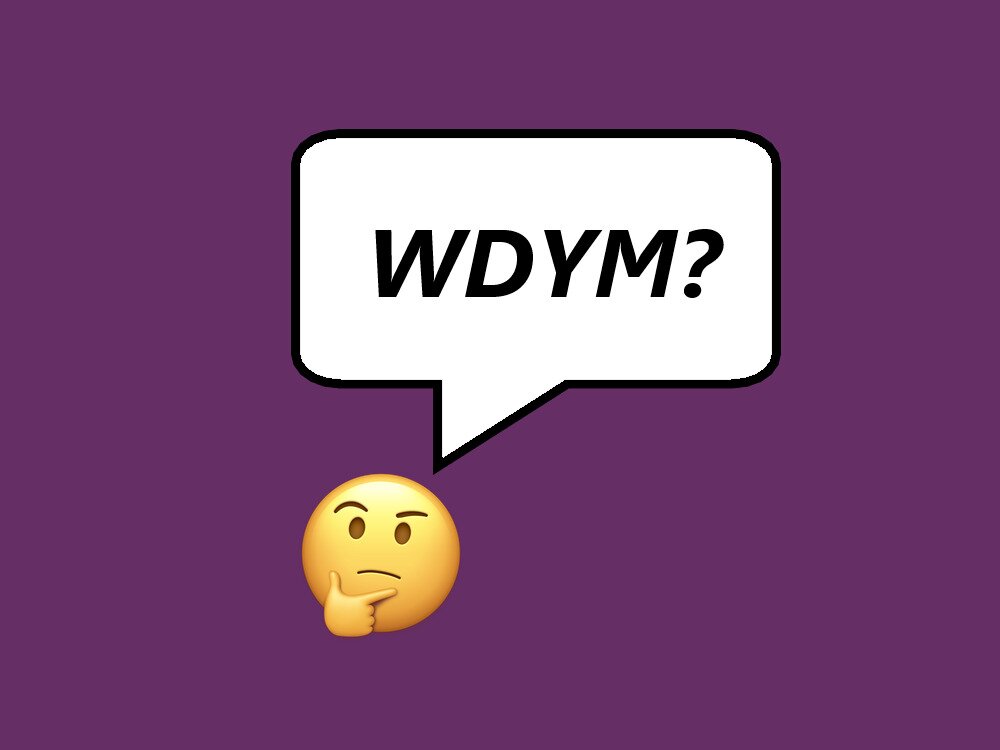
WDYM stands for “What do you mean?” That is the whole mystery. No secret code. No hidden fandom reference. No underground keyboard society. Just a shorter, faster way to ask someone to explain what they just said.
In plain English, people use WDYM when they are confused, surprised, skeptical, or trying to get more information. It is a quick request for clarification. If someone texts, “I do not think that plan is going to work,” you might reply, “WDYM?” because you want them to explain what part of the plan seems wrong.
You will usually see it written in lowercase as wdym, but uppercase WDYM is also common. Both versions mean the same thing. The difference is mostly tone and style, not definition.
Why People Use WDYM Instead of Writing the Full Phrase
Texting culture loves speed. That is the short version. The slightly nerdier version is that messaging habits grew around convenience, quick replies, and a long tradition of abbreviating common phrases. People shortened words and phrases because texting used to be slower, more limited, and more expensive. Even though phones are smarter now, the habit stuck around because typing less is still wildly attractive to the human soul.
WDYM fits perfectly into that world. It is short, recognizable, and easy to use in a fast-moving chat. It also mirrors how people actually talk online. In casual digital conversations, efficiency wins. Nobody is getting a trophy for typing out every syllable.
There is also a social reason WDYM survives: it feels conversational. It sounds like the digital version of raising an eyebrow and saying, “Wait, explain that.” That makes it useful not only for confusion but also for reaction, surprise, and playful disbelief.
How WDYM Is Commonly Used
1. To ask for clarification
This is the most common use. Someone says something unclear, and you ask them to explain.
Example:
Friend: “I think the meeting went badly.”
You: “wdym?”
Here, WDYM simply means: Can you explain what you mean by that?
2. To react with surprise
Sometimes WDYM is less about confusion and more about disbelief. In that case, it carries the energy of: Excuse me, what?
Example:
Friend: “I have never seen Star Wars.”
You: “WDYM you have never seen Star Wars?”
Now the phrase is doing double duty. It still asks for explanation, but it also adds emotion. It is part question, part dramatic gasp.
3. To challenge a statement
WDYM can also be a soft challenge. Maybe you think the other person is exaggerating, being vague, or skipping important details.
Example:
Coworker: “The project is basically done.”
You: “wdym ‘basically’ done?”
That version pushes for precision. It says, politely or not-so-politely depending on tone, Let’s not play games with the word basically.
4. To make a rhetorical point
On social media, WDYM is often used in a more expressive way. Sometimes the speaker is not actually seeking new information. They are emphasizing a point.
Example:
“wdym this is the best song on the album.”
That sentence is not really asking a question. It is more like saying, Obviously this is the best song on the album, and I cannot believe this is even up for debate.
Where You Will Usually See WDYM
WDYM is most at home in informal digital spaces. Think:
- Text messages
- Group chats
- Instagram DMs
- TikTok comments
- Snapchat messages
- Discord chats
- Casual social media conversations
It belongs to the same universe as shortcuts like IDK (I don’t know), WYD (What are you doing?), and TBH (To be honest). In other words, WDYM is casual, quick, and built for environments where people are typing fast and not polishing every sentence like it is a college application essay.
Is WDYM Rude?
Not by default. But tone is everything.
If you send a plain “wdym?” to a friend, it usually reads as casual and normal. If you send “WDYM???” in all caps with extra punctuation, it can feel sharper, more emotional, or more confrontational. Add context, relationship, and mood, and suddenly four harmless letters can sound either friendly or spicy.
That is one of the biggest lessons of online communication: people cannot hear your voice or see your face. So they fill in the emotional blanks themselves. That is why wording, punctuation, and capitalization matter so much.
Compare these examples:
- wdym? = casual, neutral
- Wdym lol? = light, playful
- WDYM??? = intense, shocked, maybe irritated
- wdym by that? = more direct, possibly serious
If you want to sound softer, add a few more words. Instead of just saying wdym?, you could write:
- “wdym exactly?”
- “what do you mean by that?”
- “wait, wdym? I want to make sure I understand”
Small additions can make a big difference. Online tone is a fragile little house of cards.
When You Should Not Use WDYM
As useful as WDYM is, it does not belong everywhere. Because it is internet slang, it is best saved for casual contexts. In more formal settings, writing out the full phrase is usually the better move.
Skip WDYM in professional communication
If you are emailing a manager, client, professor, recruiter, or customer, do not rely on WDYM. It can look too informal, rushed, or careless.
Instead of: “wdym by the updated policy?”
Try: “Could you clarify what you mean by the updated policy?”
That version sounds more polished and less like you texted it while standing in line for iced coffee.
Be careful in tense conversations
If the conversation is emotional, sensitive, or already a bit rocky, WDYM can come across as abrupt. A fuller sentence works better when you want to sound calm and thoughtful.
Instead of: “wdym?”
Try: “Can you explain what you meant by that? I want to make sure I’m understanding you correctly.”
Do not use it when clarity matters more than speed
There are moments when a shortcut saves time, and moments when it saves one second but creates five extra minutes of confusion. If there is any risk of misunderstanding, write more, not less.
WDYM vs. Similar Texting Terms
WDYM is often confused with a few other common abbreviations, so let’s untangle the alphabet soup.
WDYM vs. WYD
WDYM means What do you mean?
WYD means What are you doing?
These are very different questions, despite looking like cousins at a family reunion.
WDYM vs. IDK
WDYM asks for clarification.
IDK means I don’t know.
One asks a question. The other gives an answer, albeit not a very satisfying one.
WDYM vs. “Huh?”
Both can signal confusion, but WDYM usually asks for more explanation, while “Huh?” can sound shorter, blunter, or more puzzled. WDYM tends to feel more natural in texting because it matches the rhythm of online slang.
How to Use WDYM Naturally
If you want to sound natural using WDYM, the secret is simple: use it the way real people use it. Keep it casual. Keep it short. Match the tone of the conversation.
Here are some natural examples:
- “wdym the movie was boring? The ending was chaos in the best way.”
- “WDYM we are leaving at 6 a.m. on vacation? That is not vacation behavior.”
- “wdym by ‘it got weird’?”
- “Sorry, wdym exactly?”
- “wdym you forgot the tickets?”
Notice the pattern. Sometimes WDYM stands alone. Sometimes it appears at the beginning of a longer sentence. Both are common. What matters most is context.
Common Mistakes People Make with WDYM
Using it in formal writing
This is the biggest mistake. WDYM is great for informal messaging, not so great for professional emails, academic writing, or anything where polish matters.
Overloading it with punctuation
One question mark is fine. Two is dramatic. Three starts to sound like you are either panicking or auditioning for reality TV.
Forgetting that tone changes with capitalization
wdym feels softer than WDYM. Not always, but often. If you want to keep the tone calm, lowercase is your friend.
Using it when you actually need a fuller question
Sometimes a shortcut is too vague. If the topic is complicated, write a clearer follow-up instead of tossing out a lone WDYM and hoping for the best.
The Social Side of WDYM
There is a reason terms like WDYM keep showing up year after year: they are practical, expressive, and flexible. They save time, but they also carry attitude. A tiny abbreviation can signal confusion, curiosity, surprise, doubt, or playful disbelief depending on how it is written.
That makes WDYM more than just a shortcut. It is a little social tool. It helps people negotiate meaning quickly in chats where tone moves fast and everyone is trying to keep up. Digital language is not lazy English. It is adaptive English. It bends around platforms, habits, speed, and context.
So yes, WDYM is just four letters. But those four letters do a lot of work.
Real-Life Experiences With WDYM: Why This Tiny Acronym Feels Bigger Than It Looks
If you have ever learned WDYM by accident, congratulations, you joined the club the fun way. Most people do not sit down with a dictionary of internet slang and study for a quiz. They run into WDYM in the wild, usually in a text thread moving way too fast, and try to decode it before the conversation leaves them behind.
A common experience goes something like this: a friend sends a message that says, “wdym??” and for half a second your brain interprets it as either a typo, a secret code, or proof that the English language has officially given up. Then it clicks. What do you mean? After that, you start seeing it everywhere. It is like learning a new word and suddenly spotting it on every sign, post, and caption for the next two weeks.
Another experience people have with WDYM is realizing that the abbreviation itself is easy, but the tone is not. One person sends “wdym?” and it feels friendly. Another sends “WDYM???” and suddenly the room temperature drops. Same letters, wildly different vibes. That is why many people learn quickly that internet slang is not just about meaning. It is about emotional packaging. Punctuation is costume design. Capitalization is lighting. Everything affects the performance.
There is also the workplace crossover moment, which can be humbling. A lot of people use texting shortcuts so often with friends that they nearly type them in professional settings without thinking. Then they pause, stare at the screen, and realize that sending “wdym by the revised deliverables” to a manager is maybe not the branding they want for themselves that day. It is a funny reminder that digital fluency includes knowing not only what slang means, but where it belongs.
For younger users, WDYM can feel completely natural, almost invisible. For older users, or for anyone less immersed in internet slang, seeing it for the first time can be oddly disorienting. But once people understand it, they often appreciate the efficiency. It is quick, clear in the right context, and useful when conversations are moving fast.
Many people also discover that WDYM is one of those abbreviations that bridges generations more than expected. Teens use it. College students use it. Adults use it. Social media managers definitely use it, sometimes while pretending not to. The phrase works because the need behind it is universal: people say unclear things all the time, and somebody has to ask what on earth they meant.
In that sense, WDYM is not just internet slang. It is a small survival tool for modern conversation. It helps us slow a message down, question a vague statement, react to nonsense, or ask for details without typing a full paragraph. And honestly, in a world full of rushed communication, mixed signals, and chaotic group chats, that is a pretty respectable job for four little letters.
Conclusion
WDYM means “What do you mean?” and it is mainly used in texting, online chats, and social media when someone wants clarification, reacts with surprise, or playfully challenges a statement. It is simple, casual, and extremely common once you know what to look for.
The trick is not just knowing the definition. It is knowing the context. WDYM works best in informal conversations with people who already speak the language of texting shortcuts. In professional or sensitive situations, writing the full phrase is the smarter choice. And if you want to avoid sounding harsh, remember that tone matters: lowercase, punctuation, and extra wording can completely change how the message lands.
So the next time someone drops wdym into a chat, you will not blink. You will know exactly what it means, how it is being used, and whether the message is asking for a simple explanation or serving up a side of drama. In internet language, that counts as a survival skill.