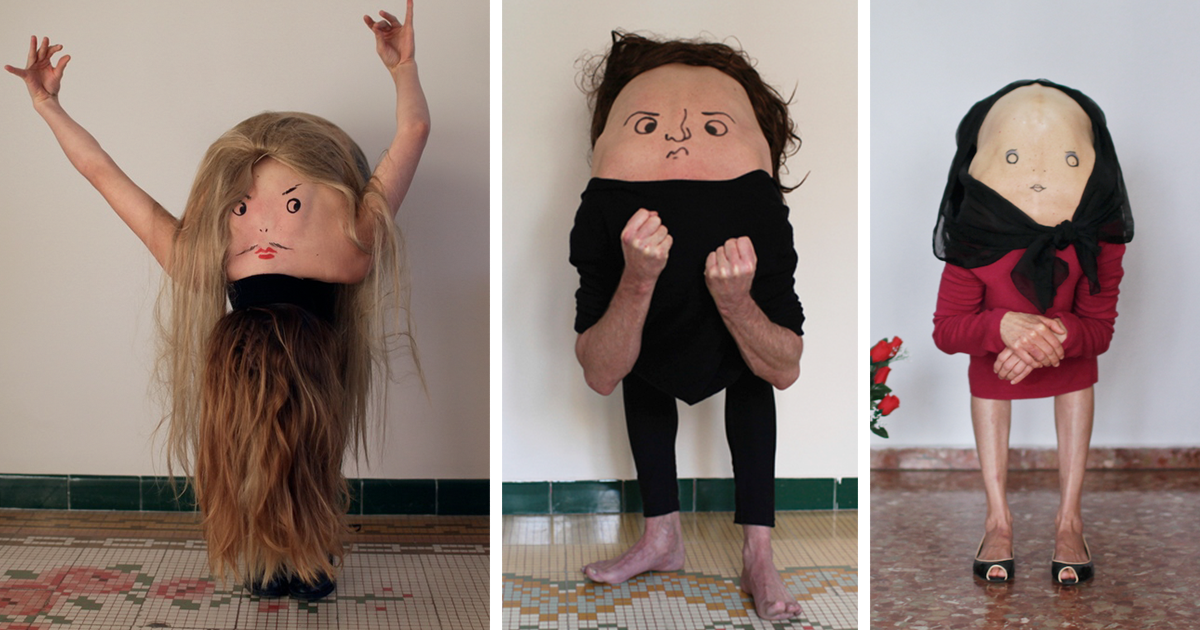
It starts as a joke and ends as a stare. A person stands in front of me, relaxed enough to trust the process, and I begin drawing a face on the back of their body as if the spine, shoulder blades, and lower curve of the torso were always waiting to become someone else. The result is usually part monster, part mask, part bad idea that somehow becomes a very good one. The magic works because the human brain is already eager to find faces in random patterns, a tendency known as pareidolia. Artists have been playing with illusion for centuries through trompe l’oeil and Op Art, both of which exist to bend perception just enough to make the viewer doubt what they know.
That is the real trick behind this kind of work. I am not just drawing a face on a back. I am building a visual excuse for the eye to finish the story on its own. A shoulder blade becomes a cheekbone. The spine becomes a nose bridge. A shadow under the ribcage becomes a grin that looks a little too wise for its own good. The body does half the storytelling before the pencil even touches skin.
Why the Back Makes Such a Strange and Perfect Canvas
Backs are excellent at being underestimated. They are broad, curved, and full of accidental geography. Unlike a flat canvas, a back changes with breath, posture, and motion, which means the artwork never stays politely still. The person shifts, and suddenly the creature blinks. The shoulders roll, and the creature looks annoyed. The torso leans forward, and the whole thing becomes a little more feral. That instability is what makes the illusion feel alive.
There is also something deliciously absurd about using the back, a place we rarely see well ourselves, as the home for a face. The viewer has to work a little harder. They circle around the body. They squint. They lean in. Then the brain does that charmingly suspicious thing where it says, Wait. Is that a face? That moment of uncertainty is the whole meal.
The old art of fooling the eye
Artists and designers have long known that a convincing illusion is often more powerful than a perfect description. Trompe l’oeil traditions are built around deceiving the eye, while Op Art uses repeated forms, sharp contrast, and precise shapes to trigger perceptual wobble. Contemporary illusion makeup and body-paint artists keep the same game alive today, using skin as both surface and subject. The effect can be witty, eerie, glamorous, or all three at once.
Some of the best examples in modern visual culture lean hard into that tension between realism and performance. Museums have celebrated “living pictures” that make human bodies look like paintings come to life, while social media has turned illusion makeup into a genre of its own. The line between painting, costume, and performance keeps getting blurrier, and that blur is where the fun lives.
What Makes the Creature Look Like It Came From Another World
The moment I stop thinking about human faces and start thinking about species, the drawings become more interesting. I like to imagine the back as a passport photo from an unregistered planet. Sometimes the creature is friendly, with round eyes and a mouth that suggests curiosity rather than menace. Sometimes it is all sharp eyebrows and a suspicious grin, like it has just heard a secret it intends to keep forever. And sometimes the funniest versions are the ones that look noble, ancient, and slightly confused, as if they have wandered out of a forest myth and into a family barbecue.
Most of the illusion depends on restraint. Too many details and the image stops breathing. Too few, and it becomes a doodle. The sweet spot is where a few clean marks suggest a complete personality. A tiny line under the eye can imply exhaustion, wisdom, or mischief. A crooked mouth can make the creature feel older than time or younger than trouble. The audience supplies the rest, which is exactly what a good illusion should invite them to do.
Why people cannot look away
Faces matter to us. We are wired to notice them, invent them, and assign them meaning even when they are barely there. That is why clouds become rabbits, toast becomes a portrait, and a carefully drawn back face can feel oddly intimate. Researchers and writers have repeatedly noted that face pareidolia is a normal feature of perception, not a weird exception. In plain English: if you can make a shoulder blade look like an eye, the brain will do the rest of the heavy lifting.
This is why the piece can be funny and unsettling at the same time. The viewer knows it is paint. The viewer also knows it is a face. Those two truths should cancel each other out, yet somehow they do not. Instead, they spark a little alarm bell in the mind, the same one that rings when a shadow looks like a person or a tree stump resembles a grin. That tiny delay before recognition lands is where the humor hides.
How I Build the Illusion Without Losing the Person Inside It
I start by studying posture. A bent shoulder gives me better angles than a rigid one. A relaxed back has natural valleys that can become eye sockets or a mouth line. Then I map the drawing lightly, looking for places where anatomy can act like architecture. I do not fight the body; I borrow from it. The body already has curves, ridges, and asymmetry. My job is to persuade those features to join the cast.
Lighting matters more than ego. A face drawn for overhead gallery light may fall apart outdoors at noon. A piece that looks deliciously spooky in a photo can become too polite in motion. So I test, tweak, and photograph from several angles. The goal is not just to create a drawing. The goal is to create a moment when the body and the image make a quiet pact to mislead the eye.
Color also changes the mood. Earth tones make the creature feel ancient, like it was carved from dust and memory. Neon colors make it feel like it escaped from a comic book. Black and white can make the back feel ghostly, elegant, and a little dangerous. Every palette tells the viewer how seriously to take the illusion, and the fun part is that the same face can be played as comedy, horror, or mythology just by changing the temperature of the color.
Why the Idea Feels Funny Instead of Just Creepy
A face on a back should, in theory, be unsettling. And sometimes it is. But humor sneaks in because the premise itself is ridiculous in the best way. A human back is not supposed to have a second personality. Yet there it is, blinking at you from between the shoulder blades, looking as though it pays rent. That mismatch between expectation and reality creates a comic jolt.
The joke gets stronger when the creature seems to be reacting to the room. One drawing may look offended by the lighting. Another may look delighted by the attention. Another may appear to be judging everyone in silence. Once the viewer starts assigning emotion, the artwork stops being a gimmick and becomes a character study. The back is still a back, but now it has attitude.
Experiences From the Studio: What Happens When I Actually Draw the Faces
The first thing I learned is that consent matters more than any brush or pencil. A person has to be comfortable enough to stand still, laugh a little, and trust that the weirdness has a purpose. Once that trust exists, the room changes. The work feels less like an invasion and more like a collaboration between skin, shadow, and imagination. That may sound romantic, but it is also practical. A relaxed subject makes better lines, and better lines make better creatures.
I also learned that backs have personalities. Some are broad and dramatic, perfect for masks with large, watchful eyes. Some are narrow and delicate, which suits smaller, sly creatures that look like they know a secret. Some bodies move like they are always in the middle of a sentence, and those are the hardest and most rewarding to draw on. Their motion keeps the work from turning stiff. Every breath changes the expression a little, and sometimes the best moment happens after I think I have already finished.
Then there is the strange silence that comes when people see the result for the first time. They usually laugh before they speak. Not because the drawing is silly, exactly, but because the brain has to reorganize itself around the new information. A back becomes a face. A face becomes a creature. A creature becomes a personality. That transition is visible in real time, and it never gets old. It is one of the few places in life where surprise is still pure.
Photography adds another layer of mischief. On screen, the creature can seem more real than it did in the room. A tiny highlight on the cheekbone, a deeper shadow along the spine, a slight tilt of the shoulders, and suddenly the image looks like proof from another dimension. That is when I understand why illusion art keeps returning in so many forms, from museum spectacle to social-media makeup to meticulous trompe l’oeil painting. People love the moment when a thing is almost true.
Some days the drawing comes out elegant. Some days it looks like a goblin had a long meeting with a cloud. I have made creatures that seem regal, creatures that seem sleepy, and creatures that look like they were born from a bad decision and a very good pen. I have also had the unpleasant pleasure of realizing that the simplest line often beats the cleverest one. A tiny mouth drawn in the right place can do more work than an entire page of decorative detail. The back is a stern teacher that way. It rewards confidence, not fuss.
Another lesson: people bring their own stories to the image. One viewer will see a forest spirit. Another sees a sea monster. Another sees a tired alien who just wants to go home. I used to worry that those interpretations were too different from my original idea. Now I think that is the point. The artwork is not a locked door. It is a trapdoor for imagination. The moment someone projects their own myth onto the body, the piece becomes larger than the ink or paint that made it.
I have also noticed that the best sessions feel a bit like theater. There is preparation, staging, costume, and then a reveal. The subject stands up, turns around, and becomes part of the audience of their own transformation. Sometimes they laugh at the result. Sometimes they get quiet. Sometimes they look into a mirror and do the most human thing possible: they recognize themselves and someone else at the same time. That split-second recognition is where the work becomes more than a novelty. It becomes a portrait of change.
There is a funny kind of honesty in that. A painted back can be a mask, but it can also be a confession. It says that identity is not always fixed to the front of the body. It can emerge from a shoulder, a curve, a line of shadow, or the space between two scars. It can look monstrous and tender in the same breath. And once you see that, it is hard to unsee it.
Why This Kind of Art Keeps Working
People return to illusion art because it gives them a double reward. First, they enjoy the technical trick: the neat little shock of “How is that even possible?” Then they enjoy the emotional aftertaste: the odd feeling that the image said something true about being human. A face on a back is ridiculous, yes. But it is also a reminder that the body is never just a body. It is surface, memory, theater, and invitation all at once.
The best part is that the joke never fully expires. The moment you think you understand the creature, it shifts. The shoulder changes. The expression mutates. The viewer blinks. The illusion moves on. That is why I keep drawing them. Every back is a doorway. Every line is a spell. And every new creature is just one more chance to turn a person into a visitor from another world without ever asking them to leave this one.
Conclusion
Drawing faces on people’s backs is a playful collision of anatomy, psychology, and visual deception. It borrows from the long tradition of trompe l’oeil, borrows from the brain’s love of finding faces everywhere, and borrows from the simple joy of making someone laugh when they realize what they are seeing. That is why the idea works: it is eerie, clever, and a little ridiculous, which is usually a very strong combination.
SEO Tags
Note: This article intentionally blends real art-history and psychology references with original creative writing.