Imagine walking into a city square with a camera that has no lens. No glass. No aperture. No light sensor quietly panicking about exposure. Instead, it has a horn pointed toward the world like an old gramophone that wandered into a computer science lab. You press a button, and the device listens. A bus exhales at the curb, shoes scrape across concrete, a vendor calls out, traffic hums in the background, and somewhere a dog contributes its very professional opinion. Then, after a short wait, an image appears.
That is the strange, delightful, and quietly profound idea behind Blind Camera: a camera that attempts to visualize a scene from its sounds alone. Rather than capturing light like a traditional camera, it uses audio as the raw material for image generation. It does not “see” in the familiar sense. It listens, guesses, associates, hallucinates, and produces a picture shaped by sound, training data, machine learning, and the unavoidable personality of artificial intelligence.
The result is not merely a clever gadget. It is a question wearing a camera body: What does a place sound like? What can sound reveal about a scene? And when AI turns audio into imagery, are we seeing reality, memory, probability, or a very confident machine doing jazz?
What Is Blind Camera?
Blind Camera is an AI-powered experimental camera created by artist and technologist Diego Trujillo Pisanty. The device preserves the familiar ritual of using a point-and-shoot camera: aim, press, wait, look. But instead of using a lens to collect light, it uses a sound-gathering form that resembles a horn. The user points the horn toward a sound source, captures audio, and the system generates an image from that acoustic input.
In a normal camera, the world enters through light. In Blind Camera, the world enters through vibration. A traditional photograph says, “Here is what bounced off objects into the lens.” A blind camera says, “Here is what this place sounded like, translated into something you can look at.” That difference sounds small until you realize it flips photography upside down, shakes the change out of its pockets, and asks whether images have always been more interpretive than we like to admit.
How Can Sound Become an Image?
Sound-to-image generation is based on a surprisingly human idea: we often imagine scenes when we hear them. Hear waves and gulls, and you probably picture a beach. Hear espresso machines, low chatter, and the occasional heroic clink of a spoon, and your brain may build a café before your eyes see one. Hear tires on wet pavement and a distant horn, and your mind sketches a rainy street.
AI systems try to learn similar associations by analyzing audio and visual data together. In the case of projects like Blind Camera, the system learns patterns between what something sounds like and what it may look like. A barking dog may correspond to streets, parks, sidewalks, homes, or, in the AI’s more dramatic moods, a blurry canine-shaped mystery. A subway rumble may correspond to platforms, tunnels, metal rails, orange signage, commuters, and motion.
The Audio-Visual Association Problem
The challenge is that sound does not contain a complete photograph. Audio can suggest a source, distance, rhythm, material, and environment, but it rarely describes exact color, shape, lighting, composition, or the number of pigeons judging everyone nearby. This is known as a modality gap: audio and visual data describe the same world in very different languages.
A sound-to-image model must therefore learn correlations rather than direct visual facts. It may learn that traffic noise often appears with roads, cars, signs, and buildings. It may learn that water sounds are linked to rivers, fountains, rain, or kitchens. But sound alone cannot always decide which one is correct. That uncertainty is not a bug hiding under the rug; it is the central artistic and technical tension of the whole idea.
The Technology Behind Blind Camera
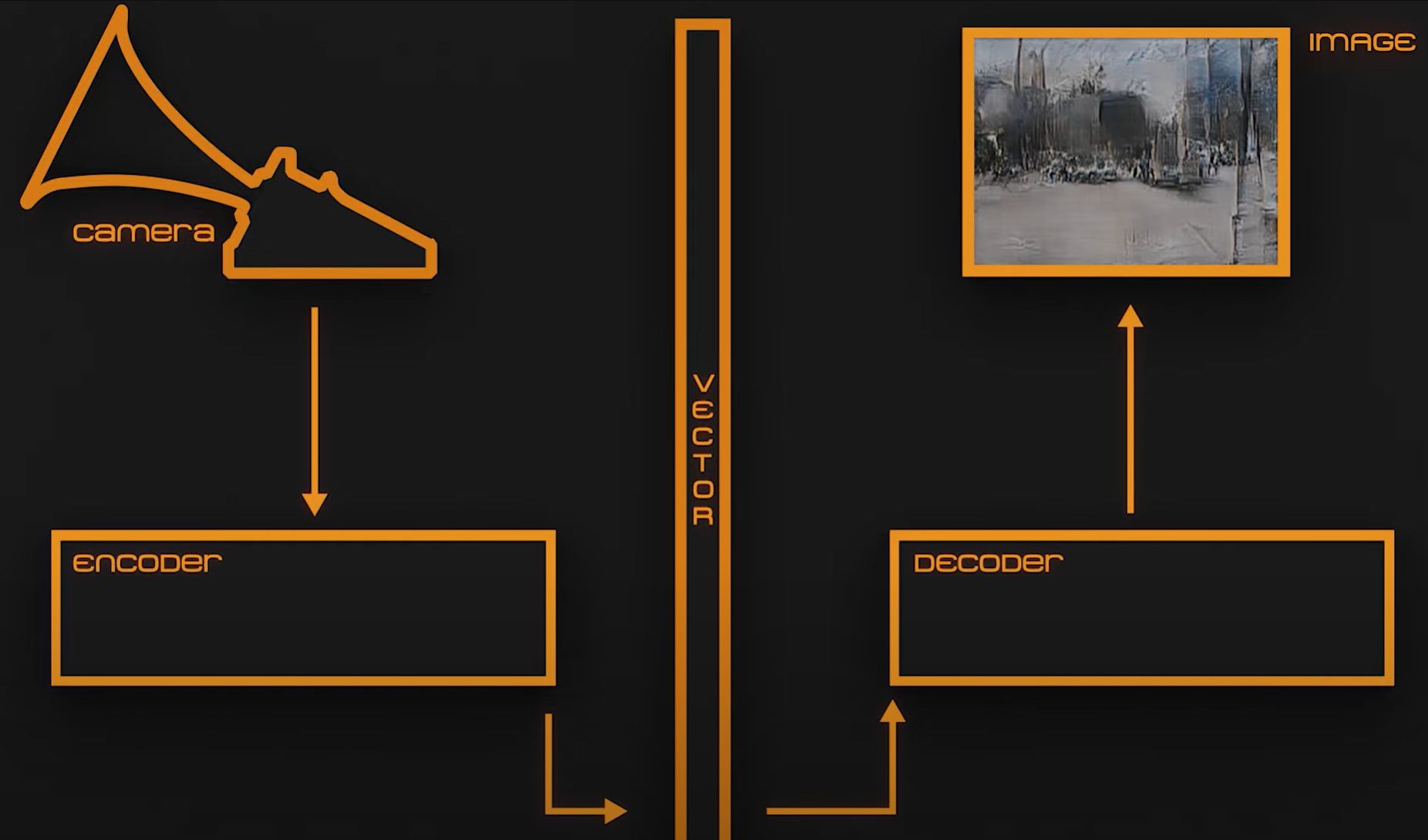
Blind Camera uses machine learning to connect audio signals with possible images. Public descriptions of the project explain that the model was trained with video material captured in Mexico City, linking sound with corresponding visual frames. The system uses neural-network techniques related to autoencoders and generative adversarial networks, or GANs, to transform audio features into images that resemble photographs.
In simple terms, the process looks something like this:
- Capture sound: The camera records audio from the environment.
- Encode audio: The sound is converted into numerical features that an AI model can process.
- Map sound to visual meaning: The model compares those audio features with patterns learned during training.
- Generate an image: A generative model produces a picture that represents what the sound might correspond to visually.
- Display the result: The generated image appears on the device, completing the familiar “take a picture” experience.
The important word is might. Blind Camera does not reveal a hidden optical truth. It creates an interpretation. The photo is less a window and more a rumor, but a fascinating one.
Why Mexico City Matters
One of the most interesting parts of Blind Camera is that it does not pretend to be an all-knowing global machine. Its training data was rooted in Mexico City, which gives the project a local accent. The model’s imagination is shaped by the city’s buses, streets, public spaces, colors, buildings, rhythms, and background noise.
This makes Blind Camera especially powerful as an artwork. Many AI systems try to erase their origins and present themselves as universal. Blind Camera does the opposite. It admits that its “vision” comes from somewhere. If it hears a certain urban roar and generates a scene, that scene is not neutral. It is filtered through the places, sounds, and images that taught the machine what the world might be.
That local bias is not treated only as a flaw. It becomes part of the artwork’s meaning. A camera trained on Mexico City will imagine differently from one trained in New York, Los Angeles, rural Montana, or a quiet library where the loudest object is a printer having an emotional breakdown.
Sound-to-Image AI Is Bigger Than One Camera
Blind Camera belongs to a wider field of audio-visual machine learning. Researchers have been exploring how machines can connect what they hear with what they see, and vice versa. Some models generate images from sound. Others generate sound from video. Some systems learn to match audio and visual data without human labels, which may help future robots understand environments more naturally.
For example, sound-to-visual-scene research explores whether a model can generate a plausible image of a scene from an audio clip. These models often use paired video and audio data, learning that certain acoustic patterns tend to occur alongside certain visual environments. The goal is not to create a perfect photograph but to build a meaningful bridge between hearing and seeing.
From Visual Microphones to Audio Cameras
The relationship between sound and image also works in the opposite direction. Researchers have shown that tiny vibrations in video footage can be analyzed to recover sound. This “visual microphone” idea demonstrates that audio and visuals are physically connected in the real world. A surface vibrates because of sound; a camera may capture those vibrations; an algorithm may reconstruct the audio. It sounds like science fiction, but it is more like physics wearing a trench coat.
Blind Camera flips that relationship. Instead of extracting sound from visuals, it creates visuals from sound. One path asks, “What did this object hear?” The other asks, “What might this sound look like?” Together, they reveal a deeper point: the senses are not isolated departments. They constantly leak into one another.
Why This Matters for Accessibility
Sound-based visual interpretation also connects to accessibility and sensory substitution. Technologies such as soundscape systems have explored ways to convert visual information into audio so blind or low-vision users can interpret shapes, locations, and movement through sound. In those systems, a camera may scan a scene and translate brightness, position, or height into tones and patterns.
Blind Camera is not the same kind of assistive device. It is an artwork and experimental AI object, not a replacement for mobility tools or accessibility technology. Still, it participates in the same larger conversation: how can one sense stand in for another? How can machines translate between perception channels? And how much training does a human or a model need before translation becomes meaningful?
For people interested in accessible design, the lesson is not that sound-to-image AI will suddenly solve everything. The lesson is that perception can be flexible. Visual information can become sound. Sound can become imagery. A scene can be represented as pixels, waveforms, language, vibration, or spatial cues. The world is not one format. It is a very complicated file conversion problem with weather.
Real-World Examples of Sound Becoming Visual
Sound visualization already appears in many practical technologies. Microphone arrays can estimate the direction of sound by comparing the tiny time differences between when audio reaches each microphone. Some experimental devices overlay sound-source locations on a visual display, helping users locate where a sound is coming from. This could be useful for people who are deaf or hard of hearing, for robotics, for industrial monitoring, or for anyone trying to find the mysterious beep in a kitchen appliance at 2 a.m.
In creative AI, audio-to-image generation can imagine a scene from birdsong, engines, rain, applause, footsteps, or music. The generated image may not be exact, but it can reveal what the model associates with those sounds. A jazz trumpet might become a dim club. Ocean waves might become a shoreline. Construction noise might become cranes, barriers, asphalt, and fluorescent vests. The machine is not “remembering” a place. It is statistically dreaming one.
The Beauty of Imperfect Machine Imagination
The most charming thing about Blind Camera is not that it gets everything right. It is that it gets things wrong in revealing ways. A normal camera can be technically wrong too: overexposed, blurry, poorly framed, or cursed by someone’s thumb in the corner. But Blind Camera’s mistakes are conceptual. It may hear a sound and generate an image that feels adjacent to reality rather than identical to it.
That makes each image a kind of machine interpretation. It may show the mood of a place more than its geometry. It may turn the roar of transit into a tunnel-like abstraction. It may convert street noise into a cityscape that feels familiar but not verifiable. It may produce colors that reflect its training environment more than the actual scene.
This is where the project becomes more than a technical demo. It becomes a critique of AI objectivity. Every AI model is shaped by its data. Every generated image carries assumptions. Blind Camera makes that visible by using an input that is obviously incomplete. When the machine invents the missing visual details, we notice the invention. In many AI systems, that invention is hidden behind confidence and polished output. Here, the uncertainty is part of the art.
SEO-Friendly Explanation: What Does “Visualizing a Scene from Sounds Alone” Mean?
For readers searching for a plain-English answer, visualizing a scene from sounds alone means using audio signals to generate or infer a visual representation of the environment. The system listens to sound, analyzes patterns such as frequency, rhythm, loudness, texture, and context, then creates an image based on learned relationships between audio and visual scenes.
This does not mean the AI can magically see through sound with perfect accuracy. It means the system can generate a plausible visual guess. A recording of waves may produce a beach. A subway sound may produce a train platform. A crowd may produce a public square or stadium. The image is a prediction, not proof.
Potential Uses of Sound-to-Image Technology
1. Robotics and Environmental Awareness
Robots operating in homes, factories, hospitals, or public spaces need to understand environments using more than cameras. Sound can reveal events outside the camera’s view, behind obstacles, or in low-light conditions. A robot that hears glass breaking, water running, or a person calling may respond more intelligently if it can connect audio with likely visual context.
2. Creative Tools for Artists
Artists can use sound-to-image systems to create visual interpretations of music, city noise, spoken performance, or field recordings. Instead of treating audio as background, the sound becomes the brush. This opens a new form of audiovisual storytelling where the image is not manually drawn but acoustically prompted.
3. Accessibility Research
Although Blind Camera itself is not a medical device, research in cross-sensory translation may inspire new accessibility interfaces. Systems that convert sound into visual cues, or visual scenes into soundscapes, can help designers think beyond traditional screens and speakers.
4. Media Search and Archiving
Audio-to-visual association could help organize large video and audio archives. A system might identify whether an audio clip likely came from a street, forest, kitchen, concert, or sports event. This would not replace human review, but it could make searching massive media collections more efficient.
Limitations and Ethical Questions
Sound-to-image AI is exciting, but it should not be mistaken for evidence. If an AI generates an image from a sound recording, that image is not a reliable record of what was physically present. It is a generated interpretation based on patterns in data. Treating it as proof would be like asking a dream to testify in court. Interesting? Yes. Legally sturdy? Please no.
Bias is another major issue. A model trained in one city, culture, climate, or neighborhood may imagine the world through that limited experience. If the training data underrepresents certain places or communities, the generated images may distort or erase them. Blind Camera is valuable partly because it makes this problem visible. It reminds us that AI systems are never born worldly. They are raised by datasets.
Privacy also matters. Sound can reveal sensitive information: conversations, locations, routines, and events. Any technology that records and interprets audio should be designed with consent, transparency, and strong privacy protections. A beautiful experiment can become creepy very quickly if it starts listening where it should not.
Why Blind Camera Feels So Human
The funny thing about Blind Camera is that humans do something similar all the time. We hear a sound and build a mental image. A siren becomes a street. Thunder becomes a dark sky. A bouncing ball becomes a driveway, a gym, or a neighbor upstairs who has apparently chosen chaos as a lifestyle.
Our brains are constantly filling gaps. Vision feels direct, but it is also interpretive. We do not simply record reality; we construct it from signals, memory, expectation, and context. Blind Camera makes that process mechanical and visible. It turns perception into an object you can hold.
That is why the project is so memorable. It is not just about AI generating pictures. It is about the imagination hidden inside perception. It asks whether a photograph must be made of light, whether a camera must have eyes, and whether a machine can develop something like a local memory of place.
Experience Notes: What It Feels Like to Use a Camera That Hears
Using a blind camera, or even imagining the experience carefully, changes the way you move through a place. With a normal camera, you hunt for light, framing, faces, shadows, reflections, and the little visual accidents that make a photo feel alive. With a sound-based camera, the hunt becomes different. You start listening for scenes before you try to capture them. A quiet alley may look beautiful but produce almost nothing for the camera to interpret. A visually boring intersection may become rich because it contains engines, crosswalk signals, bicycle bells, snippets of conversation, and the bassy sigh of a bus door opening.
The first surprise is that silence becomes visual darkness. Not literally, of course, but conceptually. A traditional camera can photograph a silent chair, a silent wall, or a silent cloud. A blind camera needs acoustic energy. It wants the world to announce itself. Suddenly, a fountain is more photogenic than a statue. A market is more expressive than a polished lobby. A train station becomes a cathedral of data, every squeal and footstep adding another clue.
The second surprise is that you become aware of how layered sound really is. When people say “traffic noise,” they usually compress dozens of events into one lazy label. But a listening camera encourages you to separate them: tire hiss, engine vibration, brake squeak, horn bursts, pedestrian chatter, music from a passing car, wind against buildings. Each sound suggests a different visual possibility. The resulting image may not be accurate, but it feels like a negotiated treaty between all those signals.
The third experience is uncertainty. After pressing the button, you wait with a strange kind of curiosity. With a normal camera, you roughly know what image you captured. With Blind Camera, the result can surprise you. The device may generate something that resembles the scene, or it may produce an image that feels like the scene’s dream. That gap is where the magic lives. You begin comparing what you saw, what you heard, and what the machine imagined. Sometimes the AI seems perceptive. Sometimes it seems charmingly confused. Either way, it makes you pay attention.
There is also a social experience. Pointing a horn-like camera at a sound is not subtle. People may wonder what you are doing, and fair enough: it looks like photography had a baby with a brass instrument. But that oddness is useful. It slows the moment down. It invites questions. It turns the act of capturing a scene into a conversation about perception, technology, bias, and place.
Most of all, the experience teaches humility. We often trust images because they look authoritative. A blind camera reminds us that every image is shaped by a system. In a regular camera, that system includes optics, sensors, software, and the photographer’s choices. In an AI sound camera, it includes microphones, datasets, training methods, and learned associations. The output is not pure reality. It is reality filtered through a machine that listens.
That may be the real gift of Blind Camera. It does not replace vision. It refreshes it. By asking us to see through sound, it makes ordinary perception feel strange again. The city becomes an instrument. The camera becomes a listener. The photograph becomes a translation. And the viewer, for once, is invited not just to look, but to wonder what looking has been doing all along.
Conclusion
Blind Camera: Visualizing A Scene From Its Sounds Alone is more than a clever AI experiment. It is a poetic challenge to the way we define photography, perception, and machine intelligence. By generating images from sound instead of light, Blind Camera exposes both the promise and the weirdness of audio-to-image AI. It shows how machines can learn relationships between sensory worlds, while also reminding us that every generated image carries bias, uncertainty, and interpretation.
In the future, sound-to-image technology may influence robotics, accessibility tools, creative software, media search, and urban sensing. But its most immediate value may be philosophical. Blind Camera teaches us that seeing is not just a matter of eyes, and listening is not just a matter of ears. Between sound and image lies imagination, and now machines are learning to wander there too.