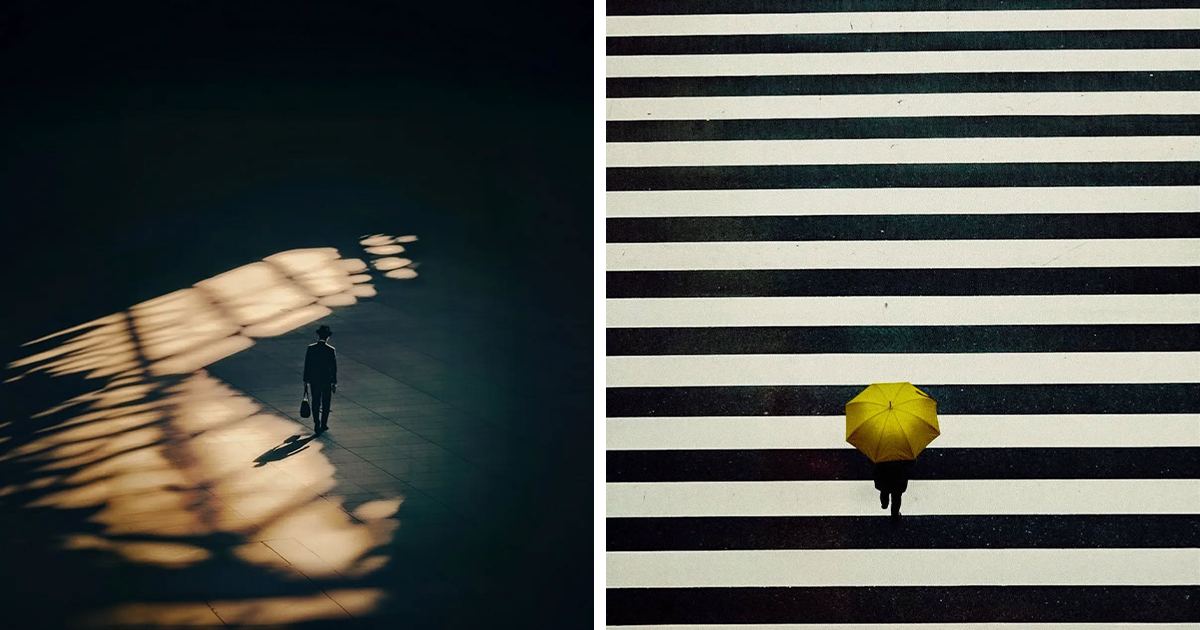
Tokyo is usually introduced with the subtlety of a neon billboard doing jumping jacks: Shibuya Crossing, bullet trains, glowing towers, vending machines that seem emotionally more available than some humans. But in “75 Photos By Shu, Showcasing Tokyo’s Quiet Beauty,” the city steps away from the spotlight and lets us notice its softer side. Photographer Shu focuses on the kind of Tokyo that does not shout for attention. It waits patiently in a puddle reflection, a lone pedestrian, a snowy backstreet, a shadow sliding across concrete, or a sliver of warm light spilling from a doorway.
This is not the Tokyo of travel brochure panic, where every attraction appears to be yelling, “Visit me before lunch!” Shu’s work feels slower, cleaner, and more contemplative. His minimalist photography reveals a capital city where modern life and traditional atmosphere coexist in small, poetic moments. A person walking beneath a bridge becomes a study in scale. A quiet alley becomes a theater of light. A building facade turns into an abstract painting, except with better plumbing.
In this article, we explore why Shu’s Tokyo photography feels so magnetic, how minimalist street photography changes the way we see a busy city, and what these 75 images can teach us about beauty, patience, and paying attention.
Tokyo’s Quiet Beauty: A City Beyond the Usual Noise
Tokyo is one of the world’s great visual cities. It has futuristic architecture, historic temples, quiet gardens, train platforms, lantern-lit lanes, elevated highways, tiny bars, polished shopping districts, and neighborhoods where the past seems to lean casually against the future. That contrast is what makes the city endlessly photographable. Yet many images of Tokyo focus on spectacle: bright signs, packed streets, giant screens, and crowds moving like perfectly choreographed chaos.
Shu’s photos choose a different rhythm. Instead of asking, “How much can fit into the frame?” they ask, “What happens if we remove the noise?” This approach makes his photography feel intimate. It captures Tokyo not as a giant machine, but as a place where individual lives unfold quietly inside a massive urban landscape.
The result is a collection that feels almost meditative. You can imagine the sound of soft footsteps, distant traffic, bicycle wheels, rainwater, or a train passing somewhere off-screen. The photos invite viewers to pause, which is a bold move in an age when most of us scroll like our thumbs are training for the Olympics.
Who Is Shu, and What Makes His Photography Stand Out?
Shu is a Tokyo-based photographer known for capturing the city through minimalism, light, shadow, and careful composition. Rather than relying on dramatic action, his images often focus on quiet human presence. A single figure may appear small within a large architectural space. A shadow may divide the frame. A muted street corner may become unexpectedly cinematic.
What makes Shu’s style memorable is his ability to find calm inside density. Tokyo is famously layered, but Shu often strips the scene down to a few essential elements: a wall, a person, a beam of light, a staircase, a street, or a geometric pattern. This makes each photo feel intentional. Nothing seems accidental, even when the moment itself may have happened in a blink.
Minimalism With a Human Pulse
Minimalist photography can sometimes feel cold, especially when it becomes too obsessed with empty spaces and perfect lines. Shu avoids that trap by adding human presence. His subjects are not posed like fashion models pretending to understand concrete. They are ordinary people moving through daily life: commuters, walkers, residents, passersby, and figures briefly caught between light and shadow.
That human element gives the images emotional warmth. The city may be vast, but each person carries a story. We do not know where they are going, what they are thinking, or whether they remembered to buy onions on the way home. But we sense the quiet dignity of everyday movement.
The Power of Light and Shadow in Shu’s Tokyo Photos
Light is one of the main characters in Shu’s photography. It does not merely illuminate the scene; it shapes the story. A sharp patch of sunlight can turn a sidewalk into a stage. A shadow can create mystery. Reflections can make ordinary streets feel dreamlike. Night lighting can transform a narrow alley into something cinematic, even if the only dramatic event nearby is someone debating which convenience-store snack to buy.
Tokyo is especially rich in artificial and natural light. Morning light cuts between buildings. Evening neon softens in rain. Train stations glow with practical brightness. Residential streets have small pockets of warmth from windows and vending machines. Shu uses these conditions to make the city feel both real and slightly surreal.
Contrast That Creates Emotion
Contrast is not just a technical choice; it is an emotional tool. In Shu’s images, dark areas often make bright areas feel more precious. A person walking through a bright rectangle of light becomes the focus of the entire scene. A snowy road feels quieter when framed by dark buildings. A simple wall gains depth when a shadow falls across it at just the right angle.
This is why the photos feel calm without being dull. They have tension, but not chaos. They have mystery, but not confusion. They let viewers enter the image slowly and discover details at their own pace.
Why Minimalist Street Photography Works So Well in Tokyo
Tokyo may seem like an unlikely place for minimalism. It is huge, visually dense, and filled with signs, wires, screens, crossings, shops, and architectural layers. But that is exactly why minimalism works so beautifully here. When a photographer can find simplicity in a complex city, the simplicity feels earned.
Shu’s Tokyo street photography often uses negative space, clean lines, and isolated subjects. These choices help viewers notice what they might otherwise miss. A stairway becomes elegant. A person with an umbrella becomes iconic. A wall becomes a canvas. A quiet street after snowfall becomes almost otherworldly.
The Beauty of Negative Space
Negative space is the open or empty area around a subject. In Shu’s photos, it gives the viewer room to breathe. Rather than filling every corner with visual information, the frame allows silence to exist. This is especially powerful in Tokyo, where the real-life experience can often feel fast, crowded, and sensory-rich.
Negative space also makes small human figures feel more meaningful. A lone person walking through a large urban frame reminds us that cities are not only made of buildings. They are made of daily routines, private thoughts, and tiny decisions repeated millions of times.
Tokyo as a Character, Not Just a Background
In many travel photos, the city becomes a backdrop for attractions. In Shu’s images, Tokyo becomes a character. It has moods. It can be lonely, elegant, sleepy, mysterious, playful, or deeply peaceful. The city is not reduced to a checklist of famous places. Instead, it appears through fragments: a street corner, an overpass, a snowy path, a sunlit wall, a quiet crossing.
This makes the collection feel more honest. Most people who live in a city do not experience it as a series of landmarks. They experience it through small routines: walking to the station, waiting at a signal, passing the same wall every morning, noticing the light change by season. Shu’s photos honor those everyday moments.
From Skyscrapers to Side Streets
Tokyo’s skyline is famous, but its side streets are where much of its personality lives. Narrow lanes, residential corners, small storefronts, and quiet walkways reveal a more personal city. Shu seems drawn to those spaces because they offer subtle stories. They are not empty; they are waiting.
In these quieter scenes, Tokyo’s beauty becomes less about scale and more about atmosphere. A giant tower impresses you immediately. A quiet alley may take a few seconds. But once it settles in, it often stays longer in the imagination.
The Role of Weather: Rain, Snow, and Seasonal Mood
Some of Shu’s most memorable images use weather as a visual partner. Rain adds reflections and softness. Snow simplifies the city and covers familiar streets with silence. Mist, cloudy skies, and winter light can turn Tokyo into a place that feels almost suspended in time.
Weather changes the emotional temperature of a photograph. A sunny street can feel open and graphic. A rainy street feels cinematic and introspective. A snowy scene feels rare and hushed. Tokyo does not often receive heavy snow, so when snow appears in photography, it can make ordinary places feel newly discovered.
Rain Reflections and Cinematic Streets
Rain is a gift to street photographers, although it is less of a gift to shoes. Wet pavement reflects signs, lamps, umbrellas, and passing silhouettes. In a city like Tokyo, where light sources are everywhere, rain turns the ground into a second image. Shu’s eye for composition makes these reflections feel deliberate rather than messy.
Rain also slows the mood. People walk differently. Umbrellas create shapes. Streets shine. The city becomes softer around the edges, and the camera finds poetry in what many commuters simply call “great, now my socks are wet.”
Why These 75 Photos Feel So Peaceful
The peacefulness of Shu’s photography comes from restraint. He does not overexplain the scene. He does not chase chaos. He gives the viewer just enough information to feel something. This restraint is powerful because it respects the audience’s imagination.
Each photo feels like a short visual poem. There is a subject, a mood, and a pause. The images do not demand that you decode them. They simply ask you to look longer. In a digital culture full of loud visuals, that quiet confidence feels refreshing.
Stillness in a Fast-Moving City
Tokyo is known for efficiency and movement. Trains arrive on time, crowds flow through stations, and neighborhoods shift from businesslike to electric within a few blocks. Shu’s work finds stillness inside that motion. A photograph freezes one person in one moment, making the city feel briefly calm.
This is one reason viewers connect with the collection. The photos suggest that even the busiest places contain pockets of quiet. You do not always need to escape the city to find peace. Sometimes you only need to notice the light on the wall.
Lessons for Photographers From Shu’s Tokyo Images
Shu’s work offers practical lessons for anyone interested in street photography, travel photography, or visual storytelling. The first lesson is patience. Minimalist images often look simple, but simple does not mean easy. A clean composition may require waiting for one person to enter the frame at exactly the right time.
The second lesson is awareness. Shu notices geometry, shadow, scale, and atmosphere. He looks at the city as a collection of shapes and emotions, not just locations. This helps turn ordinary streets into memorable photographs.
Look for One Strong Subject
Many beginner photographers try to include too much. Shu’s images show the power of choosing one strong subject and building the frame around it. That subject might be a person, a shadow, a doorway, an umbrella, or a line of light. When the subject is clear, the photo becomes easier to read and more emotionally direct.
Use Architecture as Composition
Tokyo’s architecture gives photographers endless tools: windows, bridges, stairs, platforms, walls, tunnels, and overpasses. Shu uses these elements to frame people and create visual rhythm. Buildings are not just scenery; they help organize the image.
Wait for the Human Moment
A quiet street can be beautiful, but a person moving through it adds story. The human figure gives scale and emotion. It makes the viewer wonder. Where is this person going? Why does this moment feel familiar? Good street photography often begins with that curiosity.
What Viewers Can Feel From “75 Photos By Shu”
The emotional appeal of “75 Photos By Shu, Showcasing Tokyo’s Quiet Beauty” lies in its balance between distance and intimacy. The images often show people from afar, yet they feel deeply personal. We are not intruding on private lives; we are witnessing small public moments with care.
That gentle distance is important. It allows the photos to feel respectful. The people in the frame are part of the composition, but they are not turned into spectacle. They remain ordinary, anonymous, and human.
A Reminder to Slow Down
Perhaps the strongest feeling in the collection is the urge to slow down. Shu’s photos remind us that beauty is not always dramatic. Sometimes it is a shadow, a crosswalk, a snowfall, a quiet commute, or the way afternoon light touches a building for five minutes before disappearing.
This is why the images resonate beyond Tokyo. Anyone who has walked through a city while lost in thought can recognize this mood. The setting is specific, but the feeling is universal.
Tokyo’s Quiet Side and the Idea of “Ma”
One useful way to understand the mood of Shu’s photography is through the Japanese aesthetic idea of ma, often described as meaningful space, pause, or interval. It is not simply emptiness. It is the space that allows something to be felt. In design, architecture, music, and visual art, ma gives rhythm to experience.
Shu’s compositions often feel connected to this idea. The empty wall matters. The gap between buildings matters. The pause before a person exits the frame matters. The quiet is not a lack of content; it is the content.
Why This Collection Is Perfect for Modern Audiences
Modern viewers are surrounded by high-volume visuals. Social media rewards brightness, drama, and instant impact. Shu’s photos stand out because they do not beg for attention. They invite attention. That difference matters.
For travel lovers, the collection offers a more nuanced view of Tokyo. For photographers, it demonstrates the value of composition and patience. For casual viewers, it provides a calming visual escape. And for anyone who has ever felt overwhelmed by a city, it offers a comforting message: quiet beauty is still there, even when life gets loud.
Experiences Inspired by “75 Photos By Shu, Showcasing Tokyo’s Quiet Beauty”
Spending time with Shu’s Tokyo photography feels a little like taking a slow walk through the city without needing a map, a schedule, or the emotional support of a convenience-store egg sandwich. The images encourage a different kind of travel experienceone based less on checking off famous landmarks and more on learning how to notice.
Imagine arriving in Tokyo early in the morning, before the biggest crowds wake up and before the city fully turns its volume knob to “metropolitan symphony.” A quiet residential street in Yanaka or Kagurazaka can feel worlds away from the electric energy of Shinjuku. A bicycle leans against a wall. A shop curtain moves slightly in the breeze. Someone walks past with a tote bag, and for two seconds the whole street becomes a perfect frame. That is the type of moment Shu’s work teaches you to value.
The experience is not about hunting for exact photo spots. In fact, trying too hard to copy another photographer’s image is like trying to steal someone’s dream and then wondering why it does not fit your shoes. The better approach is to borrow the mindset. Look for contrast. Watch how people move through space. Notice how Tokyo changes between morning and evening. Pay attention to the way train station staircases create shadows, how rain collects light, and how even a blank wall can become expressive when the sun hits it correctly.
One of the most rewarding experiences related to this topic is walking without a strict destination. Tokyo is surprisingly generous to wanderers. Step away from the major crossings, and the city begins revealing quieter layers: small shrines tucked between buildings, narrow lanes with potted plants, old wooden details beside modern apartment blocks, and tiny restaurants glowing warmly after dark. These are not always the places that dominate guidebooks, but they often create the strongest memories.
Another experience is observing seasonal change. Spring brings cherry blossoms and soft light, but also crowds. Autumn offers warm colors, long shadows, and a calmer mood. Rainy days, often considered inconvenient, can be visually magical. Snow, when it appears, transforms Tokyo into something delicate and rare. Shu’s photography makes it clear that weather is not an obstacle to beauty. Sometimes weather is the entire plot.
For photographers, a Shu-inspired Tokyo walk means packing patience along with the camera. Find a clean background and wait. Watch the frame. Let people enter and leave. You may stand there long enough to question your life choices, but then a person with an umbrella steps into the light, and suddenly the waiting makes sense. This is the quiet thrill of street photography: the city does most of the work, but only if you are attentive enough to receive it.
For non-photographers, the experience is just as valuable. You can use Shu’s visual style as a way to practice mindfulness in the city. Put the phone down for a few minutes. Notice reflections in shop windows. Listen to the rhythm of crosswalk signals. Look up at the geometry of buildings. Look down at the patterns on the pavement. Tokyo’s quiet beauty is not hidden because it is rare. It is hidden because people are usually moving too fast to see it.
That may be the real gift of “75 Photos By Shu, Showcasing Tokyo’s Quiet Beauty.” The collection does not simply show us Tokyo. It teaches us how to look at any city with more patience, curiosity, and kindness. It reminds us that beauty does not always arrive wearing a neon jacket. Sometimes it comes softly, stands in a patch of light, and disappears before we can say, “Wait, that would have been a great photo.”
Conclusion: The Gentle Power of Shu’s Tokyo Photography
“75 Photos By Shu, Showcasing Tokyo’s Quiet Beauty” is more than a collection of attractive street photographs. It is a visual reminder that Tokyo’s identity is not limited to speed, crowds, technology, and spectacle. Beneath the famous energy of Japan’s capital is a quieter city shaped by light, shadow, weather, architecture, and ordinary human movement.
Shu’s minimalist approach helps viewers rediscover the poetry of daily life. His photos show that a single person in the right light can carry as much emotional weight as a crowded landmark. A silent street can say more than a busy intersection. A shadow can become a story. This is photography at its most thoughtful: patient, observant, and quietly powerful.
For travelers, the collection offers a fresh way to experience Tokyo. For photographers, it is a lesson in restraint and composition. For everyone else, it is an invitation to slow down and notice the beauty already waiting in plain sight. Tokyo may be one of the busiest cities on earth, but through Shu’s lens, it also becomes one of the most peaceful.
Note: This article is original SEO content written for web publishing, synthesized from reputable photography, travel, culture, and Tokyo-focused references without inserting source-link artifacts into the body copy.