Note: The article below is written in standard American English, prepared in HTML body format for web publishing, and based on real design reporting and current kitchen-design references.
A blue-accented kitchen can go wrong in about seven seconds. Too much navy, and suddenly the room feels like a submarine with a mortgage. Too pale, and it risks looking like a baby shower with bar stools. But in the Almaty, Kazakhstan, apartment designed by Fariz Mamedov of FM Interiors, blue lands exactly where it should: crisp, cultured, quietly playful, and full of personality.
The project, widely admired as a refined example of contemporary kitchen design, is not simply a “blue kitchen.” It is a careful composition of color, proportion, practicality, and mood. Mamedov designed the space for empty nesters in an Almaty pied-à-terre, creating a kitchen that feels fresh and relaxed while still carrying the elegance of an old European apartment. The result blends Parisian chic, Scandinavian restraint, and Kazakh hospitality into one polished but livable room.
What makes the kitchen memorable is not one dramatic gesture but a series of smart decisions: blue trim instead of overwhelming blue walls, custom cabinetry, ventilated cupboard details, a café-style eating area, quartz surfaces, herringbone oak flooring, concealed storage, and lighting that feels sculptural without shouting across the room. It is a kitchen with manners, but also with a wink.
Why Fariz Mamedov’s Almaty Kitchen Stands Out
Fariz Mamedov has become known for interiors that feel layered, musical, and deeply personal. Before establishing himself in interior design, he had a creative background in music, and that sensibility shows. His rooms often feel like compositions: one element sets the rhythm, another introduces contrast, and a third quietly brings everything back into harmony.
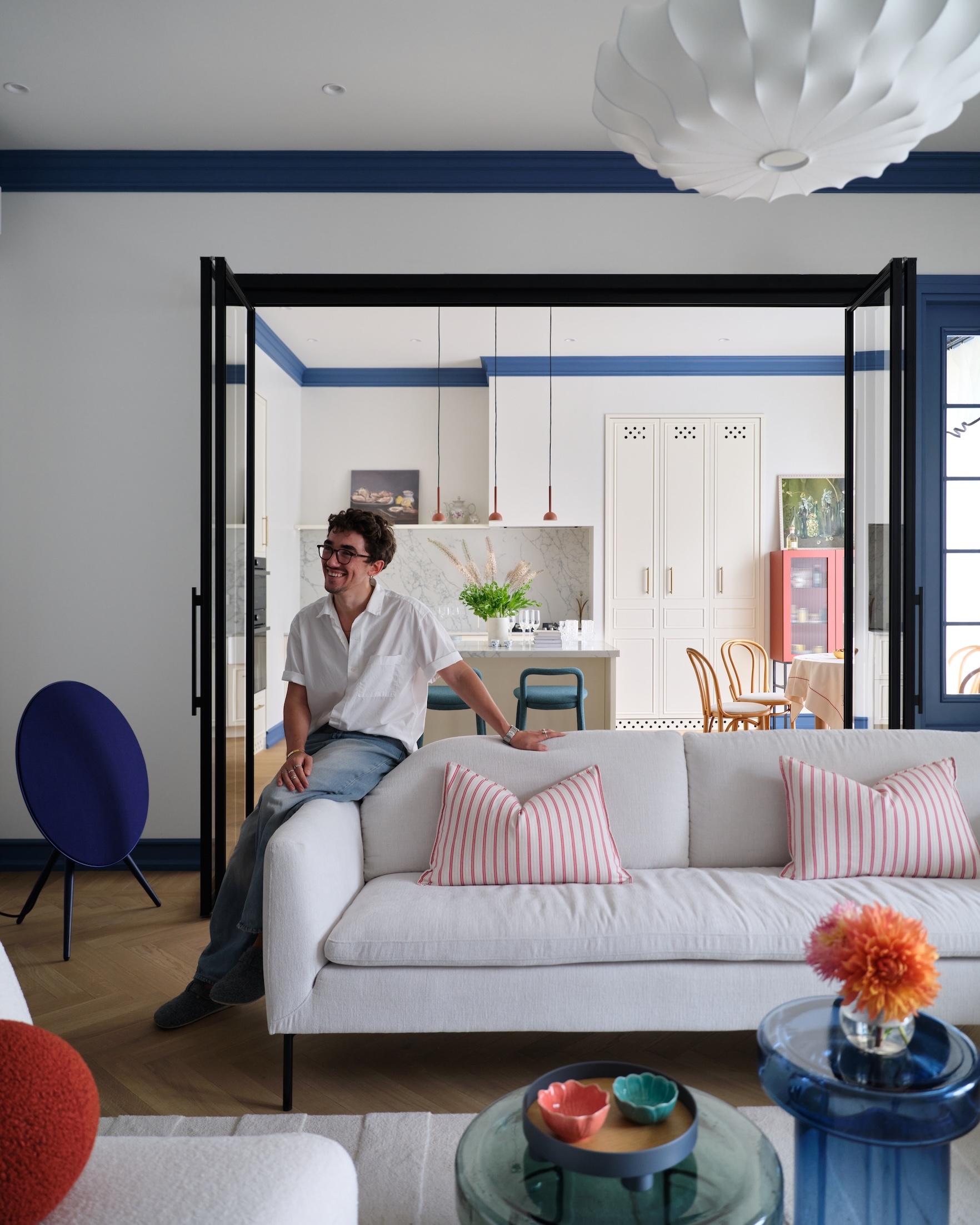
In this Almaty kitchen, blue is the melody. It appears in the architectural trim, the folding glass doors, and the pendant lights over the island. Instead of coating every cabinet in a heavy shade, Mamedov lets blue work as an accent. That restraint is the secret. The color frames the room, sharpens the edges, and gives the kitchen identity without stealing all the oxygen.
The apartment itself began as raw space in a new building, which gave the designer freedom to shape the interior from the ground up. Rather than treating the kitchen as a purely functional back room, he connected it to the living area through folding glass doors. This decision allows the kitchen to feel open and social while still giving the homeowners the option to close it off when cooking becomes, shall we say, aromatic.
The Power of Blue in Kitchen Design
Blue remains one of the most versatile kitchen colors because it can behave in several different ways. Navy can feel tailored and formal. Powder blue can feel calm and nostalgic. Blue-gray can act almost like a neutral. Brighter shades bring energy and confidence. Mamedov’s approach sits somewhere between classic and spirited, using blue as a refined accent rather than a decorative megaphone.
This is especially important in an eat-in kitchen. The kitchen is not only where meals are prepared; it is where coffee is poured, mail is dropped, stories are told, and someone inevitably asks, “Did we buy more butter?” A strong color must support all those daily moments. In the Fariz Mamedov kitchen, blue adds freshness and character while the softer surrounding tones preserve comfort.
The palette also works because it avoids the flatness that sometimes happens in trend-driven kitchens. The blue is balanced by off-white walls, warm oak herringbone flooring, quartz surfaces, and natural textures. This combination gives the room visual depth. It looks designed, not decorated in a hurry after scrolling through three too many mood boards.
Custom Cabinetry with Character
One of the strongest features of the kitchen is its custom cabinetry. The cabinets, cupboards, and island were made to Mamedov’s design, giving the room a tailored quality that off-the-shelf solutions rarely achieve. Custom work matters here because the kitchen is full of small details that create its charm: tall concealed storage, ventilated pantry doors, a hidden fridge, and a glass-fronted cabinet for tableware.
The ventilation holes are especially interesting. They introduce an old-fashioned note that softens the newness of the apartment. In many modern kitchens, everything is so seamless that the room can begin to feel like a luxury appliance showroom. Mamedov avoids that trap. The perforated details add rhythm, shadow, and a slightly nostalgic quality, making the kitchen feel as though it has already lived a little.
The glass-fronted cabinet also contributes to the room’s personality. It provides display space for dishes while hiding a service hatch for gas maintenance. That is the kind of design move homeowners appreciate after the honeymoon phase is over. Beauty is wonderful, but beauty that also hides necessary infrastructure deserves a tiny standing ovation.
Quartz, Oak, and the Beauty of Practical Materials
The kitchen uses quartz stone on the sink counter, backsplash, and island. This choice supports the room’s polished look while answering a practical need for durability and wear resistance. In a space meant for real cooking, quartz makes sense. It offers a clean, consistent surface and stands up well to daily use, which is helpful when life includes chopping vegetables, setting down hot mugs, and occasionally pretending that a store-bought pastry is homemade.
The oak herringbone parquet floor brings warmth and visual movement. Herringbone has a long association with European interiors, and here it helps connect the kitchen to the broader atmosphere of Parisian elegance. Yet because it is paired with modern lighting and streamlined cabinetry, the floor does not feel overly formal. It adds heritage without turning the apartment into a museum where nobody is allowed to eat crackers.
This material balance is central to the project’s appeal. The quartz adds crispness. The oak adds warmth. The blue adds personality. The off-white walls keep everything breathable. Together, these choices create a kitchen that feels bright but not sterile, elegant but not stiff, and charming without drifting into cuteness.
Lighting That Works Like Jewelry
Lighting is one of the easiest ways to ruin a kitchen and one of the most satisfying ways to elevate one. In this Almaty kitchen, the island pendants are blue lamps by Northern, designed by Morten & Jonas. Their color ties into the room’s blue accents, while their form gives the island a clear focal point.
Above the café table, a Gubi Satellite Pendant, originally designed by Mathieu Matégot in 1953, adds another layer of design history. This is where Mamedov’s talent for mixing references becomes visible. The kitchen does not belong to one strict style category. It has Scandinavian notes, Parisian charm, midcentury references, and local warmth. Somehow, instead of arguing with one another, the pieces behave like guests at a very good dinner party.
The lights also help define zones. The pendants over the island mark the work area, while the café table fixture creates a more intimate dining moment. In an eat-in kitchen, that distinction matters. The room needs to support food prep, conversation, breakfast, and the occasional late-night snack eaten while standing in slippers. Good lighting makes those different activities feel intentional.
The Eat-In Kitchen as a Social Space
The café table is one of the kitchen’s most appealing features because it brings human scale into the room. Large kitchen islands are wonderful, but they can sometimes feel like command centers. A café table changes the mood. It invites lingering. It says, “Sit down for tea,” rather than “Please admire my countertop acreage.”
Thonet-style bentwood chairs around the table strengthen that café feeling. Their curved lines contrast beautifully with the straighter geometry of the cabinets and island. This mix of curves and clean edges keeps the kitchen from feeling too rigid. It also adds a European sensibility that fits the project’s Parisian influence.
For empty nesters, this kind of layout is especially smart. The kitchen does not need to perform like a busy family cafeteria every morning. It can be more graceful, more relaxed, and more personal. The table offers a place for quiet breakfasts, reading, conversation, or a glass of wine while dinner slowly becomes dinner.
Parisian Chic, Scandinavian Restraint, and Kazakh Hospitality
Mamedov described the project as existing on the edge of Parisian chic, Scandinavian restraint, and Kazakh hospitality. That phrase is not just pretty design language; it explains the room’s entire logic.
The Parisian element appears in the herringbone floor, café table, elegant proportions, and historic references. The Scandinavian restraint shows in the light palette, functional storage, and refusal to overdecorate. Kazakh hospitality comes through in the warmth of the layout: the kitchen is open, welcoming, and designed for shared moments rather than display alone.
This blend is what makes the project feel fresh. Many kitchens borrow from Parisian style, and many lean into Nordic minimalism. Mamedov’s kitchen does both while grounding the space in Almaty’s atmosphere. It is not a copy-and-paste European interior placed in Kazakhstan. It feels global, but not rootless.
Small Details That Make the Design Feel Personal
The integrated plaster hood is one of those quiet details that separates a thoughtful kitchen from a merely attractive one. Instead of letting the hood dominate the wall, Mamedov built it into a plaster enclosure. This makes the cooking area feel architectural and calm. The hood is there, doing its job, but it is not waving a stainless-steel flag for attention.
The concealed refrigerator behind tall cabinetry is another important move. By hiding the fridge, the designer preserves the room’s continuity. Large appliances can visually interrupt a kitchen, especially one with a refined palette. Concealment keeps the eye moving smoothly through the space.
The nearby pocket laundry room also shows how carefully the apartment was planned. Built-in cabinets and patterned Spanish encaustic tiles give a utilitarian zone its own identity. It proves that the best interiors do not reserve beauty for the rooms guests see first. Even the hardworking corners get a little dignity.
Why This Kitchen Feels Timeless, Not Trendy
Blue kitchens are popular, but popularity alone does not create longevity. What makes this kitchen feel timeless is the way blue is used with discipline. Instead of chasing a loud cabinet trend, Mamedov applies color where it can frame, punctuate, and guide the eye.
The room also avoids excessive novelty. The herringbone floor, quartz surfaces, glass-fronted storage, bentwood chairs, and midcentury lighting all have design staying power. They are not disposable gestures. Even if kitchen trends shift toward warmer neutrals, deeper browns, or softer greens, this room will still make sense because it is built on proportion, material contrast, and practical elegance.
That is a useful lesson for homeowners. A kitchen does not have to be colorless to be timeless. It simply has to use color with intelligence. Blue can become classic when it is paired with natural materials, thoughtful lighting, and cabinetry that serves the room instead of overpowering it.
How to Borrow Ideas from Fariz Mamedov’s Blue-Accented Kitchen
1. Use blue as architecture, not just decoration
Instead of placing blue only in accessories, consider using it on trim, doors, cabinet frames, or an island. Architectural color feels more intentional than a random collection of blue bowls, though blue bowls are innocent and should not be blamed for everything.
2. Balance blue with warm wood
Blue can feel cool, so it benefits from wood tones. Oak, walnut, ash, or even a warm butcher-block accent can make a blue kitchen feel inviting rather than chilly.
3. Choose durable surfaces
Quartz works well in kitchens where homeowners want a polished look with practical performance. It pairs especially well with blue because it can keep the palette clean and bright.
4. Mix design eras carefully
Mamedov’s kitchen combines old-world touches, Scandinavian simplicity, and midcentury lighting. The key is restraint. Choose a few meaningful references rather than turning the room into a design-history group project.
5. Make storage beautiful
Concealed appliances, glass-fronted cabinets, and ventilated pantry doors prove that storage does not have to be boring. The most useful parts of a kitchen can also be the most charming.
Experience Notes: Living With a Blue-Accented Kitchen
Spending time in a blue-accented kitchen like the one designed by Fariz Mamedov would likely feel different from living with an all-white or all-gray kitchen. The first experience is emotional: blue changes the pace of the room. It slows things down. Morning coffee feels calmer, even if your inbox is already behaving like a caffeinated raccoon. The color creates a sense of freshness that works particularly well in a kitchen because it suggests cleanliness without feeling clinical.
The second experience is visual comfort. In many kitchens, the eye has nowhere to rest because every surface is either shiny, busy, or aggressively “statement-making.” In Mamedov’s kitchen, blue helps organize the view. The trim, doors, and pendant lights create a rhythm, while the off-white walls and warm flooring soften the composition. That means the space can handle daily clutter better. A cutting board, fruit bowl, or stack of plates does not instantly ruin the design because the room already has depth and structure.
There is also a strong social experience. The café table makes the kitchen feel less like a workstation and more like a small neighborhood bistro. You can imagine sitting there with tea while sunlight moves across the herringbone floor. You can also imagine a friend leaning on the island while someone cooks, offering moral support and absolutely no help with chopping onions. The room encourages conversation because it is open but still intimate.
From a homeowner’s perspective, the practical decisions would become more valuable over time. Concealed storage keeps the kitchen visually calm. Quartz counters reduce anxiety about stains and wear. Ventilated cupboard details help the cabinetry feel crafted rather than generic. The integrated hood keeps the room from being dominated by appliance bulk. These are not flashy choices, but they are the kind of choices people appreciate after months and years of use.
The blue accents would also offer seasonal flexibility. In spring, the kitchen could feel airy with flowers, pale linens, and glassware. In winter, the same blue could feel cozy beside warm lighting, wood boards, and deeper textiles. That adaptability is one reason blue works so well in interiors. It is not locked into one mood. It can be crisp, romantic, coastal, urban, traditional, or modern depending on what surrounds it.
The biggest lesson from the experience of this kitchen is that color does not need to dominate a home to define it. Mamedov’s blue is memorable because it is edited. It gives the kitchen a signature without turning every surface into a performance. For anyone planning a renovation, that may be the most useful takeaway: choose one strong idea, support it with practical materials, and let the room breathe. Your kitchen does not need to scream to be unforgettable. Sometimes a confident blue accent is enough.
Conclusion
The blue-accented kitchen by Fariz Mamedov in Almaty, Kazakhstan, is a strong example of how thoughtful color can transform a kitchen without overwhelming it. Through custom cabinetry, quartz surfaces, oak herringbone flooring, blue architectural accents, concealed storage, and carefully chosen lighting, Mamedov created a room that feels elegant, useful, and quietly joyful.
Its success comes from balance. The kitchen is refined but warm, modern but not cold, colorful but not chaotic. It borrows from Parisian, Scandinavian, and Kazakh influences while remaining personal to its setting and its homeowners. For anyone searching for blue kitchen ideas, custom kitchen inspiration, or a more soulful approach to contemporary interiors, this Almaty project offers a lesson worth remembering: the best kitchens are not just designed to impress. They are designed to be lived in beautifully.