Most traffic poles have the charisma of a spoon. They stand there quietly, painted, bolted, and mostly ignored, while the world rushes past them at 35 miles per hour and one iced coffee per driver. But that plain-looking pole at the corner is doing far more than holding up a signal or a sign. It is part safety device, part structural system, part accessibility tool, part communications platform, and part urban peacekeeper. In other words, it is not just a pole. It is a roadside overachiever wearing a very modest outfit.
The clever design behind everyday traffic poles starts with a simple reality: roads are chaotic places. Drivers need clear information, pedestrians need accessible crossings, cyclists need visibility, maintenance crews need durable hardware, and cities need infrastructure that survives wind, weather, vibration, and occasional bad decisions made by people in pickup trucks. Traffic poles sit right in the middle of all that. Their job is to make order look effortless.
Why Traffic Poles Matter More Than Most People Realize
Traffic control works best when it feels obvious. You see a signal where you expect it, a sign where your eyes naturally search for it, and a push button where your hand can find it without a scavenger hunt. That sense of “of course it goes there” is not accidental. It is engineered. National traffic control guidance in the United States is built around uniformity because consistency helps people process information faster and react more safely. A pole is one of the main tools that makes that consistency possible.
That is why engineers do not treat poles like random metal sticks from the municipal hardware aisle. They think about where the pole stands, how high it must be, what it carries, how visible its equipment will be in daylight and darkness, and what happens if a car hits it. A well-designed traffic pole is a quiet compromise between safety, strength, clarity, and maintenance. A bad one becomes a headache with a concrete base.
The Pole’s First Trick: Putting Information Where Humans Can Actually See It
One of the smartest things about traffic poles is how they solve a visibility problem that drivers do not even notice. At a busy intersection, a low signal can disappear behind a delivery truck, blend into storefront clutter, or get lost in a visual soup of billboards, trees, and brake lights. That is why many intersections use mast-arm or span-wire configurations. By suspending signals farther out and higher over the roadway, the support structure makes the signal more prominent upstream, where drivers need time to understand and react.
It sounds simple, but the effect is powerful. A signal that can be seen earlier is a signal that can be obeyed earlier. That matters at wide suburban intersections, truck-heavy corridors, and streets with lots of competing visual noise. The pole, then, is not just supporting a signal head. It is supporting decision-making. That is a very fancy job for something people describe as “that gray thing by the curb.”
Mast Arms, Span Wires, and Pedestal Poles
Different traffic poles serve different conditions. Pedestal poles are the compact sidekicks near the corner. They are good for mounting pedestrian signal equipment, push buttons, and signal heads close to the stop line. Mast-arm poles are the dramatic extroverts that cantilever out over traffic lanes to place signal heads where drivers can see them clearly. Span-wire systems, often used where geometry or budget makes them practical, stretch signals across intersections with wire-supported hardware.
Each type exists because the street itself changes. A narrow downtown corner does not need the same support strategy as a six-lane arterial with heavy turning traffic. Pole design follows the street, not the other way around.
The Pole’s Second Trick: Failing Safely When Things Go Wrong
Here is where traffic pole design gets unexpectedly clever. Some roadside supports are built not just to stand up, but also to give way in the right circumstances. In clear zones near traffic, post-mounted sign supports are often required to be crashworthy, meaning breakaway, yielding, or shielded. That sounds dramatic, because it is. Engineers know that a rigid obstacle near the roadway can turn a collision into something much worse. So the support itself becomes part of the safety strategy.
Think about the intelligence of that idea. Instead of assuming drivers will always behave perfectly, the design assumes reality will occasionally show up. A pole or support can be engineered to absorb impact, separate in a controlled way, or reduce the severity of a crash. That is not weakness. That is mercy in steel.
Not every traffic pole is designed the same way, because not every pole sits in the same risk environment. A small roadside sign post, a decorative downtown pedestal, and a heavy mast-arm signal support each face different structural and crash considerations. But the larger principle remains elegant: everyday traffic infrastructure is often designed around the question, “What happens on someone’s worst day?”
The Pole’s Third Trick: Hiding a Structural Engineering Problem in Plain Sight
Traffic poles look light because they are meant to look ordinary. In reality, many of them are carrying serious loads. A mast arm might support several signal heads, signs, cameras, sensors, luminaires, wiring, and communication hardware. Wind does not care that the assembly is visually tidy. Wind sees sail area, leverage, fatigue, and opportunity. So do engineers.
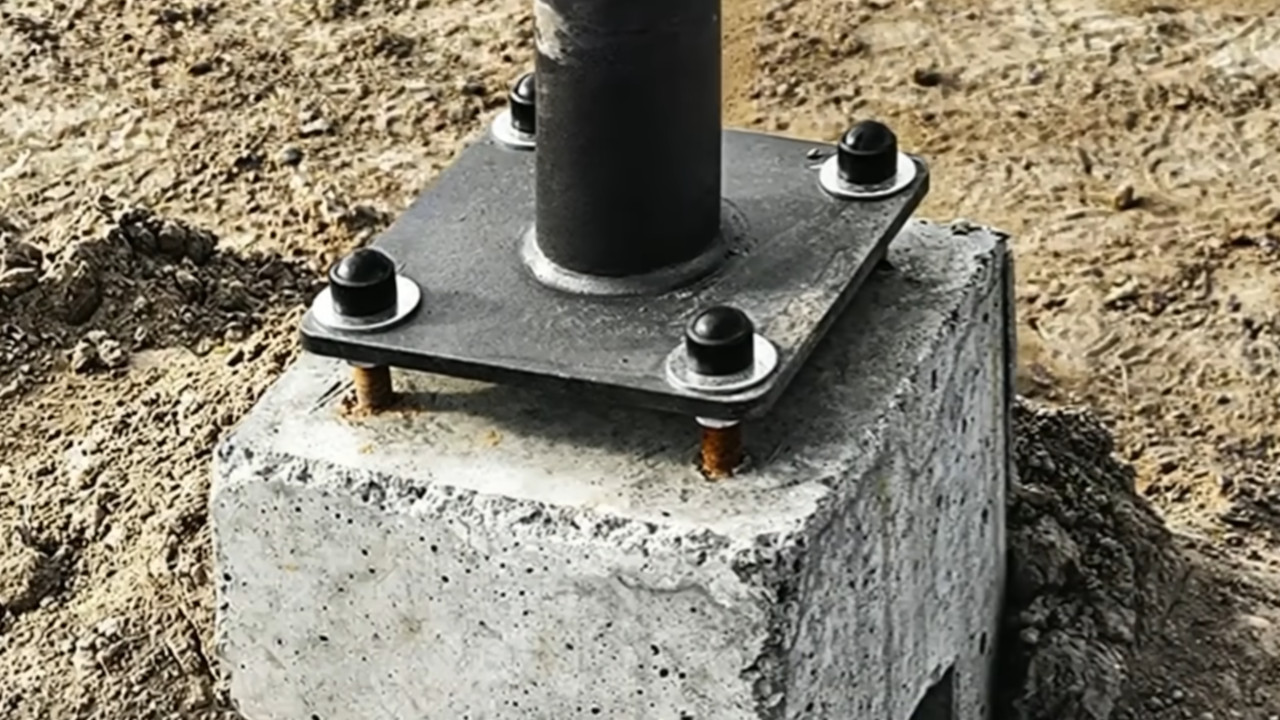
That is why the hidden half of the traffic pole story lives underground and inside the metal. Foundation size, anchor bolts, base plates, weld quality, arm length, and bolt circles all matter. On wide intersections, geotechnical information can affect how the support is designed. What looks like a simple pole above grade is often the visible tip of a carefully coordinated system below grade. There is usually reinforced concrete beneath your feet doing the boring but heroic work of keeping everything upright during storms.
Materials matter too. Galvanized steel is common because corrosion is patient, rude, and expensive. Agencies also inspect these structures because aging, vibration, weather exposure, and added equipment can change their performance over time. In other words, the design of a traffic pole does not end when it is installed. Maintenance and inspection are part of the design logic from the beginning. A smart pole is one that engineers can check, repair, and manage long after the ribbon-cutting photos are over.
The Pole’s Fourth Trick: Helping Pedestrians Without Making Them Guess
Modern traffic poles do something wonderfully human-centered: they help people cross streets without relying on luck, guesswork, or superhero hearing. When a pole carries pedestrian push buttons and accessible pedestrian signal equipment, its placement becomes more than a convenience issue. It becomes an accessibility issue.
Current U.S. accessibility guidance requires pedestrian push buttons and accessible pedestrian signals to meet specific functional needs. That includes tactile arrows aligned with the direction of travel, audible and vibrotactile walk indications, and locator tones that help users find the device. Separate pole placement for certain accessible pedestrian signal setups is not bureaucratic fussiness. It helps make clear which crossing a device serves. At a busy corner, that clarity can be the difference between confidence and confusion.
This is one of the most underrated examples of clever design in transportation. The pole is not merely holding technology. It is translating the intersection into usable information for people with different sensory and mobility needs. When done well, it fades into the background and the crossing simply feels understandable. That is excellent design at work: helpful, precise, and almost invisible.
The Pole’s Fifth Trick: Acting Like a Tiny Tech Tower
If you still think traffic poles are low-tech, allow the modern intersection to politely disagree. More and more poles now support cameras, radar, microwave sensors, wireless equipment, access points, and connected transportation hardware. Agencies use these systems to detect vehicles, monitor performance, improve signal operations, and prepare for connected and vehicle-to-everything communication systems.
That means today’s traffic pole is often part of a larger digital network. It can help a signal controller know when vehicles are present, help engineers evaluate timing performance, and support roadside communications that interact with vehicles and vulnerable road users. From the sidewalk, it still looks like a pole. From the inside, it is increasingly part of a data and safety ecosystem.
And yet the cleverness here is not that engineers crammed gadgets onto a mast arm like a holiday tree for transportation nerds. The cleverness is restraint. Equipment must be mounted where it works, where it can be maintained, where line-of-sight remains usable, and where the structure can still safely carry the load. Good design keeps the intersection smart without making it look ridiculous.
Why Traffic Poles Are Usually So Unremarkable Looking
Oddly enough, part of the brilliance of traffic pole design is aesthetic understatement. Drivers should notice the signal indication, not admire the artisanal curvature of the supporting hardware. The pole’s visual job is to support legibility. It should not compete with the message it carries. That is why many traffic poles are simple in color, form, and finish. They are engineered to disappear just enough that the important information stands out.
Even decorative poles in downtown districts must walk a fine line. Cities may want them to look more attractive, but transportation engineers still need them to preserve visibility, function, and maintenance practicality. A beautiful pole that makes a signal harder to read is basically a very expensive misunderstanding.
The Hidden Trade-Offs Engineers Deal With
Everyday traffic poles are full of trade-offs. Put a pole closer to the curb and the equipment may be easier to reach, but pedestrian space may suffer. Push it farther back and accessibility or signal visibility may become more difficult. Use a longer mast arm and you can place signals more effectively over lanes, but you also increase bending moments, structural demand, and cost. Add more devices and you improve data collection, but you also add maintenance needs, wiring complexity, and wind load.
This is why pole design is more thoughtful than it appears. Engineers are balancing human behavior, vehicle paths, utility conflicts, disability access, structural capacity, inspection needs, and local climate. The final product often looks simple only because someone worked very hard to remove the drama from it.
How Traffic Poles Shape Everyday Experience
Most people interact with traffic poles without ever thinking about them. You drive through a green light because the signal was visible in time. You find a pedestrian button exactly where you expect it. You understand which crossing is yours because the tactile arrow and audible indication make sense. You move through the intersection smoothly because a detector on a nearby support helped the signal timing respond to demand. You remain blissfully unaware that dozens of design decisions just saved you from confusion.
That is the real genius here. The best traffic poles do not announce themselves. They reduce friction. They make intersections easier to read, safer to use, and more forgiving when real life gets messy. Like good editing or good plumbing, their success is measured partly by how little people need to think about them.
Experience Section: What You Notice Once You Start Looking at Traffic Poles
Once you start paying attention to traffic poles, you cannot really unsee them. A simple walk through a neighborhood becomes a tour of quiet engineering decisions. At one corner, you notice the short pedestal pole with the push button placed right where a person using a wheelchair can reach it without performing an awkward sidewalk ballet. At another corner, you spot a mast arm stretching out over the lanes, holding the signal where it stays visible even when a box truck rolls up and tries to block the whole universe. Suddenly the street starts to look less random and more like a carefully arranged conversation between people, vehicles, and infrastructure.
The experience is even more interesting when you compare places. In older downtown areas, poles often have to squeeze into tight corners already crowded with storefront signs, utilities, curb ramps, and impatient pedestrians who clearly believe the countdown timer is a negotiation. In suburban corridors, the poles feel bigger, more spread out, and more structural because the intersections are wider and the traffic moves faster. The same basic object has adapted to entirely different street personalities. It is the transportation equivalent of someone owning both hiking boots and dress shoes and somehow pulling off both.
You also start to notice how much comfort comes from consistency. A push button on the expected side of the pole feels intuitive. A signal placed clearly over the lane feels reassuring. A locator tone that is easy to identify gives confidence to pedestrians who rely on it. These are not dramatic experiences, but they matter because transportation safety is built from small moments of understanding. Every second spent wondering where to look or what applies to you is a second lost to uncertainty.
There is also a strangely satisfying feeling in realizing how much roadside design anticipates human imperfection. The poles are not arranged for idealized road users from a textbook planet where nobody speeds, nobody gets distracted, and nobody brakes late because they were busy arguing with a breakfast sandwich. They are designed for real people. That means accounting for clutter, fatigue, weather, noise, visibility problems, maintenance lapses, and the occasional spectacularly bad turn. Once you see that, the street feels less like a random pile of hardware and more like a system trying very hard to help ordinary humans succeed.
And perhaps the most memorable experience is this: traffic poles begin to feel like one of the best examples of humble public design. They do not ask for praise. They do not sparkle. They do not get viral admiration online from strangers declaring them “iconic.” They just do their jobs every day, in heat, rain, dust, and darkness, helping cities function one signal cycle at a time. That kind of design is easy to overlook because it is so normal. But once you notice the intelligence packed into those ordinary poles, every intersection looks a little more impressive and a little less accidental.
Conclusion
The clever design behind everyday traffic poles is not about flashy technology or futuristic styling. It is about solving many different problems at once while looking almost boring enough to ignore. These poles improve signal visibility, support accessible crossings, manage structural loads, reduce crash severity in the right contexts, carry sensors and communications equipment, and make maintenance possible over the long haul. They are the quiet stagehands of the transportation system, holding the whole performance together while the actors get all the attention.
So the next time you stop at an intersection, give a tiny mental nod to the pole nearby. It may not be glamorous, but it is doing an impressive amount of work for a piece of infrastructure whose main design goal is making you think about literally anything else.