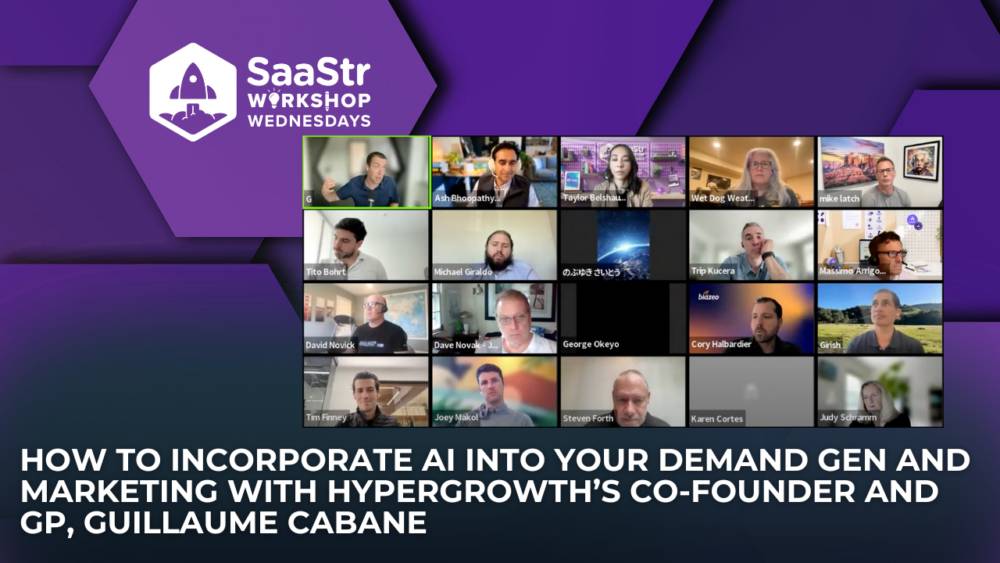
Artificial intelligence has given demand generation teams a powerful new ability: they ize outreach, test creative, and nurture leads without adding an army of sales development representatives. It has also inspired marketers to subscribe to a heroic number of tooutionizes the company credit card.
Guillaume “G” Cabane, co-founder and general partner at HyperGrowth Partners and a veteran growth leader, offers a more practical approach. Instead of starting with software, he starts with the demand generation system itself. The job is to define the right market, identify meaningful intent, create relevant actions, and improve the process with measurable data.
AI demand generation is therefore not traditional outbound with an automated copywriter attached. It is a connected workflow in which audience building, enrichment, scoring, message creation, activation, and measurement work together. Done well, AI makes marketing more precise. Done poorly, it creates mediocre spam at breathtaking speed.
Why Cabane’s AI Demand Generation Framework Matters
Demand generation has moved through several eras. Early outbound teams relied on humans to build lists, research accounts, write emails, and manage follow-up. Sales engagement platforms later made it possible to send more sequences at lower cost, but relevance often collapsed. Buyers received more messages, yet fewer of them reflected what was actually happening inside their businesses.
Cabane’s framework shifts intelligence upstream. An AI-enabled system can assemble information from multiple sources, estimate account fit, recognize a timely signal, generate a situational message, and route the opportunity to the right channel or person. Humans remain essential for strategy, creative judgment, relationships, negotiation, and complex decisions. AI handles the repetitive digital shovel work.
The Three Building Blocks: TAM, Intent, and Outreach
Cabane organizes the modern demand generation stack around three connected jobs: building the total addressable market, identifying intent signals, and activating personalized outreach. These layers provide a useful blueprint for companies that want to incorporate AI without turning marketing operations into a science fair project.
1. Build and Segment Your Total Addressable Market
The first step is defining who could realistically buy. AI-assisted prospecting platforms can combine firmographic, technographic, hiring, geographic, and business-model data to create a more accurate total addressable market, or TAM.
A weak list says, “Find software companies with 50 to 500 employees.” A stronger model asks which companies use a competing product, recently raised funding, hired a new executive, entered a target region, or launched a relevant initiative. It also estimates potential account value and the likely cost of winning each segment.
This allows marketers to divide the market into tiers. High-value accounts may justify account-based marketing and human attention. Mid-value accounts may receive AI-assisted personalization. Smaller accounts may enter automated product-led or content-driven programs. Not every prospect needs the same expensive courtship ritual.
2. Detect Intent Instead of Guessing It
Once the market is mapped, the next challenge is identifying which accounts are becoming active. Useful intent signals may include pricing-page visits, product usage, event attendance, community participation, job postings, technology changes, executive moves, funding announcements, competitor research, and previous sales conversations.
AI helps because those signals are scattered. A person may discuss a problem in a community, visit a comparison page, and begin hiring for a related role. Separately, each event is interesting. Together, they may reveal a real buying window.
A strong system aggregates activity at the account and contact levels, weights important signals, and allows old behavior to decay. This prevents a webinar attendee from three years ago from being treated like someone who viewed the pricing page yesterday. Marketing automation should have a memory, but not a grudge.
3. Turn Signals Into Relevant Action
Traditional sequences rely on prewritten messages sent according to a fixed schedule. Cabane’s approach is more contextual: every message should reflect the prospect’s situation, available evidence, and conversation history.
Suppose an AI workflow identifies a retailer promoting a new product line. It could analyze the campaign, match the company with a relevant use case, draft a concise explanation of the opportunity, and recommend an appropriate next step. That is more useful than, “I noticed you are doing great things at CompanyName,” a sentence that has done great things for nobody.
The system can send the message, create a sales task, add the account to an advertising audience, trigger direct mail, or place the lead into nurture. The action should match the account value and the strength of the signal.
Start With the Workflow, Not the Tool
Before choosing technology, map the process in plain language:
- Which accounts are we trying to reach?
- What data identifies a strong fit?
- Which behaviors indicate interest?
- What action should follow each signal?
- Where does human review add value?
- How will revenue impact be measured?
Then select the level of technology that matches the use case. No-code platforms help small teams test quickly. Low-code tools provide greater control over enrichment, scoring, routing, and personalization. Large organizations with high volume and technical resources may prefer a composable stack in which separate systems handle data, orchestration, generation, activation, and measurement.
Cabane’s practical lesson is to prove the channel with a packaged platform before investing in a custom machine. Confirm that the audience, signal, offer, and channel work. Then add engineering sophistication. Building a rocket before confirming that customers want to leave the ground is an expensive way to discover gravity.
Design a Modern AI Marketing Stack
Data and Enrichment
Gather reliable company and contact information from the CRM, product analytics, website behavior, public business sources, job listings, review sites, ad libraries, and enrichment providers. The objective is not maximum data. It is accurate, permission-aware data that improves a decision.
Scoring and Intelligence
Classify accounts by fit, potential value, timing, and intent. Begin with explainable scoring rules before building a mysterious predictive model. A transparent score based on company size, technology fit, and recent behavior is easier to audit than an “engagement score” calculated by what appears to be a moody horoscope.
Orchestration and Activation
The orchestration layer moves information between systems and applies business logic. It can enrich a lead, update the CRM, select a playbook, request approval, generate content, and trigger outreach. This is why growth marketers increasingly need working knowledge of fields, APIs, prompts, conditions, and error handling, even when they are not full-time engineers.
Measurement
Connect activity to pipeline, revenue, and customer quality. Track qualified-account rate, positive replies, meetings, opportunity creation, cost per opportunity, pipeline velocity, win rate, and retention. Open rates are operational clues, not a business strategy.
Personalize Outbound Without Becoming Creepy
Personalization should demonstrate relevance, not surveillance. A message can mention a public product launch, job opening, advertising campaign, or business challenge. It should not reveal a dossier of every digital breadcrumb the prospect has dropped since breakfast.
A useful outbound prompt contains verified facts, the target persona, the problem being solved, approved claims, the desired action, and examples of brand voice. It also needs uncertainty rules. When a detail cannot be verified, the model should omit it rather than improvise. Confident fiction is charming in a novel and expensive in a sales email.
Use human review for strategic accounts, sensitive claims, and early campaign samples. Inspect generated facts, links, personalization fields, replies, and deliverability. AI should increase informed decisions, not eliminate accountability.
Apply AI to SEO and Paid Media
AI-Assisted SEO
AI can analyze keywords, structure drafts, summarize proprietary data, produce comparison tables, and refresh outdated content. Programmatic SEO works best when each page contains distinctive information, clear search intent, expert input, and real utility.
It should not be used to manufacture hundreds of nearly identical pages merely to occupy search results. Google’s guidance focuses on helpfulness and warns against scaled content created primarily to manipulate rankings. Sustainable AI content combines automation with subject-matter expertise, fact-checking, examples, editorial judgment, and quality control.
AI-Assisted Paid Marketing
Advertising platforms already use machine learning for bidding, audience expansion, placement, and optimization. Marketers can improve performance by supplying stronger first-party data and clearer conversion signals. AI can also create testable ad concepts, analyze patterns, and recommend audience-message combinations.
Still, creative volume is not creative insight. Ten thousand beige versions of the same headline remain beige. Humans must define the customer tension, positioning, proof, and emotional angle.
A 90-Day AI Demand Generation Roadmap
Days 1–30: Audit and Prioritize
Map the funnel, identify repetitive work, document data gaps, and select one use case with a clear outcome. Good starting points include enriching inbound leads, reactivating closed-lost opportunities, identifying high-intent visitors, or personalizing outreach to a defined segment.
Record the current cost, time, response rate, conversion rate, and pipeline contribution. Without a baseline, every AI pilot becomes a success because everyone remembers the old process as vaguely terrible.
Days 31–60: Build a Controlled Pilot
Connect a small number of reliable data sources, define scoring rules, create prompts, and route outputs into a review queue. Test on a limited audience and compare the AI-assisted process with the existing workflow.
Review false positives, hallucinated facts, weak personalization, CRM errors, and deliverability issues. The pilot exists to expose problems while the blast radius is small.
Days 61–90: Scale What Works
When the pilot improves conversion or economics, automate additional steps and expand to nearby segments. Add monitoring, prompt versioning, fallback rules, ownership, and training across marketing, sales, RevOps, legal, and security.
Scale gradually. A process that works for 500 selected accounts may fail at 50,000 because data quality, inbox reputation, customer expectations, and operational complexity change with volume.
Governance, Privacy, and Trust Are Growth Functions
Responsible AI is not a decorative policy stored in a folder named “Final_Final_Approved.” Teams should document data sources, access controls, model usage, approval rules, retention practices, and escalation procedures.
Commercial email must follow applicable laws and platform policies. In the United States, marketers need accurate sender information, truthful subject lines, a valid physical address, and a working opt-out process. Companies must also consider consent, data licensing, privacy obligations, and regional rules when combining customer and third-party information.
Trust will become more important as AI-generated communication becomes difficult to distinguish from human writing. Brands can protect credibility through specific claims, recognizable senders, verifiable proof, respectful frequency, and messages that are genuinely useful.
Common AI Demand Gen Mistakes
- Automating a broken process: AI magnifies weak segmentation and bad offers just as efficiently as good ones.
- Using unverified data: Incorrect personalization damages trust faster than generic copy.
- Optimizing for volume: More sends may create more complaints and deliverability problems.
- Ignoring the handoff: Qualified responses still require fast, informed follow-up.
- Measuring vanity metrics: The objective is profitable pipeline and durable customer value.
- Locking into one vendor: Keep data and workflows modular so components can change.
- Removing humans too early: Strategic accounts and unusual replies require judgment.
Experience Notes: What Teams Learn After Implementing AI
The first practical lesson is that data preparation takes longer than prompt writing. Teams often begin excited about clever email copy and quickly discover duplicate contacts, outdated job titles, missing domains, inconsistent lifecycle stages, and CRM fields last touched during a forgotten reorganization. The AI is ready to sprint; the database is wearing one roller skate.
A successful implementation usually starts with a narrow segment and a visible reason for outreach. For example, a B2B company might identify target accounts that recently hired an operations leader and visited a high-intent page. The workflow enriches the account, verifies the executive’s role, checks for an existing opportunity, summarizes relevant changes, and drafts a message. A marketer reviews the first 50 outputs, flags weak assumptions, and improves the instructions before anything is sent at scale.
The second lesson is that the best prompt is rarely one giant paragraph. Teams get stronger results when they divide the job into steps: research the account, classify the use case, select evidence, draft the opening, check the claim, and format the final message. Each stage can be evaluated independently. When something fails, the operator can determine whether the problem came from the source data, scoring logic, model, or sending rule.
The third lesson is that AI changes team roles. Demand generation managers become part strategist, part analyst, and part workflow designer. RevOps becomes central because clean routing and CRM governance determine whether automation produces pipeline or chaos. Sales representatives spend less time collecting basic facts and more time handling qualified conversations. Creative teams focus on concepts, proof, and differentiation instead of endless minor variations.
The fourth lesson is that buyers reward usefulness more than visible effort. A deeply personalized message is not automatically good. The prospect does not care that a system analyzed 37 data points if the offer is irrelevant. The best outreach often contains one accurate observation, one credible connection to a business problem, and one easy next step. Restraint is a personalization feature.
The fifth lesson is that measurement changes behavior. When teams optimize for emails sent, the system produces emails. When they optimize for qualified opportunities and revenue, they become selective. Strong programs review performance by segment, signal, message angle, channel, and downstream customer quality. They also use holdout groups to determine whether the AI workflow caused improvement rather than merely appearing near it.
Finally, implementation is never finished. Data sources change, prompts drift, products evolve, and buyers adapt. The durable advantage is not one automation. It is the ability to run controlled experiments, learn quickly, replace weak components, and preserve the human judgment that makes the system trustworthy.
Conclusion
Guillaume Cabane’s approach to AI demand generation is valuable because it starts with economics and workflow rather than hype. Build a clear market, detect real intent, create situational outreach, connect actions to measurable revenue, and use humans where judgment matters most.
The companies that benefit most will not necessarily have the largest software budgets. They will combine clean data, modular systems, disciplined testing, useful creative work, and responsible governance. AI can make marketing faster and less expensive, but the durable advantage still comes from understanding customers better than competitors do.