Note: This article is written as original editorial content for web publication, based on publicly available information about Maureen Doherty, Egg Trading London, and the design legacy she left behind.
Some people build stores. Maureen Doherty built a world. Egg Trading London, the quietly legendary shop she founded in Belgravia, never behaved like an ordinary boutique. It did not shout from a neon-lit corner, chase trends like a caffeinated teenager, or make customers feel as if they had wandered into a luxury spaceship where touching the clothes might trigger an alarm. Egg was different. Egg was slower, warmer, stranger, calmer, and more human.
Maureen Doherty, born in London in 1951 and remembered after her death in 2022, was a fashion designer, shopkeeper, curator, storyteller, mentor, and aesthetic force. Calling her simply the founder of Egg Trading London is accurate, but it is a little like calling a garden “some plants.” Her work included clothing, ceramics, objects, architecture, friendship, hospitality, and the lost art of paying attention. In a retail culture obsessed with speed, scale, and the next big thing, Doherty made a powerful case for the small, the useful, the personal, and the beautifully made.
This remembrance looks at Maureen Doherty’s life, her influence on fashion and design, and the lasting spirit of Egg Trading London. It is also a love letter to a rare kind of creative genius: the kind that notices a button, a pot, a pocket, a piece of cloth, a cup of coffee, and a young maker who needs someone to believe in them.
Who Was Maureen Doherty?
Maureen Doherty’s creative instincts appeared early. She was born in London, and stories about her childhood often return to objects: pottery, artifacts, materials, and the emotional charge of things that last. Her father’s interest in archaeology helped shape her appreciation for objects that carry time inside them. That sensitivity later became central to Egg, where a garment was never just a garment and a bowl was never just a bowl. Everything had weight, texture, history, and use.
Before Egg, Doherty had already made a serious mark on fashion. She studied at the London College of Fashion and became part of the energetic retail and design scene that helped bring international fashion into London’s orbit. During her twenties, she was associated with influential names such as Elle, Fiorucci, Valentino, and Issey Miyake. Her work with Miyake was especially important. She helped develop his presence in Europe, worked on retail spaces, and became part of the creative world around one of the most innovative designers of the late 20th century.
But Doherty was never a person who seemed content to simply polish someone else’s empire. Her eye was too independent, her taste too specific, and her tolerance for fashion-industry nonsense apparently limited. The conventional runway machine, with its hierarchy, spectacle, and commercial pressure, was not where her imagination wanted to live forever. She wanted something more intimate, more useful, and more honest. That desire eventually became Egg.
The Birth of Egg Trading London
Egg opened in 1994 on Kinnerton Street in Belgravia, inside a converted former dairy. The location mattered. This was not a glossy flagship on a roaring shopping avenue. It was tucked away, almost secretive, as if the shop had decided it would rather be discovered than advertised. That decision already said a lot about Doherty’s philosophy. Egg did not chase people down the street. It waited for those curious enough to find it.
The building itself helped define the experience. Its old blue tiles, quiet rooms, and mews setting gave Egg a sense of lived-in authenticity. Doherty stripped the place back rather than dressing it up. Instead of hiding the building’s past, she let it speak. In the process, the shop became part boutique, part gallery, part kitchen-table conversation, and part creative refuge.
The idea behind Egg was simple but radical: sell the beautiful and the everyday. That phrase sounds gentle, but it is a pretty bold retail manifesto. It rejects the idea that beauty must be fragile, formal, expensive-looking, or saved for special occasions. It also rejects the idea that everyday things should be dull. At Egg, clothes, pots, books, scarves, shoes, pencils, jars of flowers, and useful objects could exist together naturally. Nothing needed to perform luxury in a loud voice. The mood was more like, “Here is a perfect jacket, a handmade spoon, and possibly lunch upstairs.” Frankly, more stores should consider the lunch option.
Egg’s Fashion Philosophy: Clothes That Become Your Own
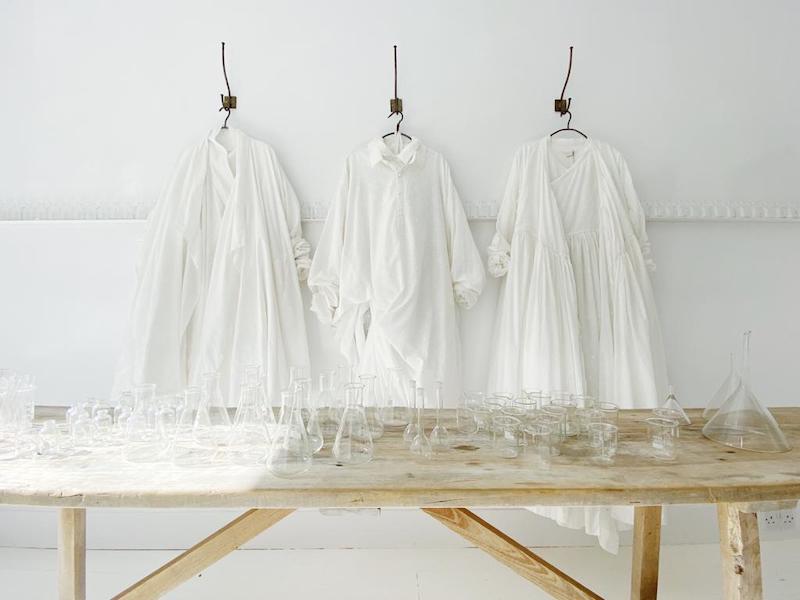
Maureen Doherty’s clothing was often described as loose, layered, timeless, and non-body-conscious. That last phrase is important. Egg clothes were not designed to bully the body into submission. They gave the wearer room. They wrapped, tied, buttoned, draped, and moved. They were made for comfort, but not the sloppy kind. This was comfort with architecture, wit, and dignity.
Doherty’s designs frequently drew from workwear: garments made for gardeners, milkmen, butchers, monks, and people who actually had to move through the world doing things. She understood that practical clothing often contains deep beauty. A gardener’s jacket has pockets because a gardener needs pockets. A smock has volume because work demands ease. A wrap can adapt to the body instead of demanding that the body adapt to it. Egg took these lessons and elevated them without losing their usefulness.
In a fashion market that often treats women’s bodies as seasonal problems to be solved, Doherty’s approach felt generous. Her garments were made for different ages, sizes, and personalities. They could be passed down. They could improve with wear. They could sit beside older Egg pieces and still make sense. That is not just good design; it is good manners.
A Shop That Felt Like a Gallery, Kitchen, Studio, and Home
Many boutiques talk about “experience” now, usually while installing an Instagram wall and calling it community. Egg was an experience long before the word became marketing confetti. The shop did not rely on spectacle. It relied on atmosphere.
Visitors often remembered the way things were placed: a few garments hanging with breathing room, shoes beneath them, objects arranged on tables, ceramics sitting near books, flowers appearing without fuss. There was space to look, to think, and to feel. Stock was not crammed into every corner. Doherty understood that emptiness can be generous. It lets the eye rest. It lets the object matter.
Egg was also a meeting place for makers. Young designers and craftspeople found encouragement there. Ceramics played a major role in the shop’s identity, and Egg became associated with artists and makers whose work was treated with the same seriousness as clothing. The result was a rare retail environment where fashion, craft, domestic life, and art were not separated into tidy departments. They mingled, as they do in real life.
Maureen Doherty and the Power of Personal Retail
One of Doherty’s greatest achievements was proving that retail could be deeply personal without becoming sentimental. Egg was not built around anonymous consumption. It was built around relationships: between maker and wearer, object and owner, shopkeeper and customer, room and memory.
Before online shopping became the default mode of buying almost everything short of a house and possibly a goat, Doherty’s way of communicating with customers was famously direct. She paid attention to people. She understood what they wore, what suited them, and what they might love before they knew it themselves. That kind of retail requires more than taste. It requires emotional intelligence, patience, and the ability to see people clearly.
This is why Egg attracted creative customers, including actors, writers, designers, and artists. Its appeal was not celebrity-driven, even though well-known women wore Doherty’s clothes. The deeper attraction was freedom. Egg offered clothes for people who did not want to be styled into someone else’s idea of desirability. It offered clothing for people with inner lives, busy days, strong opinions, and, ideally, a healthy respect for pockets.
The Issey Miyake Connection
Doherty’s relationship with Issey Miyake deserves special attention because it reveals a great deal about her creative seriousness. Miyake’s work is known for its experimentation with fabric, movement, technology, and the relationship between clothing and the body. Doherty’s time in his world sharpened her own understanding of shape, space, and restraint.
She helped establish Miyake’s presence in London and worked on projects that extended beyond straightforward retail. Her role connected fashion to architecture, performance, and material culture. She also helped bring Miyake into contact with potter Lucie Rie, an important figure in modern ceramics and one of Doherty’s lasting influences. That bridge between fashion and pottery may sound unusual only if one has never handled a garment and a bowl with equal seriousness. Doherty had. She understood that both are forms shaped around human use.
What she carried from that world into Egg was not imitation. It was confidence. She knew that clothing could be conceptual and practical at the same time. She knew that a shop could be a cultural space. She knew that a garment could be quiet and still unforgettable.
Egg Trading London as an Alternative to Fast Fashion
Today, Egg feels even more relevant than it did in 1994. Fast fashion has trained shoppers to expect constant novelty, low prices, and rapid disposal. The consequences are visible everywhere: overstuffed closets, textile waste, exhausted trend cycles, and clothes that look tired after three washes and one mildly emotional Tuesday.
Doherty’s work offered another model. Buy fewer things. Choose better things. Let clothes age with you. Repair them. Layer them. Wear them in different seasons. Allow them to collect memory. This philosophy is not just stylish; it is sustainable in the truest sense. Sustainability is not only about fiber content or carbon calculations, although those matter. It is also about attachment. People keep what they love.
Egg clothes encouraged attachment because they were not designed as disposable statements. They were companions. They allowed wearers to build a wardrobe slowly, adding new pieces to old ones without the whole system collapsing. That continuity is rare in fashion. It is also deeply sane.
The Architecture of Egg: A World Built Around Light, Utility, and Feeling
Doherty’s aesthetic extended beyond garments into architecture and interiors. Her work with architect Jonathan Tuckey on the spaces around Egg reflected her preference for simplicity, reuse, and atmosphere. The adjoining spaces became part home, part office, part retreat, and part extension of the shop’s philosophy.
Her interiors were minimal but not cold. They were stripped back, but not empty in the sterile sense. They made room for light, wood, tiles, water, fire, ceramics, and ordinary rituals. Doherty seemed to understand that minimalism becomes meaningful only when it serves life. Otherwise, it is just expensive echo.
The idea of an “urban hut” captures this spirit beautifully. Doherty did not appear to want a show home. She wanted shelter, usefulness, and poetry. A hut suggests humility and independence. It is small, elemental, and close to weather. Translating that feeling into a London mews building was an act of imagination, and it made sense that the same mind behind Egg would want a home that was both practical and dreamlike.
Why Maureen Doherty’s Legacy Matters
Maureen Doherty’s legacy matters because she showed that taste can be ethical. Not ethical in the finger-wagging, joy-removing sense, but ethical because it asks better questions. Who made this? Why does it exist? Will it last? Does it respect the body? Does it bring daily pleasure? Does it create a relationship between people?
She also showed that small businesses can shape culture. Egg was not a global chain. It did not need to be. Its influence spread through designers, customers, makers, writers, architects, and anyone who walked into that quiet Belgravia space and left slightly rearranged inside. A truly original shop can become a school without calling itself one.
For creative people, Doherty’s life offers a valuable lesson: clarity beats noise. She did not need to chase every platform, trend, collaboration, or growth opportunity. She built a world with rules of its own. That takes courage, especially in industries that reward expansion over depth. Egg remained special because it did not try to become everything to everyone. It trusted its own heartbeat.
A Beloved Founder Remembered
To remember Maureen Doherty is to remember more than a designer. It is to remember a way of seeing. She saw beauty in function, elegance in workwear, importance in ceramics, humor in daily rituals, and possibility in young makers. She knew that a shop could nourish people. She knew that clothes could give confidence without shouting. She knew that a room could hold a philosophy.
Her genius was not the cold, intimidating kind. It was warm, exacting, funny, and human. It showed up in a sleeve, a display table, a conversation, a button, a bathhouse, a pot, a garment that looked better after years of wear, and a shop where the everyday became luminous.
Egg Trading London continues to stand as part of her legacy. For those who visit, the experience is still a reminder that retail can be quiet and radical at once. It can honor craft. It can slow people down. It can make space for beauty without turning beauty into a performance.
Experiences and Reflections Inspired by Maureen Doherty and Egg Trading London
The most powerful experiences related to Maureen Doherty’s world are not necessarily dramatic. They are small, almost private moments: walking down a quiet street and finding a shop that does not look like it is trying to sell you a lifestyle package; touching a piece of linen and realizing it has more personality than half the things in your closet; seeing a ceramic bowl displayed with the same respect as a coat; noticing that the room has not been arranged to impress you, but to let you breathe.
Anyone who has spent time in independent shops knows the difference between a store with inventory and a store with a soul. The first has products. The second has a point of view. Egg belonged to the second category. It offered the rare pleasure of entering a place where decisions had clearly been made by a person, not a spreadsheet wearing a blazer. The spacing, the materials, the objects, the quietness, even the apparent lack of urgency all communicated trust. The shop trusted the customer to look slowly. It trusted the clothes to speak softly. It trusted beauty not to require a marching band.
For writers, designers, stylists, and makers, Doherty’s example can feel like permission. Permission to be specific. Permission to resist the pressure to over-explain. Permission to value repair, repetition, and refinement over constant reinvention. In many creative fields, people are told to build a brand, scale fast, optimize content, and post until their phone becomes a second nervous system. Doherty’s life suggests another path: build a world so carefully that people remember how it felt to stand inside it.
There is also a practical lesson in the way Egg approached clothing. Many people have experienced the small defeat of owning too many clothes and still feeling badly dressed. Egg’s philosophy points toward a better wardrobe: fewer pieces, better shapes, natural materials, useful layers, and garments that adapt to the wearer. The goal is not to look “finished” in a stiff way. The goal is to look inhabited, as if your clothes have joined your life instead of auditioning for attention.
One can imagine applying the Egg principle beyond fashion. In a kitchen, it might mean choosing a wooden spoon that feels good in the hand, a bowl that makes breakfast seem less like a calendar obligation, or a linen cloth that gets softer over time. In a workspace, it might mean clearing visual noise so the few remaining objects earn their place. In a home, it might mean accepting irregularity, patina, and the occasional chair that looks as if it has heard excellent gossip.
The Egg experience also reminds us that hospitality matters. A shop does not become beloved merely because it sells beautiful things. It becomes beloved because people feel recognized there. Doherty’s genius included the ability to connect makers and customers, clothing and character, object and setting. That kind of attention cannot be automated. It is human work, and it is increasingly precious.
In the end, the experience most closely associated with Maureen Doherty may be the feeling of being invited to live more deliberately. Not more perfectly. Not more expensively. More deliberately. Notice the seam. Use the good bowl. Keep the coat. Repair the button. Buy the thing you will love for twenty years instead of the thing that flirts with you for twenty minutes. Leave some space in the room. Let the light in. Make coffee. Talk to people. Laugh when possible. Add pockets whenever civilization allows.
That is the enduring beauty of Maureen Doherty’s legacy. She did not simply sell clothes and objects. She taught a way of choosing, wearing, arranging, and living. Egg Trading London remains a reminder that the everyday is not the opposite of beauty. In the right hands, the everyday is where beauty finally gets to prove itself.
Conclusion
Maureen Doherty’s life and work continue to resonate because they were grounded in values that never go out of style: usefulness, craft, generosity, individuality, humor, and respect for materials. Through Egg Trading London, she created a place where fashion slowed down, objects gained meaning, and customers became part of a living creative conversation.
Her influence reaches beyond one shop on Kinnerton Street. It lives in the growing desire for timeless clothing, sustainable wardrobes, thoughtful interiors, and independent retail experiences that feel genuinely human. Maureen Doherty understood that beauty does not need to be loud to be unforgettable. Sometimes it looks like a linen coat, a handmade pot, a blue-tiled former dairy, a fresh cup of coffee, and a shopkeeper with the rare gift of seeing what others miss.