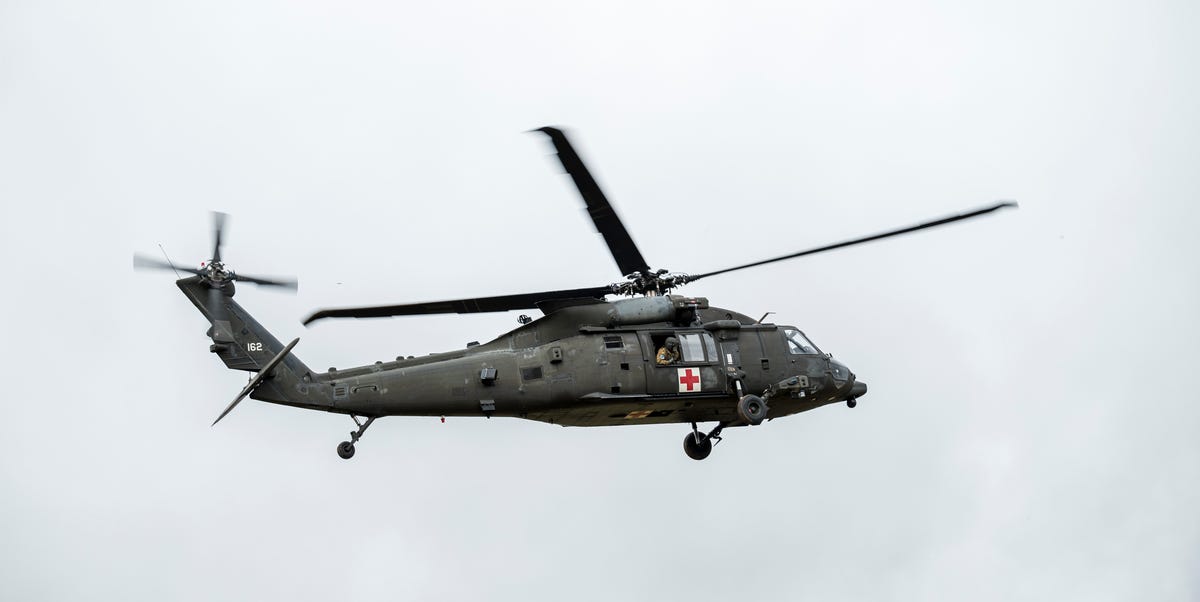
Ukraine has made a habit of turning military surprises into strategic theater. First came the battlefield drones built in garages, then naval drones that made Russia’s Black Sea Fleet suddenly allergic to open water, and now the plot twist with rotor blades: Ukraine’s military intelligence service has been seen operating American-made UH-60 Black Hawk helicopters, even though no major Western government publicly announced handing them over.
The story sounds like the opening scene of a spy thriller: a legendary U.S. helicopter appears in Ukrainian colors, disappears into the fog of war, then reappears with a friend. Russia claims one was shot down. Ukraine answers not with a press conference, but with footage showing two Black Hawks alive, airborne, and very much not parked in the “destroyed” section of the battlefield. Somewhere, a Russian propagandist probably dropped his tea.
The mystery is not whether Ukraine has Black Hawks. It does. The mystery is how they arrived, how many are truly in service, and what their presence says about the new rules of wartime procurement. In a conflict where drones, crowdfunding, private sellers, and intelligence agencies all share the same crowded stage, the Black Hawk episode reveals a bigger truth: modern war is not supplied only by official aid packages. Sometimes it is supplied by quiet deals, private markets, volunteer networks, and a national survival instinct with excellent logistics.
What Is the UH-60 Black Hawk?
The UH-60 Black Hawk is one of the most recognizable military helicopters in the world. Developed by Sikorsky, now part of Lockheed Martin, it became the U.S. Army’s workhorse utility helicopter and has served in troop transport, medical evacuation, search and rescue, special operations support, and cargo missions. It is not glamorous in the way a stealth fighter is glamorous. It does not scream “future weapon” like a hypersonic missile. But it does something militaries value even more: it shows up, lifts heavy things, survives rough use, and keeps flying.
A Black Hawk can carry a small squad of troops, move supplies, evacuate wounded personnel, and operate in demanding environments. That flexibility matters enormously for Ukraine. The country entered the full-scale war with a helicopter fleet rooted largely in Soviet-era platforms such as the Mi-8 and Mi-24. Those aircraft remain useful, but they are old, heavily worked, and dependent on parts pipelines complicated by the fact that Russia designed many of them. In plain English: it is hard to maintain a helicopter when the original manufacturer is currently trying to destroy you.
The Black Hawk offers Ukraine a bridge toward Western aviation standards. It is not a magic shield against air defenses, and helicopters remain vulnerable in a sky filled with missiles, drones, electronic warfare, and radar. But for special operations, rapid extraction, casualty evacuation, and carefully planned missions, a reliable Western utility helicopter is a serious upgrade.
The First Surprise: A Black Hawk Appears in Ukraine
The first public clue came in February 2023, when Ukraine’s Main Directorate of Intelligence, widely known as GUR or HUR, released imagery showing a UH-60 Black Hawk in Ukrainian service. The aircraft appeared alongside Ukrainian personnel and other aviation assets. This was not a normal aid-package announcement. There was no tidy government press release, no diplomatic handshake photo, no “today we are proud to deliver” ceremony with flags arranged at mathematically patriotic angles.
Instead, the Black Hawk simply appeared. That alone made defense watchers lean closer to their screens. The helicopter looked like an older UH-60A variant, reportedly connected by observers to a former U.S. Army airframe that had passed into the commercial market. Public analysis linked one aircraft to registration N60FW and to Alabama-based Ace Aeronautics, a company known for acquiring and modernizing older Black Hawks for non-Army customers.
That detail is important. If the helicopter came through a private seller or intermediary rather than directly from U.S. government stocks, it would explain why it did not appear in the usual public lists of American military assistance. Ukraine has received massive Western support, including air defense systems, artillery, armored vehicles, drones, ammunition, and Soviet-designed helicopters such as Mi-17s. But Black Hawks were not publicly listed as a standard U.S. transfer to Ukraine.
The Second Surprise: Ukraine Shows Two Black Hawks
In March 2024, the plot thickened. Russian sources circulated claims that a Ukrainian helicopter near the border had been shot down and suggested it might have been a UH-60 Black Hawk. Ukraine’s GUR responded in a very Ukrainian way: not by writing a long denial, but by releasing footage showing Black Hawk crews continuing combat work. The video appeared to show at least two UH-60 helicopters in Ukrainian markings.
That was more than a rebuttal. It was a message. The first message was for Russia: the aircraft you claimed to destroy are still working. The second message was for everyone else: yes, we have more than one. The third message was the quietest and perhaps the most interesting: do not assume you know how many we have.
The footage showed helicopters with Ukrainian identification markings, including national symbols and visible adaptations for combat use. Analysts noted that at least one appeared to have defensive machine-gun mounts. These were not museum pieces or parade props. They were being integrated into real missions by an intelligence service known for high-risk operations, cross-border raids, covert insertions, and psychological messaging.
So, How Did Ukraine Get Them?
The honest answer is: no one outside the relevant circles knows the full story. But public evidence points to several likely channels.
Private Purchases
The strongest public explanation for the first Black Hawk is a private purchase. Older U.S. Army Black Hawks have entered the commercial market after retirement or divestment. Companies buy them, refurbish them, upgrade them, and sell them to approved customers. This creates a path for a country like Ukraine to acquire an American-made aircraft without it appearing as a direct U.S. military donation.
That does not mean the process is simple. Military aircraft transfers can involve export controls, end-user requirements, licensing, inspections, transport arrangements, spare parts, training, and maintenance planning. A helicopter is not a used pickup truck. You cannot just kick the tires, Venmo somebody six million dollars, and ask whether the rotors fit in checked luggage.
Intermediaries and Quiet Logistics
Another possibility is that intermediaries helped connect Ukraine with available aircraft. In wartime, procurement rarely moves in a perfectly straight line. Governments, private sellers, friendly donors, repair firms, aviation brokers, and intelligence services may all play a role. The public may see only the final result: a Black Hawk wearing Ukrainian markings, sitting in a hangar, or lifting off from a field.
This is especially true for equipment used by intelligence units. GUR has every reason to limit what it reveals. Details about aircraft numbers, locations, maintenance hubs, mission profiles, and delivery routes would be valuable to Russia. Silence is not suspicious in this context. It is basic operational hygiene.
Crowdfunding and Volunteer Campaigns
The Black Hawk story also overlaps with one of the most unusual features of the Ukraine war: public crowdfunding for military hardware. Czech and Slovak supporters helped fund a Black Hawk through the “Gift for Putin” initiative, a volunteer campaign that raised millions from tens of thousands of donors. Later reporting indicated that the publicly funded helicopter, named Čestmír, was delivered to Ukraine for use by intelligence forces.
This may sound bizarre to readers used to traditional defense procurement. But Ukraine’s war has normalized what once seemed impossible. Volunteers have funded drones, vehicles, ammunition support, medical evacuation equipment, and even heavy military platforms. The old model says weapons come from ministries. The Ukraine model says weapons can also come from citizens with credit cards, a cause, and a deep dislike of imperial invasions.
Why Black Hawks Matter for Ukraine
Ukraine does not need Black Hawks because they are famous. It needs them because they are useful. A helicopter like the UH-60 can support special operations, transport small teams, evacuate wounded troops, move supplies, and conduct missions where speed and flexibility are essential. For GUR, whose operations often rely on surprise, timing, and mobility, a reliable aircraft can be the difference between a mission that makes headlines and a mission that never gets off the ground.
Ukrainian crews have publicly praised the Black Hawk’s handling, reliability, speed, and ease of operation compared with older Soviet-designed helicopters. GUR has said its personnel trained with the aircraft for landing combat groups, evacuation, rope insertion, and night flights. Those are exactly the kinds of tasks where a utility helicopter earns its keep.
Still, the Black Hawk is not invincible. Ukraine’s battlefield is one of the most dangerous air-defense environments in the world. Russian surface-to-air missiles, fighter aircraft, radar systems, anti-aircraft guns, and drones create constant risk. Helicopters must fly low, move fast, use terrain, coordinate carefully, and avoid predictable patterns. A Black Hawk gives Ukraine more capability, but not immunity from physics, missiles, or bad luck.
The Black Hawk Mystery Shows How War Procurement Has Changed
The biggest lesson is not only about helicopters. It is about procurement under pressure. Ukraine is fighting a larger enemy and cannot afford to wait for perfect bureaucratic processes. When official channels move slowly, Ukraine looks for other channels. When one supply route closes, another opens. When a platform is available on the private market, Kyiv and its supporters explore it. When donors cannot provide a finished solution, volunteers try to create one.
This creates a messy but effective supply ecosystem. Western governments provide large-scale support. Domestic Ukrainian industry produces drones and electronic warfare tools. Private donors buy vehicles and equipment. International volunteers fund specific systems. Intelligence services appear to obtain specialized platforms through routes that remain intentionally unclear.
To Moscow, this is frustrating. Destroying a single official supply line is not enough when the system has many small arteries. To Ukraine, this is survival. A country under invasion does not get the luxury of waiting for the cleanest procurement spreadsheet. It builds the aircraft, buys the aircraft, repairs the aircraft, hides the aircraft, and then releases a video at the exact moment it will annoy the enemy most.
Could Ukraine Have More Black Hawks Than We Know?
It is possible. Publicly confirmed numbers have shifted over time as new footage and reports emerged. At one point, only one was known. Then at least two appeared. Later, volunteer-funded efforts added more evidence that additional aircraft could enter service. Because GUR operates in the intelligence space, the absence of public confirmation does not prove absence of aircraft.
However, responsible analysis should stop short of fantasy. Ukraine is not secretly operating a giant hidden fleet of Black Hawks unless evidence emerges. These helicopters are expensive to acquire, maintain, arm, crew, fuel, and protect. Spare parts, trained mechanics, pilots, documentation, and secure basing all matter. The more aircraft Ukraine operates, the more support infrastructure it needs.
A realistic view is that Ukraine likely has a small number of Black Hawks used for specialized tasks, especially by intelligence and special operations elements. Even a handful can matter if used well. In modern war, quality, timing, and mission design often matter more than raw numbers.
Why the Secrecy Makes Sense
Secrecy is not just dramatic branding. It protects lives. If Russia knew where the helicopters were stored, how they were maintained, how often they flew, which routes they used, and which units operated them, those aircraft would become priority targets. Helicopters are valuable, visible, and vulnerable when parked. Operational security is not optional; it is survival with a checklist.
The secrecy also creates psychological pressure. Russia cannot be sure how many Western helicopters Ukraine has. It cannot be sure which missions they support. It cannot be sure whether a newly released video reflects current operations, past operations, or a carefully staged information message. In a war where morale and perception matter, uncertainty is a weapon.
Ukraine has shown a talent for turning limited assets into outsized strategic effects. A small naval drone fleet helped change the balance in the Black Sea. Limited long-range strike assets forced Russia to rethink rear-area security. A small number of Black Hawks will not transform the war by themselves, but they can support operations that are politically, militarily, and psychologically significant.
Experience-Based Lessons From the Black Hawk Episode
The experience surrounding Ukraine’s secretive Black Hawk acquisitions offers several practical lessons for anyone studying defense, logistics, crisis management, or modern geopolitics. The first lesson is that wartime procurement is no longer confined to government-to-government pipelines. In older wars, the public usually learned about major equipment transfers through official announcements. In Ukraine, the battlefield often reveals the answer before the paperwork does. A drone appears in a strike video. A missile system shows up in fragments. A helicopter appears in a hangar photo, and analysts begin matching paint lines, tail numbers, engine covers, and registration records like aviation detectives with too much coffee.
The second lesson is that adaptability beats elegance. Ukraine did not wait for an ideal Western helicopter modernization program. It absorbed what it could get, where it could get it, and then adapted. Older Soviet helicopters continued flying. Western systems were integrated as they arrived. Private-market aircraft were investigated. Crowdfunding became a procurement tool. This is not the neatest way to build a military aviation fleet, but war rarely rewards neatness. It rewards the side that can make imperfect tools work under impossible pressure.
The third lesson is that public information can be powerful without being complete. Open-source researchers were able to identify likely aircraft origins by comparing photos, registrations, and commercial listings. At the same time, many details remain hidden, and they should remain hidden while the war is active. This balance is important. Good analysis respects the difference between explaining what is already public and exposing details that could endanger people.
The fourth lesson is that morale has material value. A Black Hawk is a machine, but the story around it is also a signal. To Ukrainian troops, it says allies, donors, and supporters are still finding ways to help. To Russian forces, it says Ukraine’s capabilities may be broader than Moscow’s assumptions. To Western audiences, it says support can move through official and unofficial channels. In wartime, symbols do not replace ammunition, but they help sustain the will to keep delivering it.
The fifth lesson is that maintenance is strategy. Acquiring a helicopter is only the opening chapter. Keeping it flying requires spare parts, trained crews, mechanics, tools, secure facilities, fuel, planning, and discipline. The real achievement is not simply getting a Black Hawk into Ukraine. It is keeping it operational in a war zone where every valuable asset is hunted. That is where the quiet professionals matter: pilots, engineers, logisticians, crew chiefs, procurement officers, and volunteers whose names may never appear in a headline.
Finally, the Black Hawk episode shows that Ukraine’s defense effort is a network, not a single pipeline. Governments provide the largest flows of aid. Private firms offer unexpected options. Civil society fills gaps. Intelligence units protect secrets. Open-source communities interpret clues. The result is sometimes confusing, occasionally messy, and often surprisingly effective. In that sense, the mystery of Ukraine’s Black Hawks is not a loose end. It is a preview of how modern resistance works when a country is fighting for survival and every useful aircraft, drone, truck, radio, and wrench matters.
Conclusion
Ukraine’s American Black Hawks remain wrapped in mystery for good reason. Public evidence shows that GUR has operated UH-60 helicopters, that at least one likely came through private-market channels, that additional aircraft appeared later, and that volunteer campaigns have helped fund more. What the public does not know is the full chain of acquisition, the exact number in service, or the details of their missions.
That uncertainty is part of the story. Ukraine has learned to survive by blending official aid, private procurement, volunteer fundraising, domestic innovation, and strategic secrecy. The Black Hawk is not just a helicopter in this narrative. It is a symbol of a country building an improvised but resilient military supply web under fire.
No one outside the inner circle knows exactly how every Ukrainian Black Hawk arrived. But the fact that they arrived at all says plenty. In this war, the most interesting question is sometimes not “Who announced the delivery?” It is “What just flew over the tree line, and how did Ukraine get it there?”