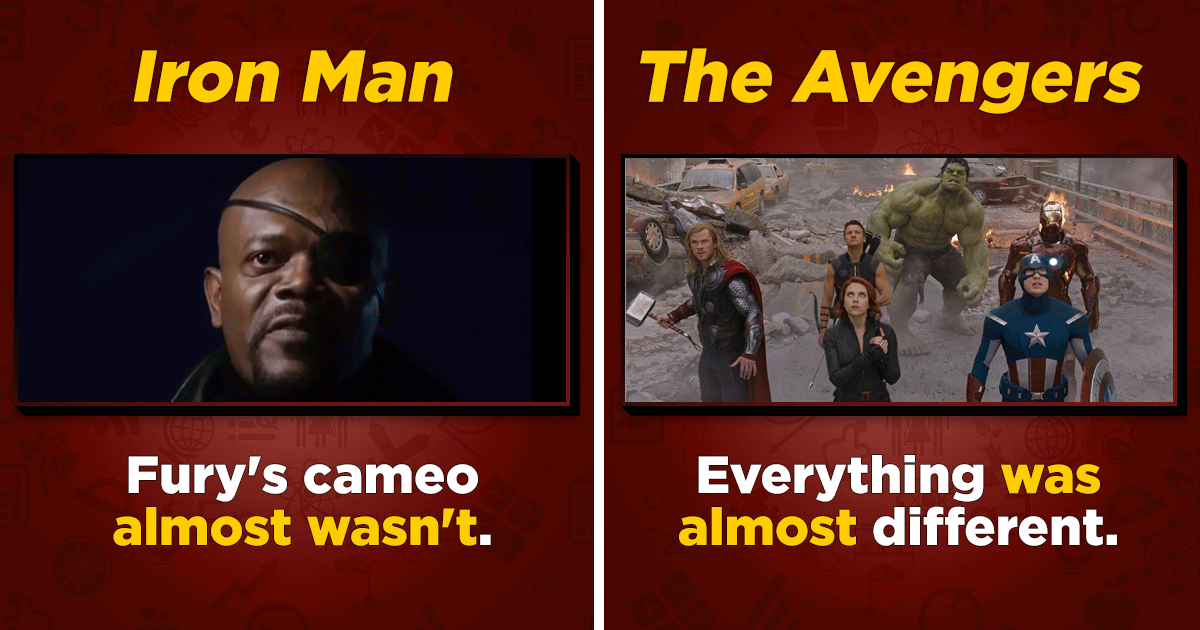
The Marvel Cinematic Universe feels inevitable now, like Thanos snapping his fingers and saying, “Of course this would become a multibillion-dollar pop-culture machine.” But the MCU was not born wearing a shiny Infinity Gauntlet. It was built on risky loans, rejected castings, abandoned scripts, director changes, and decisions that could have sent the whole franchise into a very different timeline.
Today, it is hard to imagine anyone but Robert Downey Jr. saying, “I am Iron Man.” It is equally hard to picture the original Avengers without Scarlett Johansson’s Black Widow, Tom Hiddleston’s Loki, Chris Hemsworth’s Thor, or Mark Ruffalo’s warm, anxious Bruce Banner. Yet behind the scenes, Marvel Studios came dangerously close to making a version of the MCU that would look less like the universe fans know and more like a chaotic multiverse fever dream.
This is not just trivia for comic-book superfans who can name every background extra in the Battle of New York. These almost-decisions reveal how fragile the MCU’s early success really was. One different casting choice, one different script draft, or one director staying instead of leaving could have changed the tone, structure, and emotional core of Marvel’s shared universe.
So grab a shawarma, keep your helmet nearby, and let’s explore five weird ways the MCU was almost way different.
1. Iron Man Could Have Been Played by Someone Very Different
The almost-version of Tony Stark
The MCU began with Iron Man in 2008, but Robert Downey Jr. was not always the obvious choice. In fact, he was a creative gamble. At the time, Downey was respected as a talented actor, but he was not considered the safest blockbuster investment. Marvel needed its first self-financed movie to work, and casting him meant trusting charisma over corporate caution.
Before Downey became the face of Marvel Studios, other names circled the role. Clive Owen was reportedly a top choice at one point. Timothy Olyphant also screen-tested for Tony Stark. Tom Cruise had been associated with earlier versions of an Iron Man movie before Marvel Studios finally launched the version we know.
That means the MCU’s first big domino almost fell in a completely different direction. Imagine a Tony Stark with Cruise’s action-star intensity, Owen’s cool detachment, or Olyphant’s dry gunslinger charm. Each could have been interesting, but none would have created the exact strange cocktail that Downey brought: wounded ego, comic timing, self-destruction, brilliance, and a tiny hint that Tony Stark was always one bad day away from turning a press conference into performance art.
Why this would have changed the MCU
Downey’s Tony Stark did not simply headline a movie; he taught the MCU how to talk. His rhythm shaped Marvel’s house style: fast banter, emotional damage hidden behind jokes, and heroes who could be ridiculous without becoming disposable. Without that performance, Marvel may have leaned more heavily into traditional action drama, and the shared universe might have felt more polished but less alive.
More importantly, Downey’s personal comeback story blended with Tony’s redemption arc. Viewers were not just watching a rich weapons manufacturer become a hero. They were watching an actor rebuild his own public image through a character learning accountability. That extra layer gave Iron Man emotional fuel Marvel could not have manufactured in a boardroom.
If Marvel had chosen a safer Tony, the movie might still have succeeded. But would audiences have cared enough to follow breadcrumbs into The Avengers? Would Nick Fury’s post-credit cameo have felt like an invitation to a universe, or just a cute bonus scene? The difference matters. The MCU did not need only a hero in a metal suit. It needed a personality strong enough to make a cinematic universe feel like a party worth attending.
2. The First Avengers Movie Almost Had Wasp Instead of Black Widow
The team that nearly assembled
By the time The Avengers arrived in 2012, the lineup felt natural: Iron Man, Captain America, Thor, Hulk, Black Widow, and Hawkeye. But early versions of the story were not so settled. There was a period when Scarlett Johansson’s availability was uncertain, and writer-director Joss Whedon developed drafts that gave a major role to the Wasp.
That is a huge alternate timeline hiding in plain sight. In Marvel Comics, Wasp is one of the founding Avengers, so her inclusion would not have been random. But in the MCU, introducing her in the first team-up movie would have changed the balance of the story. Instead of building around characters audiences already knew from earlier films, The Avengers would have needed to introduce a new hero while also juggling Loki, S.H.I.E.L.D., the Tesseract, the Chitauri, and six different personalities with enough ego to power Stark Tower.
The early drafts also reportedly considered Ezekiel Stane, the son of Iron Man villain Obadiah Stane, as an additional antagonist. That would have connected the first Avengers-level threat more directly to Tony Stark’s past. It also might have made the story feel less cosmic and more like Iron Man 2.5: Group Project Edition.
Why this would have changed the MCU
Black Widow’s place in The Avengers was important because she grounded the team. She had no armor, no hammer, no super-soldier serum, and no green rage monster hiding under the hood. Her power was competence. She was the spy in a room full of demigods and science disasters, and she helped make the impossible team feel tactical.
If Wasp had replaced her, the MCU might have introduced shrinking technology years earlier. Ant-Man mythology could have become central to Phase One instead of arriving near the end of Phase Two. Hank Pym, Janet van Dyne, or Hope van Dyne might have entered the franchise before Scott Lang ever had a chance to steal a suit and charm everyone with nervous dad energy.
That also would have changed Black Widow’s future. Without The Avengers cementing Natasha Romanoff as one of the original six, her later relationships with Steve Rogers, Bruce Banner, Clint Barton, and the wider team might never have developed the same weight. The emotional sacrifice in Avengers: Endgame depends partly on the audience understanding that Natasha was there from the beginning.
Wasp joining early could have been fun, visually inventive, and comic-accurate. But it would have created a very different emotional map for the MCU. Sometimes the weirdest “almost” is not about adding something bad. It is about adding something good too early.
3. The Hulk Could Have Stayed Darker With Edward Norton
The Banner before Ruffalo
Before Mark Ruffalo became the MCU’s soft-spoken, cardigan-adjacent science uncle, Edward Norton played Bruce Banner in 2008’s The Incredible Hulk. That film is technically part of the MCU, even though it often feels like it wandered in from another franchise, looked around, and quietly stood near the snack table.
Norton’s Bruce Banner was more haunted, more isolated, and more connected to the tragic-monster tradition of the character. His version leaned into the pain of being hunted, the fear of losing control, and the loneliness of living as a man with a walking natural disaster inside him. Had Norton continued into The Avengers, the team dynamic would likely have been sharper and more tense.
Marvel eventually recast the role with Ruffalo, whose Banner brought a different flavor: nervous humor, warmth, vulnerability, and a sense that he was always trying to manage both his blood pressure and the room’s emotional temperature. That shift helped Hulk fit into an ensemble built on banter and reluctant friendship.
Why this would have changed the MCU
If Norton had stayed, Hulk may have remained a more dramatic and unstable figure. That could have worked beautifully in a darker franchise. But the MCU’s Avengers needed a Bruce Banner who could sit in a lab with Tony Stark, trade awkward jokes, and become part of the family without making every scene feel like a psychological thriller.
Ruffalo’s version made Hulk surprisingly lovable. He was dangerous, yes, but also oddly gentle. The contrast made moments like “I’m always angry” land with crowd-pleasing force. It also made later developments, including Professor Hulk, easier to imagine. A darker Norton-style Hulk might have made that evolution feel strange or even impossible.
This is one of the MCU’s most important tonal pivots. Marvel did not simply recast an actor; it changed the emotional function of a character. Hulk went from tragic loner to anxious teammate. That helped The Avengers become a movie about broken people forming a team instead of powerful people barely surviving each other.
Would a Norton-led Hulk arc have been more serious? Probably. Would it have given the MCU a richer monster story? Maybe. But would it have fit the bright, messy, joke-fueled chemistry that defined the original Avengers? That is where the timeline gets shaky.
4. Ant-Man Could Have Been an Edgar Wright Movie Years Earlier
The tiny hero with a giant development history
Long before Ant-Man finally reached theaters in 2015, Edgar Wright was attached to develop the project. Wright, known for fast editing, visual comedy, clever transitions, and genre-loving chaos, seemed like a fascinating match for a superhero who shrinks, steals things, talks to ants, and somehow makes all of that less silly than it sounds.
Wright worked on the project for years with Joe Cornish, and the idea of an Edgar Wright-directed Ant-Man became one of the great MCU what-ifs. Eventually, Wright and Marvel parted ways over creative differences, and Peyton Reed directed the finished film. The final version still retained story and screenplay DNA from Wright and Cornish, but it became more clearly integrated into the MCU’s larger structure.
The finished Ant-Man is charming, funny, and more important to the Infinity Saga than many viewers expected. Scott Lang eventually became a key part of the time-heist solution in Avengers: Endgame. Not bad for a guy whose superhero brand is basically “what if a burglar became extremely small and emotionally sincere?”
Why this would have changed the MCU
An Edgar Wright Ant-Man might have been stranger, more stylized, and less visibly connected to the rest of Marvel’s machine. It may have played more like a self-contained heist comedy with superhero elements than a carefully positioned franchise chapter. That could have pushed the MCU toward more director-driven experiments earlier in its timeline.
If Wright’s version had arrived in Phase One as originally imagined, Ant-Man and the Wasp mythology might have stood beside Iron Man, Thor, and Captain America from the start. The Avengers lineup could have been more comic-accurate. The science of the Quantum Realm might have entered the MCU years earlier. Even the rhythm of Marvel comedy could have changed, because Wright’s visual humor is very different from the dialogue-driven quips Marvel became famous for.
At the same time, the split revealed something important about Marvel Studios. The MCU was not only a collection of individual movies; it was a connected system. Directors could bring personality, but the universe had to remain cohesive. That approach helped Marvel build a reliable brand, but it also created ongoing debates about creative freedom.
In another timeline, Ant-Man becomes the MCU’s early weird masterpiece. In this timeline, it became a lovable heist movie that arrived later, fit neatly, and quietly carried the keys to saving half the universe. Honestly, for a hero who rides ants, that is still a strong résumé.
5. Thor and Loki Almost Had a Very Different Family Dynamic
The thunder god casting shuffle
Chris Hemsworth’s Thor and Tom Hiddleston’s Loki became one of the MCU’s strongest emotional pairings. Their relationship gave the franchise mythology, rivalry, tragedy, comedy, betrayal, reconciliation, and several excellent opportunities for Loki to look offended in expensive leather.
But the casting process could have gone very differently. Hiddleston originally auditioned for Thor, not Loki. Chris Hemsworth has also discussed how his brother Liam Hemsworth got far in the Thor casting process before Chris ultimately landed the role. That means two major “almosts” were hiding inside Asgard before the first Thor movie even arrived.
Picture Hiddleston as Thor for a moment. He has the theatrical training, the intensity, and the Shakespearean command that director Kenneth Branagh clearly valued. But if Hiddleston had played Thor, who would have played Loki? More importantly, would Loki have become the MCU’s first truly beloved villain?
Now picture Liam Hemsworth as Thor. He might have brought a younger, different heroic energy to the role. But Chris Hemsworth’s particular blend of size, sincerity, comedy, and golden-retriever nobility became crucial to Thor’s survival as a character. When the early Thor movies struggled with tone, Hemsworth’s charm kept the character alive long enough for Thor: Ragnarok to reinvent him.
Why this would have changed the MCU
Loki’s impact is difficult to overstate. He was the villain of Thor, the villain of The Avengers, a recurring chaos agent, and eventually the emotional center of his own Disney+ series. Hiddleston gave Loki a strange combination of wounded pride, elegance, humor, and loneliness. He made betrayal look theatrical but also sad.
Without Hiddleston’s Loki, The Avengers might have lacked a villain charismatic enough to unite the heroes while still entertaining the audience. The MCU’s early villain problem could have become much worse. Loki proved that a Marvel villain could be funny, stylish, dangerous, and emotionally complicated at the same time.
Chris Hemsworth’s Thor also evolved in ways that depended heavily on the actor’s hidden comic talent. The serious prince of the first film eventually became the cosmic disaster himbo of Ragnarok, the grieving powerhouse of Infinity War, and the emotionally battered survivor of Endgame. That flexibility kept Thor from becoming a stiff fantasy hero trapped in a cape.
The MCU did not simply need someone who looked like Thor. It needed someone who could grow with Thor. It also needed Loki to be more than a villain. The final casting gave Marvel both.
What These Alternate MCU Timelines Prove
The strangest thing about these MCU almost-changes is that many of them sound reasonable. Clive Owen could have played a compelling Tony Stark. Wasp belongs in Avengers history. Edward Norton had a valid darker take on Hulk. Edgar Wright’s Ant-Man sounds amazing. Tom Hiddleston auditioning for Thor makes sense on paper.
But franchises are not built on paper alone. They are built on chemistry, timing, audience response, studio strategy, and the occasional miracle of casting. The MCU succeeded because certain decisions lined up at the right moment: Downey’s swagger, Evans’ sincerity, Hemsworth’s mythic goofiness, Ruffalo’s warmth, Johansson’s grounded intensity, and Hiddleston’s elegant mischief.
Marvel’s early years were also a lesson in controlled risk. The studio made bold choices, but it often pulled those choices back toward a shared-universe structure. That balance created both magic and criticism. Fans love the MCU because it feels connected, but some also wonder what stranger, more director-driven versions were left behind.
In a way, the MCU we know is only one branch of a giant creative multiverse. Somewhere out there in imagination-land, Tom Cruise is doing his own stunts in an Iron Man suit, Wasp is bantering with Captain America in 2012, Norton’s Hulk is brooding in Avengers Tower, Edgar Wright’s Ant-Man is cutting between action scenes like a superhero music video, and Hiddleston is swinging Mjolnir while someone else tries to make Loki happen.
Would that MCU be better? Not necessarily. But it would be fascinating, weird, and probably full of arguments on the internet. So, basically, still Marvel.
Experience Notes: What Fans Can Learn From These Almost-MCU Moments
One of the most enjoyable experiences of revisiting MCU history is realizing how many “obvious” choices were not obvious at all. Fans often look backward and assume success was guaranteed. Of course Robert Downey Jr. was Tony Stark. Of course Chris Hemsworth was Thor. Of course Loki became a fan favorite. But when those decisions were being made, they were uncertain, risky, and sometimes controversial.
That makes MCU what-if stories surprisingly useful beyond entertainment. They remind writers, filmmakers, marketers, and fans that great creative projects often depend on decisions that feel uncomfortable at first. Downey was not the safest corporate option, but he was the most electric artistic one. Ruffalo was not the original Hulk, but his version fit the ensemble better. Wright leaving Ant-Man disappointed many fans, yet the final movie still found a place in the larger saga.
For viewers, these behind-the-scenes stories can make a rewatch more interesting. The next time you watch The Avengers, pay attention to how Black Widow functions in the group. She is not just “the non-powered one.” She is the human intelligence line running through the movie. Now imagine replacing her with Wasp and introducing shrinking technology at the same time. The entire pacing changes. The story becomes more crowded, maybe more colorful, but less clean.
The same is true for Thor and Loki. Watching Thor after learning that Hiddleston auditioned for the title role adds an extra layer of irony. Loki’s whole emotional wound is that he believes he should have been equal to Thor, maybe even superior. In real life, the actor playing Loki also began the process by aiming for Thor. That is almost too perfect, like the casting gods were writing bonus symbolism in the margins.
These almost-versions also show why chemistry matters more than checklists. A performer may look perfect for a role and still not unlock it. A director may have a brilliant version of a movie that does not fit the franchise’s immediate needs. A comic-accurate choice may not be the best cinematic choice at that moment. Adaptation is not a photocopy machine. It is more like cooking: ingredients matter, but timing, heat, and balance decide whether the final dish is delicious or just expensive soup.
For longtime Marvel fans, the best attitude is curiosity rather than outrage. It is fun to imagine the lost versions, but the final MCU became powerful because of the emotional connections it actually built. Tony’s sacrifice, Natasha’s loyalty, Thor and Loki’s tragic bond, Banner’s uneasy peace with Hulk, and Scott Lang’s unlikely importance all came from the path Marvel chose. The alternate paths are fascinating, but this timeline gave pop culture some unforgettable moments.
And honestly, that is the real magic of MCU history. The franchise is full of gods, aliens, witches, robots, and multiverse portals, but its most important superpower may be casting the right person at exactly the right time.
Conclusion
The MCU was almost way different in ways that sound funny now but were serious turning points at the time. A different Iron Man could have changed Marvel’s voice. Wasp replacing Black Widow could have reshaped the original Avengers. Edward Norton staying as Hulk might have pushed the franchise darker. Edgar Wright’s Ant-Man could have made the MCU weirder earlier. And a different Thor or Loki could have altered one of Marvel’s most important relationships.
These almost-changes prove that the MCU was never guaranteed. It survived because Marvel made a series of risky, lucky, and sometimes painful decisions that somehow formed a coherent universe. In true Marvel fashion, the timeline we got may not be the only possible onebut it is the one that made audiences cheer, cry, argue, rewatch, and occasionally wonder why nobody in this universe has better password security.