Finding the perimeter of a trapezoid sounds like one of those math tasks that might require a dramatic soundtrack, a sharpened pencil, and possibly a snack. Good news: it is much friendlier than it looks. The perimeter of a trapezoid is simply the total distance around the outside of the shape. In plain English, you are adding the four side lengths. That is it. No secret geometry handshake required.
Still, trapezoids can show up in different forms. Sometimes all four sides are given. Sometimes one side is missing. Sometimes the trapezoid is isosceles, meaning its two legs are equal. And sometimes the shape appears on a coordinate plane, where you must calculate side lengths before adding them. That is why learning several methods is useful. You are not just memorizing a formula; you are learning how to choose the right tool for the problem.
In this guide, we will walk through 3 ways to find the perimeter of a trapezoid: using the basic side-addition formula, using special trapezoid properties, and using geometry tools like the Pythagorean theorem or coordinate distance formula. Each method includes examples, practical tips, and common mistakes to avoid, because math errors love to hide in tiny details like missing units.
What Is a Trapezoid?
A trapezoid is a four-sided polygon, also called a quadrilateral, with at least one pair of parallel sides. The parallel sides are usually called the bases. The other two sides are called the legs. In most classroom problems, you will see a shorter top base, a longer bottom base, and two slanted sides. It may look like a table wearing roller skates, but mathematically, it is just a quadrilateral with structure.
The perimeter does not care whether the sides are parallel, slanted, fancy, or emotionally complicated. If a side is part of the outside boundary, it counts. To find the perimeter, you add every outside edge once.
The Main Perimeter of a Trapezoid Formula
The basic formula is:
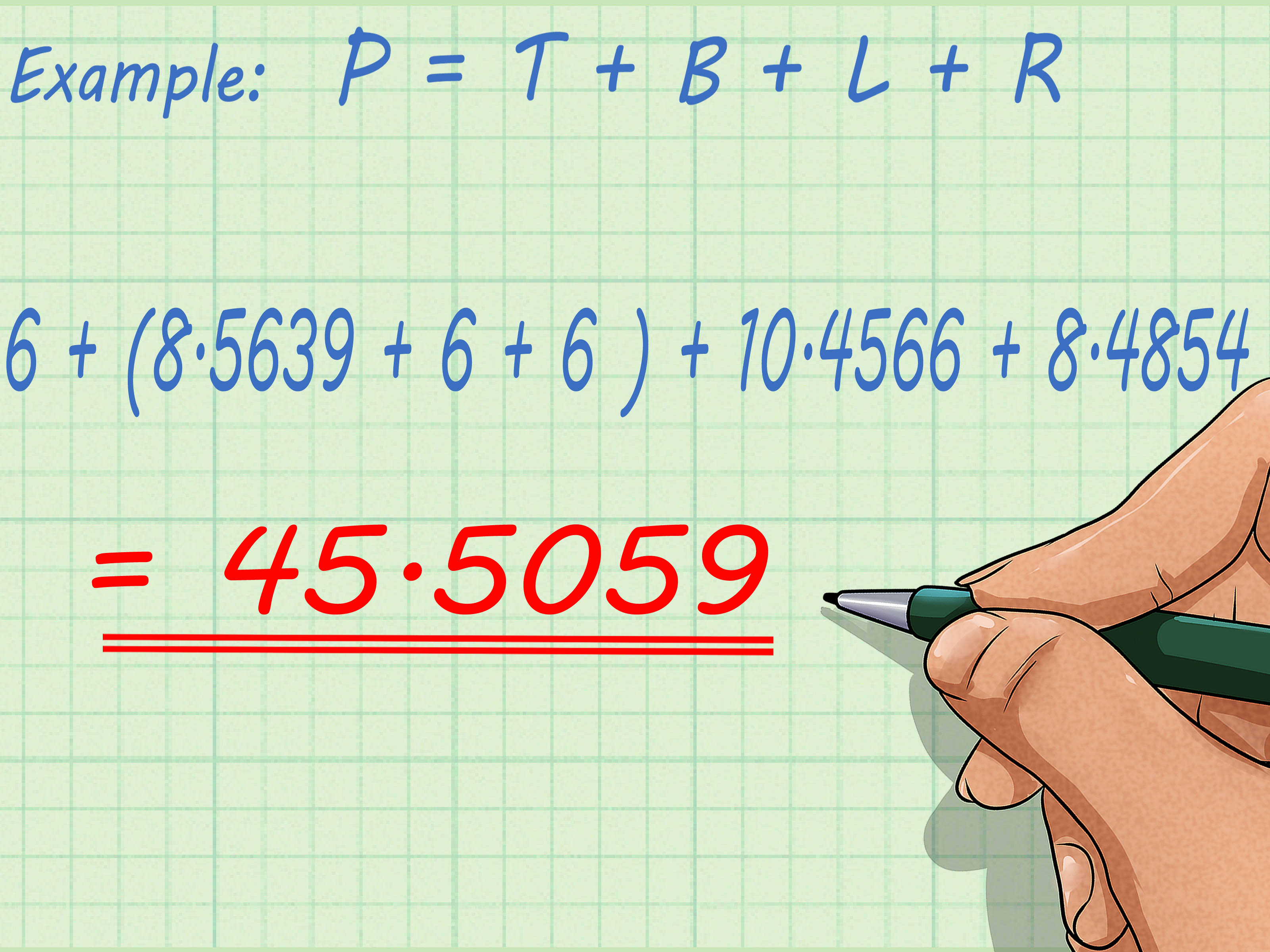
P = a + b + c + d
In this formula, P stands for perimeter, and a, b, c, and d represent the four side lengths of the trapezoid. You may also see the formula written as:
P = base 1 + base 2 + leg 1 + leg 2
Both versions mean the same thing. The second version is often easier because it uses the actual parts of a trapezoid. If the bases are 10 inches and 16 inches, and the legs are 7 inches and 9 inches, the perimeter is:
P = 10 + 16 + 7 + 9 = 42 inches
Notice the unit. Since the side lengths are measured in inches, the perimeter is also measured in inches. Perimeter is always a linear measurement, not square units. Square units are for area. Mixing them up is like putting ketchup in your calculator: technically possible, but deeply unhelpful.
Way 1: Add All Four Side Lengths
The simplest way to find the perimeter of a trapezoid is to add the lengths of all four sides. This method works when the problem gives you every side length directly. No extra formulas. No detective work. Just addition with a geometry hat on.
Step-by-Step Method
- Identify the two bases.
- Identify the two legs.
- Add all four side lengths.
- Write the final answer with the correct unit.
Example 1: All Sides Are Given
Suppose a trapezoid has side lengths of 8 cm, 12 cm, 5 cm, and 6 cm.
P = 8 + 12 + 5 + 6
P = 31 cm
The perimeter is 31 centimeters.
This is the most common beginner-friendly trapezoid perimeter problem. The key is to include every side exactly once. Students sometimes add only the bases because those are the sides that look important. Unfortunately, the legs do not politely disappear just because they are slanted. They are still part of the boundary, so they count.
Example 2: A Word Problem
A garden bed is shaped like a trapezoid. The two parallel sides are 14 feet and 20 feet. The two non-parallel sides are 9 feet and 11 feet. How much edging is needed to surround the garden?
Because edging goes around the outside, this is a perimeter problem.
P = 14 + 20 + 9 + 11
P = 54 feet
The garden needs 54 feet of edging. Buying 54 feet exactly may be brave, but in real life, a little extra material is smart. Measuring tapes, soil, and human optimism are not always perfectly aligned.
Way 2: Use the Isosceles Trapezoid Shortcut
An isosceles trapezoid is a trapezoid whose legs are equal in length. The bases are parallel, and the two non-parallel sides match. This symmetry gives you a shortcut. Instead of adding both legs separately, you can multiply one leg by 2.
The formula is:
P = base 1 + base 2 + 2(leg)
This is especially useful when the problem gives one leg length and tells you the trapezoid is isosceles. Once you know one leg, you automatically know the other.
Example 3: Isosceles Trapezoid
An isosceles trapezoid has bases of 18 inches and 26 inches. Each leg is 10 inches. Find the perimeter.
P = 18 + 26 + 2(10)
P = 18 + 26 + 20
P = 64 inches
The perimeter is 64 inches.
What If Only One Leg Is Shown?
If a diagram labels only one leg of an isosceles trapezoid, do not panic. If the problem states that the trapezoid is isosceles, the missing leg has the same length. For example, if one leg is 13 meters, the other leg is also 13 meters. The shape is basically saying, “I believe in balance.”
Example 4: One Leg Labeled
An isosceles trapezoid has a top base of 7 meters, a bottom base of 15 meters, and one leg of 6 meters. What is the perimeter?
Since the trapezoid is isosceles, both legs are 6 meters.
P = 7 + 15 + 6 + 6
P = 34 meters
Or use the shortcut:
P = 7 + 15 + 2(6) = 34 meters
Either way, the answer is 34 meters.
Way 3: Find Missing Sides First, Then Add
Sometimes a trapezoid perimeter problem does not give all four side lengths. Instead, it may give the height, the bases, a coordinate graph, or enough information to calculate a missing side. In this case, you must find the missing length first. Then you use the perimeter formula.
This method often uses the Pythagorean theorem or the distance formula. It sounds more advanced, but the idea is simple: before you can add the sides, you need to know what the sides are.
Using the Pythagorean Theorem
The Pythagorean theorem is used with right triangles:
a² + b² = c²
In trapezoid problems, you may be able to drop a height from the top base to the bottom base. This creates a right triangle along one side. If you know the height and the horizontal difference, you can find the slanted leg.
Example 5: Missing Leg in a Right Trapezoid
Imagine a trapezoid with bases of 10 inches and 16 inches. Its height is 8 inches. One leg is vertical and also 8 inches. The other leg is slanted. Find the perimeter.
First, find the horizontal difference between the bases:
16 – 10 = 6 inches
The slanted side forms a right triangle with legs 6 inches and 8 inches.
6² + 8² = c²
36 + 64 = c²
100 = c²
c = 10 inches
Now add all four sides:
P = 10 + 16 + 8 + 10
P = 44 inches
The perimeter is 44 inches.
Using Coordinates
If the trapezoid is on a coordinate plane, you may need to calculate each side length from the points. For horizontal and vertical sides, count the units. For slanted sides, use the distance formula:
d = √((x₂ – x₁)² + (y₂ – y₁)²)
After you find all four side lengths, add them. The process is not hard, but it does require careful labeling. Coordinate-plane mistakes usually happen because someone grabs the wrong point or subtracts coordinates in a hurry. Math rewards calm people. It is unfair, but true.
Example 6: Coordinate Trapezoid
Suppose a trapezoid has vertices at A(1, 2), B(7, 2), C(5, 6), and D(2, 6).
Side AB is horizontal:
AB = 7 – 1 = 6
Side CD is horizontal:
CD = 5 – 2 = 3
Now find the slanted sides.
For BC, use B(7, 2) and C(5, 6):
BC = √((5 – 7)² + (6 – 2)²)
BC = √((-2)² + 4²)
BC = √(4 + 16) = √20 ≈ 4.47
For DA, use D(2, 6) and A(1, 2):
DA = √((1 – 2)² + (2 – 6)²)
DA = √((-1)² + (-4)²)
DA = √(1 + 16) = √17 ≈ 4.12
Now add:
P = 6 + 3 + 4.47 + 4.12
P ≈ 17.59 units
The perimeter is approximately 17.59 units.
Common Mistakes When Finding Trapezoid Perimeter
Confusing Perimeter with Area
Perimeter measures the distance around a shape. Area measures the space inside it. A trapezoid area formula uses height and bases, but perimeter uses side lengths. If the answer is in square units, you probably found area, not perimeter.
Forgetting One Side
A trapezoid has four sides. The perimeter must include all four. If your calculation has only three numbers, pause and investigate. One side may be hiding in the diagram like a tiny geometry raccoon.
Assuming the Legs Are Equal
Not every trapezoid is isosceles. Only use the equal-leg shortcut when the problem says the trapezoid is isosceles or clearly marks the legs as congruent. Otherwise, the legs may have different lengths.
Using Height as a Slanted Side
Height is the perpendicular distance between the bases. It is not always the same as a leg. In a right trapezoid, one leg may equal the height, but in a regular slanted trapezoid, the height is inside the shape and does not replace the outside edge.
How to Choose the Best Method
Use the direct addition method when all four sides are given. Use the isosceles shortcut when the trapezoid has equal legs. Use the missing-side method when the problem gives height, coordinates, or partial information instead of all side lengths.
A helpful strategy is to ask: “Do I know every outside edge?” If the answer is yes, add them. If the answer is no, find the missing edge first. That one question can save you from most perimeter mistakes.
Real-Life Uses of Trapezoid Perimeter
Trapezoids appear more often than people notice. You can find them in ramps, tabletops, roof designs, bridge supports, garden beds, tiles, signs, handbags, and decorative panels. Whenever someone needs to place trim, fencing, border tape, edging, framing, or rope around a trapezoid-shaped object, perimeter matters.
For example, a landscaper may need to calculate the border length for a trapezoid flower bed. A carpenter may measure the outside trim for a trapezoid tabletop. A designer may calculate the seam length around a trapezoid fabric panel. In each case, the process is the same: measure the outside sides and add them.
Practice Problems
Problem 1
A trapezoid has side lengths of 9 cm, 14 cm, 7 cm, and 8 cm. What is the perimeter?
Answer: 9 + 14 + 7 + 8 = 38 cm
Problem 2
An isosceles trapezoid has bases of 11 feet and 19 feet. Each leg is 5 feet. Find the perimeter.
Answer: 11 + 19 + 2(5) = 40 feet
Problem 3
A trapezoid has bases of 12 inches and 18 inches. One leg is 10 inches, and the other leg is 8 inches. What is the perimeter?
Answer: 12 + 18 + 10 + 8 = 48 inches
Experiences and Practical Tips for Learning Trapezoid Perimeter
One of the best experiences related to learning how to find the perimeter of a trapezoid is discovering that the problem is usually less about complicated formulas and more about careful observation. Many students first approach trapezoids as if the shape is trying to trick them. The slanted sides look suspicious. The bases are different lengths. The diagram may not be perfectly drawn. But once students understand that perimeter means “walk around the outside,” the whole topic becomes much easier.
A useful classroom experience is to trace the trapezoid with a finger before calculating anything. Start at one corner and move around the shape, saying each side length out loud. This small habit helps prevent skipped sides. It also makes perimeter feel physical instead of abstract. Imagine placing a string around the trapezoid. The length of that string is the perimeter. That mental picture works surprisingly well, especially when a diagram includes extra lines like height marks or diagonals.
Another helpful experience is comparing two trapezoids with the same bases but different legs. Students often assume that if the bases are the same, the perimeter must be the same. Then they see one trapezoid with short legs and another with long slanted legs, and the idea clicks: perimeter depends on all four sides, not just the parallel ones. This is where a quick drawing can do more than a paragraph of explanation. Geometry likes pictures. It is practically begging for them.
For real-world practice, measuring objects around the house can make the concept stick. A trapezoid-shaped lampshade panel, a decorative tile, a garden border, or even a paper cutout can become a perimeter problem. Measure each side with a ruler or tape measure, write the values down, and add them. If the object is isosceles, check whether the legs are actually equal instead of assuming. Real objects are not always perfect, which is a nice reminder that math models are clean, while life sometimes has crooked scissors.
When working with missing sides, patience matters. If a trapezoid problem gives height, it is tempting to add the height as if it were an outside side. That is one of the most common mistakes. A good habit is to highlight only the outer boundary before adding. If the height is drawn inside the trapezoid, it helps you find a missing side, but it may not be part of the perimeter itself. Think of height as a helpful assistant, not automatically a side of the fence.
For coordinate-plane trapezoids, organization is everything. Label the vertices in order, find each side separately, and keep your work neat. If decimals appear, round only at the end when possible. Rounding too early can make the final perimeter slightly inaccurate. Also, always check whether the side is horizontal or vertical before using the distance formula. Sometimes you can simply count units, which is faster and less error-prone.
The biggest lesson from practicing trapezoid perimeter is that formulas are useful, but understanding is better. If you remember that perimeter is the outside distance, you can handle regular trapezoids, isosceles trapezoids, right trapezoids, and coordinate trapezoids with confidence. The shape may lean, stretch, or show up on a graph, but the mission stays the same: find every outside side and add them like a calm, mathematically responsible human.
Conclusion
Learning 3 ways to find the perimeter of a trapezoid gives you flexibility. When all four sides are known, add them directly. When the trapezoid is isosceles, use the equal-leg shortcut. When a side is missing, use geometry tools such as the Pythagorean theorem or distance formula, then add every outside length.
The perimeter of a trapezoid is not about memorizing a scary equation. It is about understanding the shape, identifying the sides, and keeping your units straight. Once you get used to that process, trapezoid perimeter problems become less mysterious and much more manageable. They may still look slanted, but at least now they are slanted in a way you can calculate.