Note: This article is synthesized from current U.S.-based guidance on book donation, resale, recycling, reuse, community libraries, literacy programs, and safe handling of damaged books.
Old unwanted books have a sneaky way of multiplying. One day you have a cozy shelf of favorite novels. The next, your hallway looks like a used bookstore lost a wrestling match with a moving truck. Maybe the books are outdated textbooks, mystery novels you will absolutely not reread, cookbooks from your “I’m going to master soufflé” era, or hardcovers that have been silently judging you since 2009.
Before you toss them in the trash, pause. Books are not ordinary clutter. They can become classroom tools, neighborhood treasures, home decor, secret storage, art supplies, charitable donations, or even recycled paper. The trick is knowing which option fits the book’s condition, value, and usefulness. A clean recent novel deserves a second reader. A moldy basement book deserves careful disposal. A damaged hardcover with a beautiful cover might deserve a second career as a lamp, clock, or conversation piece.
Below are 13 shocking, creative, practical, and surprisingly satisfying things you can do with old unwanted bookswithout turning your home into a paper-based obstacle course.
1. Donate Them to a Local Library Sale
Many public libraries do not add every donated book to their shelves, but they often use donated books for fundraising sales. These sales help support library programs, children’s events, reading clubs, technology access, and community services. That means your old beach read could help fund a toddler story hour. Not bad for a paperback that spent three summers under your nightstand.
Before you load six boxes into your car, check your library’s donation rules. Libraries usually prefer clean books in good condition. They may reject moldy books, outdated encyclopedias, damaged textbooks, or books with missing pages. A helpful rule: if you would feel embarrassed handing the book to a friend, do not hand it to a librarian and pretend it is a “vintage treasure.”
2. Drop Them Into a Little Free Library
Little Free Libraries are small neighborhood book-sharing boxes where people can take a book or leave a book. They are perfect for novels, children’s books, memoirs, cookbooks, and other titles that still have reading life left in them. This is one of the easiest ways to give unwanted books a second chance without paperwork, appointments, or awkward small talk.
Be considerate. Do not cram a tiny book box with 40 outdated manuals and run away like a literary raccoon. Add a few good books at a time, especially titles that match the neighborhood. Children’s books are wonderful near schools and parks. Popular fiction works almost anywhere. Damaged, wet, smoky, or moldy books should stay out because they can ruin the entire collection.
3. Sell Valuable Books for Cash
Some unwanted books are worth money. Textbooks, collectible editions, signed copies, niche nonfiction, recent bestsellers, and out-of-print titles may sell online or at used bookstores. Local shops such as used bookstores may buy books in person, while online marketplaces can help you compare resale prices by ISBN.
Condition matters. A clean book with a tight binding, unmarked pages, and a dust jacket usually does better than a coffee-stained copy with mysterious crumbs in chapter seven. For textbooks, edition matters even more. A biology textbook from 1998 may be scientifically interesting, but it is probably not paying for your vacation.
If you have rare books, first editions, antique volumes, or signed works, research before selling. A quick scan can prevent you from letting a valuable book go for pocket change. On the other hand, most ordinary used books are not gold mines. Think of selling as a decluttering bonus, not a retirement plan.
4. Donate to Literacy Organizations
Books can travel far beyond your shelves. U.S.-based literacy organizations collect books for schools, libraries, underserved communities, and international education programs. Groups focused on book access often look for children’s books, young adult titles, educational materials, dictionaries, reference books, and current nonfiction.
Donation guidelines matter here. Some organizations accept only specific categories. Others may request financial support to help cover sorting, shipping, or distribution costs. Sending the wrong books can create extra work and expense for charities. In short: do not donate your 1974 tax guide unless someone specifically asks for “ancient financial anxiety in hardcover form.”
When your books are clean, relevant, and useful, literacy donations can have real impact. A book you no longer need may become the first book a child owns, a classroom resource, or a library shelf in a community with limited access.
5. Give Books to Schools, Teachers, or Homeschool Groups
Teachers often build classroom libraries with their own money, which is both heroic and mildly unfair. If you have age-appropriate children’s books, young adult novels, graphic novels, poetry, biographies, or classroom-friendly nonfiction, local teachers may appreciate them.
Ask first. Schools may have policies about donated materials, and teachers know what their students actually need. Books with inclusive themes, diverse characters, high-interest topics, and durable covers can be especially useful. Homeschool groups, tutoring centers, after-school programs, and community centers may also welcome good-condition books.
A practical tip: sort books by age range before offering them. “Here are ten clean picture books and eight middle-grade adventure novels” is much more helpful than “Here is a box of mystery paper bricks, good luck.”
6. Send Appropriate Books to Prison Book Programs
Books can be deeply meaningful for incarcerated readers, but prison book donations require extra care. Many programs have strict rules about book type, condition, subject matter, and mailing procedures. Some facilities restrict hardcovers. Others may reject books with writing, damaged bindings, spiral bindings, or certain content categories.
Instead of mailing books directly to a prison without checking, contact a prison book program or review its current donation guidelines. High-demand categories often include dictionaries, GED study guides, language learning books, art instruction, health and wellness, history, job skills, and popular fiction. Policies can change, so current instructions are essential.
This option is not the quickest way to declutter, but it can be one of the most meaningful. The right book can provide education, comfort, imagination, and connection in an environment where access to reading material may be limited.
7. Host a Book Swap Party
A book swap is exactly what it sounds like: everyone brings books they no longer want and leaves with books they actually want to read. It is affordable, social, and much less emotionally intense than trying to decide alone whether you still need four copies of the same thriller.
Set simple rules. Ask guests to bring books in good condition. Create categories on tables: fiction, nonfiction, children’s books, cookbooks, self-help, and “wild cards.” Let everyone browse, trade, and take leftovers homeor agree in advance to donate the remaining books to a library sale or charity.
For extra fun, add sticky notes where guests can write mini-reviews. “This book made me cry in public” is a surprisingly powerful recommendation.
8. Turn Old Books Into Secret Storage Boxes
One of the most shocking uses for an old hardcover is turning it into a secret storage box. Choose a sturdy hardcover book you do not mind altering. Glue the page edges together, let them dry, then carefully cut a rectangular compartment into the pages with a craft knife. Seal the inside with a diluted glue mixture, and you have hidden storage for keepsakes, spare keys, jewelry, emergency cash, or tiny treasures.
This project works best with thick books that have strong covers. Do not use valuable, rare, or sentimental books. Also, choose a title that will not attract attention. A fake storage box titled “Advanced Tax Regulations Volume III” may be the safest object in your house. Nobody is opening that voluntarily.
9. Make Book Page Wreaths and Wall Art
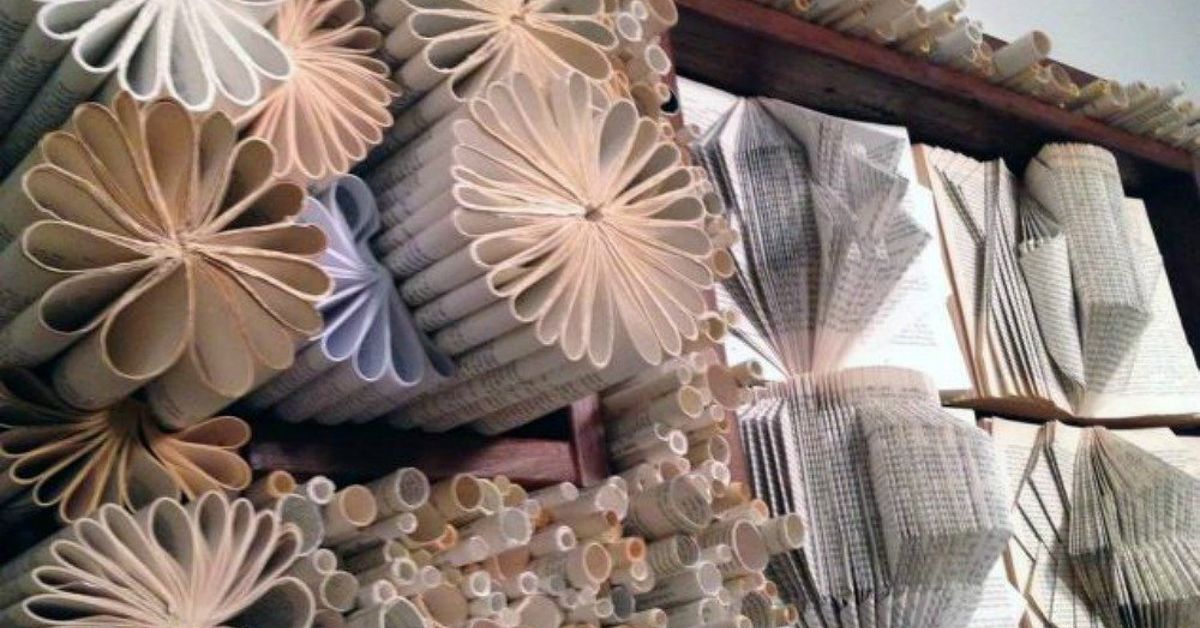
Damaged books with pretty pages can become beautiful home decor. Book page wreaths are popular because they look elegant, vintage, and surprisingly expensive. Pages can be rolled into cones, folded into petals, layered around a wreath form, or arranged into framed designs.
You can also use book pages for decoupage, paper flowers, garlands, collage art, handmade bookmarks, gift tags, and framed quotes. For a rustic farmhouse look, use aged pages. For a cleaner modern look, pair black text pages with simple white frames.
One warning: book crafts can become addictive. Today you make one wreath. Tomorrow you are explaining to your family why the dining room table is covered in paper roses and hot glue strings. This is normal. Probably.
10. Create a Book Planter or Succulent Display
A thick hardcover can become a unique planter for succulents or faux greenery. The basic idea is similar to a secret storage box: cut a hollow space into the pages, line it with plastic or a waterproof barrier, add a shallow container, and place small plants inside.
Real succulents need drainage and careful watering, so this project is best for people who understand that “just a splash” of water can become “why is my book growing a swamp?” Faux succulents are easier, cleaner, and safer for indoor decor. They still give the charming look without risking soggy pages.
This is a great use for damaged hardcovers with attractive covers. It makes a striking centerpiece, bookshelf accent, or gift for a book lover who also enjoys plants but maybe should not be trusted with another living thing.
11. Build a Stacked-Book Lamp or Side Table
Old books can become furniture and lighting accents. A stack of hardcovers can be turned into a small side table, a decorative riser, or even the base of a lamp. Designers have used books this way for years because they add texture, color, height, and personality.
For a stacked-book lamp, you will need basic lamp hardware, a drill, and careful measuring. If electrical projects make you nervous, use battery-powered puck lights or consult someone experienced. Safety beats style every time, even if the lamp would look fantastic next to your reading chair.
For a simple side table, stack sturdy books evenly and secure them if needed. Top the stack with a tray or small piece of glass. Avoid placing heavy drinks directly on books unless you want a coaster-related tragedy.
12. Use Pages for Gift Wrap, Envelopes, and Packaging
Book pages make charming recycled gift wrap for small presents, especially when paired with twine, ribbon, dried flowers, or a simple tag. They can also become handmade envelopes, confetti, package filler, or protective wrapping for fragile items.
This is especially useful for books that are already damaged and cannot be donated. Instead of buying new decorative paper, you can reuse what you already have. Old dictionary pages, music books, poetry collections, and illustrated books create especially attractive wrapping details.
Be thoughtful about the page content. Before wrapping Grandma’s birthday candle in a random book page, check that the visible paragraph is not a dramatic murder scene or a very weird medical description. Paper has comedic timing when you least expect it.
13. Recycle Books That Cannot Be Reused
When a book is moldy, wet, badly damaged, missing pages, or too outdated to be useful, recycling may be the responsible choice. In many U.S. recycling programs, paperback books can often be recycled as they are. Hardcover books may require removing the cover because hard covers can contain cloth, glue, plastic, or other non-paper materials.
Always check local recycling rules because requirements vary by city and county. Some curbside programs accept softcover books but not hardcover books. Others ask residents to remove bindings or take books to a drop-off center. If the book is moldy, handle it carefully. Mold can spread to other books and may cause irritation for sensitive people. Bag severely moldy books and follow local disposal guidance rather than donating them.
Recycling should be the final option after donation, resale, swapping, and creative reuse. Still, it is far better than sending usable paper straight to the landfill.
How to Decide What to Do With Each Book
Not every unwanted book deserves the same ending. Use a simple sorting system to make decisions faster.
Keep the Best
Keep books you genuinely love, use, reference, or plan to reread. Be honest. “I might become fluent in Italian using this workbook from 2003” is a dream, not a storage strategy.
Donate the Useful
Books in clean, readable condition can go to libraries, schools, Little Free Libraries, literacy groups, thrift stores, shelters, or community centers. Prioritize books that are current, appealing, and easy to place.
Sell the Valuable
Check textbooks, collectible editions, signed books, niche nonfiction, and recent releases. If the resale value is low, donation may be more efficient than spending hours listing a book for $2.
Craft With the Damaged
Books with broken spines, missing covers, or outdated information can still become art, decor, gift wrap, or storage projects.
Recycle the Unsalvageable
Books that are moldy, soaked, heavily damaged, or unusable should not be passed along. Recycle or dispose of them according to local rules.
Common Mistakes to Avoid When Getting Rid of Old Books
The biggest mistake is donating books that are not actually usable. Charities, libraries, and thrift stores often spend time and money sorting unwanted donations. If you donate damaged, dirty, or outdated materials, you may be shifting disposal work onto someone else.
Another mistake is assuming all books are recyclable in the same way. Hardcover books are more complicated than paperbacks because of their covers and binding materials. Local rules matter, so a quick check can prevent contamination in the recycling stream.
Finally, do not destroy books that may have value. Before turning a beautiful antique book into a planter, make sure it is not rare, signed, or historically interesting. Crafting is fun, but accidentally cutting into a valuable first edition is the kind of plot twist nobody wants.
Personal Experiences: What Happens When You Finally Deal With the Book Pile
Anyone who has ever decluttered books knows it is not just a cleaning task. It is an emotional excavation. You pick up one novel and suddenly remember the apartment where you read it, the coffee shop where you bought it, or the person who recommended it with alarming enthusiasm. Books hold memories, ambitions, phases, and sometimes guilt. Especially guilt. The unread book pile is basically a paper monument to optimism.
The first useful experience is learning to sort by purpose, not by pressure. When I have helped people organize bookshelves, the easiest question is not “Should I keep this?” That question invites drama. The better question is “What job does this book still have?” If the job is comfort, beauty, reference, or genuine future reading, it can stay. If the job is making you feel bad every time you dust, it can leave.
One surprisingly joyful approach is creating a “release stack.” These are books you appreciate but no longer need. Instead of thinking of them as rejected, think of them as ready for their next assignment. A children’s book can go to a young reader. A thriller can land in a Little Free Library and rescue someone from a boring bus ride. A cookbook can inspire a neighbor’s dinner. Suddenly decluttering feels less like loss and more like matchmaking.
Another real-world lesson: the fastest way to avoid overwhelm is to use multiple exits. One box for donation, one for selling, one for crafts, one for recycling. Do not try to make every book fit the same solution. That is how people end up donating water-damaged encyclopedias or trying to sell books worth twelve cents. Different books need different futures.
Book swaps are especially fun because they turn decluttering into a social event. People love explaining why a book is great, strange, heartbreaking, ridiculous, or “not for everyone, but maybe for you.” The leftover books can be donated afterward, and everyone leaves feeling like they participated in a tiny community festival with snacks.
Crafting with old books is another experience worth trying at least once. Making a wreath or secret box from a damaged hardcover feels oddly rebellious, as if you are breaking a rule and creating something beautiful at the same time. The key is choosing books that truly cannot be donated or enjoyed as reading copies. That way the craft feels respectful, not wasteful.
The final experience is the shelf after the purge. It looks calmer. The books that remain seem more important because they are no longer buried behind guilt, dust, and outdated software manuals. You can actually see what you own. You may even feel inspired to read again. That is the real shock: getting rid of old unwanted books can make you love your remaining books more.
Conclusion
Old unwanted books are not useless clutter. They are opportunities wearing dusty jackets. Some can educate students, comfort readers, support literacy programs, or raise money for libraries. Others can become art, decor, secret storage, lamps, planters, gift wrap, or recycled paper. The smartest approach is to match each book with its best next life.
If the book is clean and useful, donate it. If it is valuable, sell it. If it is damaged but beautiful, repurpose it. If it is beyond saving, recycle it properly. Your shelves will breathe easier, your home will feel lighter, and somewhere out there, a book you no longer need may become exactly what someone else was hoping to find.