Note: This article is written in original American English for web publication and is based on real public-domain Library of Congress children’s book materials and historical children’s literature research. No source-link markup is embedded in the publishable article.
Rare children’s books have a funny way of making grown-ups act like kids again. One minute you are calmly browsing a digital archive; the next minute you are emotionally invested in an apple pie, a rolling baby carriage, a fragile egg with big dreams, or an inkblot monster that looks like it escaped from a Victorian nightmare with excellent manners.
The Library of Congress preserves an extraordinary range of historic children’s literature, including primers, fables, alphabet books, fairy tales, toy books, religious teaching books, picture books, and illustrated classics. Many of these works were published in the United States or England before 1924 and are now in the public domain. That means modern readers can explore them not only as stories, but also as artifacts of childhood, printing, illustration, education, humor, and social values from earlier centuries.
Below are 11 rare children’s books from the Library of Congress that show how wildly inventive, beautiful, strange, moralistic, playful, and occasionally unintentionally hilarious early children’s publishing could be. Together, they reveal a world where reading was meant to teach the alphabet, polish manners, explain scripture, spark imagination, and sometimes send a baby carriage rocketing downhill for the sake of comedy.
Why Rare Children’s Books from the Library of Congress Matter
Children’s books are easy to underestimate because they are usually small, colorful, and covered with rabbits, pies, clowns, or eggs in distress. But historically, they are powerful cultural documents. They show what adults believed children should learn, fear, admire, memorize, laugh at, and become. A primer is never just a primer. A fairy tale is never just a fairy tale. Even a goofy alphabet rhyme can reveal ideas about language, discipline, gender roles, religion, art, commerce, and family life.
The Library of Congress children’s collections are especially valuable because they include both celebrated classics and lesser-known treasures. Some books are famous because they shaped popular culture; others are important because they preserve forgotten reading habits. A tiny pocket book from the 1780s, a hieroglyphic Bible, or a slanted novelty book can tell us as much about childhood as a thick historical textbookonly with more woodcuts and significantly better clowns.
11 Rare Children’s Books from the Library of Congress
1. A Apple Pie by Kate Greenaway (1900)
A Apple Pie is an alphabet book with one very important leading character: dessert. Kate Greenaway’s version follows the fate of an apple pie as each letter of the alphabet does something to it. A wants it, B bites it, C cuts it, and so on. It is simple, rhythmic, and beautifully illustrated, proving that early literacy becomes much more interesting when pastry is involved.
Greenaway was one of the great names in children’s illustration, and her delicate style helped define the look of late Victorian picture books. This book matters because it shows how alphabet learning could be turned into a tiny theatrical performance. Instead of drilling letters like a stern schoolmaster with a ruler, A Apple Pie gives children a sequence of actions, images, and humor. The pie may not survive, but the alphabet does.
2. The Arabian Nights: Their Best-Known Tales, edited by Kate Douglas Wiggin and Nora A. Smith; illustrated by Maxfield Parrish (1909)
This children’s edition of The Arabian Nights gathers famous stories associated with the larger tradition of One Thousand and One Nights. Its editors, Kate Douglas Wiggin and Nora A. Smith, shaped the material for young readers, while Maxfield Parrish’s illustrations gave the tales a glowing, dreamlike visual identity.
The book is a reminder that children’s literature has always traveled across cultures, languages, and publishing traditions. Stories such as Aladdin and Sinbad reached English-speaking children through layers of translation, adaptation, and editorial taste. Today, readers can study this edition with two minds at once: enjoying its fantasy atmosphere while also recognizing how early 20th-century publishers filtered global stories for Western audiences. It is beautiful, influential, and very much a product of its time.
3. The Baby’s Own Aesop by Walter Crane (1887)
Aesop’s fables were already ancient by the time Walter Crane dressed them up for Victorian children, but The Baby’s Own Aesop makes them feel brisk, musical, and visually sharp. The book condenses familiar fables into rhyme and pairs them with bold illustrations. The result is moral instruction with a decorative punch.
Crane was not merely illustrating stories; he was designing a reading experience. His pages combine text, image, pattern, and lesson into a unified style. The fables teach practical virtues and warningsdo not be vain, greedy, lazy, foolish, or overly impressed with yourself, which is still good advice for adults with social media accounts. This book shows how moral education in children’s literature could be serious in purpose while still lively in presentation.
4. The Cheerful Cricket and Others by Jeannette Marks; illustrated by Edith Brown (1907)
The Cheerful Cricket and Others belongs to the charming world of animal and insect stories designed to teach character. Its little creatures face problems involving cooperation, kindness, sharing, and community. The cricket may be cheerful, but the book is not merely cute; it uses tiny lives to talk about large human habits.
What makes this work especially appealing is its combination of storytelling and music. Several stories include singable elements, inviting families to read and perform together. That matters because children’s books were often social objects. They were read aloud, sung, memorized, handled, and shared. In this book, the page becomes a miniature stage where insects teach ethics and parents get gently tricked into singing.
5. The Circus Procession by McLoughlin Bros. (1888)
McLoughlin Bros. was one of the major American publishers of colorful children’s books, games, and paper amusements. The Circus Procession captures the spectacle of a parade, complete with animals, performers, clowns, and pageantry. It is less a quiet bedtime story than a printed marching band.
The book appeared during an era when circuses were major entertainment events, and circus parades could turn streets into moving theaters. For children, a book like this offered the thrill of spectacle in portable form. For historians, it preserves the visual vocabulary of popular entertainment: elephants, costumes, banners, crowds, and comic exaggeration. It reminds us that children’s publishing was not only about moral improvement. Sometimes it was about color, noise, wonder, and the deep educational value of looking at a clown and thinking, “Yes, this is literature.”
6. A Curious Hieroglyphick Bible by Isaiah Thomas (1788)
Isaiah Thomas’s A Curious Hieroglyphick Bible is one of the most fascinating items in early American children’s publishing. It uses pictures in place of selected words, so children read a hybrid of text and image. In other words, it is part Bible lesson, part rebus puzzle, and part 18th-century reading game.
The goal was serious: to introduce young readers to scripture and reading at the same time. But the method is surprisingly playful. A dove may appear as a small image in the middle of a sentence. Other nouns become pictures, forcing the child to decode meaning visually. Long before emojis invaded family group chats, this book understood that pictures could help young readers connect language with memory. It is a rare example of early American print culture trying to make religious instruction more engaging through design.
7. Denslow’s Humpty Dumpty by W. W. Denslow (1903)
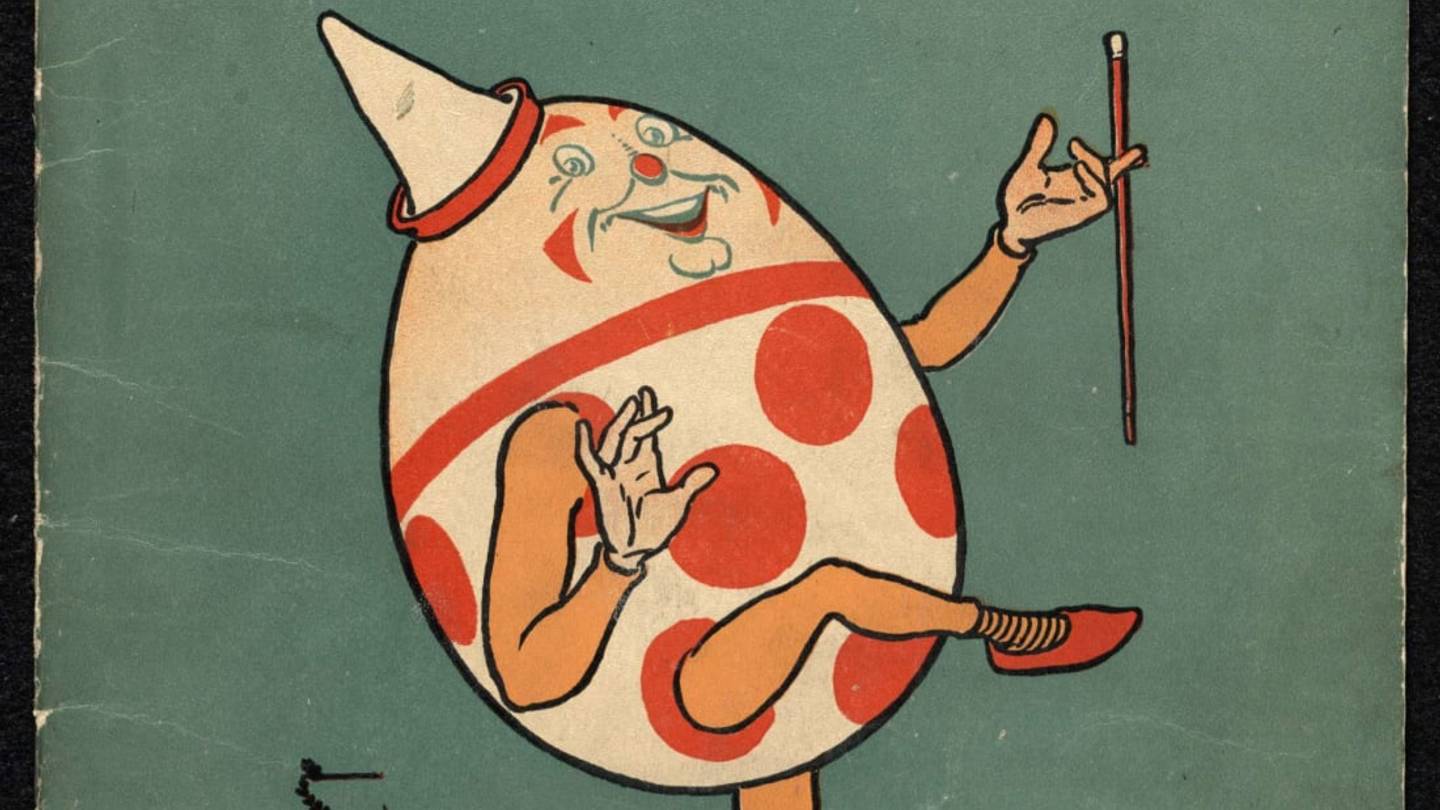
Humpty Dumpty is usually famous for one bad afternoon involving a wall. W. W. Denslow, however, gives the nursery rhyme character more personality and a fuller comic world. In Denslow’s Humpty Dumpty, the egg becomes a character with worries, charm, and a surprisingly dramatic sense of self-preservation.
Denslow’s importance to children’s literature is enormous, partly because he also illustrated The Wonderful Wizard of Oz. His bold, theatrical style gives Humpty Dumpty a stage presence that turns a short rhyme into a visual adventure. The book also shows how publishers expanded familiar nursery material into new formats. A few lines of rhyme could become a whole picture book if the illustrator had enough imaginationand apparently enough sympathy for anxious eggs.
8. The Wonderful Wizard of Oz by L. Frank Baum; illustrated by W. W. Denslow (1900)
The Wonderful Wizard of Oz is the most famous title on this list, but fame does not make it less rare in its early forms. Published in 1900, Baum’s fantasy introduced Dorothy, the Scarecrow, the Tin Woodman, the Cowardly Lion, and a uniquely American dreamscape that would echo through books, theater, film, and popular culture.
The Library of Congress copy is important not only for the story but also for the physical and artistic history of the book. Denslow’s illustrations helped establish Oz as a visual world before the 1939 film fixed its imagery in the public imagination. The original book is stranger, brighter, and more episodic than many modern readers expect. It feels like a road trip through American fairyland, with danger, jokes, color, and enough suspicious authority figures to keep everyone alert.
9. The Slant Book by Peter Newell (1910)
Peter Newell’s The Slant Book is a masterpiece of format-as-storytelling. The book is shaped like a parallelogram, and the physical slant of the pages reinforces the plot: a child in a runaway go-cart rolls downhill through a series of comic disasters. The design is not a gimmick pasted onto the story; it is the story.
This is why rare children’s books are so exciting to study. They often experiment with reading as a physical act. You do not simply read The Slant Book; you feel its tilted logic. The page itself seems to slide. The format makes gravity visible. Modern interactive books, pop-ups, and app-based stories have ancestors in works like this, where paper engineering and comic timing joined forces to create chaos in the safest possible way.
10. Gobolinks, or Shadow-Pictures for Young and Old by Ruth McEnery Stuart and Albert Bigelow Paine (1896)
Gobolinks may be the weirdest delight on this list. It presents inkblot images paired with verses that imagine creatures, characters, and scenes inside the accidental shapes. Long before inkblots became widely associated with psychology, this book treated blot-making as a game of imagination.
The brilliance of Gobolinks is that it invites readers to become creators. A blot is not just a blot. It might be a goblin, a wolf, a dancer, a monster, or something nobody has named yet because everyone is too busy backing away slowly. The book encourages children and adults to look at randomness and make meaning from it. That is a surprisingly sophisticated creative lesson: imagination is not always about inventing from nothing; sometimes it begins by noticing what a strange shape is trying to become.
11. A Little Pretty Pocket-Book by Isaiah Thomas (1787)
A Little Pretty Pocket-Book is one of the landmark works in the history of children’s publishing. Isaiah Thomas’s 1787 Worcester edition reprinted a work first associated with John Newbery’s 1744 London publication. It was designed for “instruction and amusement,” a phrase that neatly captures the emerging idea that children’s books could teach while also entertaining.
The book includes alphabet material, rhymes, moral instruction, and references to play. Its marketing famously connected reading with objects such as a ball or pincushion, reminding us that early children’s books were often sold as part lesson, part gift, and part behavior-management technology. Today, it is easy to smile at its old-fashioned tone, but its central insight still feels modern: children learn better when reading feels like discovery rather than punishment.
What These Books Reveal About Childhood, Art, and Reading
Read together, these 11 rare children’s books from the Library of Congress show that children’s literature has never been one simple thing. It has been moral training, religious instruction, entertainment, visual art, commercial product, family ritual, classroom tool, and imaginative playground. The books also show how quickly publishers learned that children respond to rhythm, repetition, pictures, novelty, humor, and touch.
Some of the books feel surprisingly modern. The Slant Book plays with format in a way that resembles interactive design. Gobolinks encourages creative participation. A Apple Pie uses food, action, and humor to teach letters. Others feel distant because their moral lessons, religious emphasis, or social assumptions reflect older worlds. That distance is part of their value. Rare books do not simply tell us what children read; they tell us what childhood was imagined to be.
A Reader’s Experience: Browsing These Rare Children’s Books Today
Exploring rare children’s books from the Library of Congress feels different from reading a modern picture book on a couch. A modern book usually asks you to enter the story. A rare book asks you to enter the story, the printing shop, the classroom, the nursery, the parlor, and the mind of a long-ago adult who was absolutely certain that children needed both entertainment and a firm moral spine.
The first experience is visual. The colors, typefaces, borders, ornaments, and page layouts immediately announce that these books come from another era. Some illustrations are delicate and graceful; others are bold, strange, or unintentionally funny. You begin noticing how much information is carried by the design. A crooked page shape, a woodcut dove, a circus elephant, or a blot of ink can tell you what the publisher thought would capture a child’s attention.
The second experience is emotional. There is something moving about seeing books that were made for hands much smaller than ours, more than a century ago. Children may have turned these pages with jammy fingers, read them aloud by lamplight, received them as gifts, or studied them in schoolrooms where silence was expected and fidgeting was probably considered a character flaw. The survival of such books feels almost miraculous. Children’s books are not always treated gently. They are loved hard, dropped, bent, scribbled in, chewed by toddlers, and sometimes defeated by applesauce. When one survives long enough to be preserved, digitized, and read again, it becomes a tiny time machine.
The third experience is intellectual. These books challenge the idea that old children’s literature was simple. Many of these works are formally inventive. The Slant Book uses shape as narrative. Gobolinks turns chance into creativity. A Curious Hieroglyphick Bible blends reading with image decoding. The Baby’s Own Aesop compresses ancient moral tales into rhyme and design. Even the humble alphabet book becomes a miniature drama when the alphabet attacks a pie one letter at a time.
The final experience is personal. Reading these books makes you remember that childhood has always involved a negotiation between rules and wonder. Adults create lessons; children find the fun. Adults print morals; children notice the elephant, the monster, the runaway cart, the glowing castle, or the egg with anxiety issues. That is the lasting charm of these rare children’s books from the Library of Congress. They preserve the serious hopes of past generations, but they also preserve the unruly sparkle of childhood itself. The pages may be old, but the impulse behind them remains fresh: give a child a book, and the world gets bigger.