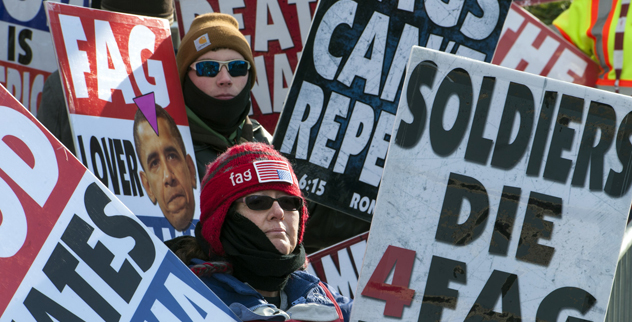
Few organizations have generated as much outrage with as few actual members as the Westboro Baptist Church. Based in Topeka, Kansas, this tiny congregation became internationally notorious through fluorescent protest signs, attacks on grieving families, and rhetoric directed at LGBTQ+ people, Jewish communities, military personnel, celebrities, and nearly anyone else unfortunate enough to appear on the evening news.
By “insane,” we mean astonishingly extremenot a medical diagnosis. Westboro’s story is disturbing precisely because its rise did not depend on millions of followers, sophisticated technology, or a secret underground headquarters with a dramatic swivel chair. It depended on a closely connected family, an instinct for publicity, and a willingness to say things most people would not whisper into an empty refrigerator.
The Southern Poverty Law Center and Anti-Defamation League classify Westboro as a hate group, while mainstream Baptist organizations have repeatedly emphasized that it is not affiliated with them. Its history also produced a landmark Supreme Court decision, new funeral-protest laws, nationwide counterdemonstrations, and several remarkable stories of people escaping an insular ideology.
1. The Church Was Founded in 1955but It Is Not Part of a Major Baptist Denomination
Westboro Baptist Church was founded in Topeka in 1955 under the leadership of Fred Phelps. Although its name includes the word “Baptist,” the group is independent and has no official relationship with major Baptist bodies such as the Southern Baptist Convention or Baptist World Alliance.
That distinction matters because the name has frequently caused casual observers to assume that Westboro represents a large branch of American Christianity. It does not. Mainstream Christian leaders, including conservative Baptist figures, have condemned both its theology and its tactics.
The organization has described itself as an “Old School” or Primitive Baptist church, but its theology, family-centered leadership, and confrontational activism developed largely in isolation. In other words, it borrowed a recognizable label while operating as its own highly unusual religious islandan island where every welcome sign appears to have been replaced with an insult.
2. It Became Famous Despite Having a Remarkably Small Membership
At the height of its national notoriety, Westboro was commonly described as having only several dozen members. Most were related to Fred Phelps by blood or marriage. This was less a conventional congregation than an extended family organization with a church building, a legal strategy, and an alarming quantity of poster board.
Its small size made its influence even more surprising. Larger religious institutions spend millions of dollars trying to attract national attention. Westboro often achieved the same result by sending a handful of people to a highly emotional event and waiting for television cameras to arrive.
The family structure also reinforced the group’s internal control. Children grew up surrounded by the same teachings, participated in demonstrations from an early age, and faced the possibility of losing contact with relatives if they eventually left. Researchers and former members have therefore described Westboro as more than a church: it functioned as an insular social system in which family, faith, work, and activism were tightly intertwined.
3. Fred Phelps Once Worked as a Civil Rights Attorney
One of the strangest contradictions in Westboro’s history is that Fred Phelps once represented Black clients in civil rights and discrimination cases. During the 1960s and 1970s, when many attorneys avoided such work, Phelps took cases challenging racial discrimination in Kansas.
This history has occasionally been presented as evidence that he once held broadly progressive beliefs. The reality appears more complicated. Civil rights law was part of his professional career, but it did not prevent him from developing an organization built around attacks on other minority groups.
Phelps was permanently disbarred by the Kansas Supreme Court in 1979 following professional misconduct connected to his treatment of a court reporter. He later stopped practicing in federal court as well. The legal background did not disappear, however. Several of his children became attorneys, and the family’s understanding of protest regulations helped Westboro stage demonstrations that were offensive but usually remained just inside legal boundaries. Hate, apparently, sometimes arrives after carefully reviewing the municipal code.
4. Its Modern Protest Campaign Began in a Topeka Park
Westboro existed for decades before becoming a national symbol of anti-LGBTQ+ extremism. Its modern protest campaign began in the early 1990s with demonstrations at Gage Park in Topeka.
Fred Phelps claimed that one of his grandsons had been approached by a man in the park. Westboro responded with what it called the Great Gage Park Decency Drive, holding repeated protests and accusing city officials of tolerating homosexual activity.
The campaign quickly expanded beyond the park. Westboro began targeting local churches, politicians, businesses, journalists, and residents who criticized it. This established a pattern that would define the organization for decades: announce a provocative accusation, condemn anyone who objected, and treat the resulting backlash as proof of persecution.
It was a remarkably efficient outrage machine. Every protest produced opponents; every opponent became a new target; every new target created another opportunity for publicity. It was the ideological equivalent of a smoke alarm that responded to smoke by setting another room on fire.
5. The Funeral of Matthew Shepard Brought Westboro National Attention
Westboro had already been demonstrating for years when it appeared outside the 1998 funeral of Matthew Shepard, a gay University of Wyoming student who was brutally attacked and later died. The murder became a defining moment in the national conversation about anti-gay violence.
Westboro members used Shepard’s funeral and the trials of his killers to promote their anti-LGBTQ+ message. Images of the group’s signs reached audiences across the United States, transforming a relatively obscure Kansas congregation into a national symbol of cruelty.
The demonstrations also inspired one of the most memorable forms of peaceful counterprotest. At later events connected with Shepard, participants dressed as angels and used large white wings to shield mourners from Westboro’s signs. Rather than matching hostility with hostility, they turned fabric, wire, and basic human decency into a visual barrier.
Westboro discovered that funerals guaranteed attention because journalists were already present and emotions were already intense. That discovery shaped many of its future campaigns.
6. The Group Expanded From Anti-LGBTQ+ Protests to Military Funerals
Beginning in 2005, Westboro started protesting funerals of American service members. Its members claimed that military deaths represented divine punishment for the United States accepting homosexuality.
The fallen soldiers did not need to be gay, support LGBTQ+ rights, or have any connection to the group’s stated grievances. Their funerals were selected because they symbolized the country and attracted media coverage. The mourners were essentially used as unwilling props in Westboro’s larger argument against American society.
The campaign created outrage across political, religious, and ideological lines. Veterans’ groups, lawmakers, civil-liberties advocates, military families, and ordinary residents debated how to protect mourners without violating the First Amendment.
Westboro members generally stood on public property, followed police instructions, and kept a legally required distance from funeral services. This discipline was intentional. The signs appeared chaotic, but the operation behind them often involved detailed planning.
7. Westboro Won a Landmark Supreme Court Case by an 8–1 Vote
In 2006, members of Westboro picketed near the funeral of Marine Lance Corporal Matthew Snyder, who had died while serving in Iraq. His father, Albert Snyder, sued the church for claims including intentional infliction of emotional distress.
A jury initially awarded Snyder millions of dollars. The judgment was later reduced, and an appeals court overturned it. The dispute eventually reached the U.S. Supreme Court as Snyder v. Phelps.
In 2011, the Court ruled 8–1 in favor of Westboro. The majority concluded that the protest involved matters of public concern, occurred on public land, followed police directions, and was therefore protected by the First Amendment. The ruling did not endorse Westboro’s message. It held that the government generally cannot punish public speech simply because that speech causes severe pain or inspires widespread contempt.
Justice Samuel Alito was the lone dissenter, arguing that the First Amendment should not provide a license for a targeted verbal assault on a grieving private individual. The case remains a powerfuland deeply uncomfortablelesson in how constitutional protections can apply to speakers almost everyone despises.
8. Its Protests Helped Produce New Funeral-Protection Laws
Although the Supreme Court protected Westboro from liability in the Snyder case, lawmakers could still create reasonable rules governing when and where demonstrations occurred.
In 2006, President George W. Bush signed the Respect for America’s Fallen Heroes Act. The federal law restricted certain demonstrations near cemeteries controlled by the National Cemetery Administration. Numerous states adopted their own funeral-protest regulations, typically using distance and time limits rather than banning a particular viewpoint.
This distinction is essential. A law saying “Westboro may not speak” would face an enormous constitutional problem. A content-neutral rule saying “all demonstrators must remain a specified distance from a funeral during a defined period” has a stronger legal foundation.
The result was a very American compromise: the group could continue speaking, the public could continue condemning it, and mourners could receive at least some physical separation from the spectacle. Nobody was completely satisfied, which is often how one recognizes that constitutional law has entered the room.
9. Counterprotesters Often Overwhelmed Westboro With Flags, Humor, and Music
Westboro’s demonstrations repeatedly generated responses far larger than the original protest. The Patriot Guard Riders, a motorcycle organization formed during the era of military-funeral protests, positioned volunteers between Westboro members and grieving families. Riders used American flags, physical screening, and sometimes the sound of motorcycle engines to reduce the protesters’ impact.
Other communities responded with humor. Counterprotesters carried parody signs, organized charity drives, dressed in costumes, or pledged donations to LGBTQ+ organizations for every minute Westboro remained present. The approach transformed the group’s publicity stunt into a fundraiser for the very people it opposed.
Musicians also joined the action. When Westboro targeted entertainment events, performers and fans sometimes staged spontaneous concerts or dance parties nearby. The strategy was simple: do not let a handful of fluorescent signs control the emotional atmosphere.
These responses exposed a weakness in Westboro’s publicity model. Outrage gave it attention, but creative counterprotests could redirect that attention toward solidarity, charity, or sheer ridiculousness. It is difficult to dominate a news cycle when the opposing side arrives with 500 flags, a brass band, and better punch lines.
10. Social Media Helped Spread Westboro’s Messageand Helped a Prominent Member Escape It
Megan Phelps-Roper, one of Fred Phelps’s granddaughters, became a highly visible spokesperson for Westboro. In 2009, she began using Twitter to promote the church’s ideology and debate its critics.
That online engagement had an unexpected result. Some users challenged her beliefs without treating her as less than human. Over time, patient conversations, questions she could not easily answer, and contradictions within church leadership weakened her certainty.
In 2012, Megan and her sister Grace left Westboro. Because the group demanded separation from former members, leaving also meant losing close relationships with much of their family. Megan later publicly apologized for the harm she had caused and wrote about her transformation.
Her experience does not provide a magical formula for deradicalization. Plenty of online arguments merely produce creative new ways to misspell insults. Nevertheless, her story demonstrates that curiosity, sustained contact, and respectful disagreement can sometimes reach people who have been trained to view the outside world as uniformly evil.
The same platform Westboro hoped would amplify its message instead exposed one of its future leaders to perspectives that helped her walk away.
What It Can Feel Like When Westboro Comes to Town
The following account is a composite based on documented community responses, not a claim of personal eyewitness experience.
Imagine learning that Westboro Baptist Church plans to appear at an event in your town. Perhaps it is a soldier’s funeral, a high school, a concert, a memorial, or a religious service. At first, the announcement sounds almost unreal. The organization may be sending only five or six people, yet local officials, reporters, community groups, and hundreds of residents suddenly begin preparing for them.
The first instinct is often anger. People want to confront the protesters, shout them down, or demand that authorities stop them from appearing. Then the practical questions begin. Where will the group be allowed to stand? How far is that location from the entrance? Can mourners arrive through another route? Will cameras accidentally give the protesters exactly the publicity they are seeking?
Police establish separate areas. Volunteers unfold enormous flags. Clergy members, veterans, LGBTQ+ advocates, students, parents, and neighbors arrive with handmade signs. Some messages are solemn: “Love Wins” or “We Stand With the Family.” Others are intentionally absurd. Humor offers emotional distance from rhetoric designed to shock.
When the Westboro members finally arrive, their physical presence may seem strangely small compared with the machinery their announcement created. A few people hold brightly colored signs while a much larger crowd forms across the street. News crews point their cameras. Officers watch the boundaries. Organizers remind counterprotesters not to cross the road or provide dramatic footage that can be edited into Westboro’s narrative of persecution.
For mourners, however, the event is not funny. Even when flags block the signs and engines cover the chanting, knowing that strangers selected a loved one’s funeral as a publicity opportunity can feel invasive. The legal right to protest does not erase the emotional harm. Constitutional protection and moral acceptability are two very different things.
Communities that handle these demonstrations effectively often focus on the people being targeted rather than the protesters. Volunteers escort families, collect money for charities, organize peaceful gatherings, and create physical barriers. The objective changes from “defeat Westboro in an argument” to “make Westboro irrelevant to the day.”
Afterward, the protesters leave, sometimes after less than an hour. What remains is not usually their message but the community’s response: photographs of hundreds of people standing together, donations made in a victim’s name, and stories about strangers protecting one another.
That may be the most important experience connected with Westboro Baptist Church. A tiny group can inflict real distress, but it can also unintentionally reveal how many people reject its worldview. The protesters arrive expecting to demonstrate divine anger. They frequently depart having demonstrated something elsethe ability of ordinary people to organize compassion on very short notice.
Conclusion: A Small Group With an Enormous Cultural Footprint
The history of Westboro Baptist Church is not simply a collection of offensive signs. It is a case study in media manipulation, family control, constitutional law, counterprotest, and the difficult process of leaving an extremist community.
Westboro turned a tiny congregation into a household name by attaching itself to tragedies that were already receiving public attention. Yet its campaigns also produced consequences it could not control: stronger community alliances, creative forms of peaceful resistance, legal protections for mourners, and public conversations about the limits of free speech.
The Supreme Court confirmed that even hateful public speech can receive constitutional protection. That ruling also leaves everyone else free to criticize it, counter it, mock it, block its signs with angel wings, or transform its appearance into a charity fundraiser.
Westboro’s greatest lesson may therefore be an accidental one. A society does not prove its strength by pretending hateful ideas do not exist. It proves its strength by protecting lawful expression while refusing to let cruelty define the community’s response.