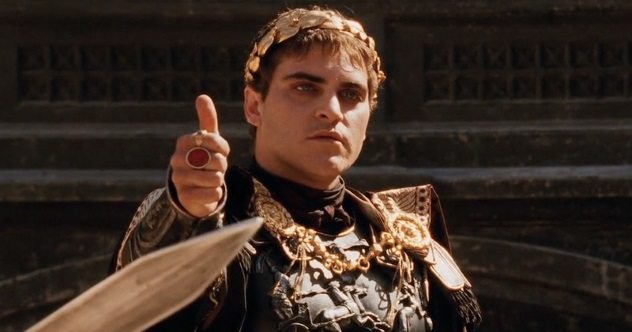
Emperor Commodus is remembered by many movie fans as the sneering villain of Gladiator, the jealous son who murders Marcus Aurelius, steals the throne, and spends the rest of the film being emotionally allergic to virtue. Joaquin Phoenix gave us a wonderfully creepy performance, but history, as usual, walked into the room wearing sandals and said, “Actually, it was weirder.”
The real Commodus ruled Rome from 180 to 192 CE, after serving as co-emperor with his father, Marcus Aurelius. He did not kill Marcus in a tent, Maximus Decimus Meridius was not a real Roman general, and the final duel in the Colosseum is dramatic fiction. Yet the historical Commodus did fight in the arena, styled himself as a living Hercules, renamed Rome after himself, terrified the Senate, and died in a palace conspiracy involving poison, panic, and a professional wrestler. Hollywood did not need to exaggerate much. In a few places, it actually toned him down.
So, grab your laurel wreath, check your toga for hidden daggers, and let’s explore ten insane facts about Emperor Commodus that Gladiator left out.
1. Commodus Was Born Into Power, Not Just Ambition
In Gladiator, Commodus is presented mainly as a power-hungry son desperate for his father’s approval. That part feels believable, but the historical situation was more complicated. Commodus was not some overlooked prince clawing his way toward the throne. He was groomed for imperial authority from a young age.
Born in 161 CE, Commodus was the biological son of Marcus Aurelius and Faustina the Younger. That mattered because the so-called “Five Good Emperors” before him had often relied on adoption to choose capable successors rather than simply passing power to a son. Commodus changed that pattern. He became Caesar as a child, co-Augustus with Marcus Aurelius in 177 CE, and sole emperor after his father’s death in 180 CE.
That means Commodus did not steal the throne in the simple movie-villain sense. Rome’s political system had already placed him in the imperial spotlight. The tragedy is not that an outsider seized power. The tragedy is that the empire had every warning sign and still handed him the keys to the marble-coated supercar.
2. Marcus Aurelius Was Not Murdered by Commodus
One of the most memorable scenes in Gladiator shows Commodus suffocating Marcus Aurelius after learning that his father does not want him to rule. It is powerful cinema. It is also not what historians generally believe happened.
Marcus Aurelius died in 180 CE while on campaign near the northern frontier, likely from illness. Ancient sources do not support the movie’s dramatic murder scene. Commodus was already recognized as his successor, and he became sole emperor after Marcus died. The film needed a personal betrayal to launch its revenge story, but real Roman politics were already messy enough without adding bedroom smothering to the itinerary.
This difference matters because it changes how we understand Commodus. He was not necessarily a throne-stealing usurper. He was a legitimate emperor who squandered legitimacy through vanity, paranoia, poor judgment, and an Olympic-level talent for making senators wish they had chosen a quieter career, like volcano inspection.
3. He Thought He Was Hercules Reborn
Gladiator hints at Commodus’ vanity, but it does not fully capture his religious self-branding campaign. Commodus did not merely admire heroes. He identified himself with Hercules, the mythic strongman famous for killing monsters, wearing a lion skin, and making every gym influencer look undercommitted.
Portraits and sculptures showed Commodus wearing Hercules’ lion skin and holding heroic symbols such as the club and the apples of the Hesperides. This was not casual cosplay. In Roman political culture, imagery mattered. Coins, statues, and titles were public messaging tools. Commodus used them to suggest that he was more than a ruler. He wanted Romans to see him as a divine protector and superhuman champion.
The famous bust of Commodus as Hercules captures this perfectly. It is technically impressive and psychologically loud. The emperor stares out with polished confidence, draped in mythological accessories, as if Rome had ordered a statesman and accidentally received a demigod with a branding consultant.
4. He Actually Fought as a Gladiator
The movie shows Commodus stepping into the arena for a final duel, but the real Commodus made arena performance part of his imperial identity. Roman elites considered gladiators socially low, even when crowds adored them. For an emperor to fight like one was scandalous. It was like seeing a modern head of state abandon a summit to enter a cage match, then billing the treasury for costume design.
Commodus appeared in gladiatorial contests dressed in the style of a fighter. Ancient writers say these bouts were staged, with opponents expected to submit. That does not mean there was no danger, but it does mean the emperor was not exactly entering fair combat. When the most powerful man in the known world asks you to lose gracefully, you do not reply, “Actually, Your Majesty, I’ve been working on my counterattack.”
He reportedly loved the applause and even accepted payment for his appearances, as if the emperor of Rome needed a side hustle. The result was a bizarre inversion of Roman dignity: the man who should have embodied imperial authority was chasing arena cheers like a celebrity doing increasingly questionable reality television.
5. His Animal Hunts Were Blood-Soaked Public Spectacles
Commodus did not limit himself to mock gladiator fights. He also performed in staged hunts, killing exotic animals in the arena. Ancient sources describe him shooting or spearing beasts from protected positions, turning imperial spectacle into a personal highlight reel.
Stories about Commodus’ animal kills include lions, panthers, ostriches, and other creatures brought into the arena for entertainment. Some accounts are probably exaggerated by hostile ancient writers, but the overall picture is clear: Commodus used the amphitheater to display himself as a superhuman hunter. He wanted the crowd to see Hercules in action. What they often saw was an emperor using state resources to turn wildlife into props.
The ostrich story is especially infamous. Cassius Dio claims Commodus decapitated an ostrich and then gestured toward the senators with the bird’s head, implying that they could be next. Whether the scene happened exactly that way or was sharpened by senatorial gossip, it captures the atmosphere of the reign: fear wearing feathers.
6. He Renamed Rome After Himself
When Rome suffered major fire damage during Commodus’ reign, the emperor saw an opportunity. A practical ruler might have focused on reconstruction, emergency relief, and public confidence. Commodus decided the city needed something else: more Commodus.
He renamed Rome Colonia Lucia Annia Commodiana, presenting himself as a new founder of the city. He also renamed institutions and even months of the year after his own titles. This was not modest imperial commemoration. This was a branding takeover so complete that even a modern marketing agency would whisper, “Maybe dial it back.”
The symbolism was enormous. Rome was not just a city; it was the sacred center of Roman identity. By renaming it after himself, Commodus placed his ego over centuries of tradition. He wanted to be remembered not merely as one emperor in a long line, but as the man who remade Rome in his own image. Unfortunately for him, the Senate later worked very hard to undo that image.
7. He Renamed the Months Too
Yes, Commodus also went after the calendar. The months were reportedly renamed to match his many names and titles, including references to Commodus, Augustus, Hercules, Invictus, Felix, and other self-glorifying labels. Imagine waking up and being told that October is now “Commodus Month,” and December has been replaced by “Please Clap for the Emperor.”
Roman rulers often used titles and ceremonies to reinforce authority, but Commodus pushed symbolic politics into absurd territory. Renaming months was a way of making daily life revolve around him. Every date became a reminder of imperial self-worship.
This is one of the reasons Commodus remains such a fascinating figure for historians and SEO readers alike. He was not just cruel or irresponsible. He understood performance. He turned government into theater, religion into personal publicity, and time itself into a fan club newsletter.
8. His Reign Was Run by Favorites and Power Brokers
Gladiator focuses on Commodus as a personal tyrant, but the machinery of his rule depended heavily on palace favorites, chamberlains, and praetorian officials. Commodus often preferred pleasure, performance, and spectacle to the daily grind of administration. Into that gap stepped powerful figures such as Saoterus, Perennis, and Cleander.
This created instability. When emperors delegate responsibly, government can function. When they delegate recklessly to favorites who gain too much influence, the palace becomes a shark tank with better furniture. Officials rose and fell, conspiracies multiplied, and the emperor grew more suspicious.
Cleander’s career is especially notorious. He accumulated enormous power and was accused of selling offices. During a food shortage, public anger turned against him. Commodus eventually had him executed, which was a very Roman way of saying, “The customer service department has reviewed your complaint.”
9. His Own Sister Was Linked to a Plot Against Him
Commodus’ sister Lucilla appears in Gladiator as a sympathetic figure caught between family, politics, and survival. The real Lucilla was also part of a dangerous imperial drama. In 182 CE, she was implicated in a conspiracy against Commodus.
The plot failed, and its consequences were severe. Commodus became more distrustful of the Senate and aristocracy. Executions and purges followed. From that point, his reign grew darker and more paranoid. The emperor who already loved applause became increasingly convinced that elite Rome was plotting against himwhich, to be fair, some of elite Rome was.
This is where Commodus’ story becomes more than a collection of eccentric facts. His rule shows how fear corrodes political systems. The more he suspected betrayal, the more brutally he acted. The more brutally he acted, the more people wanted him gone. It was a feedback loop with swords.
10. His Death Involved Poison, Vomiting, and a Wrestler
Gladiator gives Commodus a cinematic death in the arena. The real ending was less noble and much stranger. By late 192 CE, Commodus had reportedly planned to appear as both consul and gladiator at the start of the new year. Key people around him feared for their lives, including his mistress Marcia, the praetorian prefect Laetus, and the chamberlain Eclectus.
According to ancient accounts, the conspirators first tried poison. Commodus vomited it up. Since Plan A had failed in the most inconveniently biological way possible, they turned to Plan B: Narcissus, a wrestler, was sent to strangle him. Commodus died on December 31, 192 CE.
His assassination ended the Nerva-Antonine dynasty and helped trigger the chaotic Year of the Five Emperors. The Senate condemned his memory, reversed many of his symbolic changes, and tried to erase his honors. Later, Septimius Severus rehabilitated him for political reasons. In Roman history, even disgrace could be recycled if it helped the next guy look legitimate.
Why "Gladiator" Left So Much Out
Movies need emotional clarity. Gladiator turns Commodus into a concentrated villain: jealous son, false emperor, cowardly manipulator. That works for storytelling. The real Commodus, however, was not just a villain in a black cloak. He was a living case study in imperial narcissism, political decay, public spectacle, and the danger of confusing applause with legitimacy.
Some details were probably left out because they would have made the film feel unbelievable. A ruler renaming Rome after himself? A calendar full of Commodus titles? An emperor dressed as Hercules, killing animals from a platform and accepting gladiator fees? Audiences might have accused the screenwriters of going too far. History, as usual, was sitting in the back row eating olives and saying, “No, that part happened.”
Was Commodus Really the Worst Roman Emperor?
Calling Commodus the “worst” Roman emperor is tempting, but history is crowded with applicants for that unpleasant trophy. Caligula, Nero, Domitian, Caracalla, and Elagabalus all have their supporters in the Worst Emperor Olympics. Commodus stands out because his reign followed Marcus Aurelius, one of Rome’s most admired rulers. The contrast was brutal.
It is also worth remembering that many ancient sources were written by elite authors who disliked emperors who humiliated the Senate. Commodus may have remained popular with some soldiers and common spectators because he staged lavish games and public entertainments. But popularity is not the same as good governance. Bread and circuses can fill seats while institutions rot underneath.
The fairest assessment is that Commodus was not merely “crazy,” a label often thrown around too lazily in popular history. He was theatrical, insecure, violent, self-obsessed, and politically reckless. His reign exposed weaknesses in Rome’s imperial system: succession by blood could fail, court favorites could dominate policy, and public spectacle could distract from administrative collapseat least until the bill arrived.
Experiences and Reflections: What Commodus Teaches Modern Readers
Reading about Commodus today is an oddly familiar experience. No, most of us do not know anyone who has renamed a capital city after himself while dressed as Hercules. If you do, please leave that group chat immediately. But the patterns behind Commodus’ behavior still feel recognizable.
First, Commodus shows the danger of inherited power without earned discipline. He was born near the center of the Roman world and raised for command, but preparation is not the same as wisdom. In modern life, this applies far beyond politics. A person can inherit a company, a platform, a title, or a reputation and still lack the patience to manage it well. Commodus had the empire; what he lacked was self-command.
Second, his story is a warning about performance replacing substance. Commodus loved the arena because the arena gave immediate feedback. The crowd cheered, the animals fell, the emperor felt heroic. Governing, by contrast, is slow, boring, and full of paperworkthe ancient equivalent of answering emails with a stylus. Many leaders, creators, and professionals face a similar temptation today. Public attention feels rewarding. Quiet responsibility feels invisible. Commodus chose the spotlight so often that the machinery behind the curtain began to smoke.
Third, Commodus reminds us that branding cannot rescue bad judgment. He could call himself Hercules Romanus, rename Rome, redesign the calendar, and commission heroic images. None of that made him a better ruler. The lesson is simple: you can polish the statue, but if the foundation is cracked, people will eventually notice. Modern personal branding works the same way. A powerful image may attract attention, but character decides whether attention becomes trust.
Fourth, his reign shows how fear damages decision-making. After conspiracies and assassination attempts, Commodus became more suspicious and punitive. That suspicion encouraged more plots, which encouraged more brutality. In workplaces, families, governments, and online communities, fear creates the same spiral. When people cannot speak honestly, problems go underground. When problems go underground, they grow teeth.
Finally, Commodus teaches us why history is often stranger than fiction. Gladiator gave audiences a clean story: noble general versus corrupt emperor. The real story is messier and more useful. Commodus was not just a bad man doing bad things. He was a ruler shaped by privilege, insecurity, propaganda, entertainment culture, court politics, and public expectation. That complexity makes him more disturbing, not less.
For anyone writing, teaching, or simply enjoying Roman history, Commodus is a reminder to look beyond the movie version. The real emperor was not defeated by a fictional hero named Maximus. He was defeated by the consequences of his own rule. His ego became policy. His fantasies became public ceremonies. His paranoia became danger to the people closest to him. In the end, the man who wanted to be Hercules was killed not by a mythic monster, but by palace insiders who had decided that Rome had endured enough of the show.
Conclusion
Emperor Commodus remains one of ancient Rome’s most unforgettable rulers because his life reads like political history written by a satirist. Gladiator captured his insecurity, cruelty, and hunger for admiration, but it left out some of the wildest historical details: the Hercules obsession, the staged gladiator career, the animal spectacles, the renamed months, the rebranded city, the palace favorites, the family conspiracy, and the wrestler-assisted assassination.
The real Commodus was not simply a movie villain. He was a warning wrapped in purple cloth. His reign shows what can happen when supreme power meets bottomless vanity, when spectacle replaces service, and when an emperor decides that ruling the world is less exciting than starring in his own mythological action franchise. Rome survived Commodus, but it did not forget him. Neither have we.
Note: This article is written for web publication in standard American English, based on reputable historical references, museum materials, and ancient-source summaries. It avoids copied wording, unnecessary source-code artifacts, and AI-style reference placeholders.