Note: This article is written for web publication in standard American English and is based on real underwater archaeology, cultural heritage, and historical research. Source links are intentionally omitted from the article body for clean publishing.
When History Goes for a Swim
Some ruins sit on hilltops, looking dramatic at sunset. Others hide under jungles, waiting for explorers with machetes and excellent mosquito tolerance. And then there are submerged ruinsthe historical overachievers that decided ordinary archaeology was too dry.
Across the world, ancient cities, sacred settlements, ports, temples, villas, and entire neighborhoods rest beneath seas, lakes, and harbors. Some sank slowly as shorelines changed. Others vanished in earthquakes, tsunamis, volcanic movement, or modern dam projects. A few were rediscovered only after divers, sonar specialists, or local fishermen noticed that the seafloor looked suspiciously like a street plan.
These incredible submerged ruins are more than spooky travel-list material. They show how humans lived with water, traded across oceans, built ports, worshiped gods, enjoyed luxury, survived disasters, and occasionally made extremely questionable real estate decisions next to unstable coastlines. Below are ten of the most fascinating underwater archaeological sites and sunken cities ever documented.
1. Pavlopetri, Greece: The Oldest Planned City Underwater
Pavlopetri, off the coast of Laconia in southern Greece, is often described as one of the oldest known submerged cities in the world. Unlike a random pile of stones that requires a generous imagination, Pavlopetri still shows an actual town plan: streets, buildings, courtyards, tombs, and traces of everyday urban life.
The site dates back thousands of years, with occupation commonly associated with the Bronze Age and earlier activity. What makes Pavlopetri so special is not just its age, but its completeness. It gives researchers a rare underwater snapshot of a coastal community connected to trade, domestic life, and possibly textile production. Large storage jars and pottery fragments suggest it was not some sleepy seaside village. It was a working town with economic muscle.
The likely causes of its submergence include earthquakes, sea-level change, and coastal instability. Today, the site is shallow enough that snorkelers can appreciate the ghostly outlines below, though protection remains essential. Anchors, looting, pollution, and careless tourism can damage what the sea has preserved for millennia. History may be underwater, but it is not invincible.
2. Thonis-Heracleion, Egypt: The Lost Gateway to the Nile
Before Alexandria became Egypt’s Mediterranean superstar, Thonis-Heracleion was a powerful port city near the mouth of the Nile. To the Greeks it was Heracleion; to the Egyptians it was Thonis. Either way, it was a big deal. Ships entered Egypt through its harbors, goods moved through its canals, and temples anchored its religious life.
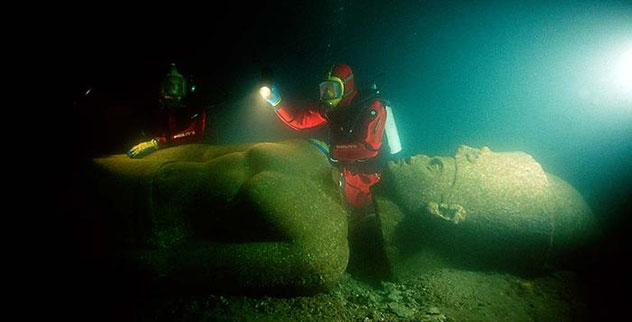
For centuries, the city was known mostly from ancient texts. Then underwater archaeologist Franck Goddio and his team located its remains in Aboukir Bay after careful surveys using advanced geophysical tools. What emerged from the mud and sediment was astonishing: colossal statues, temples, anchors, shipwrecks, inscriptions, ritual objects, and evidence of a bustling harbor system.
Thonis-Heracleion seems to have been especially vulnerable because it was built on unstable ground in a watery delta environment. Earthquakes, rising seas, flooding, and soil liquefaction likely contributed to its collapse. The result is one of the greatest submerged ruins on Earth: not a mythic Atlantis, but a real Egyptian port where trade, politics, religion, and geology collided spectacularly.
3. Port Royal, Jamaica: The Pirate City That Sank in Minutes
Port Royal was once one of the richest and rowdiest cities in the Caribbean. In the 17th century, it was a British colonial port, a privateering hub, and a place with enough taverns, gambling, and scandal to make even modern reality television look shy. It earned the nickname “the wickedest city on Earth,” which is not exactly something a tourism board would print on tote bags today.
On June 7, 1692, disaster struck. A massive earthquake and tsunami caused much of the city to slide into the sea. Buildings, streets, ships, household goods, and personal objects sank with terrifying speed. Because portions of the town were sealed underwater, Port Royal became a rare time capsule of 17th-century colonial life.
Archaeological work has uncovered artifacts that reveal details of trade, food, architecture, slavery, privateering, and daily routines. A stopped pocket watch famously helped reinforce the moment of catastrophe. Port Royal is incredible because it is not just a pirate story. It is a preserved urban disaster site, showing how wealth, empire, violence, and nature met in one unforgettable collapse.
4. Atlit-Yam, Israel: A Neolithic Village Beneath the Mediterranean
Atlit-Yam, off the coast near Haifa, is one of the most important submerged prehistoric settlements ever found. This was not a marble-column city of kings and emperors. It was something older and, in many ways, more intimate: a Neolithic village where people farmed, fished, raised animals, dug wells, buried their dead, and lived close to a changing shoreline.
The site dates to roughly 9,000 years ago. Archaeologists have documented stone-lined wells, human burials, flint tools, animal remains, and a striking arrangement of upright stones near what was once a freshwater source. That combination makes Atlit-Yam especially valuable for studying early agriculture, coastal adaptation, and the relationship between people and rising post-glacial seas.
Its submergence reminds us that climate and shoreline movement are not new forces in human history. Ancient communities also had to deal with changing coastlines, though without satellite forecasting, climate models, or the luxury of blaming the group chat for poor planning. Atlit-Yam is a quiet, profound reminder that civilization has always lived at the edge of water.
5. Baiae, Italy: Rome’s Underwater Luxury Resort
Baiae was the glamorous spa town of ancient Rome, located near Naples in the volcanic region of the Phlegraean Fields. If ancient Rome had invented celebrity gossip magazines, Baiae would have been on every cover. Julius Caesar, Nero, and other elites were connected to the area, which was famous for thermal baths, villas, mosaics, pleasure grottos, and the kind of luxurious behavior historians describe with raised eyebrows.
Unlike cities destroyed in one dramatic event, Baiae sank gradually because of bradyseism, a geological process in which land rises and falls due to volcanic activity. Over time, parts of the Roman resort slipped below the Gulf of Pozzuoli. Today, visitors can see underwater mosaics, statues, roads, villa remains, and architectural fragments in the Submerged Archaeological Park of Baiae.
Baiae is remarkable because it feels almost modern in spirit. It was a resort town built for relaxation, spectacle, and social status. The ruins now sit underwater with fish drifting across marble floors, as if the Roman elite finally got the infinity pool they were always trying to invent.
6. Alexandria’s Royal Quarter, Egypt: Cleopatra’s Submerged World
Ancient Alexandria was one of the most magnificent cities of the Mediterranean world. Founded by Alexander the Great, it became a capital of learning, politics, trade, and royal drama. Parts of its ancient harbor and royal quarter, including the island of Antirhodos, eventually sank beneath the waters after centuries of earthquakes, subsidence, and coastal change.
Underwater archaeology has revealed statues, sphinxes, columns, temple remains, palace-area structures, and harbor installations. These discoveries are often associated with the Ptolemaic period and the world of Cleopatra VII, although responsible archaeology separates romance from evidence. Not every stone underwater personally belonged to Cleopatra, no matter how badly documentary narrators want it to.
The submerged ruins of Alexandria are incredible because they connect written history with physical remains. The city was described by ancient writers as dazzling, cosmopolitan, and powerful. Beneath today’s harbor, archaeologists continue to recover fragments of that world. Every statue and block helps reconstruct a city where Egyptian, Greek, Roman, and Mediterranean cultures met in spectacular fashion.
7. Dwarka and Bet Dwarka, India: Where Myth Meets Marine Archaeology
Dwarka, on India’s western coast in Gujarat, is one of the most culturally charged underwater archaeology locations in the world. In Hindu tradition, Dwarka is associated with Lord Krishna, which has made offshore discoveries in the region especially fascinating to the public. Archaeology, however, works best when excitement wears a life jacket and brings evidence.
Underwater and coastal explorations around Dwarka and Bet Dwarka have documented stone anchors, submerged structural remains, architectural fragments, pottery, beads, metal objects, and signs of maritime activity. These findings support the importance of the region as an ancient coastal and trading zone. They do not prove every legendary detail, but they do show that the area has deep historical significance.
The beauty of Dwarka as a submerged ruins story is its layered identity. It is a sacred landscape, a living pilgrimage center, a coastal archaeological puzzle, and a reminder that myth and history often share the same shoreline. The best approach is neither blind skepticism nor wild exaggeration. It is curiosity with a measuring tape.
8. Mahabalipuram, India: The Seven Pagodas Beneath the Surf
Mahabalipuram, also known as Mamallapuram, sits on the coast of Tamil Nadu and is famous for its shore temples, rock-cut monuments, and Pallava-era artistry. For generations, local tradition spoke of the “Seven Pagodas,” suggesting that more temples once stood along the coast than are visible today.
Underwater investigations near the Shore Temple area have recorded submerged features, stone blocks, angular cuts, and structural anomalies in shallow water. Archaeologists have approached the site carefully because coastal geology, erosion, and human construction can be tricky to interpret underwater. Still, the remains strongly suggest that the coastline around Mahabalipuram has changed significantly over time and that parts of the ancient cultural landscape may now lie below the waves.
What makes Mahabalipuram compelling is the way folklore, architecture, coastal science, and underwater survey overlap. The sea here is not just scenery; it is part of the archive. Every stone under the surf adds another sentence to the long story of South India’s maritime heritage.
9. Shi Cheng, China: The Lion City Under Qiandao Lake
Shi Cheng, or Lion City, is different from many other submerged ruins because it did not sink in ancient times. It was intentionally flooded in 1959 during the creation of Qiandao Lake for the Xin’an River hydroelectric project. The result is haunting: an old Chinese city preserved under freshwater, with gates, archways, carved stonework, streets, and architectural details still visible in the cold darkness.
The city is often associated with imperial Chinese urban history and is admired for its remarkably preserved carvings of dragons, lions, and phoenixes. Because the lake water protects the ruins from wind, sun, and many forms of surface weathering, Shi Cheng has remained surprisingly intact. Of course, “surprisingly intact” does not mean “easy to visit.” Diving conditions can be dark, cold, silty, and suitable only for experienced divers.
Shi Cheng is incredible because it raises difficult questions. It is beautiful, but it was submerged as part of a modern development project that displaced many people. Beneath the lake is not just a preserved city; it is a reminder that progress often leaves emotional ruins too.
10. Kekova, Türkiye: A Lycian City Half in Water, Half in Memory
Kekova, along Türkiye’s Turquoise Coast, is one of the most photogenic submerged ruin sites in the Mediterranean. The region includes ancient Lycian settlements such as Simena and Teimiussa, with stone stairs, house remains, quays, and walls partly submerged along clear blue water. If ancient ruins could pose for postcards, Kekova would have its own agent.
Geological movement and earthquakes caused parts of the settlement landscape to sink, leaving a striking scene where architecture slips directly into the sea. Some remains are visible from boats or kayaks, and the area is protected to preserve its archaeological and natural value. Visitors are often restricted from swimming or diving directly over the most sensitive ruins, which is inconvenient for selfies but excellent for heritage preservation.
Kekova stands out because it combines natural beauty with layered history. It is not a single isolated monument, but a coastal cultural landscape of islands, bays, ancient cities, tombs, harbors, and living villages. The result is a place where the past does not feel locked away. It feels like it is breathing through the water.
Why Submerged Ruins Matter
Submerged ruins are not just underwater sightseeing attractions. They are fragile historical records. A shipwreck, a flooded town, a temple foundation, or a sunken harbor can reveal details that dry-land archaeology sometimes misses. Organic materials may survive underwater. Street plans can remain undisturbed. Artifacts may stay where people dropped them, abandoned them, or lost them in a moment of disaster.
Modern underwater archaeology relies on careful survey, sonar, mapping, photography, conservation science, and sometimes excavation. The old treasure-hunting mindsetgrab the shiny object and wave triumphantlyhas largely been replaced by a better question: what can this site teach us if we leave it in context?
That context matters. A bronze object removed without recording may become a museum display. The same object documented properly can explain trade, diet, religion, technology, disaster, migration, and social life. Underwater sites are like history books written in mud, stone, timber, and silence. Tear out one page for decoration, and the whole chapter suffers.
Experiences Inspired by the World’s Most Incredible Submerged Ruins
Experiencing submerged ruins is different from visiting a castle, museum, or dry archaeological park. On land, history usually waits politely behind ropes, signs, and glass cases. Underwater, history becomes moody. It shimmers, hides behind suspended sand, appears through shafts of light, and disappears the moment a careless fin kick turns visibility into underwater soup.
For travelers, the first experience is often emotional rather than educational. Imagine floating above Pavlopetri and realizing those pale lines below are not random rocks but the bones of a town older than classical Greece. The mind performs a little backflip. Streets once crossed by merchants, children, farmers, and sailors now lie under fish shadows. There is no dramatic soundtrack, just waves, breath, and the awkward realization that your snorkel mask is leaking at a deeply symbolic moment.
At places such as Baiae, the experience can feel almost playful. You are looking at Roman luxury ruins while marine life cruises past mosaics that once impressed dinner guests. The contrast is wonderful. Ancient aristocrats designed villas to show off wealth, taste, and influence. Today, sea grass and curious fish have taken over the guest list. It is both humbling and slightly funny. Rome conquered much of the Mediterranean, but it still lost several fancy floors to geology.
In Kekova, the experience is more cinematic. You may not dive directly over the protected ruins, but passing slowly by boat or kayak can be unforgettable. Stone steps descend into blue water as though someone forgot to finish building a staircase to Atlantis. Walls rise half-submerged. Sarcophagi and ruins on nearby land complete the atmosphere. The best way to appreciate it is not to rush. Let the coast tell the story gradually, because Kekova is less of a single “wow” moment and more of a landscape whispering, “Keep looking.”
Shi Cheng offers another kind of experience entirely. It is not bright Mediterranean snorkeling. It is darker, colder, more technical, and more mysterious. The lake muffles everything. Carved stone faces appear in artificial light, and divers must respect limited visibility and depth. The emotional weight is different too. This was not only a lost city of the distant past; it was submerged within living memory because of a dam project. Wonder and unease exist together.
For non-divers, submerged ruins can still be meaningful. Glass-bottom boats, coastal viewpoints, museum exhibits, 3D reconstructions, documentaries, and responsible guided tours can all bring these places to life. In fact, staying out of the water is sometimes the most respectful choice. Many sites are protected because bubbles, fins, anchors, touching, souvenir collecting, and “just one quick photo” behavior can cause real damage.
The best experience is responsible wonder. Do not touch artifacts. Do not remove anything. Do not pressure guides to enter restricted areas. Choose operators who respect local laws. Learn a little before you go, because underwater ruins become far more powerful when you understand what you are seeing. A submerged wall is interesting. A submerged wall that once guarded a Bronze Age street, a Roman villa, or a Lycian harbor is unforgettable.
Most of all, submerged ruins teach patience. They remind us that history is not always loud. Sometimes it waits beneath calm water, covered in barnacles, refusing to become a simple story. That is exactly what makes these places extraordinary.
Conclusion: The Past Is Not GoneIt Is Just Underwater
The world’s most incredible submerged ruins reveal a truth that is both thrilling and unsettling: coastlines move, cities fall, empires fade, and water keeps receipts. From the Bronze Age streets of Pavlopetri to the pirate-era remains of Port Royal, from Egypt’s sunken ports to Rome’s underwater resort, these places show that human history has always been tied to the sea.
They also remind us to be careful. Underwater cultural heritage is fragile. Once damaged, looted, or disturbed without proper documentation, a site may lose information forever. That is why preservation, responsible tourism, scientific research, and public education matter. The ocean has protected these ruins for centuries or millennia. Now it is our turn to return the favor.
Submerged ruins are not just lost cities. They are found warnings, found memories, and found proof that the past still has plenty to sayeven if it has to say it through a snorkel.