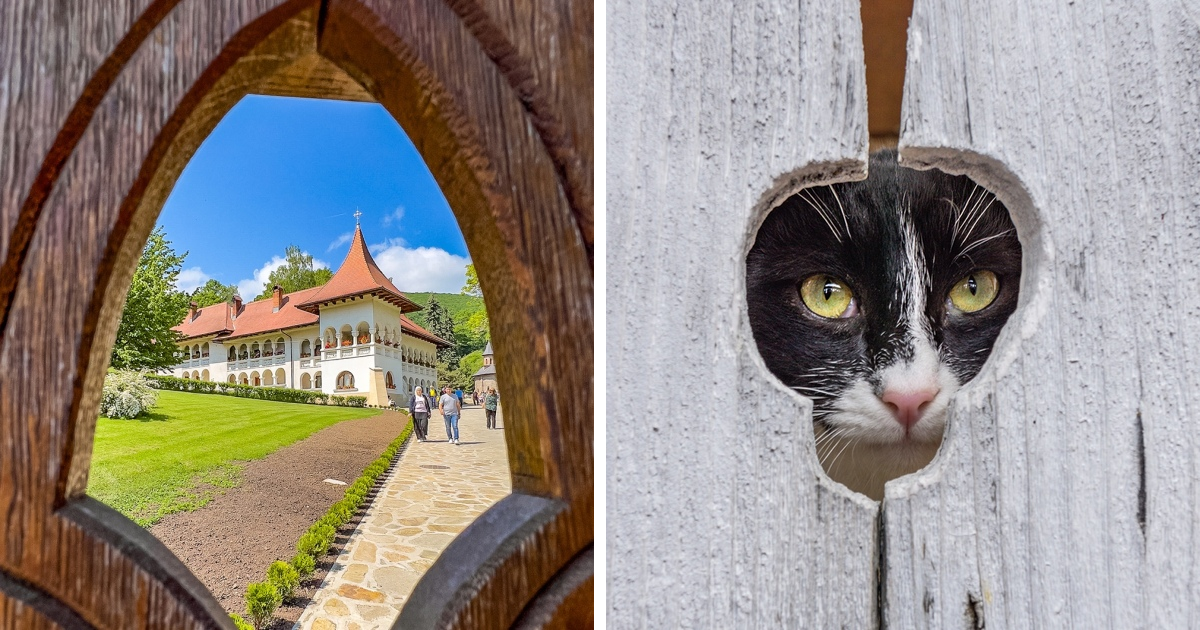
Most people walk past fences, windows, archways, railings, shadows, and oddly shaped gaps without giving them a second thought. I walk past them, stop, back up three steps, crouch like I have lost a contact lens, and point a camera through them.
That habit became “Framed Moments,” a collection of 34 photographs built around one simple idea: ordinary surroundings can become extraordinary when one element naturally frames another. A circular opening in a fence can isolate a distant person. Tree branches can wrap around a landscape. A doorway can turn a routine street scene into a tiny stage. Modern architecture can create layers, borders, and geometric puzzles that make the viewer pause. The original series grew from a deliberate search for unconventional angles, urban patterns, natural curves, and structures that could transform familiar places into carefully composed photographs.
These images are not primarily about famous landmarks or once-in-a-lifetime events. They are about learning to notice what is already there. The world supplies the materials; the photographer simply rearranges them inside a rectangle.
A Slow Way of Seeing in a Fast-Moving World
Life moves quickly. People hurry through stations, traffic flows between buildings, sunlight slides across walls, and pedestrians disappear behind corners with suspicious efficiency. Photography gives me an excuse to resist that speed.
Creating this series required slowing down enough to examine places that initially appeared visually unremarkable. Instead of asking, “What should I photograph?” I began asking, “What can I photograph through?” That small change opened a much larger creative world.
A fence was no longer merely a fence. It became a collection of circles, rectangles, repeating lines, and possible viewpoints. A staircase became a diagonal path guiding the eye. A tunnel became a dark border around a bright destination. Even a gap between two buildings could function like a custom-made picture frame, although the architects probably did not receive my thank-you card.
This style of observation reflects a central tradition in street photography: finding meaning in unplanned daily life. Institutions devoted to photography frequently describe strong street images as a combination of observation, composition, narrative, and a personal response to ordinary human experience.
What Is Frame-Within-a-Frame Photography?
Every photograph already has an outer frame: the four edges of the image. Frame-within-a-frame photography adds another visual boundary inside those edges. The inner frame may completely surround the subject, or it may only suggest a border along one or two sides.
Common natural and architectural frames include:
- Windows, doors, gates, and archways
- Fences, railings, bridges, and circular openings
- Tree trunks, branches, leaves, rocks, and caves
- Reflections, shadows, silhouettes, and areas of darkness
- Staircases, tunnels, corridors, and building facades
- Foreground objects placed close to the lens
These elements help organize the photograph and direct attention toward the main subject. They can also create depth by separating foreground, middle ground, and background. Photography educators commonly recommend windows, doorways, branches, arches, and similar structures as framing devices because they help isolate a subject while preserving information about its environment.
The technique sounds simple, and technically it is. Finding a hole and pointing a camera through it is not exactly advanced aerospace engineering. The challenge is deciding what belongs inside that hole, where it should appear, and when all the moving pieces will briefly cooperate.
The Visual Language of the 34 Photos
Fences Become Creative Tools
Fences usually communicate separation: this side and that side, public and private, stay here and please stop climbing. In these photographs, however, fences become visual partners.
Round openings create porthole-like views. Repeating metal bars introduce rhythm. Decorative curves soften hard urban surroundings. By moving closer to the fence and carefully aligning the background, I can turn a functional object into the dominant compositional element.
The fence does more than decorate the scene. It controls how much information the viewer receives. Instead of presenting an entire street, park, or building at once, the opening reveals a selected fragment. That limitation creates curiosity. The viewer sees enough to understand the scene, but not enough to stop wondering what exists outside the frame.
Architecture Becomes Geometry
Modern buildings are generous to photographers. They provide curves, reflective surfaces, sharp corners, repeating windows, sweeping staircases, and lines that race toward vanishing points. They also provide security guards who may wonder why someone has photographed the same wall for 20 minutes.
In architectural photography, changing position by only a few feet can dramatically alter the relationship between forms. A circular structure may align with a distant tower. Two walls may create a narrow vertical frame around a pedestrian. A staircase can divide the image diagonally, while a curved facade guides the eye back toward the center.
The Getty Museum has documented the long relationship between photography and architecture, including photographers who used skyscrapers, windows, and structural gaps as active framing devices rather than treating buildings merely as subjects.
Nature Supplies Its Own Borders
Nature rarely produces perfect rectangles, which is precisely why it is interesting. Branches bend unpredictably. Leaves overlap. Rocks create irregular openings. Rivers and paths curve rather than politely traveling in straight lines.
A natural frame feels less formal than a doorway or window. It can make an image seem discovered rather than constructed. Branches may partially hide a landscape, encouraging the eye to travel deeper into the scene. Dark leaves in the foreground can surround a bright subject, creating contrast without requiring dramatic editing.
Natural framing also changes with the seasons and weather. A gap filled with summer foliage may become an open view in winter. Morning light can turn a plain branch into a glowing border. Fog can erase background clutter and reduce the landscape to a few essential shapes. The location remains the same, but the frame keeps changing its mind.
Patterns Make Ordinary Details Feel Intentional
Not every photograph needs a recognizable person or landmark. Repetition can become the subject. Rows of windows, stacked balconies, pavement markings, shadows, tiles, and railings create patterns that reward careful observation.
Patterns offer visual order, but the most memorable compositions often include a small interruption: one open window among closed ones, a person crossing a field of repeated lines, or a single contrasting shape. That disruption gives the viewer somewhere to stop.
The series uses these visual surprises to turn simple objects into miniature design studies. The result can feel abstract at first, yet the materials remain familiar. It is the same city, fence, tree, or staircase everyone else sawjust edited by attention before it was ever edited on a screen.
How Composition Gives the Frames Their Power
Leading Lines Direct the Viewer
Frames are most effective when they work with other compositional elements. Railings, roads, shadows, walls, rivers, and staircases can act as leading lines, pulling the viewer toward the primary subject.
Straight vertical lines often make architecture feel strong or imposing. Diagonal lines suggest movement and depth. Curving lines encourage the eye to wander more slowly through the photograph. When several lines converge, they create a visual destination. Adobe’s photography guidance similarly explains that natural and human-made lines can direct attention, establish balance, suggest distance, and support storytelling.
Negative Space Allows the Subject to Breathe
It is tempting to fill every corner of a photograph with interesting material. Unfortunately, when everything is shouting, nothing gets heard.
Negative spacethe quieter area around a subjectcan make a small figure or detail feel more important. In a framed composition, empty walls, open sky, water, or shadow provide visual rest. They also clarify the relationship between the inner frame and the subject.
A lone pedestrian inside a large circular opening may occupy only a tiny portion of the picture, yet the surrounding emptiness makes that person impossible to ignore. Scale becomes part of the story.
Symmetry Creates Order, but Imperfection Creates Life
Many architectural frames invite symmetry. A centered doorway, tunnel, or circular opening can create immediate stability. Centered composition is especially effective when the frame itself is balanced and the background contains few distractions.
However, perfect symmetry is not mandatory. Placing the subject slightly off-center can make the photograph feel more active. A person entering one side of a frame may suggest anticipation; a person leaving may suggest conclusion. Composition guidance from Nikon, Canon, and National Geographic emphasizes that rules such as the rule of thirds, central placement, layering, and open space are flexible tools rather than universal commands.
Perspective Turns Familiar Places Into New Ones
The easiest way to make an ordinary location look ordinary is to photograph it from ordinary eye level. The series often depends on moving higher, lower, closer, or farther away.
Crouching can place a foreground opening against the sky. Stepping sideways can align unrelated objects. Moving close to a frame can make it appear enormous, while the distant subject becomes small and delicate. A telephoto perspective can visually compress separate elements, making them seem unusually close together.
The location does not change. The photographer does.
Timing: The Missing Ingredient in a Perfect Frame
A beautiful frame may remain incomplete until something enters it. This is where patience becomes part of composition.
I might find an excellent opening in a wall, align it with a bright section of pavement, and then wait for a pedestrian, cyclist, bird, or vehicle to pass through the correct area. The scene is already composed, but the photograph has not yet happened.
Sometimes the subject arrives immediately. Sometimes the street suddenly becomes empty, as if everyone has received a secret message warning them about the photographer nearby. Waiting is not wasted time, though. It allows me to study how light changes, predict movement, adjust focus, and remove distractions from the edges.
This combination of prepared composition and unpredictable action connects the project to the long photographic tradition of capturing fleeting everyday moments. MoMA’s writing on Henri Cartier-Bresson, for example, discusses his ability to extract precisely composed fragments from continuing action and transform ordinary social behavior into meaningful visual documents.
Why the Collection Works Better as a Series
One framed photograph can be an interesting composition. Thirty-four framed photographs become a visual argument: unusual perspectives are everywhere once we train ourselves to notice them.
The repeated framing concept gives the collection consistency, while the variety of locations, shapes, subjects, and lighting prevents it from becoming monotonous. A rigid architectural frame may be followed by soft branches. A symmetrical image may sit beside a playful off-center scene. Human subjects appear in some photographs, while structures and patterns carry others.
This balance between repetition and variation is important in any photo series. The viewer should understand why the images belong together without feeling that the same photograph has been served 34 times wearing different pants.
Sequencing also creates rhythm. Wide views can alternate with tight details. Visually busy photographs can be followed by quieter compositions. Curves can answer straight lines, and bright images can provide relief after darker frames. The collection becomes more than an online gallery; it becomes a guided way of looking.
What Photographers Can Learn From “Framed Moments”
Start With Observation, Not Equipment
This type of photography does not demand exotic gear. A phone, compact camera, or basic interchangeable-lens camera can all capture effective framed compositions. The essential skill is noticing relationships between foreground and background.
Before raising the camera, examine the entire scene. Look through openings. Study shadows. Walk around the subject. Check whether a frame becomes stronger from another angle. Nikon’s composition guidance likewise recommends exploring different positions, distances, and viewpoints instead of settling for the first available perspective.
Keep the Edges Clean
A frame should simplify the scene, not introduce fresh chaos. Watch for clipped objects, bright distractions, awkward poles, and mysterious half-people wandering into the corners.
Moving the camera slightly can eliminate distractions before the shutter is pressed. This is usually preferable to spending an evening attempting digital surgery on a trash can that could have been avoided by taking one step to the left.
Experiment With Focus and Exposure
The foreground frame can be sharp, blurred, silhouetted, or partially visible. A wide aperture may soften the frame and emphasize the distant subject. A smaller aperture can keep several layers clear, which is useful when the surrounding structure contributes important context.
Exposure also changes the effect. Darkening the foreground can produce a bold silhouette around a brighter scene. Keeping detail in both areas creates a more descriptive image. Neither approach is automatically correct; the choice depends on the mood and story.
Break Rules With a Reason
Composition guidelines are excellent starting points, but they should not become tiny officers issuing tickets inside the viewfinder. Center the subject when symmetry demands it. Tilt the camera when diagonals strengthen the image. Crop tightly when the frame itself deserves attention.
A broken rule works when the result feels deliberate. Randomness says, “I forgot.” Creative rule-breaking says, “I saw another possibility.”
Experiences Behind the Search for Framed Moments
The most important experience connected with this project was not learning a new camera setting. It was learning to walk differently.
Before developing the series, I often moved through a location while searching for obvious subjects: an impressive building, a colorful street, an interesting person, or dramatic light. Once I began looking for frames, the route itself became more engaging. I paid attention to small openings, overlapping structures, reflections, and the relationship between objects at different distances.
A typical photography walk became a process of discovery. I would notice an attractive archway and photograph it immediately. The first image was usually acceptable but unsurprising. Then I would move closer, step backward, kneel, or wait for someone to cross the background. The fifth or tenth attempt often looked completely different from the first, even though I had barely traveled a few yards.
This taught me that finding a subject is only the beginning. Working the scene matters. An angle that appears perfect to the eye may become cluttered inside the camera. A frame that looks insignificant from a distance may dominate the composition when photographed up close. Small adjustments can separate overlapping shapes, remove distractions, and transform visual confusion into order.
Patience was another lesson. Some frames needed a human element, but pedestrians rarely cooperate with an invisible composition. One person might pass too close to the edge. Another might merge with a pole. A third might stop directly in the center to check a phone and remain there long enough to establish residency.
Rather than becoming frustrated, I learned to watch patterns. People tend to follow similar paths through stations, parks, and sidewalks. Cyclists often enter from predictable directions. Repeated observation makes timing less dependent on luck. The photograph still contains spontaneity, but preparation improves the chance of capturing it.
The project also changed how I responded to imperfect weather. Harsh sun created graphic shadows that acted as frames. Rain added reflections and richer surfaces. Cloudy conditions reduced contrast and revealed subtle architectural details. Instead of waiting for supposedly perfect light, I began asking what the existing light could contribute.
There were failures, of course. Some images looked clever in the moment but confusing later. Other compositions were technically clean yet emotionally empty. A few frames overwhelmed the subject so completely that the photograph became an enthusiastic portrait of a railing.
Reviewing those unsuccessful images was useful. I learned that framing should support the subject rather than compete with it. The viewer needs a clear visual destination. Strong geometry alone is not enough; the photograph also needs atmosphere, tension, humor, scale, or a small unanswered question.
Perhaps the best experience was realizing that creative opportunities do not require constant travel. New photographs can emerge from familiar neighborhoods because attention changes faster than geography. The same street offers different shadows in the afternoon, different people on weekends, different foliage in another season, and different alignments when viewed from the opposite sidewalk.
“Framed Moments” ultimately became an exercise in curiosity. The camera encouraged me to investigate rather than merely pass through. Every opening suggested a possible picture, and every unsuccessful attempt made the next composition more deliberate.
That habit continues even when I am not carrying a camera. I still notice a person perfectly positioned inside a bus window, a tree branch curving around the moon, or two buildings forming a narrow slice of sky. Occasionally, I simply enjoy the moment instead of photographing it. This is either personal growth or proof that my battery is dead.
Conclusion: The World Is Already Full of Frames
The 34 photographs in “Framed Moments” celebrate a form of visual creativity that begins with attention. Fences, windows, branches, tunnels, shadows, and architectural curves are not merely background elements. They can guide the eye, create depth, reveal context, and turn ordinary scenes into layered visual stories.
The collection also demonstrates that photography is less about discovering untouched places than discovering fresh relationships within familiar ones. A good frame does not hide the world. It helps us concentrate on one meaningful piece of it.
For photographers, the lesson is practical: walk slowly, examine the edges, explore several viewpoints, and wait for the scene to complete itself. For everyone else, the lesson is even simpler. Look through things occasionally. The view may surprise you.