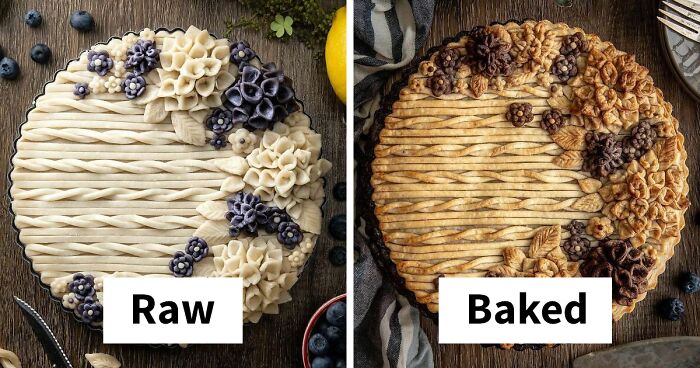
Some Thanksgiving pies quietly wait beside the coffee pot. Helen Nugent’s pies arrive looking as though they have a reservation, a stylist, and possibly their own security detail. Covered with braided pastry, sculpted flowers, geometric lattices, autumn leaves, berries, animals, and holiday motifs, her creations turn an ordinary dessert into an edible centerpiece.
Meet Helen Nugent, the Self-Taught Baker Behind the Pie Art
Helen Nugent did not begin her career in a pastry school surrounded by copper pans and instructors shouting about laminated dough. The Toronto-based baker spent much of her professional life working in corporate communications and instructional design. Baking was a hobby she had enjoyed since childhood, influenced heavily by a mother known for being an excellent baker.
As Nugent became increasingly burned out in her corporate career, decorative pies offered a creative escape. She began studying intricate crusts she encountered online, particularly designs shared through Pinterest. What started as curiosity soon became experimentation: leaves were cut, lattices were woven, pastry flowers were assembled, and more than a few scraps of dough presumably disappeared under mysterious, butter-scented circumstances.
Practice gradually gave Nugent a recognizable style. Her work attracted attention on social media, led to projects with Food Network, and eventually resulted in a cookbook, Pie Style: Stunning Designs and Flavorful Fillings You Can Make at Home. Her journey is a useful reminder that self-taught does not mean casually talented. It often means repeating the same technique until the hands finally understand what the brain has been demanding.
Why These 30 Decorative Pies Look Like Edible Artwork
The pies featured in this collection are impressive because they succeed on two levels. First, they look beautiful in photographs. Second, they still look unmistakably edible. Nugent does not disguise pie as something else; she celebrates the textures, colors, and possibilities of pastry itself.
Floral Pie Crusts With Remarkable Depth
Many of the designs use layered flowers, leaves, vines, and petals to create dimension. Instead of placing one flat cutout on top of another, Nugent varies the size, thickness, shape, and direction of each piece. The result resembles a botanical relief carved from dough.
Some flowers appear tightly curled like roses, while others spread outward like dahlias or chrysanthemums. Scored leaf veins, carefully pinched petals, and overlapping stems create shadows as the crust browns. Once baked, the high points become deep gold while recessed areas remain lighter, making the decoration look even more detailed.
Braids, Lattices, and Geometric Patterns
Traditional lattice pie crust is already attractive, but Nugent treats it as a starting line rather than a finish line. Narrow braids may cross wider pastry strips. Repeating diamonds create quilt-like surfaces. Woven patterns curve around the filling instead of marching straight across it like tiny carbohydrate railroad tracks.
Geometric designs work especially well because pie is naturally circular. Radiating lines, rings of leaves, and symmetrical cutouts guide the eye toward the center. Even highly complicated patterns feel balanced because the round pie dish provides a strong visual frame.
Seasonal Designs Made for Thanksgiving
Thanksgiving provides an entire craft store of inspiration without requiring anyone to leave the produce aisle. Nugent’s holiday pies incorporate pumpkins, turkeys, cranberries, apples, wheat, pinecones, acorns, wreaths, and fall foliage. Warm fillings peek through openings in the crust, adding deep red, purple, or amber color to the design.
A cranberry filling can become part of a holiday wreath. Dark and light pastry pieces can form the feathers of a turkey. Braided strands can transform a round tart into a pastry pumpkin. These details make the dessert feel connected to the season rather than merely placed on the table because someone remembered Thanksgiving legally requires pie.
The Secret Is Not Decoration Alone
A beautiful crust cannot rescue a watery filling or flavorless pastry. Nugent’s work emphasizes that successful pie art must still function as good pie. The foundation needs to taste buttery, bake evenly, support the design, and slice without collapsing into fruit soup.
A Workable Pie Dough Matters
Decorative pie dough must be smooth enough to roll, cut, braid, and shape. Large, irregular butter chunks can produce dramatic flakes, but they may also tear delicate strips or distort fine decorations. A more even dough gives the baker greater control when creating leaves, letters, flowers, and woven patterns.
Nugent favors an all-butter crust for its flavor and crisp texture. Butter also encourages attractive browning, which helps sculpted details stand out after baking. Whatever recipe is used, the dough should remain cool. Warm pastry becomes sticky, stretchy, and generally as cooperative as a cat being introduced to bathwater.
The Filling Must Hold Its Shape
Fruit filling should be thick enough to support the crust without becoming rubbery or overly starchy. Excess liquid can bubble through decorative openings, soften the bottom crust, and blur carefully arranged details. Precooking particularly juicy fruit or allowing macerated fruit to drain can provide greater control.
Color also matters. Blueberry, blackberry, cherry, cranberry, and deeply spiced apple fillings create contrast against pale unbaked dough and golden finished pastry. Strategic openings in the top crust allow those natural colors to become part of the artwork.
How Home Bakers Can Create a Showstopping Thanksgiving Pie
You do not need to begin with a three-dimensional pastry peony surrounded by 47 individually scored leaves. Starting there is an excellent way to spend Thanksgiving hiding behind the refrigerator. Choose one manageable technique and execute it neatly.
1. Make the Dough Ahead
Prepare pie dough one to three days before assembling the dessert, or freeze properly wrapped portions farther in advance. Resting gives the flour time to hydrate and reduces the pressure of completing every task on Thanksgiving morning. The turkey already controls enough oven-related drama.
2. Roll the Dough Evenly
A thickness of approximately one-eighth inch works well for many crusts and decorations. Dough that is too thin tears and browns quickly; dough that is too thick can become heavy and lose detail. Roll from the center outward and rotate the dough frequently to prevent sticking.
3. Chill Before Cutting
Transfer the rolled pastry to a flat baking sheet and refrigerate it until firm. Chilled dough produces cleaner shapes when cut with a knife or cookie cutter. If the pastry softens while you work, stop and chill it again for 10 to 15 minutes. Refrigeration is not surrender. It is strategy.
4. Use Simple Tools Creatively
Leaf cutters, small flower cutters, a pastry wheel, a ruler, and a sharp paring knife can produce dozens of patterns. A fork can stamp basket-weave textures. The dull side of a knife can mark leaf veins. The tip of a piping nozzle can cut tiny circles. Specialized equipment is convenient, but imagination remains cheaper and takes up less drawer space.
5. Build Decorations Separately
Assemble braids, flowers, and complex lattice sections on parchment paper before transferring them to the pie. This method lets you correct mistakes without disturbing the filling. Chill finished components so they are easier to move and less likely to stretch.
6. Attach Pieces Carefully
A small amount of water or egg wash can help pastry decorations adhere. Avoid soaking the pieces; too much liquid may create slippery dough or uneven patches. Press gently enough to secure each element without flattening its texture.
7. Chill the Entire Pie Before Baking
Once assembled, refrigerate the pie for about 30 minutes. Firm butter and chilled decorations retain their shapes better as the crust enters the oven. This final rest is especially valuable for detailed leaves, scalloped edges, narrow braids, and floral work.
8. Apply Egg Wash With a Light Hand
Egg wash encourages shine and browning, but thick puddles can collect between decorations and obscure fine details. Use a soft pastry brush and apply a thin, even layer. Different washes create different finishes, so choose one that complements the desired color.
What the Pie Gallery Teaches About Visual Design
Nugent’s 30 pies offer useful lessons beyond baking. Her strongest designs combine repetition, contrast, texture, and negative spacethe same principles used in illustration, textiles, architecture, and graphic design.
Repetition makes complicated pies feel organized. A ring of similar leaves creates rhythm. Contrast allows a bright cranberry center to stand out against pale pastry. Texture distinguishes a braided border from a smooth cutout. Negative space prevents the surface from becoming so crowded that the pie appears to be wearing every accessory it owns at once.
The designs also reveal the value of restraint. An intricate floral border may surround an exposed fruit center, while a densely woven top may need only a simple crimped edge. Every section does not need to compete for attention. Even edible art benefits from occasionally taking a breath.
Why Pie Art Belongs on the Thanksgiving Table
Thanksgiving food carries memories. Families may debate pumpkin versus pecan with the intensity normally reserved for professional sports, but the attachment is rarely about flavor alone. Pie recalls grandparents, handwritten recipe cards, crowded kitchens, annual mistakes, and the person who always cuts suspiciously large slices.
A decorated Thanksgiving pie adds another layer to that tradition. The crust can reflect the season, honor a family interest, or simply show that someone invested time in making the gathering feel special. The pie becomes part dessert, part centerpiece, and part conversation starter.
Professional bakeries understand this emotional connection. Thanksgiving is one of the busiest periods of the year for American pie shops, requiring extensive preparation, carefully organized dough schedules, and large-scale production. Home bakers face smaller numbers but similar pressures. Making dough and fillings ahead, choosing a realistic design, and baking before the holiday can turn the experience from frantic to festive.
Perfection Is Not the Point
The most encouraging part of Nugent’s approach is her belief that making pie should be enjoyable. Decorative baking can look intimidating on social media because viewers see the finished photograph rather than the cracked leaf, crooked braid, flour-covered floor, and emergency patch hidden beneath a strategically placed flower.
A homemade pie does not need to resemble one of Nugent’s masterpieces to be successful. It needs a flavorful crust, a satisfying filling, and a baker who remains emotionally stable enough to serve it. A slightly uneven lattice is evidence that human hands made dessert. Besides, whipped cream has covered greater crimes.
The goal is to borrow inspiration rather than demand imitation. Try a border of overlapping leaves. Add one braided strip. Cut a few stars or acorns from leftover dough. Each pie teaches the baker something about temperature, timing, texture, and patience.
A Home Baker’s Experience: What Attempting Decorative Pie Art Really Feels Like
For a home baker, the first attempt at an elaborate pie often begins with unreasonable confidence. The inspiration photo is open on a phone, the dough is perfectly chilled, and the kitchen feels unusually peaceful. For roughly seven minutes, it appears that a new career in pastry design may be developing.
Then the first leaf sticks to the counter.
The practical experience of making pie art is less like decorating a cake and more like working with a material that constantly changes its mind. Cold dough is firm and clean but may crack when folded. Warm dough bends beautifully but can stretch, stick, and lose its shape. The baker learns to recognize a narrow working window when the pastry is flexible without being soft.
The biggest surprise is how much time small details require. Cutting 30 leaves is quick. Scoring veins into 30 leaves, curving them naturally, arranging them around a rim, and attaching them without flattening their edges is not. A design that looked simple on screen can quietly consume an afternoon. This is why advance preparation matters more than raw talent.
It also becomes clear that consistency creates the professional appearance. The individual leaves do not need to be perfect, but they should appear related. Braided strands should have similar thickness. Lattice strips should be reasonably straight. Repeated elements give the eye a pattern to follow, which makes minor flaws less noticeable.
Another common lesson involves flour. Too little flour allows the dough to stick. Too much leaves pale streaks, dries the surface, and prevents pieces from adhering. A pastry brush becomes surprisingly useful for removing excess flour before assembly. Suddenly, the humble brush feels like a precision instrument instead of something purchased during an optimistic kitchen-supply phase.
Moving a finished decoration can be the most suspenseful moment. A floral cluster that looked sturdy on parchment may behave like an archaeological artifact during transfer. Building elements on small pieces of parchment, chilling them thoroughly, and sliding them into position reduces the chance of collapse. When a petal breaks, a dab of water and a tiny patch of dough usually solve the problem.
The baking stage brings a different kind of anxiety because the oven transforms the design permanently. Thin pieces brown before thick ones. Exposed edges may darken quickly. Fruit can bubble through gaps. Watching the pie during the final portion of baking and shielding overly dark areas with foil can protect hours of work.
Yet the finished result is almost always more satisfying than expected. Egg wash gives the surface depth, the filling becomes glossy, and uneven handmade pieces merge into a cohesive design. Details that seemed awkward while raw often look charming after baking.
The experience teaches patience, but it also encourages flexibility. A torn strip can become a leaf. An off-center pattern can be balanced with another flower. A cracked edge can receive a decorative braid. Pie art rewards the ability to convert mistakes into design decisionsand then behave as though that was the plan all along.
Most importantly, the process changes how the baker views the dessert. Pie is no longer merely crust plus filling. It becomes a creative medium that can express a season, tell a story, or honor a family tradition. Even when the finished pie is less museum masterpiece and more enthusiastic folk art, cutting into it at Thanksgiving feels wonderfully dramatic.
Final Thoughts
Helen Nugent’s decorative pies prove that pastry can be playful, expressive, and technically impressive without losing its identity as comfort food. Her path from corporate communications to full-time pie artistry also demonstrates what can happen when curiosity is supported by practice, patience, and a willingness to learn publicly.
The 30 stunning pies may inspire admiration, hunger, or a sudden online purchase of leaf-shaped cutters. The best response, however, is simply to begin. Make cold dough, choose one design element, prepare ahead, and accept that the first flower may resemble a confused cabbage. Every skilled baker once made something lopsided.
Thanksgiving pie does not have to be perfect. It should be delicious, made with care, and proudly placed on the table. If it also looks like an edible autumn garden, nobody is going to complain.