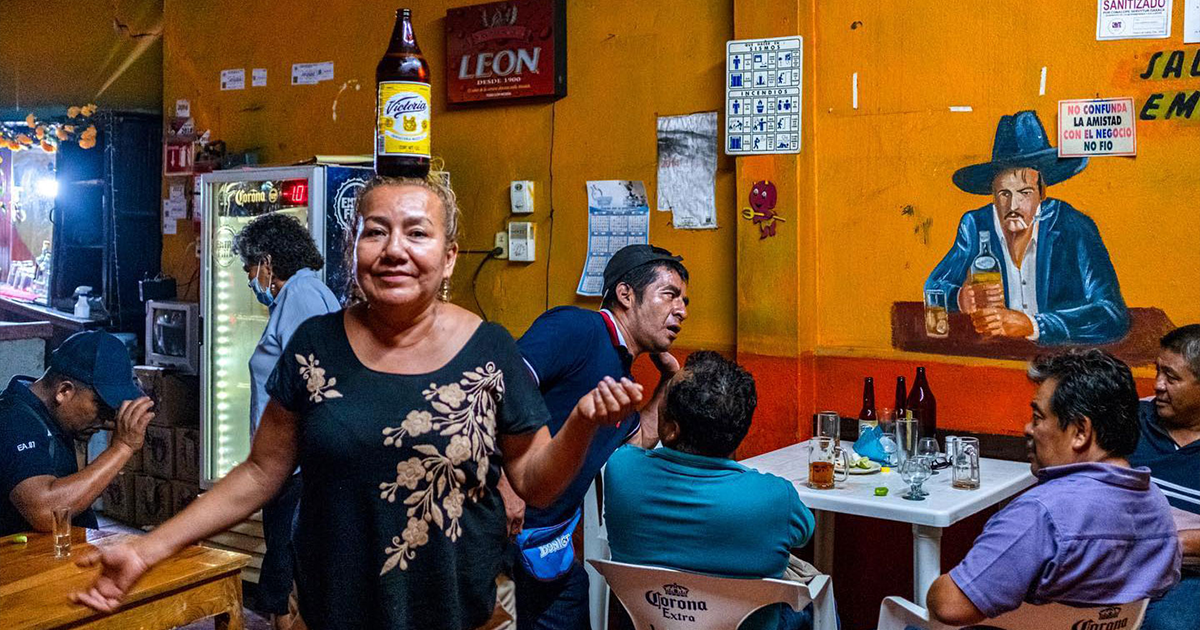
Cities rarely stop moving long enough to pose for a photograph. People rush through intersections, disappear behind buses, lean against faded walls, argue beside storefronts, and stare into the distance while waiting for something that may or may not arrive. Most of these moments vanish without ceremony. Noel Rojo, however, has developed a talent for catching them before they escape.
In 50 Striking Street Photography Moments From Around The World By Noel Rojo, ordinary public spaces become stages for quiet drama. A patch of colored light can transform a wall into scenery. A solitary figure can make a crowded city feel strangely empty. A reflection can split a scene into several possible stories, each one whispering, “You had to be there.”
Rojo’s street photography is not powered by explosions, celebrity sightings, or people dramatically leaping over puddles while wearing perfect coats. His images work through patience, visual tension, layered composition, and emotional ambiguity. They invite viewers to slow down and notice how much human experience is hidden inside an apparently uneventful afternoon.
Who Is Noel Rojo?
Noel Rojo is a Mexican-American documentary and street photographer born in Chihuahua, Mexico, in 1987. Now based in Oaxaca, his visual practice blends documentary observation, street photography, and fine-art sensibility. His work frequently explores transitions: between places, identities, relationships, cultures, and emotional states.
Rojo’s perspective is closely connected to migration. His father spent extended periods working in the United States when Rojo was young, leaving his mother to manage family life in Mexico. Those early experiences later helped shape his interest in separation, belonging, and the lives of people existing between different worlds.
Together with journalist Magdaléna Rojo, he co-founded Women Who Stay, a multimedia project examining the experiences of women whose families have been transformed by migration. Another major project, Gotas de Fuego, enters the cantinas of Oaxaca to explore longing, temporary connection, memory, and alcoholism through candid yet carefully structured photographs.
His travels and assignments have taken him through Latin America, Southeast Asia, India, Africa, and Europe. Yet his photographs rarely behave like conventional travel pictures. Famous landmarks are not the main characters. Rojo is more interested in the person standing slightly outside the celebration, the gesture occurring at the edge of the frame, or the shadow that seems to know more than the viewer does.
A Global Collection That Still Feels Personal
A gallery assembled from photographs taken around the world can easily become a visual passport checklist: colorful market, historic building, local costume, sunset, repeat. Rojo avoids that problem by concentrating on emotional continuity rather than geographic novelty.
The streets may belong to Oaxaca, Slovakia, India, or another location encountered during his international work, but the underlying experiences remain recognizable. People wait. They work. They drift apart. They seek company. They retreat into private thoughts while standing in very public places.
This makes the collection feel less like a tour of destinations and more like a study of human behavior. Cultural details matter, but they are not treated as exotic decorations. They provide context while the emotional center remains universal.
That balance is difficult. A photographer visiting an unfamiliar place can be seduced by whatever appears unusual. Rojo instead searches for connections between the unfamiliar and the deeply familiar. His camera asks not merely, “What is different here?” but also, “What do people here feel that people everywhere might understand?”
What Makes Noel Rojo’s Street Photography So Striking?
He Photographs the Pause Between Events
Many photographers chase action. Rojo often watches what happens immediately before or after it. His strongest images seem to exist inside pauses: a person waiting near a doorway, someone looking away from a conversation, a pedestrian briefly separated from the surrounding crowd, or a figure suspended between sunlight and shadow.
These moments do not explain themselves. That is precisely why they hold attention. The viewer arrives without a caption providing a tidy beginning, middle, and end. Instead, the photograph functions like a sentence torn from a longer letter. We understand the emotion before we understand the circumstances.
Waiting is one of the most common human activities and one of the least celebrated. Nobody throws a parade because a bus is seven minutes late. Yet waiting reveals posture, fatigue, expectation, loneliness, impatience, and hope. Rojo recognizes that stillness can carry as much narrative force as visible action.
Geometry Gives Emotion a Place to Live
Rojo frequently uses doorframes, windows, sidewalks, painted walls, railings, reflections, and architectural divisions to organize spontaneous scenes. These geometric elements are not merely decorative. They control how emotional information moves through the frame.
A small figure surrounded by empty space may appear isolated. Two people divided by a vertical line can seem emotionally separated even when they are physically close. A person framed inside a doorway may look protected, trapped, observed, or ready to leave. Architecture quietly becomes psychology.
Layering is another important part of his visual language. Foreground objects may partially hide the subject, while reflections or background figures introduce competing stories. Instead of presenting a scene on a silver platter, complete with garnish and a tiny flag, Rojo allows viewers to explore it.
The complexity remains controlled. His images may contain several visual layers, but the strongest ones still give the eye a clear path. Structure keeps chance from becoming clutter.
Color Is Used as Narrative, Not Confetti
Street photography is often associated with black-and-white images, partly because monochrome can simplify chaotic environments and emphasize gesture. Rojo frequently embraces color instead, using it as an active storytelling element.
Faded blues, dusty yellows, deep reds, fluorescent greens, and sun-worn pastels can establish mood before the viewer has consciously identified the subject. Warm colors may suggest intimacy, heat, danger, memory, or desire. Cooler tones can create distance and melancholy. A brightly colored object may connect two otherwise unrelated parts of a frame.
His palette often carries a nostalgic quality, as though the photograph belongs simultaneously to the present and to a memory of the present. The effect is not created by spraying every editing slider with digital hot sauce. It comes from observing how real light interacts with aging surfaces, clothing, signs, glass, and weather.
Solitude Does Not Always Mean Loneliness
Lone figures appear frequently in Rojo’s visual world, but their meaning remains open. Some look lonely. Others seem peaceful, guarded, exhausted, contemplative, or simply busy doing absolutely nothinga skill modern society has nearly classified as suspicious behavior.
By avoiding overly dramatic conclusions, Rojo respects the uncertainty of public life. A photographer cannot know everything about a stranger from one gesture. A person sitting alone may be grieving, resting, daydreaming, or waiting for a friend who is terrible at punctuality.
This ambiguity gives the photographs emotional flexibility. Viewers bring their own experiences to the frame. Someone who has migrated may recognize displacement. Someone who has experienced loss may see absence. Another viewer may notice calm, humor, or resilience.
Small Gestures Become Major Plot Points
Street photography rewards sensitivity to gestures that last only a fraction of a second: crossed hands, lowered eyes, a tilted head, fabric caught by wind, or two bodies unconsciously mirroring one another.
Rojo’s images often depend on these tiny physical clues. The gesture does not need to be theatrical. In fact, subtle movements are often more convincing because they occur without apparent performance. They reveal how people carry emotions even when their faces remain unreadable.
The camera becomes a collector of visual evidence. A hand touching a wall, an empty chair beside a person, or an object left near a doorway may suggest an entire relationship. Nothing is formally explained, but everything feels suspiciously meaningful.
Street Photography Without the Tourist Gaze
Photographing unfamiliar communities requires more than technical skill. It requires awareness of power, context, and representation. An image can be visually impressive while still reducing a person to a stereotype. The photographer’s responsibility does not disappear simply because the subject is standing in public.
Rojo’s documentary background appears to encourage a slower, more relational form of observation. His work focuses on people and places without turning hardship into spectacle. Even when photographs contain solitude, poverty, labor, migration, or emotional strain, the subjects retain individuality.
This is especially important in global street photography. Images from another country are often presented to Western audiences as evidence of colorful difference or dramatic struggle. Rojo’s photographs resist easy categorization. They are grounded in specific environments while allowing people to remain complicated.
Ethical photography is not only about whether pressing the shutter is legally permitted. It also involves considering how an image may affect the person depicted, how it will be captioned, and whether it preserves dignity. Sometimes the most responsible decision is to take the picture. Sometimes it is to ask permission. Sometimes it is to lower the camera and continue walking.
Why the Collection Works as a Sequence
One powerful street photograph can deliver an emotional jolt. Fifty photographs require something more: rhythm.
A successful sequence alternates visual density, distance, color, motion, and emotional intensity. A crowded composition may be followed by an image with abundant negative space. A humorous moment can provide relief after a somber frame. A close human gesture may lead into a wider photograph in which the environment dominates.
Rojo has described his editing process as similar to assembling a puzzle. This comparison helps explain why his photographs feel connected even when they originate in different countries. Each image contributes a shape, color, mood, or idea that communicates with the pictures around it.
Repetition also creates meaning. Recurring doors, windows, shadows, isolated figures, and visual barriers begin to function like motifs in a novel. Their significance grows as the sequence progresses. The collection becomes not merely a group of successful photographs but a sustained meditation on belonging and transition.
What Photographers Can Learn From Noel Rojo
Return to the Same Places
Great street photographs are not always discovered during heroic expeditions to distant capitals. Familiar neighborhoods can be more productive because repeated visits reveal patterns: where light falls, when workers take breaks, how crowds move, and which corners generate interesting visual relationships.
Rojo’s substantial bodies of work in Oaxaca and Slovakia demonstrate the value of sustained observation. Familiarity makes it easier to move beyond obvious subjects and notice quieter changes.
Compose the Background Before the Person Arrives
Instead of chasing random pedestrians, photographers can identify a promising arrangement of light, color, and geometry, then wait for the right person or gesture to complete it. This approach turns street photography into a collaboration between preparation and chance.
The street provides the set, wardrobe, extras, weather machine, and occasional delivery truck blocking the entire composition. The photographer’s job is to recognize when those unpredictable elements briefly cooperate.
Carry Less and Observe More
A small camera or smartphone can be more useful than a heavy collection of lenses if it encourages longer walks and faster reactions. Mobility matters because street scenes often dissolve while the photographer is still negotiating with a complicated camera bag.
Technical preparation should make observation easier. A practical aperture, dependable shutter speed, automatic ISO, and familiar focal length can reduce hesitation. Settings matter, but awareness matters more. A perfectly exposed photograph of nothing remains an extremely accurate photograph of nothing.
Edit for Meaning, Not Social-Media Applause
The most immediately popular image is not always the most important one. Some photographs reveal their value slowly, particularly those built on ambiguity or subtle emotional relationships.
Photographers should review images over time, search for recurring themes, and experiment with sequencing. A quiet photograph that seems weak alone may become essential when placed beside another image. Editing is where scattered moments begin turning into a personal visual language.
Why These 50 Street Photography Moments Matter
Billions of photographs are created every day, many designed to prove that someone attended a meal before it became cold. Against that endless stream of images, thoughtful street photography offers a different experience. It asks viewers to look rather than scroll.
Noel Rojo’s work matters because it restores mystery to ordinary life. His photographs acknowledge that public spaces are filled with private emotions. A sidewalk may contain grief, romance, boredom, labor, humor, and memory within a few feet of concrete.
The collection also reminds us that striking photography does not require a spectacular subject. Light, timing, empathy, color, and composition can transform a modest scene into something unforgettable. The photographer’s greatest tool is not the latest camera body. It is sustained attention.
Rojo does not offer fifty definitive explanations of the world. He offers fifty invitations to examine it more carefully. That uncertainty is not a weakness. It is what keeps the images alive after the first glance.
Conclusion
50 Striking Street Photography Moments From Around The World By Noel Rojo reveals how much visual poetry survives in overlooked places. Through layered composition, expressive color, fleeting gestures, and an interest in migration and belonging, Rojo turns ordinary streets into emotionally complex narratives.
His photographs do not shout instructions at the viewer. They leave room for interpretation, memory, and doubt. A doorway can become a boundary. A reflection can suggest divided identity. An empty space can feel crowded with absence.
Most importantly, the series encourages us to become better observers. The world is constantly performing small, unscripted scenes. We simply need enough patience to notice themand enough humility to understand that not every mystery requires an answer.
Extended Experience: What Spending Time With Street Photography Teaches You
Photographers who regularly walk city streets eventually discover that the hardest part is not operating the camera. It is remaining attentive after nothing interesting has happened for forty minutes. Street photography includes long stretches of wandering, waiting, second-guessing, and pretending that standing beside the same newspaper kiosk for ten minutes is completely normal.
The first practical lesson is that promising scenes often need time to mature. A wall may have beautiful afternoon light but no human element. Rather than immediately leaving, an experienced photographer studies how pedestrians move through the area. One person may disappear into the background. Another may wear a color that connects with a sign. Then, for half a second, a gesture, shadow, and expression align. The result looks effortless, although it was built from patience.
Another common experience is learning to accept missed photographs. The camera may be switched off. Autofocus may choose a trash can instead of the wonderfully expressive person beside it. A bus may enter the frame at the precise moment everything becomes perfect. These failures are frustrating, but they sharpen anticipation. After missing the same type of moment several times, photographers begin recognizing its early signals.
Working in unfamiliar places also teaches the importance of reading the atmosphere. Some streets are relaxed and welcoming. Others demand greater distance or explicit permission. A photographer must pay attention to body language, local customs, vulnerable situations, and the possibility that a technically legal photograph may still be unnecessarily invasive.
Respectful interaction can produce experiences more valuable than the picture itself. A smile, nod, brief conversation, or offer to share the photograph can reduce tension. When someone clearly objects, lowering the camera is not artistic defeat. It is basic decency. No portfolio becomes legendary because its creator bravely defeated a grandmother who did not want her picture taken.
Reviewing the day’s images provides another surprise: the photograph that felt spectacular on the street may be visually chaotic, while an almost forgotten frame contains the strongest emotional detail. Memory favors excitement. Editing favors evidence. This is why photographers benefit from waiting before making final selections.
Over months and years, recurring interests become visible. One photographer may repeatedly notice umbrellas, windows, workers, children playing, or people lost in thought. These repetitions are not necessarily creative limitations. They can reveal a personal visual vocabulary. Rojo’s attention to separation, transition, geometry, and belonging demonstrates how repeated themes can develop into coherent long-term work.
Street photography ultimately changes how people move through the world. Light on a wall becomes an event. Reflections become alternate realities. A crowded bus stop becomes a study of distance and intimacy. Even without a camera, the photographer continues framing scenes mentally.
That heightened awareness may be the medium’s greatest reward. A successful photograph is wonderful, but the deeper experience is learning that supposedly ordinary life is not ordinary at all. It is endlessly strange, emotional, funny, and visually generousprovided someone is paying attention.