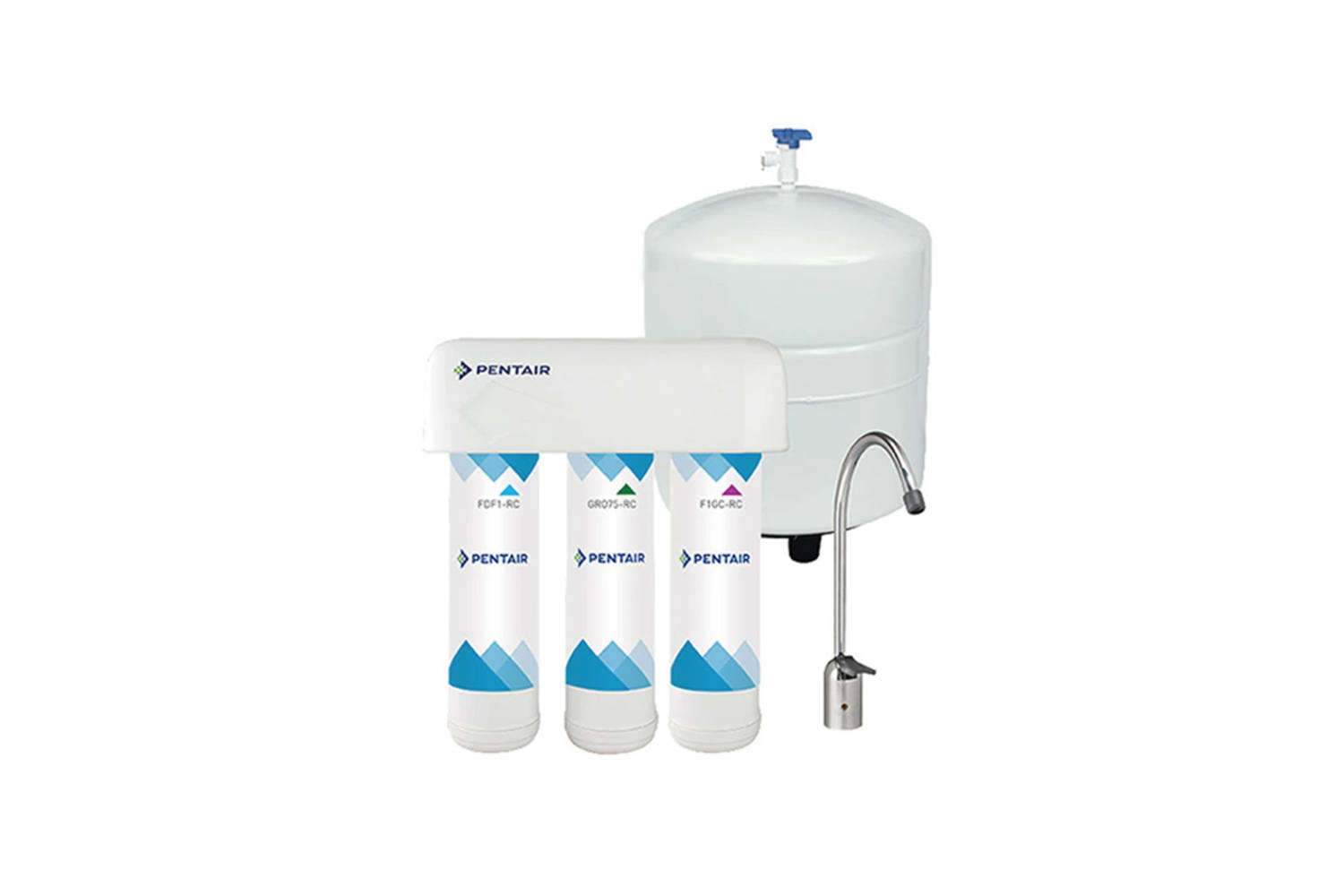
The Pentair FreshPoint GRO-350B 3-Stage Reverse Osmosis System is designed for households that want cleaner, better-tasting drinking water without turning the kitchen into a miniature municipal treatment plant. Installed beneath the sink, it combines sediment and carbon filtration, a reverse osmosis membrane, and a final polishing filter to reduce a broad range of impurities before storing treated water for use at a dedicated faucet.
Its biggest attractions are certified contaminant-reduction claims, relatively compact filter hardware, color-coded quick-change cartridges, and a more water-efficient membrane than many traditional residential RO designs. However, it still requires cabinet space, adequate incoming water pressure, regular cartridge replacement, and a willingness to sacrifice some water to the drain. Reverse osmosis is effective, but it has never been accused of being completely drama-free.
What Is the Pentair FreshPoint GRO-350B?
The FreshPoint GRO-350B is a point-of-use reverse osmosis water filtration system intended primarily for installation under a kitchen sink. It supplies treated water through a separate air-gap faucet rather than filtering every gallon used by the home.
This approach makes sense because most households do not need reverse osmosis water for flushing toilets, washing socks, or giving the driveway a refreshing beverage. The system concentrates its efforts on drinking, cooking, coffee, tea, ice, and other uses where taste and dissolved contaminants matter most.
The package includes the three-cartridge filtration assembly, an installation hardware kit, a dedicated faucet, tubing, and a pressurized storage tank. The filter assembly measures approximately 11.32 inches wide, 5.46 inches deep, and 12.54 inches high. The separate tank is about 8.94 inches in diameter and 13.83 inches high.
Although the tank is commonly described as a 3.2-gallon tank based on its physical size, its maximum usable water capacity is approximately 2.1 gallons. The remaining internal space is occupied by the air charge and bladder needed to push water toward the faucet.
How the Three Filtration Stages Work
Stage 1: Sediment and Carbon Pre-Filtration
The first cartridge is the Pentair FDF1-RC. It uses Diamond Flow technology that combines a carbon block with a spun outer layer. The outer material captures sediment, while the carbon section reduces chlorine taste and odor.
This stage does more than improve flavor. Chlorine, grit, rust particles, and other debris can shorten membrane life or interfere with performance. By handling these materials first, the pre-filter acts like a polite but firm security guard for the more expensive RO membrane.
Stage 2: GRO50-RC Reverse Osmosis Membrane
The second stage is the GRO50-RC membrane. Water pressure forces pre-filtered water across a semipermeable membrane. Water molecules pass through, while many dissolved salts, metals, and other impurities are rejected and directed to the drain.
Pentair markets this membrane as a high-efficiency Green RO design. The membrane platform is described as capable of delivering up to 50 gallons per day under favorable conditions. However, the certified production rate for the complete GRO-350B system is listed at 14.96 gallons per day under standardized testing conditions.
That difference is not necessarily contradictory. Membrane capacity ratings and complete-system production ratings are measured differently. Storage-tank back pressure, feed-water temperature, incoming pressure, dissolved-solids concentration, and daily usage patterns can all affect the amount of water actually available at the faucet.
Stage 3: Granular Activated Carbon Polishing
After treatment by the membrane, water passes through the F1GC-RC granular activated carbon post-filter. This final stage polishes the stored water to improve taste and reduce lingering odors before the water reaches the dedicated faucet.
The polishing cartridge is particularly useful because water may sit inside the storage tank between uses. The final carbon stage helps ensure that the first glass tastes like water rather than an exciting tour of the plumbing cabinet.
Certified Contaminant Reduction
The Pentair FreshPoint GRO-350B is tested and certified to NSF/ANSI Standards 42 and 58, as well as CSA B483.1, for the specific claims listed in its performance data. NSF/ANSI 42 addresses aesthetic effects such as chlorine taste and odor, while NSF/ANSI 58 applies specifically to reverse osmosis drinking-water systems.
Selected average reductions reported under controlled laboratory conditions include:
| Substance or Water-Quality Issue | Reported Average Reduction |
|---|---|
| Chlorine taste and odor | 95.9% |
| Total dissolved solids | 96.9% |
| Lead | 98.6% |
| Fluoride | 93.6% |
| Pentavalent arsenic | 88.0% |
| Copper | 98.5% |
| Cadmium | 99.1% |
| Filterable cysts | More than 99.99% |
| Turbidity | More than 99.1% |
The certification also covers reduction claims involving barium, selenium, nitrate and nitrite, hexavalent chromium, trivalent chromium, and radium 226/228.
These percentages should not be interpreted as a promise that every installation will produce identical results. Laboratory performance can differ from household performance because of water pressure, temperature, contaminant concentration, cartridge age, maintenance, and the chemistry of the source water.
It is also important to understand arsenic chemistry. The GRO-350B is tested for pentavalent arsenic, also called As(V). It may not effectively remove trivalent arsenic, or As(III), unless the source water is appropriately treated to convert it. Private-well owners concerned about arsenic should test both untreated and treated water through a qualified laboratory.
Important Operating Requirements
The GRO-350B performs best when the incoming water remains within Pentair’s specified operating limits:
- Feed-water pressure: 40 to 100 psi
- Water temperature: 40°F to 100°F
- Total dissolved solids: below 2,000 ppm
- Water hardness: below 10 grains per gallon
- Iron, manganese, and sulfide: below 0.1 ppm combined
- Chlorine concentration: below 2 ppm
- Acceptable pH range: 3 to 11
Water harder than 10 grains per gallon can rapidly form scale on the membrane. In homes with very hard water, a softener or other pretreatment may be necessary. Excess iron, manganese, or sulfide can also foul the system and reduce production.
The standard GRO-350B does not include an electric booster pump. Homes with pressure below 40 psi should address the pressure problem or consider the GRO-350BP version, which is designed for low-pressure applications and includes a pump.
This system should be connected only to a cold-water line and protected from freezing. It should not be used on microbiologically unsafe water or water of unknown quality without adequate disinfection before or after treatment.
Water Production, Storage, and Efficiency
The system’s certified production rate is 14.96 gallons per day. That sounds modest beside the advertised 50-GPD membrane capacity, but the storage tank allows the unit to produce water gradually and keep it ready for normal household use.
A full tank generally provides enough water for several glasses, a pot of coffee, meal preparation, and routine drinking. Heavy back-to-back use can empty the tank faster than the membrane can refill it. Once depleted, the system may require two to four hours to replenish the storage tank, depending on operating conditions.
The tested efficiency rating is 22.05%. This rating represents the portion of incoming water that becomes treated water available to the user during conditions resembling typical daily use. Based on that figure, the system may discharge roughly 3.5 gallons for every gallon delivered under the applicable test conditions.
The membrane recovery rating is higher at 38.65%, but recovery is measured without the influence of the storage tank. The two numbers describe different operating situations and should not be treated as interchangeable.
The GRO membrane is more efficient than many older residential RO designs, some of which can waste five or more gallons per gallon produced. Nevertheless, the GRO-350B still sends reject water to the drain. Buyers in drought-prone areas or homes with expensive water service should include this factor in their decision.
Installation: DIY-Friendly but Not Tool-Free
Pentair’s push fittings, color-coded tubing, and click-in cartridges simplify installation, but the project still involves plumbing. Typical tasks include adding a cold-water supply adapter, mounting the filter assembly, connecting the tank, installing a drain saddle, routing several tubes, and fitting the dedicated air-gap faucet.
The faucet requires an available sink or countertop opening. If no suitable opening exists, a 3/4-inch hole may need to be drilled. Drilling stainless steel, granite, porcelain, or composite materials is the moment when many confident do-it-yourselfers suddenly remember the phone number of a plumber.
The unit should be mounted vertically on a solid surface, with enough room beneath the cartridges for removal. The tank must also sit on a stable surface because it weighs approximately 19.5 pounds when full.
Initial startup requires more patience than simply opening the valve and filling a glass. Pentair instructs users to flush the membrane, allow the storage tank to fill, drain it, and repeat the tank-flushing process several times. The procedure removes food-grade sanitizing material, trapped air, and harmless carbon fines from the new cartridges.
Every fitting should be inspected for leaks during startup and again after the system becomes fully pressurized. A connection can look perfectly innocent while empty and become unexpectedly ambitious once the tank fills.
Maintenance and Replacement Filters
The GRO-350B uses three proprietary replacement cartridges:
- FDF1-RC pre-filter, part number 655123-96
- GRO50-RC reverse osmosis membrane, part number 655121-96
- F1GC-RC post-filter, part number 655117-96
Pentair’s specification sheet suggests replacing the pre-filter and post-filter annually and the RO membrane approximately every 18 months. The operating manual provides a broader recommendation of replacing filter cartridges every six to 12 months, every 750 gallons, or when taste, odor, or flow changes noticeably. Membrane life may range from approximately 12 to 24 months.
Actual service life depends on household consumption and incoming water quality. High sediment, hardness, chlorine, or dissolved solids can shorten replacement intervals. A family that fills water bottles all day will naturally use the cartridges faster than someone who turns on the RO faucet only when making Sunday coffee.
The click-in locking mechanism is one of the system’s most convenient features. Cartridges slide into the manifold and lock into place without traditional filter housings. Color-coded shapes help prevent installation in the wrong sequence.
Owners should periodically test treated-water total dissolved solids rather than judging performance only by taste. Pentair recommends checking system performance at least every six months. A sudden rise in treated-water TDS can indicate a failing membrane, a damaged seal, or a clogged reject-flow control.
Advantages of the GRO-350B
- Independent certification: The system carries NSF certification for numerous specific reduction claims rather than relying only on broad marketing language.
- Strong dissolved-contaminant reduction: It targets substances that ordinary carbon-only filters may not effectively reduce, including fluoride, nitrate, arsenic, and dissolved salts.
- Easy cartridge changes: Click-in cartridges and color coding reduce maintenance frustration.
- Compact filtration assembly: The manifold is relatively shallow and can fit against the back or side of many sink cabinets.
- Dedicated storage tank: Treated water is available without waiting for the membrane to produce it on demand.
- Improved taste: Carbon filtration before and after the membrane helps address chlorine flavors and storage-tank odors.
- No electricity required: The standard GRO-350B operates from household water pressure.
Potential Drawbacks
- It consumes cabinet space: The filter assembly is compact, but the tank occupies a substantial portion of the under-sink area.
- It produces reject water: The system is more efficient than many conventional units but is not waste-free.
- Flow depends on stored water: Once the tank is empty, production becomes slow until it refills.
- Replacement filters are model-specific: Proprietary cartridges are convenient but may cost more than generic housing filters.
- Low pressure reduces performance: The standard model requires at least 40 psi and has no built-in booster pump.
- Hard water may require pretreatment: Scale can shorten membrane life and reduce efficiency.
- Installation may require drilling: Adding the dedicated faucet can be difficult on some sinks and countertops.
Who Should Consider This Reverse Osmosis System?
The Pentair FreshPoint GRO-350B is a strong match for households that have tested their water, identified contaminants addressed by its certification, and want treated water from a dedicated kitchen faucet. It is also appealing to people who dislike bottled-water clutter and want a steady supply for drinking, cooking, coffee, tea, and ice.
It is less suitable for renters who cannot modify plumbing, homes with very low pressure, households with severely hard or iron-rich water and no pretreatment, and anyone expecting whole-house filtration. Consumers concerned only about chlorine taste may be better served by a simpler carbon filter that does not discharge reject water.
The best buying decision begins with a water test. A filter should be selected to solve a documented problem, not because its product page contains the greatest number of impressive scientific nouns.
Practical Ownership Experience: What Daily Life Is Likely to Feel Like
The following experience is a realistic ownership scenario based on the GRO-350B’s published installation requirements, performance data, maintenance instructions, and the normal behavior of storage-tank reverse osmosis systems. It is not presented as a claim of personal laboratory testing.
The first noticeable change is usually taste. In a home where municipal water carries a distinct chlorine odor, the difference can be obvious when drinking a plain glass of water or brewing coffee. Water from the dedicated faucet generally tastes more neutral, and ice cubes may have less of the faint swimming-pool character that occasionally sneaks into an otherwise respectable beverage.
The second change is behavioral. Family members often begin filling reusable bottles at the RO faucet instead of reaching for bottled water. Cooking habits may change as well. Treated water becomes the default for rice, soup, baby formula prepared according to professional guidance, coffee machines, kettles, and anything else where the water remains part of the final product.
The storage tank makes everyday use convenient, but it has limits. A couple of glasses and a coffee pot are no challenge. Filling several large containers in rapid succession can drain the available supply. Flow then slows dramatically because the membrane produces water gradually rather than delivering it like the main kitchen faucet. This is normal behavior, not a sign that the system has entered retirement.
The tank can also surprise new owners. A unit advertised with a 3.2-gallon tank does not dispense 3.2 gallons of water because the pressurized air chamber occupies part of the tank. Approximately 2.1 gallons is a more realistic maximum water capacity, and the usable amount may vary with pressure.
Installation is manageable for a person comfortable with shutoff valves, plastic tubing, drain connections, and careful measurements. The quick-connect fittings are friendly, but tubing must be cut squarely and pushed fully into each fitting. Most installation anxiety centers on the faucet hole and the drain saddle. An existing soap-dispenser opening can turn the project into an easy afternoon job. A granite countertop with no spare hole can turn it into an afternoon of reconsidering every life choice that led to this moment.
The startup flushing procedure requires patience. New water may initially look cloudy from trapped air or contain tiny black carbon particles. These are expected startup effects and normally disappear after proper flushing. Skipping the flushing sequence to save time is a poor bargain; the first glass may taste strange, and the owner may incorrectly conclude that the new filtration system has made the water worse.
Routine maintenance is easier than installation. Raising the locking bar, removing a cartridge, and clicking in a replacement is cleaner than unscrewing a traditional filter housing full of water. A towel and small container are still wise because plumbing retains a remarkable ability to locate the one dry item stored beneath the sink.
The most useful ownership habit is recording replacement dates. Writing the date on a label or setting a calendar reminder prevents filters from remaining in service long after their useful life. Taste can provide a warning, but TDS testing offers a more objective view of membrane performance.
Over time, the greatest benefit is convenience rather than spectacle. There are no flashing lights, smartphone graphs, or dramatic purification noises. The system quietly fills its tank and provides treated water when needed. For a household with suitable feed water and realistic expectations, that low-key reliability is exactly the point.
Final Verdict
The Pentair FreshPoint GRO-350B 3-Stage Reverse Osmosis System offers a well-designed combination of certified contaminant reduction, straightforward cartridge replacement, compact filter hardware, and improved membrane efficiency. Its performance sheet provides meaningful reduction data for lead, fluoride, total dissolved solids, pentavalent arsenic, cysts, and several other substances.
It is not maintenance-free, it does not provide unlimited high-flow water, and it still generates reject water. The system also needs appropriate pressure and source-water conditions to work correctly. Those limitations are typical of tank-style reverse osmosis systems rather than unique defects.
For homeowners who have tested their water and need the reductions covered by its certification, the GRO-350B can be a practical upgrade from bottled water, pitcher filters, or basic carbon filtration. The key is to install it correctly, flush it thoroughly, replace cartridges on schedule, and verify performance periodically. Water treatment works best when science is accompanied by maintenance instead of wishful thinking.