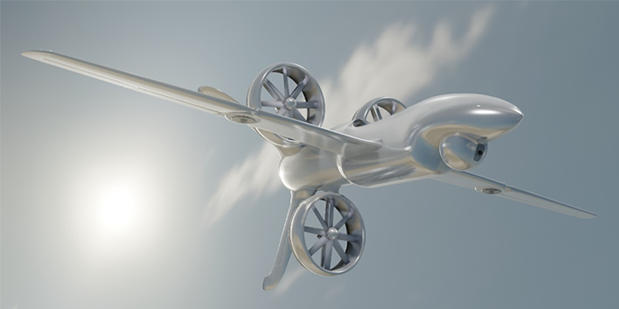
Some drones arrive with a roar. DARPA’s newest vision for electric-powered spy drones wants to arrive with something closer to a whisper. That is the whole point. In modern warfare, the aircraft that survives is not always the biggest, fastest, or loudest machine in the sky. Sometimes it is the one that slips into the air from a ship deck, watches quietly, sends back useful intelligence, and returns before anyone has had time to ask, “Was that a bird, a weather balloon, or government paperwork with wings?”
DARPA, the Defense Advanced Research Projects Agency, has been pushing several related ideas that could reshape how the U.S. military uses unmanned aerial systems. Two programs stand out in this conversation: ANCILLARY, a vertical takeoff and landing unmanned aircraft concept designed to operate without runways or bulky launch equipment, and SHEPARD, the hybrid-electric aircraft effort behind the XRQ-73 experimental drone. Together, they point toward a future where electric and hybrid-electric propulsion could make surveillance drones quieter, more efficient, easier to deploy, and more useful to smaller military units.
The phrase “electric-powered spy drone” sounds like something from a comic book, preferably one with a villain stroking a cat in a volcano bunker. In reality, the technology is less theatrical and more practical. The goal is not simply to build a battery-powered toy with military stickers. It is to rethink how intelligence, surveillance, reconnaissance, communications relay, and even logistics can be delivered from aircraft that are smaller than traditional military drones but far more capable than hobby-style quadcopters.
What Is DARPA Actually Building?
DARPA’s ANCILLARY program, short for AdvaNced airCraft Infrastructure-Less Launch And RecoverY, focuses on a long-endurance VTOL unmanned air system. In plain English: a drone that can take off and land vertically like a helicopter, then fly efficiently like a fixed-wing aircraft. That matters because helicopters are great at getting off the ground without a runway, but they usually pay for it in speed, range, and fuel efficiency. Fixed-wing aircraft are efficient in forward flight, but they typically need a runway, catapult, launcher, or recovery system. ANCILLARY wants the best of both worlds, minus the logistical circus.
The aircraft is designed for ship flight decks and small, austere land locations. That means it could launch from a Navy destroyer, a Marine expeditionary base, or a rough forward location where nobody has time to build a runway and repaint the welcome sign. The aircraft would not need large mechanical launchers, heavy recovery equipment, or a team of specialists wrestling with cables and nets. For military planners, that is not a small improvement. It changes where persistent surveillance can begin.
Meanwhile, DARPA’s SHEPARD program, or Series Hybrid Electric Propulsion AiRcraft Demonstration, has produced the XRQ-73, a hybrid-electric unmanned experimental aircraft. The XRQ-73 is a larger Group 3 UAS, reported at roughly 1,250 pounds, and is intended to demonstrate how hybrid-electric propulsion can support long-endurance, quiet, efficient mission aircraft. In 2026, DARPA announced that the XRQ-73 had flown at Edwards Air Force Base in California, a major milestone for the program.
Why Electric Power Matters for a Spy Drone
Electric propulsion is attractive for surveillance aircraft for several reasons. First, electric motors can be quieter than conventional engines, especially in certain operating modes. For a spy drone, noise is not just annoying; it is a liability. A loud drone announces itself like a leaf blower at a library. A quieter drone has a better chance of monitoring an area without drawing attention.
Second, electric and hybrid-electric systems can be more flexible in how they distribute power. Instead of one engine mechanically driving one propeller, designers can use multiple electric motors, advanced control systems, batteries, generators, fuel cells, or hybrid architectures to optimize flight. That can help aircraft transition from vertical lift to efficient forward cruise, power sensors, manage thermal signatures, and support mission systems without relying on a single old-school propulsion layout.
Third, hybrid-electric propulsion can improve fuel efficiency and operational flexibility. Pure battery aircraft still face energy-density limits, especially when they need long range, heavy payloads, and vertical lift. Batteries are wonderful, but compared with liquid fuels, they are still a bit like bringing a granola bar to a marathon and calling it catering. Hybrid-electric systems offer a compromise: fuel provides energy, while electric systems provide efficient power management and design freedom.
ANCILLARY: The Runway-Free Drone Idea
ANCILLARY is especially interesting because it targets a gap between small tactical drones and large military unmanned aircraft. Small drones are easy to carry but limited in range, payload, and endurance. Large drones can fly long missions and carry sophisticated sensors, but they need serious infrastructure. DARPA is trying to create a drone class that gives small units access to capabilities that once belonged mostly to bigger platforms.
Small Footprint, Big Ambition
The program emphasizes low weight, large payload capacity for its size, long endurance, and vertical takeoff and landing. In DARPA’s accelerated EVADE demonstration effort, related aircraft concepts were described as weighing less than 330 pounds while targeting long endurance with useful payload capacity. That is a sweet spot for expeditionary operations. A drone in that category could be moved, stored, launched, and recovered much more easily than a traditional aircraft.
DARPA has described potential mission sets including intelligence, surveillance, reconnaissance, target acquisition, communications relay, logistics, synthetic aperture radar, and weapons delivery. That does not mean every aircraft will do everything. It means the platform is being designed like a flying truck: adaptable, modular, and useful in more than one awkward military scenario.
Why Ships Care About This
Ships have limited deck space. Every square foot matters. A destroyer cannot simply roll out a runway because the captain feels ambitious. A small VTOL drone that can fold, store compactly, launch vertically, and cruise efficiently could dramatically expand a ship’s sensing range. Instead of relying only on helicopters, large drones, or distant aircraft, a ship could launch multiple unmanned systems to create a wider surveillance network.
This is where the “spy drone” label begins to make sense. A ship commander needs to find, fix, track, and identify vessels, threats, or suspicious activity beyond the horizon. A network of quiet, long-endurance drones could act like extra eyes in the sky. Not glamorous eyes, perhaps. More like very expensive, extremely disciplined seagulls with sensors.
XRQ-73: The Hybrid-Electric Flying Wing
The XRQ-73 represents a different but related track. Instead of focusing mainly on runway-free VTOL operations, the XRQ-73 is about proving the military value of hybrid-electric propulsion in a missionized unmanned aircraft. Its flying-wing style design suggests an emphasis on efficiency and potentially lower observability. The “RQ” designation also points toward intelligence, surveillance, and reconnaissance.
DARPA has presented SHEPARD as an X-prime effort, meaning it is intended to mature emerging technology and reduce integration risk quickly. That phrase sounds bureaucratic, but it matters. Many promising aircraft technologies work beautifully in slides, models, and conference speeches. The difficult part is integrating engines, motors, batteries, cooling, flight controls, sensors, software, structure, and mission equipment into an aircraft that actually flies. SHEPARD is about getting beyond the “cool diagram” stage.
Why a Flying Wing?
Flying-wing aircraft can offer aerodynamic efficiency because the body and wings blend together. They can also support low-observable shaping when carefully designed. The XRQ-73 is not simply a mini B-2, and it should not be treated as a magic invisibility cloak with landing gear. But the broad design direction makes sense for a quiet, efficient surveillance drone that may need to carry sensors and stay airborne for extended missions.
Hybrid-electric propulsion may also help reduce acoustic and infrared signatures compared with some conventional propulsion systems. A cooler, quieter aircraft is harder to notice, harder to track, and more useful for surveillance. In reconnaissance, the best performance metric is often not “how dramatic was the takeoff?” but “did anyone know it was there?”
The Military Problem DARPA Is Trying to Solve
Modern battlefields are crowded with sensors. Satellites, radar, radio-frequency detectors, electronic warfare systems, thermal imagers, loitering munitions, and cheap commercial drones all compete for attention. At the same time, military units need more information, faster. They need to see over hills, beyond shorelines, across urban terrain, and around threats that may move quickly.
Large drones can help, but they are not always available at the right place or time. A small unit cannot simply summon a high-altitude unmanned aircraft whenever it wants a better view. That aircraft may be tasked elsewhere, based far away, vulnerable to air defenses, or tied up in command layers. DARPA’s electric-powered and hybrid-electric drone concepts are partly about democratizing air power: giving smaller units their own persistent aerial tools.
Autonomy Is the Secret Ingredient
Propulsion gets the headlines, but autonomy may be just as important. A drone that requires constant expert piloting is useful, but it still demands attention, training, and support. A drone that can handle much of its own flight, navigation, takeoff, landing, and mission management becomes far more attractive to troops who already have enough going on.
DARPA’s related efforts have emphasized autonomy software, payload integration, and reducing reliance on dedicated ground control stations. That is a big deal. The future of military drones is not just “more aircraft.” It is aircraft that can be operated with fewer people, integrated into existing battlefield software, and handed useful tasks instead of constant joystick babysitting.
Potential Missions: Surveillance, Relay, Logistics, and More
The obvious mission is intelligence, surveillance, and reconnaissance. A quiet drone can watch roads, coastlines, ships, base perimeters, or suspicious movement. It can carry electro-optical cameras, infrared sensors, radar, communications equipment, or electronic payloads depending on size and mission requirements.
Communications relay is another important role. In mountains, cities, forests, and maritime environments, radio signals can be blocked or degraded. A drone overhead can become a temporary communications tower, helping troops, ships, vehicles, and command centers stay connected.
Logistics may sound less thrilling, but it can be lifesaving. A VTOL drone that carries a useful payload could move medical supplies, batteries, ammunition, food, spare parts, or blood products into hard-to-reach locations. Nobody makes blockbuster movies about spare parts delivery, but the person waiting for a critical component in the field would absolutely give that drone five stars.
The Challenges: Batteries, Heat, Weather, and Reality
None of this is easy. Vertical takeoff demands high power. Long endurance demands efficiency. Payload demands lift. Shipboard operations demand compact storage, reliable control, and safe recovery in wind, spray, and moving-deck conditions. Add bad weather, salt water, electronic warfare, cybersecurity, and maintenance realities, and suddenly the “small drone” becomes a very large engineering headache wearing a tiny aircraft costume.
Energy storage remains one of the biggest issues. Electric motors are efficient, but batteries are heavy. Hybrid-electric designs can help, yet they add complexity: generators, thermal management, power electronics, control software, and safety systems. Heat must be managed carefully, especially when mission sensors and onboard electronics also demand power.
Autonomy also has limits. A drone must understand where it is, where it should go, when conditions are unsafe, how to avoid obstacles, and how to communicate securely. On a battlefield, signals may be jammed, spoofed, or interrupted. The drone must be helpful without becoming confused, compromised, or overly dependent on perfect connectivity.
Why This Technology Could Change the Drone Market
DARPA programs often do not become mass-produced systems exactly as first imagined. That is normal. DARPA’s job is to take risks, test ideas, and push technology beyond comfortable limits. The most important output may not be one aircraft model. It may be a set of propulsion architectures, autonomy tools, manufacturing methods, payload interfaces, and operational lessons that migrate into future military systems.
If ANCILLARY-style VTOL drones prove reliable, they could influence Navy, Marine Corps, Army, special operations, and Coast Guard requirements. If XRQ-73-style hybrid-electric propulsion proves useful, it could shape the next generation of quiet ISR drones. The commercial world may also benefit indirectly as aircraft designers learn more about distributed propulsion, efficient power management, lightweight structures, and autonomous flight control.
Experience-Based Perspective: What This Drone Would Feel Like in Real Operations
Imagine a small maritime task group operating far from a large airbase. The crew wants more awareness beyond the horizon, but sending a helicopter every time something appears on a sensor is expensive, tiring, and risky. A compact electric or hybrid-electric VTOL surveillance drone changes the rhythm. Instead of waiting for scarce aviation assets, the ship can launch a quiet unmanned aircraft from the deck, let it climb, transition into efficient forward flight, and extend the ship’s awareness bubble. The experience would feel less like “calling in air support” and more like opening a new window in the sky.
Now imagine a Marine unit on a temporary forward base. The terrain is uneven, the roads are questionable, and the local weather has the personality of a malfunctioning washing machine. A runway is out of the question. A catapult system is too bulky. A helicopter may be unavailable or too visible. A runway-free drone that can rise vertically, carry a sensor package, and loiter for hours becomes a practical tool. It could scout a route before a convoy moves, confirm whether a ridgeline is clear, or relay communications between teams separated by hills. That kind of experience is not flashy, but it is exactly the sort of quiet advantage that changes decisions.
For operators, the most important improvement may be reduced workload. A drone that needs constant manual control can become another job in an already stressful environment. If autonomy handles takeoff, navigation, and routine flight management, the human can focus on the mission: What are we looking at? Is it relevant? Does someone need to act? Good drone design should make the operator feel more informed, not more exhausted.
There is also a psychological effect. Persistent surveillance gives units confidence. When troops know they can look beyond the next hill, road bend, or harbor entrance, they make better choices. They may avoid ambushes, reduce unnecessary movement, or confirm threats before escalating. The drone becomes a patient observer, not a replacement for judgment. It gives people more time and better context.
Maintenance crews would have their own experience, and it would matter just as much. A brilliant drone that takes ten specialists and three crates of fragile tools to keep alive is not expeditionary; it is a diva. The real success of DARPA’s electric-powered spy drone concept will depend on whether it can be stored, launched, recovered, repaired, and relaunched without turning every mission into a traveling aerospace science fair. Ruggedness, modular parts, simple diagnostics, and reliable power systems will decide whether the technology becomes field gear or just another impressive prototype remembered fondly at conferences.
From a broader defense perspective, the experience is one of decentralization. Intelligence gathering no longer has to come only from large, centralized platforms. Smaller units can carry their own aerial sensing layer. Ships can create wider surveillance webs. Remote teams can request supplies, relay data, or monitor movement without waiting for a perfect support chain. That is why DARPA’s electric-powered spy drone work feels important. It is not just about a new aircraft. It is about making airpower more available, more flexible, and less dependent on big infrastructure.
Conclusion
DARPA’s electric-powered spy drone efforts show where unmanned aviation is heading: quieter aircraft, hybrid-electric propulsion, vertical takeoff, long endurance, modular payloads, and smarter autonomy. ANCILLARY aims to make capable drones launchable from ships and rough ground sites without special infrastructure. SHEPARD and the XRQ-73 show how hybrid-electric propulsion could support efficient, quiet, mission-focused surveillance aircraft. Together, they suggest a future where small military units get big-aircraft awareness without waiting for a runway, a large crew, or a perfect day.
The technology still has to prove itself in difficult conditions. Energy storage, heat, autonomy, weather, payload integration, and maintainability remain serious challenges. But the direction is clear. The next generation of spy drones may not thunder overhead. It may lift quietly from a ship deck, slip into the distance, watch patiently, and return with the kind of information that keeps people alive. Not bad for a machine that, at first glance, sounds like a Roomba that went to flight school.
Note: This article is based on publicly available information from U.S. government announcements, DARPA program descriptions, defense industry releases, and reputable defense technology reporting available at the time of writing.