Editor’s note: This article discusses a disputed viral allegation. Public alerts and multiple fact-checking reports said the road was opened for emergency evacuation and that the road commonly called “Oprah’s road” is not owned outright by Oprah Winfrey.
When a tsunami warning hits Hawaii, nobody is in the mood for celebrity real estate trivia. People want higher ground, clear roads, reliable alerts, and absolutely zero plot twists involving a famous neighbor’s driveway. That is why a viral claim accusing Oprah Winfrey of refusing to open a private Maui road during a tsunami evacuation spread so quickly: it had fear, traffic, wealth, disaster, and social media outrage all packed into one very shareable suitcase.
But the facts are more complicatedand far less cinematicthan the online version. The allegation that Oprah refused to open a private road for residents trying to escape an oncoming tsunami was strongly disputed by her representatives, local emergency updates, and fact-checking reports. Maui County alerts said the road was open for access Upcountry, and reporting from major outlets found that the road in question, often nicknamed “Oprah’s road,” is associated with her property access but is owned by Haleakalā Ranch, not Winfrey herself.
What Happened During the Hawaii Tsunami Warning?
The controversy began after a powerful 8.8 magnitude earthquake struck off Russia’s Kamchatka Peninsula on July 29, 2025. The quake triggered tsunami warnings and advisories across the Pacific, including Hawaii, parts of the U.S. West Coast, Japan, and other coastal regions. In Hawaii, emergency officials urged people in tsunami evacuation zones to move inland or to higher ground.
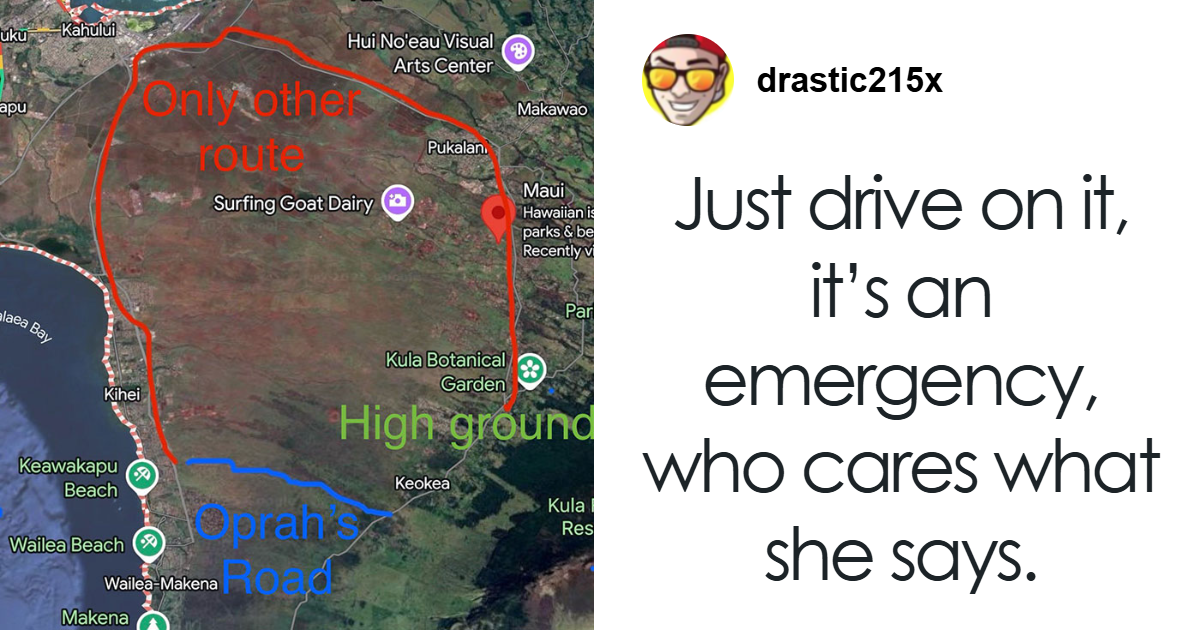
On Maui, that meant roads became crowded fast. Anyone who has ever watched a single Costco checkout line turn into a civic crisis can imagine what happens when an entire coastal community tries to evacuate at once. Videos of gridlocked traffic circulated online, and social media users began demanding that a private road near Oprah Winfrey’s Maui property be opened to help residents reach Upcountry areas more quickly.
The online claim was explosive: Oprah was allegedly refusing to open a private road while people were trying to escape the tsunami. The story spread across X, TikTok, Instagram, Facebook, and entertainment news pages. Some posts framed the situation as a billionaire blocking desperate locals. Others used maps, traffic footage, and emotional captions to suggest that time was running out.
But public information available after the fact does not support the claim that Winfrey refused access. Maui County’s emergency updates stated that “Oprah’s road” was open to get Upcountry. Reports from the Associated Press, PolitiFact, AFP Fact Check, Honolulu Civil Beat, Newsweek, People, E! News, Fox News, and other outlets also said Winfrey’s team denied the allegation and that the road was opened in coordination with local authorities.
The Road at the Center of the Backlash
The road involved in the controversy is commonly referred to online as “Oprah’s road,” but that nickname is part of the confusion. According to fact-checking reports, the portion of Kealakapu Road discussed in the viral posts belongs to Haleakalā Ranch. Winfrey reportedly has an easement agreement connected to the road, allowing use and maintenance improvements, but ownership and public access decisions were described as primarily belonging to the landowner.
That distinction matters. In a disaster, the public does not care who has the easement, who paved what, or whether a ranch gate has a more complicated legal history than a prestige TV finale. People care whether the road is open. Still, from a reporting standpoint, the difference between “Oprah owns the road and refused to open it” and “a private ranch road associated with her property access was opened through coordination with officials” is enormous.
Haleakalā Ranch representatives told the Associated Press that they contacted emergency officials shortly after the tsunami warning was issued and helped open the road. Reports said the road became accessible around 5 p.m. local time, with vehicles escorted in groups to keep traffic safe on the mountain route. Around 150 to 200 vehicles were reportedly assisted before officials determined that the urgent evacuation need had eased.
Winfrey’s representatives also said her team contacted local law enforcement and FEMA after hearing the tsunami warnings to ensure the road was opened. Maui County emergency alerts later confirmed that the road was available for Upcountry access, which directly undercut the viral claim that it remained closed throughout the emergency.
Why the Claim Spread So Quickly
The Oprah road controversy became viral because it fit a powerful emotional pattern: disaster plus inequality plus celebrity. During emergencies, people are frightened, information is incomplete, and social media rewards the loudest version of events. If the loudest version also involves a world-famous billionaire, the algorithm basically throws confetti.
Hawaii already has deep public concerns about land ownership, housing affordability, tourism, short-term rentals, and the influence of wealthy outsiders. Maui, in particular, has carried heavy trauma since the 2023 Lahaina wildfire, one of the deadliest U.S. wildfires in modern history. In that context, any story about private land and emergency access is not just gossip. It touches a real nerve.
Oprah Winfrey has long owned property on Maui and has previously faced public scrutiny related to disasters on the island. After the Lahaina fires, Winfrey and Dwayne Johnson launched the People’s Fund of Maui and committed $10 million, but even that relief effort drew backlash from people who felt wealthy celebrities should give more directly rather than ask the public to donate. Whether fair or not, that history made the tsunami-road allegation instantly believable to many users before the facts had time to put on shoes.
That is the danger of viral disaster claims. The first post often becomes the emotional truth, even if later reporting corrects it. By the time official updates arrive, the internet has already held a trial, selected a villain, designed the merch, and moved on to the next outrage buffet.
What Official Reports Said
Public alerts from Maui County said tsunami evacuations were issued through sirens, emergency alerts, door-to-door notifications, and other official systems. The county also listed shelter openings and traffic guidance, including instructions to avoid coastal roads and use inland routes where possible. In its traffic section, Maui County said the road commonly called “Oprah’s road” was open to get Upcountry, according to Maui Police Department information.
NOAA and the National Weather Service later reported that tsunami wave heights had diminished and that Hawaii’s tsunami advisory ended on July 30, 2025. Officials still warned that strong or unusual currents could persist for several hours, which is a classic tsunami lesson: the ocean does not clock out just because your phone alert stopped screaming.
The tsunami itself was real. The Kamchatka earthquake was one of the most powerful quakes recorded in the 21st century, and waves were observed across the Pacific Basin. Hawaii and Northern California experienced wave heights of more than one meter in some areas, while officials across multiple countries issued warnings or advisories as the waves moved through the ocean.
So the fear was justified. The confusion was understandable. But the specific allegation that Oprah refused to open the road was not supported by the strongest available evidence.
Public Anger Was About More Than One Road
Even though the claim was disputed, the public reaction revealed something important. People were not only angry about a gate. They were angry about the idea that private property might complicate public survival during a disaster. That is a much bigger issue than one celebrity, one ranch road, or one viral video.
In island communities, evacuation routes are precious. There may be only a handful of roads connecting coastal neighborhoods to higher ground. When a tsunami warning arrives, minutes matter. If a private road could save time, residents naturally want to know whether emergency access is planned, rehearsed, and clearly communicated before the sirens sound.
This is where local governments, private landowners, emergency agencies, and communities need boring but essential agreements. The best disaster plan is not a celebrity statement issued after social media catches fire. It is a pre-written protocol: who opens the gate, who controls traffic, who has keys, who sends alerts, who escorts vehicles, and how residents know where to go without refreshing TikTok like it is an emergency management office.
The Oprah controversy should push a practical question: Are private roads that could serve as emergency routes integrated into official evacuation planning? If yes, the public needs clear messaging. If not, officials should explain why and identify alternatives. In a disaster, uncertainty is gasoline.
Lessons From the Oprah Tsunami Road Backlash
1. Viral claims need a speed bump
During emergencies, bad information moves fast because people are scared. A dramatic post can feel true before it is verified. But sharing unconfirmed claims can make evacuations more chaotic, direct anger at the wrong target, and distract from official instructions.
2. Official communication must be extremely clear
Maui County did confirm the road was open, but the controversy shows that public messaging must be fast, repeated, and easy to understand. If a road is open, say it everywhere. If it is closed, explain why. If it is limited to escorted groups, explain that too.
3. Disaster planning should include private land access
Private roads can become public lifelines during wildfires, floods, tsunamis, and other emergencies. Local governments should have agreements in place before disaster strikes, especially in communities with limited escape routes.
4. Celebrity ownership magnifies public distrust
When famous or wealthy people own large properties in places with housing shortages, local resentment does not appear out of nowhere. It builds over time. Disaster rumors spread more easily when people already believe the system favors the rich.
5. Corrections rarely travel as far as accusations
Fact-checks later said the claim was false, but many people likely saw only the original accusation. That is the internet’s least charming magic trick: misinformation gets a rocket, corrections get a bicycle with one flat tire.
Was Oprah Responsible for the Road?
Based on available reporting, Oprah Winfrey was not the sole decision-maker for opening the road. The road was owned by Haleakalā Ranch, and Winfrey had an easement connected to its use and maintenance. Reports said ranch representatives, local officials, and Winfrey’s land management team coordinated during the emergency.
That does not mean the public was wrong to ask questions. During a tsunami warning, every possible safe route matters. But asking questions is different from declaring guilt. The stronger conclusion is not “Oprah blocked evacuees.” The stronger conclusion is “Maui needs clear public understanding of which private routes can be activated during emergencies and how quickly that happens.”
In other words, the scandal may have been aimed at Oprah, but the useful takeaway belongs to emergency planning. Communities need systems that do not depend on viral pressure, celebrity goodwill, or someone finding the right phone number while the ocean is behaving suspiciously.
Experience-Based Reflections: What This Situation Teaches People Facing a Tsunami Warning
Imagine being in a coastal area when a tsunami warning hits. Your phone buzzes. Sirens sound. People start moving. The first instinct is not calm research. It is action. You grab your family, your pets if you can, medication if it is nearby, and whatever shoes are closest to the door. Nobody is carefully reading land easement documents while packing granola bars.
That is why this Oprah road controversy feels so personal to many people. Whether someone believed the allegation or not, the fear underneath it was real. During a disaster, people want to know that every possible escape route is available and that nobody’s private convenience is being placed above public safety. Even the appearance of a closed road can create panic if residents think it might be the fastest path to higher ground.
One practical experience people can take from this story is the importance of knowing evacuation routes before an emergency. Do not wait for a siren to figure out where “higher ground” is. Coastal residents and visitors should check local tsunami evacuation maps, learn the difference between a tsunami warning and advisory, and identify multiple routes inland. Hotels, vacation rentals, schools, and workplaces should also make this information obvious. A laminated map near the door may not be glamorous, but neither is sitting in bumper-to-bumper traffic wondering whether the ocean has RSVP’d.
Another lesson is to rely on official emergency channels first. Social media can be useful for real-time observations, but it can also turn uncertainty into accusation. During the Maui warning, official sources provided shelter locations, road updates, evacuation notices, and later cancellation information. Those are the channels people should treat as the backbone of decision-making.
There is also a community lesson. Private landowners in hazard zones should work with local emergency agencies before disasters happen. If a private road can safely help residents evacuate, the plan should be written down, tested, and publicly understood. Gates, escorts, liability concerns, road conditions, and traffic control all matter. A narrow mountain road cannot simply become a free-for-all without creating new danger. But if the route can be used safely, people should not have to beg for clarity while a tsunami warning is active.
Finally, this story is a reminder to slow down before sharing outrage. Anger can feel helpful during a crisis, but verified information saves more lives. A false accusation can distract from evacuation instructions, harass people who may not control the situation, and deepen distrust at the exact moment a community needs coordination. The better response is simple: move to safety, follow official alerts, help neighbors, and verify before amplifying. In a tsunami warning, the goal is not to win the internet. The goal is to get everyone to higher ground.
Conclusion
The claim that Oprah Winfrey refused to open a private Maui road during a tsunami evacuation became a viral flashpoint because it combined real fear with existing frustration over wealth, land, and disaster readiness in Hawaii. But the best available reporting shows the central allegation was not accurate. The road was reportedly opened in coordination with local authorities, Maui County alerts said it was available for Upcountry access, and fact-checkers found that the road was owned by Haleakalā Ranch, with Winfrey holding an easement rather than full control.
Still, the controversy should not be dismissed as mere celebrity gossip. It exposed an important preparedness issue: communities need clear, pre-planned emergency access routes, especially where private roads may provide critical shortcuts to higher ground. The internet may have aimed its spotlight at Oprah, but the bigger story is about trust, communication, and disaster planning before the next siren sounds.