Some comics make you laugh because the punchline is clever. Others make you laugh because the final panel arrives like a raccoon falling through an open skylight: completely unexpected, slightly chaotic, and somehow exactly what the story needed.
Canadian comic artist Blanche Draw specializes in the second kind. Her short comics begin with recognizable situations, friendly characters, or familiar fantasy scenarios. Just when readers think they understand where the story is going, the narrative swerves toward an absurd reveal. The result is a collection of funny comics with unexpected endings that reward careful readingand occasionally make you wonder whether mermaids have been judging humanity this entire time.
Meet Blanche Draw, the Artist Behind the Comics
Blanche Draw is a French Canadian comic artist based in Montréal. She grew up in Québec, speaks French as her first language, and began drawing stories when she was around 13 years old. After studying visual arts, she completed a bachelor’s degree in comic arts at the Université du Québec en Outaouais in 2018. Her public profile continues to identify her as a Montréal-based comic creator.
That formal background helps explain why her comics feel compact without seeming rushed. A strip may last only a few panels, but it still contains the basic ingredients of a miniature movie: framing, expressions, camera angles, timing, dialogue, conflict, and a final reveal. Blanche has described comics in similar terms, viewing them as movies that readers experience through images arranged in sequence.
Her work moves freely between ordinary life and imaginary worlds. One strip might start with a recognizable social situation, while another introduces aliens, animals, supernatural beings, or creatures from the ocean. The settings can change dramatically, but the comedic engine remains consistent: establish a believable expectation, encourage the reader to commit to it, and then cheerfully pull the floor away.
Why These Funny Comics With Unexpected Endings Work
The Setup Feels Familiar
A surprise ending works best when the beginning gives readers something stable to believe. Blanche often uses situations that feel emotionally recognizable even when the characters are fantastical. Someone wants approval. Someone misunderstands a conversation. Someone tries to look impressive, avoid embarrassment, help a friend, or solve a suspiciously simple problem.
These familiar motives act as narrative handrails. Readers quickly understand what appears to be happening, so they begin predicting what comes next. That prediction is important because a twist cannot overturn an expectation that never existed.
The Final Panel Changes the Meaning of Everything
The funniest twist comics do more than place a random joke at the end. Their last panel changes how readers interpret the earlier panels. An innocent expression suddenly looks suspicious. A dramatic speech turns out to be about something hilariously minor. A seemingly threatening creature reveals an unexpectedly wholesome goalor a cute character reveals that it has been the real menace all along.
This structure is closely connected to the incongruity theory of humor. Philosophers and psychologists have long argued that comedy often begins when an established mental pattern is unexpectedly violated. Modern explanations also emphasize that the contradiction must feel understandable or harmless enough to remain funny rather than merely confusing.
The Artwork Protects the Punchline
In a visual joke, every raised eyebrow can become evidence. The artist must reveal enough information to keep the story clear without accidentally giving away the ending. Blanche’s clean character designs and readable compositions help direct attention toward the apparent story while small visual details quietly prepare the alternate interpretation.
That balance is more difficult than it looks. A crowded panel can bury the joke, while an overly obvious clue can spoil it. Effective comic composition guides the reader’s eye from panel to panel, coordinating text, character placement, expressions, and scene changes into one coherent path.
What to Expect From the 24 New Comics
Everyday Problems That Refuse to Stay Ordinary
Blanche’s humor frequently begins with something small: clothing, relationships, social expectations, awkward conversations, pets, personal habits, or the little misunderstandings that make daily life feel like an unpaid improvisational theater performance.
Instead of simply making an observational joke, she lets the situation evolve into something stranger. Everyday logic gradually collides with fantasy logic. The reader may not notice the transition immediately because the characters respond to bizarre developments with impressive calm. Apparently, maintaining a straight face while reality collapses is an essential cartoon survival skill.
Mermaids With More Than Swimming on Their Minds
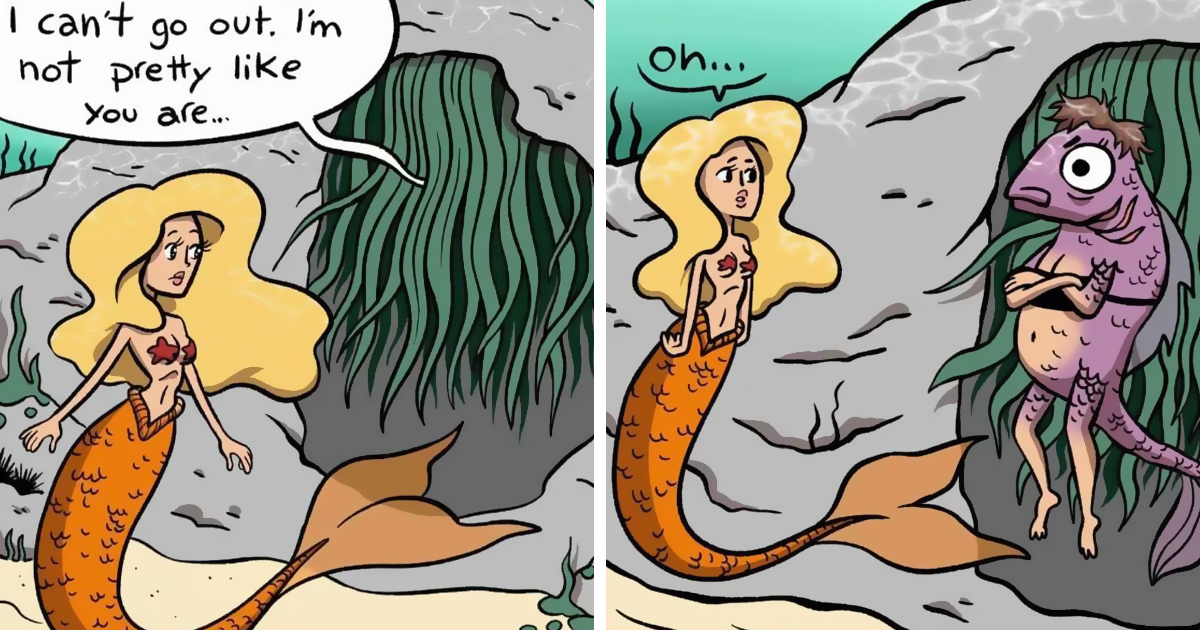
Several comics in the collection explore mermaid-centered ideas. These pieces were connected to MerMay, an annual drawing challenge in which artists create mermaid-themed work during May. Blanche adapted the challenge to her own style by developing mermaid-based comics instead of limiting herself to conventional character illustrations.
This was a clever match for her storytelling. Mermaids come with familiar mythology, visual beauty, and a ready-made contrast between human and underwater life. That gives a cartoonist plenty of expectations to reverse. A majestic ocean scene can become a joke about personal space, fashion, dating, food, friendship, or the practical difficulties of owning a tail.
Animals, Aliens, and Other Unreliable Participants
Nonhuman characters give these funny comics additional freedom. An animal can behave like an office worker. An alien can have surprisingly domestic interests. A monster can be emotionally sensitive, while a seemingly harmless pet can operate with the confidence of a tiny organized-crime boss.
Anthropomorphic characters also create useful distance from real-world problems. Readers can recognize human insecurity, vanity, affection, or confusion without feeling that the comic is lecturing them. The strange character makes the situation playful, but the emotion underneath it remains familiar.
Wholesome Moments With Suspicious Energy
Not every surprise needs to be dark or cynical. Some of Blanche’s strongest ideas come from mixing absurdity with sweetness. A scene may appear ominous before revealing an unexpectedly kind motive. Elsewhere, a cute setup may become ridiculous rather than disturbing.
This tonal flexibility keeps the collection unpredictable. Readers cannot assume that every final panel will be cruel, comforting, bizarre, or sarcastic. The only dependable rule is that the first interpretation probably should not be trusted.
The Bilingual Personality of Blanche’s Webcomics
Blanche has produced her comics in both English and French, reflecting her Québec background and her desire to remain connected to her first language. That choice also allows the work to reach audiences beyond a single linguistic community.
Translating a comic is not always as simple as replacing one sentence with another. Dialogue must fit inside speech balloons, preserve the character’s voice, and reach the punchline at the correct moment. Puns and idiomatic expressions can be especially stubborn. A joke that performs a perfect backflip in French may land face-first in English unless it is carefully adapted.
Visual comedy helps bridge that gap. Expressions, body language, framing, and physical reactions can carry much of the joke even when the wording changes. In some strips, a single stare in the final panel may communicate more than a paragraph of dialogue ever could.
How Blanche Finds Ideas for Her Comics
The artist has explained that inspiration can come from personal experiences, random thoughts, or deliberately unpredictable prompts. When ideas are scarce, she has used lists of random words to provoke new connections. This helps explain why her comics can feel relatable one moment and gloriously unhinged the next.
She has also spoken openly about the difficulty of remaining consistent while balancing comics with other work and creative projects. Rather than treating constant production as the only measure of success, she has emphasized discipline while trying to avoid burnout.
That distinction matters for independent webcomic artists. A four-panel strip may take only seconds to read, but producing it can require brainstorming, writing, thumbnailing, sketching, revising, lettering, coloring, translating, formatting, and publishing. The reader receives one quick laugh; the artist may have spent hours negotiating with a fictional mermaid who refuses to stand in the correct corner of the panel.
Why Short Webcomics Are Perfect for Surreal Humor
Short-form comics are naturally suited to unexpected endings because readers can absorb an entire narrative in a small amount of time. Images and words work together, delivering information faster than either format could manage alone. The spaces between panels also require readers to infer movement, time, and cause, making the audience an active participant in completing the story.
This participation strengthens the punchline. As readers move through the panels, they unconsciously build a version of events. When the ending contradicts that version, the joke feels personal. The artist did not merely present a surprise; she persuaded the reader to construct the wrong answer independently.
Cartoon humor has repeatedly benefited from that kind of unpredictability. Offbeat strips such as The Far Side became influential by turning ordinary scenes into strange alternate realities, while modern webcomics have expanded the format through direct digital distribution and highly individual voices.
How to Enjoy the 24-Picture Collection Without Spoiling the Fun
Twist comics deserve a slightly slower reading style than the average social media scroll. It is tempting to race toward the last panel, especially when the format announces that a surprise is coming. Doing so, however, can flatten the setup and make the reveal less satisfying.
Pause briefly on each panel. Notice where the characters are looking, which details receive unusual emphasis, and what assumptions the dialogue encourages you to make. Then read the ending and return to the beginning. Many well-designed comics become funnier on the second pass because the clues are suddenly visible.
It also helps to resist predicting the exact punchline. Trying to outsmart every comic turns a lighthearted gallery into a standardized test administered by a sarcastic sea creature. Let the strip mislead you. Being confidently wrong is part of the entertainment.
A Reader’s Experience: Entering a Gallery Where Nothing Behaves Normally
Imagine opening the first comic during a short break. You expect a quick distraction before returning to work. The opening panel looks harmless. Two characters are talking, a problem is introduced, and your brain immediately begins assembling a reasonable explanation. By the final panel, the explanation has been launched into space, possibly by an alien who only stopped by to borrow a dog.
You move to the next strip with slightly more caution. This time you study the background. You examine every object as though solving a mystery. A chair seems suspicious. A cloud might be involved. That innocent-looking fish clearly knows something. The ending arrives, and once again the joke comes from an entirely different direction.
After several comics, the experience becomes a playful contest between reader and artist. You know Blanche is attempting to mislead you, but you do not know how. Sometimes you correctly identify the general direction of the twist, only to discover that the final detail is far stranger than your prediction. At other times, the comic does not trick you through hidden clues at all. It simply takes a familiar situation and applies a form of logic that no responsible adult would have approved.
Trying to create a similar comic reveals how carefully these short stories are constructed. Begin with a simple premise: someone hears a strange noise behind a door. The obvious ending is a monster. To produce a stronger twist, you must ask what else the reader might assume, what information can be withheld fairly, and what reveal would make the earlier panels mean something new.
Perhaps the character behind the door is rehearsing an embarrassing motivational speech. Perhaps the “monster” is afraid of the person opening the door. Perhaps the noise comes from a group of ghosts assembling furniture and refusing to read the instructions. Each possibility changes the setup, requiring different expressions, dialogue, and visual clues.
Then comes the problem of timing. Reveal the truth too early and there is no tension. Hide too much and the ending feels arbitrary. Add too much dialogue and the joke suffocates beneath an avalanche of explanation. Remove too much and readers may stare at the final panel with the expression of someone whose furniture arrived without screws.
This exercise makes Blanche’s economy more noticeable. Her comics rarely need complicated mythology or long introductions. A recognizable emotion can establish the situation in seconds. The fantasy element adds possibility, while the final image supplies the decisive shift.
The experience is also surprisingly relaxing. These strips invite readers into a world where normal assumptions are temporary and absurd outcomes are not emergencies. A misunderstanding can become a punchline. An awkward moment can transform into a supernatural adventure. Even the strangest creatures are often dealing with recognizable concerns.
By the time you reach the twenty-fourth comic, you may feel both entertained and pleasantly distrustful of final panels. Everyday life briefly appears more flexible. The next person staring intensely at a grocery-store freezer may not be comparing ice cream prices. They may be communicating with an ancient frozen oracle. It is probably the ice cream, of coursebut Blanche’s comics make the alternative seem worth considering.
Final Thoughts
Blanche Draw’s funny comics succeed because they combine accessible artwork, familiar emotions, surreal imagination, and carefully controlled timing. The characters may include humans, mermaids, animals, aliens, or creatures that would make a marine biologist quietly change careers, but their motivations remain easy to recognize.
The 24 new comics offer more than isolated punchlines. Together, they show how much storytelling can fit inside a handful of panels. Each strip creates a tiny world, encourages readers to misunderstand it, and then reveals the hidden logic at exactly the right moment.
That is the pleasure of an effective unexpected ending: the surprise lasts only a second, but the revised story stays in your mind. You laugh, scroll back, notice what you missed, and reluctantly admit that the suspicious fish had been warning you all along.