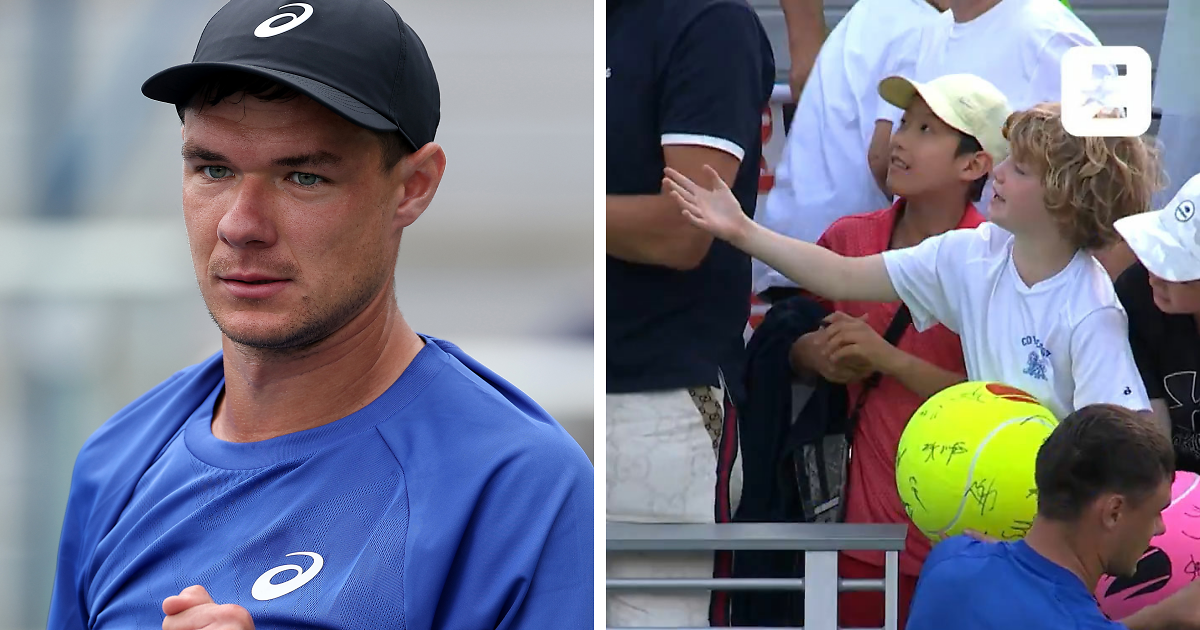
Every Grand Slam creates highlights: impossible passing shots, dramatic comebacks, celebrities pretending they understand tiebreak rules, and fans holding tennis balls the size of small planets. But during the 2025 US Open, one of the tournament’s most talked-about moments did not come from a forehand winner. It came from a hat.
After Polish tennis player Kamil Majchrzak pulled off a stunning second-round victory over No. 9 seed Karen Khachanov on August 28, 2025, he walked over to the crowd on Court 11 to sign autographs and hand out a few keepsakes. In a moment that should have been simple and sweet, Majchrzak appeared to offer his match-worn cap to a young fan named Brock. Then, in the blink of an eye, an adult man standing nearby grabbed the cap and tucked it away.
The internet saw it. The internet gasped. The internet put on its detective glasses. And, because this is the internet, the internet also immediately formed a 24-hour court of public opinion, complete with replays, zoom-ins, outrage, memes, and enough commentary to fill Arthur Ashe Stadium twice.
The viral US Open video quickly became a story about more than one souvenir. It raised questions about fan behavior, sportsmanship, entitlement, public accountability, and how athletes can turn an awkward mess into a memorable act of kindness. Majchrzak’s response gave the story its heart: he asked fans to help him find the boy, then reunited with Brock and gave him a new cap and other gifts.
What Happened In The Viral US Open Hat Video?
The incident happened after one of Majchrzak’s biggest career wins. Facing Karen Khachanov, a top-10 opponent and the No. 9 seed, Majchrzak came back from two sets down in a match that lasted more than four hours. He saved five match points and eventually won 2-6, 6-7(4), 6-4, 7-5, 7-6(5), taking the final match tiebreak 10-5.
That kind of win is not just a tennis result; it is a full-body emotional earthquake. By the time Majchrzak reached the fans, he had spent hours running, lunging, serving, recovering, and somehow refusing to lose. He signed autographs, acknowledged supporters, and tried to reward a young fan with his cap.
The video shows the player near the barrier, holding the hat toward Brock. But before the child could enjoy the moment, an adult man beside him reached in, took the cap, and placed it into a bag. The boy looked stunned and appeared to protest. Majchrzak, still signing items and surrounded by noise and movement, did not seem to notice what had happened in real time.
That small detail matters. From the player’s point of view, the crowd scene was chaotic: fans were calling his name, presenting tennis balls, asking for signatures, and trying to get close enough for a once-in-a-lifetime souvenir. From the camera’s point of view, however, the moment was clear enough to make viewers furious. A keepsake that seemed meant for a child had ended up with an adult.
Who Was The Man Who Took The Hat?
Multiple reports later identified the man as Piotr Szczerek, a Polish businessman associated with the paving company Drogbruk. After the video spread, he faced intense criticism online. The reaction was swift because the visual was so easy to understand: a child reaching for a gift, an adult taking it, and the child left empty-handed.
Szczerek later apologized on social media. He said he had made a serious mistake and claimed he believed the hat was being handed in his direction for his sons, who had reportedly asked for autographs earlier. He also said the hat had been returned to the boy and that he had apologized personally.
Whether viewers accepted that explanation is another matter. Online audiences are not known for gently sipping tea while waiting for all angles of a story. They react quickly, especially when children are involved. In this case, the video carried a strong emotional punch because it looked like an adult had used size, position, and speed to take something from a kid.
Still, the fairest way to describe the situation is this: the broadcast showed the man taking the cap; he later apologized and said it was a mistake; Majchrzak focused his attention on making the young fan whole. That final part is why the story did not remain only a tale of bad behavior. It became a story about how one athlete handled an uncomfortable public moment with class.
Kamil Majchrzak Responds With A Search For Brock
After Majchrzak saw what happened, he turned to social media. He explained that he had not realized after the match that his cap had not reached the boy. He then asked fans to help find the child from his match.
That response immediately changed the tone of the story. Instead of arguing with strangers online or making the incident about himself, Majchrzak asked a practical question: where is the kid, and how can we fix this?
It was a smart move, but more importantly, it was a kind one. In sports, athletes are often judged by statistics: aces, winners, break points saved, ranking points gained. But moments like this remind fans that reputation is also built in the margins. How does an athlete respond when the match is over, the cameras are still rolling, and someone else’s disappointment lands in his lap?
Majchrzak did not have to do much. He could have ignored the video. He could have said it was unfortunate and moved on. Instead, he used his platform to track down Brock and make sure the young fan received the kind of moment he should have had in the first place.
The Reunion: A Happy Ending At Flushing Meadows
With help from the internet, Majchrzak found Brock. The two met at the US Open, where the player gave the boy a replacement cap and additional merchandise. Photos and video from the reunion showed a smiling Brock, a relieved athlete, and the kind of wholesome sports moment that makes people temporarily forgive the existence of comment sections.
Majchrzak later shared a friendly message with Brock, turning a sour viral clip into a warm memory. It was the sports equivalent of cleaning up spilled juice before it ruins the whole picnic.
The reunion mattered because the original video felt unfair. Children remember these moments. A signed cap from a professional tennis player is not just fabric and stitching; it can become a bedroom trophy, a story told at school, or the tiny spark that makes a kid want to pick up a racket. For a young fan, that hat could represent being seen by a player he admired.
Majchrzak understood that. By meeting Brock, he restored the meaning of the gift. The replacement cap was nice, but the personal attention was even better. Anyone can hand out merchandise. Not everyone circles back to make sure a child’s big moment is rescued.
Why This US Open Moment Went Viral So Fast
The Kamil Majchrzak hat video spread quickly because it checked nearly every box for a viral sports story. It was short, easy to understand, emotionally sharp, and visually clear. No one needed a degree in tennis scoring to get the point. A player tried to give a kid a hat. A grown man took it. Cue the global chorus of “Excuse me?”
1. The Video Had Instant Moral Clarity
Some sports controversies require rulebooks, slow-motion analysis, and retired referees with laser pointers. This did not. Viewers saw a child lose a gift and reacted emotionally. That simplicity made the clip easy to share.
2. The Setting Made It Bigger
The US Open is one of tennis’s most visible stages. When something happens in New York during a Grand Slam, it does not stay quiet for long. Cameras are everywhere, fans are recording everything, and social media moves faster than a first serve down the T.
3. The Contrast Was Powerful
Majchrzak’s generosity stood in sharp contrast to the adult fan’s behavior. One person was giving. Another appeared to be taking. That contrast made the story feel bigger than a souvenir dispute.
4. The Ending Was Satisfying
Viral outrage often ends in exhaustion. This one ended with a reunion, a new cap, and a child smiling. That gave people a complete story arc: problem, outrage, search, reunion, lesson. Hollywood would call that structure. The internet calls it “finally, something nice.”
Fan Etiquette: The Lesson Nobody Should Need But Apparently We Do
Sports souvenirs can make adults behave strangely. A foul ball, a hockey puck, a golf glove, a tennis towel, or a signed cap can suddenly turn a normal person into a raccoon guarding a sandwich. But there is a simple rule that should apply everywhere: if a player gives something to a child, let the child have it.
This is not complicated. You do not need an etiquette manual, a stadium announcement, or a committee meeting. If a young fan is reaching for a gift clearly intended for them, the correct adult response is to smile, clap, and maybe tell the kid, “That’s awesome.” The incorrect response is to become the villain in a 12-second video watched around the world.
Fan etiquette is about respecting the moment. Athletes often give items to children because they know those gestures can last a lifetime. Adults can buy hats. Adults can order memorabilia online. Adults can survive leaving a stadium without a free cap. Children, however, may remember a player’s kindness forever.
The best fans add to the atmosphere. They cheer, support, laugh, and help younger fans feel welcome. The worst fans treat every giveaway as a competitive event. That is not passion; that is poor form wearing sneakers.
Majchrzak’s Bigger Win: Sportsmanship Beyond The Scoreboard
Majchrzak’s victory over Khachanov was already dramatic enough to earn headlines. Coming back from two sets down against a seeded player at a Grand Slam is the kind of performance players dream about. But ironically, many casual fans learned his name because of what happened after the match.
That may sound unfair, but it also highlights something beautiful about sports. The scoreboard tells one story. Character tells another.
Majchrzak could not control the actions of a spectator. He could not rewind the moment and stop the hat from being taken. What he could control was his response. He acted quickly, used his platform constructively, and made the young fan feel valued.
For an athlete, that is powerful branding in the best possible sense. Not the glossy, corporate kind of branding with slogans and dramatic lighting. The human kind. Fans remember who shows class when nobody requires it.
What Brands, Events, And Athletes Can Learn
The US Open hat incident also offers lessons for tournaments, teams, and brands. In a camera-filled world, small moments can become global stories before anyone has finished their stadium nachos.
First, event staff can be trained to watch crowd interactions near autograph zones. Those areas are exciting but crowded, and younger fans can easily be pushed aside. A little organization can prevent bigger problems.
Second, athletes and their teams should understand the power of fast, warm communication. Majchrzak’s appeal to find Brock worked because it was clear and genuine. He did not overcomplicate the response. He simply wanted to fix the moment.
Third, brands connected to athletes can turn problems into goodwill when they help quickly. In this case, having extra caps and merchandise made it easier to create a positive outcome. The lesson: always keep a few spare hats around. You never know when the internet will need emotional closure.
Why The Story Resonates With Fans
People reacted strongly because the incident touched a universal nerve. Most of us have seen a child lose out because an adult forgot how to act. Most of us have also seen small acts of kindness completely change the mood of a day.
That is why the story traveled beyond tennis. You did not have to know Majchrzak’s ranking, Khachanov’s seed, or the difference between a regular tiebreak and a match tiebreak to care. The story was about fairness. It was about a kid being disappointed and an athlete making it right.
Sports are at their best when they create these connections. A player gives a hat. A child beams. A crowd cheers. That is the good stuff. No analytics dashboard can measure it properly, but it is exactly why live sports still matter.
Experience-Based Reflections: What This Moment Teaches Us About Being A Better Fan
Anyone who has attended a major sporting event knows the strange electricity that fills the air when athletes come close to the stands. Suddenly, everyone becomes a hopeful collector. People stretch out programs, caps, shirts, tennis balls, phone cases, and sometimes items that make you wonder if they packed for a match or a yard sale. The excitement is real. The temptation to grab a souvenir is real too. But the best fan experiences happen when people remember that the event is shared, not owned.
A child at a tennis match is not just another person in the crowd. For many kids, seeing a professional athlete up close is magical. The player looks faster, taller, and more real than on television. A signed item can become proof that the day actually happened. It might sit on a shelf for years, gathering dust but never losing its meaning. Adults should protect that kind of joy, not compete with it.
There is also a useful lesson here for parents and guardians bringing kids to big events. Crowds can be pushy, especially around autograph zones. It helps to position children safely, keep expectations realistic, and remind them that not every player can sign every item. But when a player clearly chooses a child for a gift, nearby adults should create space. A little courtesy can turn a crowded post-match scramble into a memory everyone feels good about.
For adult fans, the rule is even simpler: do not let excitement outrun dignity. A souvenir is fun, but it is never worth becoming famous for the wrong reason. Viral videos do not care about your résumé, your company title, or your explanation afterward. Cameras capture behavior first and context second. That is why public moments require private discipline. The split second before reaching for something is the perfect time to ask, “Is this actually mine?”
Athletes can learn from Majchrzak as well. His response was not dramatic, defensive, or overly polished. He saw that something went wrong and tried to repair it. That kind of direct kindness works because it feels human. Fans can spot the difference between a public relations performance and a genuine effort to make someone smile. In this case, Majchrzak’s gesture felt like the latter.
The broader experience is this: sports memories are built by everyone in the arena. Players create the action, but fans create the atmosphere. A great crowd can lift a match; a selfish fan can stain a moment. The good news is that one thoughtful response can clean up a lot. Brock still got his cap. Majchrzak gained new admirers. The internet, for once, helped solve a problem instead of merely arguing about it for three business days.
The next time a player walks toward the stands with a signed item, remember the Kamil Majchrzak hat story. Cheer loudly. Take photos respectfully. Let kids have their moments. And if a souvenir is not meant for you, let it go. Your dignity will look much better on you than someone else’s hat.
Conclusion
The viral video of a man snatching Kamil Majchrzak’s hat from a kid at the US Open became one of those rare sports stories that moved from outrage to redemption. The original moment was uncomfortable to watch, but Majchrzak’s response gave it a better ending. He found Brock, gave him a new cap, shared a warm reunion, and reminded fans that sportsmanship does not end when the final point is played.
In the end, the hat was never just a hat. It was a symbol of how small gestures matter, how quickly poor behavior can be exposed, and how kindness can still win the rally. Majchrzak may have left the 2025 US Open earlier than he wanted because of injury, but in the eyes of many fans, he walked away with something just as valuable as a match win: respect.
Note: This article is written for web publication in original American English and summarizes verified public reporting without adding source links inside the article body.