Some cult objects announce themselves with fireworks, waiting lists, celebrity endorsements, and price tags that require a small meeting with your financial adviser. Jim Franco’s ceramic bowls take a quieter route. They sit there, calmly being bowls, while design lovers become strangely determined to own one.
That understated appeal is exactly the point. Franco, known professionally as a lifestyle photographer, developed a second creative practice around hand-thrown porcelain. What began with evening pottery classes grew into an obsession involving early mornings, a rented studio, self-directed learning, repeated practice, and shelves of softly colored vessels. The resulting Jim Franco ceramic bowls earned an enthusiastic following because they combine usefulness with the visual discipline of someone who has spent a career studying light, proportion, texture, and composition.
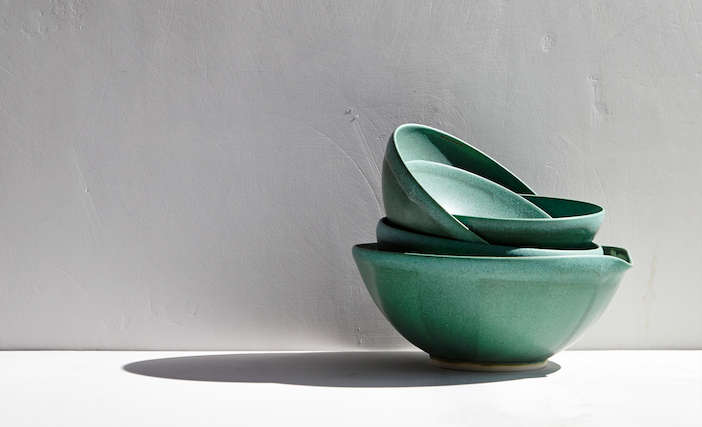
They are not loud objects. They do not need to be. A pale blush glaze, a matte cream surface, an emerald interior, or a restrained brush mark can do plenty when the form underneath is right. That is the quiet magic of Franco’s work: each bowl feels simple until you start looking closely. Then simple becomes complicated.
From Photographer to Potter: Jim Franco’s Second Creative Life
Jim Franco did not abandon photography and dramatically run away to a mountain kiln. His transition into ceramics was more interesting because it happened alongside an already established creative career. While working as a photographer, he became increasingly absorbed in pottery, beginning with a small number of evening classes at Tribeca Potters in New York.
After those introductory lessons, he continued learning through instructional videos and independent practice, eventually renting studio space at City Potters. That progression says something important about his work. The bowls were not the result of a calculated lifestyle brand launch. They grew from curiosity, repetition, and the mildly alarming stage of a hobby when you realize you now own specialized tools and think about clay before breakfast.
Franco reportedly carved out pottery time early in the morning, sometimes working from approximately 5:30 a.m. until 9 a.m. before the rest of the day took over. That schedule sounds brutal to anyone who considers 7 a.m. an unreasonable rumor, but it also helps explain the focus behind the work. Ceramics became a protected zone of concentration.
The Creative Connection Between Photography and Pottery
Photography and ceramics may seem like separate disciplines, but Franco’s bowls reveal how naturally the skills can overlap. A photographer learns to notice negative space, balance, surface, color, shadow, and the relationship between an object and its surroundings. A potter confronts many of the same questions, except the composition is three-dimensional and spinning rapidly beneath wet hands.
A bowl has a profile. It has visual weight. Its rim changes the way light defines the form. Its glaze can absorb light, scatter it, or reflect it. Even an interior curve affects how the object appears in a photograph and how it feels when held.
That dual perspective helps explain why Franco’s work has often been described as both functional and photogenic. These are objects designed to live on a table, but they also possess the kind of restrained presence that makes a stylist quietly move everything else out of the frame.
Why the Bowl Became Jim Franco’s Signature Form
Of all the objects a potter can make, the bowl may be one of the most familiar and one of the hardest to make memorable. Humanity already has quite a few bowls. Entering the market with another one requires confidence.
Franco focused especially on small porcelain bowls, exploring how a familiar form could feel comfortable in the hand while retaining visual strength. His admiration for Japanese ceramic traditions is central to understanding this approach. Rather than loading the surface with decoration, he has looked toward traditions in which modest forms, subtle irregularities, material character, and carefully controlled proportions give a vessel its power.
The challenge is not merely producing a round container. A successful functional bowl has to negotiate several demands at once. The foot must feel stable. The walls need the right degree of delicacy. The rim should be pleasant against the fingers and, depending on use, the mouth. The interior curve needs to make sense for food or serving. The whole piece must feel intentional without becoming stiff.
That is a lot of responsibility for an object that may eventually hold almonds.
Simple Forms Are Unforgiving
Minimal design has nowhere to hide. On a heavily decorated object, pattern can dominate attention. On a quiet porcelain bowl, every decision becomes visible. A slightly awkward foot, a heavy rim, or an unbalanced profile can change the character of the entire piece.
This is one reason Franco’s bowls reward close attention. Their visual interest often comes from restrained variation rather than elaborate ornament. A glaze may shift gently across a surface. Brushwork may interrupt a matte field. A series of bowls may share a family resemblance without becoming identical clones.
That balance between consistency and individuality is one of the pleasures of handmade ceramics. The maker develops a recognizable language, but the material refuses to behave like a photocopier.
Porcelain: Beautiful, Demanding, and Not Especially Forgiving
Franco’s ceramic work has been associated particularly with porcelain, a material prized for its refined appearance and smooth visual character. For the maker, however, porcelain can be demanding. It requires careful control during forming, drying, trimming, glazing, and firing. Small errors can become big disappointments somewhere between wet clay and finished object.
That difficulty matters because Franco’s aesthetic depends on restraint. A clean porcelain form can make tiny variations unusually visible. The material supports pale glazes, soft colors, and crisp silhouettes, but it also asks the potter to maintain discipline.
In Franco’s hands, porcelain has appeared in a range of finishes, including matte creams, pale pinks, soft blues, emerald tones, and surfaces animated by darker brushwork. The palette tends to feel sophisticated without becoming precious. Some pieces almost whisper. Others have enough color to make the neighboring cereal bowl suddenly question its life choices.
The Importance of Glaze
Glaze is not simply ceramic paint. It interacts with the clay body, application method, firing temperature, kiln atmosphere, and the shape of the vessel itself. A glaze that appears calm on one form may pool, break, darken, or thin differently on another.
For collectors, those variations are part of the attraction. A handmade ceramic bowl can carry subtle evidence of its production: the movement of a glaze near the rim, a change in color where material gathers, or brushwork that could never be exactly repeated.
Franco’s softer matte surfaces are particularly effective because they complement the disciplined geometry of the forms. Instead of overwhelming the bowl, color becomes part of its architecture.
The Japanese Ceramic Influence: Power Without Noise
Franco has expressed admiration for the ability of Japanese ceramic artists to give simple forms a remarkable sense of presence. That influence should not be reduced to a vague idea of “Zen style.” Japanese ceramic history is broad, diverse, technically sophisticated, and full of different regional and artistic traditions.
Still, one relevant lesson is the possibility that a humble vessel can become deeply expressive through proportion, surface, touch, and use. Historic Japanese tea bowls demonstrate how asymmetry, irregular glaze, material texture, and evidence of the hand can contribute to an object’s character rather than count as defects.
For a contemporary potter such as Franco, the attraction lies in restraint. A bowl does not have to perform a circus trick. It can gain force through subtle relationships: the width of the opening, the curve of the wall, the small lift of the foot, the weight of the porcelain, and the way a matte glaze meets a darker mark.
Function Is Part of the Beauty
The strongest handmade tableware often resists the idea that useful objects are somehow less artistic. A bowl can be visually compelling and still serve soup. In fact, use can deepen the relationship between owner and object.
Unlike a sculpture that may remain untouched on a pedestal, a functional ceramic bowl enters daily routines. It is picked up, washed, stacked, filled, emptied, and seen under different light throughout the day. Its proportions are experienced physically, not merely observed.
Franco’s work fits comfortably within this tradition of functional pottery in which beauty is not an extra feature pasted onto utility. The two are developed together.
How Jim Franco’s Bowls Developed a Cult Following
The phrase cult following can sound exaggerated when applied to tableware, until a small batch disappears almost immediately and people start watching for the next release. Franco’s bowls gained attention through design coverage, select retailers, direct requests, and limited availability.
In the mid-2010s, collections of his work were reported to sell out quickly, including a release through Dara Artisans that sold out overnight. His ceramics were also offered through design-focused outlets such as Ochre, and later appeared in a Remodelista ceramics market roundup. Historical prices varied according to size and piece, with contemporary coverage reporting a range from roughly $55 to $150 and highlighting one pale pink bowl at $105.
Those figures are best understood as historical snapshots rather than current market quotations. The more important point is the structure of the appeal: limited production plus distinctive design plus an identifiable maker creates a very different relationship from buying mass-produced dinnerware by the dozen.
Scarcity Helps, but Scarcity Is Not Enough
Limited availability can create excitement, but rarity alone does not make an object desirable. There are plenty of rare things nobody is urgently trying to put on a kitchen shelf.
Franco’s bowls attracted attention because the scarcity was connected to an authentic production process. A working photographer was making pottery in limited hours, developing small groups of pieces rather than feeding an enormous manufacturing line. Variations were part of the work, not manufacturing errors destined for a discount bin.
For collectors, that creates a sense of proximity to the maker. You are not simply purchasing a SKU. You are acquiring one object from a continuing creative practice.
What Makes a Jim Franco Ceramic Bowl Visually Distinctive?
Although individual pieces vary, several qualities help explain the recognizable appeal of Jim Franco pottery.
1. Restrained Proportions
The forms tend to avoid unnecessary drama. Curves feel considered, bases appear grounded, and rims are treated as part of the overall silhouette rather than an afterthought.
2. Soft but Sophisticated Color
Pale pink, cream, blue, and green can easily become sugary in the wrong hands. Franco’s palette often works because the colors are balanced by matte surfaces, subtle variation, and disciplined shapes.
3. A Photographer’s Sensitivity to Surface
Texture and finish affect the way light travels across the bowl. Matte glaze can soften highlights, while darker brushwork introduces contrast without turning the object into a billboard.
4. Functional Scale
Small bowls have an intimacy that large decorative vessels do not. They can be held in one or two hands, used for food, placed beside a bed, or arranged with other ceramics. Their scale invites interaction.
5. Variation Within a Recognizable Language
The work can be collected in groups without requiring every piece to match. That is an important distinction. Matching says, “I bought a set.” Relationship says, “These objects somehow found one another.”
Why Handmade Ceramic Bowls Matter in a Mass-Produced World
The renewed enthusiasm for studio pottery is not difficult to understand. Modern consumers live with an astonishing number of perfectly identical objects. Phones, appliances, packaging, furniture components, and kitchen accessories often emerge from systems designed to eliminate variation.
Handmade ceramics offer the opposite experience. They preserve evidence of decisions, materials, timing, heat, gravity, and touch. Even when a potter repeats a successful form, the individual pieces can retain small differences.
This does not automatically make every handmade bowl a masterpiece. Handmade is a production method, not a magical certificate of excellent taste. But when technical skill and a strong visual point of view meet, the result can make an everyday ritual feel more personal.
A morning bowl of yogurt remains yogurt. Yet eating it from an object whose weight, rim, color, and surface you genuinely enjoy changes the quality of the moment. That is not mystical. It is simply what good design does when it stops shouting and starts participating.
Collecting Jim Franco’s Ceramic Bowls
Anyone interested in Franco’s ceramics should approach older references with a collector’s caution. Availability, retailers, websites, prices, and production patterns can change significantly over time. Historical articles are useful for understanding the development of his ceramic practice, but they should not be treated as live store inventories.
For collectors, visual documentation can be especially important. Photographs of earlier groups reveal shifts in glaze, shape, and experimentation. A collector may be drawn to one color family, one scale, or the contrast between quieter matte bowls and pieces with stronger brushwork.
Build a Conversation, Not a Matching Set
One of the best ways to display handmade pottery is to allow different pieces to communicate rather than forcing them into strict uniformity. A pale blush bowl may look stronger beside cream and emerald than beside five identical blush bowls.
Differences in height, diameter, glaze, and finish can create rhythm. The same principle applies to using the pieces. A small bowl may hold salt one day and cherries the next. Functional ceramics are allowed to have careers.
The Experience of Living With a Handmade Bowl
The real test of a ceramic bowl is not how it looks in a perfectly styled photograph. It is what happens after the photograph, when the object enters the less glamorous world of breakfast, keys, pistachio shells, and the occasional emergency serving of ice cream.
For someone accustomed to factory-made dinnerware, the first noticeable difference is often touch. A handmade bowl asks to be handled. The curve may fit the palm in a particular way. The foot may create a slight lift from the table. A matte glaze may feel almost stone-like, while a smoother interior surface changes the tactile experience completely.
Then there is the visual experience. A quietly glazed porcelain bowl behaves differently throughout the day. Morning light may reveal subtle shifts in cream or pink that seemed nearly invisible at night. A green glaze can deepen under shadow. Brush marks that initially looked spontaneous begin to feel carefully placed once the eye learns the form.
This is where Franco’s background as a photographer becomes especially interesting. Even without consciously analyzing composition, an owner may notice that the bowl seems to work in different settings. Put it on pale wood and it feels calm. Place it against dark stone and the silhouette becomes stronger. Add lemons, figs, or a handful of cherries and suddenly the bowl is doing editorial work in your kitchen without requesting a styling fee.
The most satisfying experience, however, is often the gradual loss of preciousness. At first, a collectible handmade bowl may be treated like a visiting diplomat. It receives the safest shelf. Nobody is allowed to stack anything on it. Family members are briefed.
Eventually, assuming the piece is intended for ordinary functional use and cared for appropriately, it can become part of a routine. That transition matters. A functional object reaches its fullest meaning when admiration and use stop being enemies.
You begin to recognize small details. Perhaps one side has a glaze variation you prefer, so it unconsciously faces outward on the shelf. Perhaps the weight makes it your favorite bowl to hold while eating something warm. Perhaps it becomes the vessel that appears whenever guests arrive because it makes even a pile of olives look unusually competent.
Collecting several handmade bowls creates another experience: comparison. No two need to be identical. One may have a more open profile, another a deeper interior, another a stronger foot. The differences teach the eye to see form more carefully. You start noticing rims in restaurants. You inspect glaze breaks. You develop opinions about foot rings. This is how hobbies escalate. One minute you bought a bowl; the next you are discussing kiln atmosphere with alarming confidence.
There is also pleasure in knowing that the object emerged from a process that could fail at multiple stages. Clay must be prepared and centered. The wall must be formed. The piece must dry without cracking or distorting. It may be trimmed, bisque-fired, glazed, and fired again. The finished bowl carries no dramatic record of every decision, but the quiet success of the process is present in the final form.
That awareness can make a handmade object feel different from an anonymous product. The appeal is not nostalgia for a world without machines. Mass production is extremely useful, particularly when you need twelve plates that stack perfectly and do not cost the equivalent of a weekend trip. The pleasure of studio pottery lies elsewhere. It gives daily life a point of contact with an individual maker’s judgment.
With Jim Franco’s ceramic bowls, that judgment is shaped by two practices: making images and making objects. The photographer observes. The potter touches. One discipline is intensely aware of how a thing appears; the other must also answer how it feels, balances, survives heat, and functions in a hand.
Living with such a bowl can therefore become a small lesson in attention. You notice the object, then the light on the object, then the food inside it, then the table beneath it. A bowl does not transform breakfast into a spiritual revelation every morning. Sometimes cereal is just cereal. But a well-made object can make ordinary routines more vivid, and that is a surprisingly durable form of luxury.
Why Jim Franco’s Ceramic Bowls Continue to Fascinate
Jim Franco’s ceramic bowls occupy a compelling space between art, craft, design, and everyday usefulness. Their appeal comes not from excess but from discipline: small forms, careful proportions, nuanced glazes, tactile surfaces, and the confidence to let porcelain do some of the talking.
His path from photography into pottery also makes the work especially resonant. It demonstrates how one creative practice can sharpen another. A trained eye for composition can migrate to the potter’s wheel. An understanding of light can become an understanding of surface. A career built around images can lead, unexpectedly but logically, to objects meant to be held.
That may be the secret behind the cult following. Franco’s bowls are collectible, but they do not feel designed merely to be collected. They are beautiful, but beauty is not separated from use. They can command attention on a shelf and then, with no loss of dignity whatsoever, hold a peach.
In a design culture that often rewards novelty, these bowls make a persuasive argument for something older and harder to achieve: getting a simple form right.
Note: Retailers, availability, and prices mentioned in this article describe historical coverage from the mid-2010s and should not be interpreted as current sales information.