Some people leave behind photo albums. Others leave recipes written on index cards, mystery keys in kitchen drawers, and one suspiciously large container of buttons that nobody is emotionally prepared to throw away. Rita Smith left something even more powerful: an unfinished quilt project that seemed to whisper, “Well, are you going to help or just stand there?”
When Chicago craftivist Shannon Downey discovered Rita’s unfinished quilt materials at an estate sale in Mount Prospect, Illinois, she did not simply see fabric. She saw time, intention, memory, and a woman’s creative dream paused before its final stitch. Rita had passed away at 99, but her project was very much alive. It had a plan, a personality, and, as it turned out, a future big enough to pull strangers together from across the United States and Canada.
This is the story of Rita’s Quilt, a massive unfinished quilt project that became a crowd-sourced act of love. It is also a reminder that handmade work does not end when one pair of hands lets go. Sometimes, if the world is lucky, another pair picks it up.
The Estate Sale Discovery That Started Everything
Shannon Downey, known online for Badass Cross Stitch, has a habit many craft lovers will understand immediately: she cannot ignore abandoned needlework. At estate sales, thrift stores, and secondhand bins, unfinished embroidery projects can feel strangely personal. Someone once chose those colors. Someone separated those threads. Someone began with confidence and then, for reasons life rarely explains neatly, stopped.
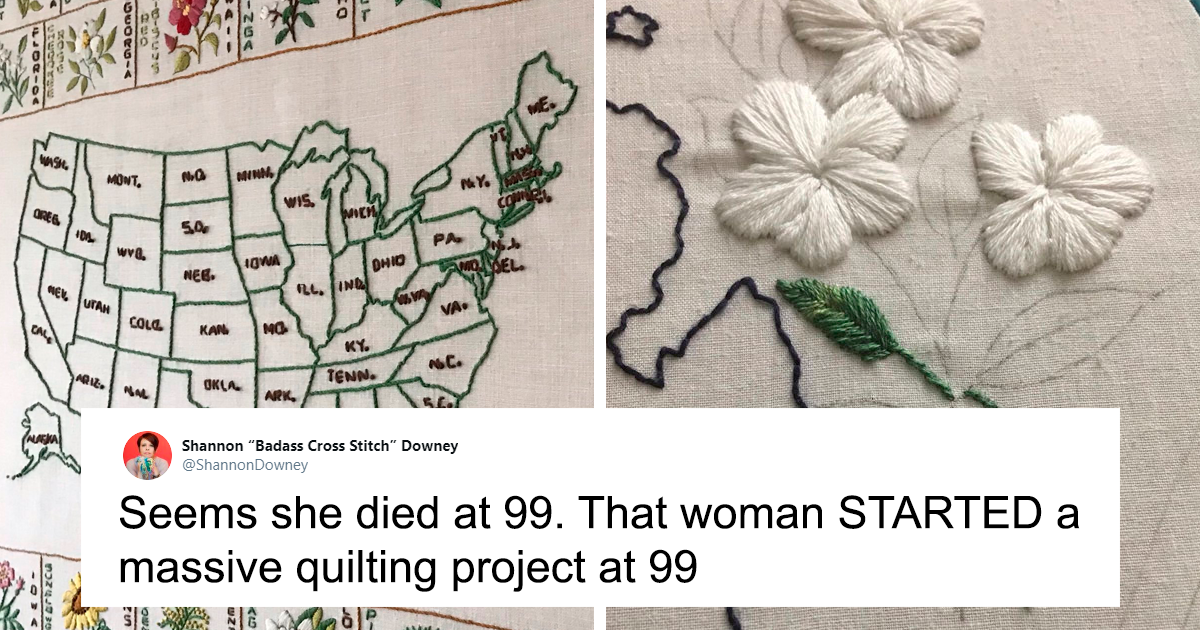
In September 2019, Downey visited an estate sale connected to Rita Smith, a 99-year-old woman from the Chicago area. Among the items was an embroidered U.S. map and a box of materials that first appeared to be ordinary craft supplies. Then Downey looked closer. The box held prepared fabric pieces, transferred designs, and evidence of a quilt that Rita had clearly planned with care.
The project was not a tiny weekend craft. It was ambitious, detailed, and boldthe kind of project that looks at a calendar and laughs. Rita had planned a quilt featuring state birds, state flowers, stars, and a beautifully embroidered map. The pieces were there. The dream was there. The only problem was that the maker was not.
Downey bought the unfinished materials for $6. That price now feels almost comically small for an object that would soon carry so much meaning. Six dollars bought fabric, yes, but also responsibility, possibility, and a nationwide quilting bee in disguise.
Who Was Rita Smith?
Rita Smith was not famous in the celebrity sense. No red carpet, no dramatic memoir, no lifestyle brand selling artisanal thimbles for $48. What she had was something quieter and more durable: skill. Her stitching showed patience, precision, and a love for traditional needlework. The finished pieces suggested a person who respected detail and believed beauty was worth spending time on.
Later accounts connected Rita to a long tradition of sewing circles and community craft. Her family shared that she had belonged to a neighborhood sewing club decades earlier, a detail that makes the ending of her quilt project feel almost poetic. Rita had once stitched in community, and when she could no longer finish her work, community returned to her.
There is something deeply moving about that circle. The unfinished quilt did not become a sad leftover. It became an invitation.
Why Shannon Downey Could Not Walk Away
For many people, an unfinished quilt found at an estate sale might feel like clutter. For Downey, it felt like a call to action. She embroiders, but she is not primarily a quilter, and the project was much too large for one person already balancing her own work and creative life. Still, walking away was not an option.
That reaction is familiar to makers. Crafters know that unfinished projects are not failures. They are suspended conversations. A half-done quilt top says, “I was going somewhere.” A box of cut pieces says, “I had a plan.” A single stitched state says, “I started.”
Downey could have placed the box on a shelf and promised herself she would return to it someday, which is how many craft closets become fabric archaeology sites. Instead, she did something smarter: she asked for help.
How the Internet Became a Quilting Bee
Downey posted the story on social media and asked whether people would be willing to stitch individual pieces if she mailed them out. The response was immediate and overwhelming. More than 1,000 people volunteered within about a day. Not one thousand people politely clicked “like” and moved on. They wanted assignments. They wanted states. They wanted to be part of Rita’s unfinished dream.
Eventually, Downey selected a group of volunteers to stitch the individual hexagons. The project included contributors from more than 30 states and two Canadian provinces, proving that a good craft project can travel farther than most people’s vacation plans. Some volunteers stitched state flowers. Others stitched birds or stars. Each person worked on one piece, then mailed it back so the quilt could be assembled.
A Hundred Hands, One Design
The brilliance of the project was not only emotional; it was practical. Downey did not ask everyone to “just do whatever.” That way lies chaos, and possibly a quilt that looks like it was designed during a power outage. Instead, the volunteers used Rita’s existing work as a guide. They studied her style and tried to honor her original stitching choices.
That mattered. The goal was not to modernize Rita’s project or turn it into someone else’s statement. The goal was to finish what she had begun. Every stitch became a small act of listening.
From Online Post to Real-World Table
The project also showed the best side of social media. Yes, the internet can be a flaming shopping cart rolling downhill. But occasionally, it becomes a sewing circle. In this case, Instagram and other platforms helped connect strangers who shared a specific skill and a generous instinct.
Local quilters in the Chicago area helped with the final assembly. A quilting studio offered space. The quilt moved from a box at an estate sale to a distributed network of hands, mailboxes, kitchen tables, and finally a finished work of art. That is not just craft. That is logistics wearing a cardigan.
Why This Unfinished Quilt Touched So Many People
Rita’s Quilt went viral because it hit several emotional buttons at once. It was about grief, but not in a heavy-handed way. It was about creativity, but not in a glossy, perfectionist way. It was about strangers helping, but without the usual internet demand for applause, sponsorships, or a limited-edition merch drop.
Most people understand unfinished work. We all have our own versions: a book half-read, a garden bed half-planted, a letter never sent, a dream waiting in a drawer. Rita’s quilt gave that universal feeling a physical form. It said that unfinished does not have to mean abandoned.
The story also challenged the idea that older people’s creative lives are somehow small or winding down. Rita was 99 and had started an enormous quilt project. That alone deserves a standing ovation, preferably from a room full of people holding rotary cutters safely away from their fingers. Her ambition was not tiny. Her imagination had not retired.
Rita’s Quilt and the American Quilting Tradition
Quilting has always been more than a practical way to keep warm. In American history, quilts have served as family records, artistic statements, memory keepers, political messages, and community projects. Museums and textile scholars often treat quilts as cultural documents because they reveal what people valued, saved, shared, and remembered.
A quilt can hold scraps from old clothing, fabric from special occasions, regional patterns, family symbols, and countless hours of labor. It is both useful and expressive. That dual purpose is part of its magic. A quilt can live on a bed, hang in a museum, comfort a child, honor the dead, or become an archive of ordinary life.
Rita’s Quilt fits beautifully into that tradition. Its U.S. map theme, state birds, flowers, stars, and collaborative completion made it both personal and national. It reflected one woman’s vision, but it also became a map of generosity. The final quilt was not only about states; it was about connections.
The Finished Quilt Became a Public Celebration
After months of stitching and coordination, Rita’s Quilt was completed in December 2019. It was displayed at Woman Made Gallery in Chicago during a pop-up exhibit, giving the community a chance to see the finished piece in person. Later, it was shown at the National Quilt Museum in Paducah, Kentucky, one of the most meaningful places a quilt can go if it wants to feel fancy.
The project also traveled into public conversation through local and national media. Viewers responded not just to the beauty of the quilt, but to the idea behind it. A woman began a project late in life. Another woman found it. Strangers finished it. Then the world got to witness the result.
That arc is simple, but it is powerful. It says that creativity can outlive us. It says that care can be organized. It says that a small decision at an estate sale can become a community memorial.
What Made Shannon Downey’s Organizing So Effective?
One reason the project worked is that Downey gave people a clear, meaningful task. “Help finish this quilt” is inspiring, but “I will mail you one piece, you stitch it, and send it back by a deadline” is actionable. Good community projects need both heart and structure. Too much structure feels cold. Too little structure becomes a group text with 73 unread messages and no snacks.
Downey also centered Rita. She did not make the story about rescuing a forgotten object for her own fame. She framed it as honoring the original maker. That tone helped volunteers understand their role. They were not replacing Rita; they were joining her.
The project also succeeded because craft communities already understand shared labor. Quilting bees, stitching circles, knitting groups, and sewing clubs have long mixed creativity with companionship. Rita’s Quilt simply used modern toolssocial media, mailing envelopes, hashtagsto revive an old model: many hands making one thing together.
Lessons From Rita’s Quilt
1. Unfinished Does Not Mean Unimportant
Many unfinished projects are full of meaning. They may represent hope, ambition, love, or a plan interrupted by illness, age, family duties, or everyday life. Rita’s Quilt reminds us to look at incomplete work with curiosity instead of judgment.
2. Community Can Be Built Around One Clear Need
People often want to help but do not know how. Downey made the request specific. That turned warm feelings into real stitches.
3. Handmade Objects Carry Human Energy
A machine can make something neat. A human hand makes something alive. Slight differences in thread tension, color choice, and rhythm become part of the story.
4. Social Media Is Not Always the Villain
Used well, online platforms can connect generous people with meaningful projects. Rita’s Quilt is proof that the internet can occasionally put down its pitchfork and pick up an embroidery hoop.
Experiences and Reflections: What Rita’s Quilt Teaches Anyone Who Has Ever Tried to Finish Something Big
Anyone who has ever started a large creative project knows the strange optimism of the first day. You buy supplies with heroic confidence. You imagine the finished result. You tell yourself, “This will be relaxing,” which is how the universe knows to hide one critical tool from you immediately.
That is why Rita’s Quilt feels so relatable. It speaks to the emotional life of making things. Creative work begins with excitement, but it continues through patience. A quilt especially asks for a long kind of devotion. Cutting, marking, stitching, pressing, assembling, backing, quilting, bindingeach step looks manageable until you realize there are approximately one billion of them.
The experience of finishing someone else’s project is even more delicate. You are not just completing a task. You are entering another person’s rhythm. You have to ask: What would they have wanted? How close should I stay to the original? Where can I help without taking over? In Rita’s case, the volunteers respected her style and followed the evidence she left behind. That is a beautiful model for any inherited project, whether it is a quilt, a recipe collection, a garden, or a family story.
There is also a lesson here for people who feel embarrassed by unfinished work. Maybe you have a half-written novel, a half-painted room, a scrapbook from 2017, or a craft drawer that makes eye contact when you walk by. Rita’s story suggests that unfinished projects are not proof of failure. They are proof that you began. Beginning matters.
Of course, not every project needs to be finished by 150 artists and displayed in a museum. Most of us would be thrilled just to sew on the missing button before the shirt becomes vintage. But the principle still applies. Ask for help. Break the work into pieces. Give people specific roles. Celebrate progress. Do not wait for perfect conditions, because perfect conditions are a myth invented by people who have never tried to thread a needle under bad lighting.
Rita’s Quilt also shows how objects can become bridges between strangers. The volunteers did not all know Rita. Many never met one another. Yet they became connected through care. Their stitches turned distance into participation. That is the quiet genius of collaborative craft: it makes belonging visible.
In a fast digital culture, handmade projects slow us down. They ask us to notice texture, repetition, and effort. They remind us that beauty is often built one small motion at a time. Rita may not have seen the finished quilt, but her idea gathered people after her lifetime and gave them something good to do together. That is a legacy with seams strong enough to hold.
Conclusion: A Quilt Finished by Strangers, Held Together by Kindness
The story of the 99-year-old woman who died leaving her massive quilt project unfinished is not simply a sweet internet moment. It is a case study in community, craft, memory, and practical compassion. Rita Smith started something beautiful. Shannon Downey recognized its value. Volunteers across borders helped complete it. Together, they transformed unfinished fabric into a finished tribute.
In the end, Rita’s Quilt is not moving because it is perfect. It is moving because it is shared. Every stitch says someone cared enough to continue. Every piece says a stranger made time. Every seam says that when one person cannot finish the work alone, community can step innot loudly, not dramatically, but patiently, with thread.
And honestly, that may be the most comforting pattern of all.
Note: This article is based on publicly reported details about Rita Smith, Shannon Downey, Rita’s Quilt, and the broader American quilting tradition. Source links are intentionally not included inside the article body so the HTML can be copied cleanly into a publishing system.