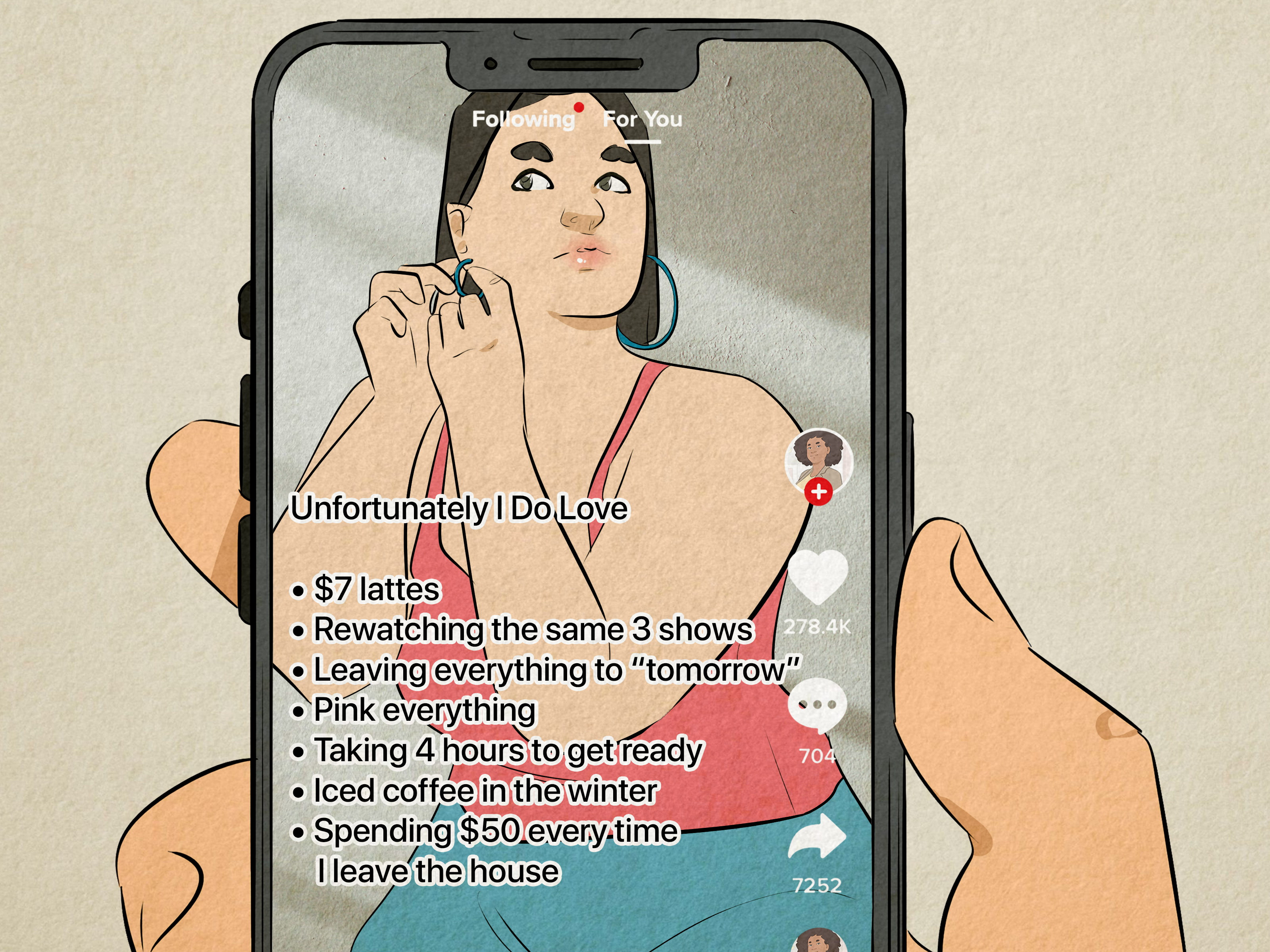
Every few weeks, TikTok invents a new way for people to confess something deeply personal while still looking suspiciously photogenic. The latest example? The “Unfortunately I Do Love” TikTok trend, a charmingly self-aware format where creators admit the habits, cravings, quirks, emotional loopholes, and tiny personality crimes they love despite knowing they probably should not.
The basic formula is simple: take a flattering video, add the phrase “unfortunately I do love,” then list the things that define you in the most honest, funny, slightly embarrassing way possible. Think: iced coffee at financially irresponsible times, ignoring texts while watching people’s Instagram Stories, online shopping as a coping mechanism, romanticizing a 12-minute walk, or acting like a single Pilates class has reset your entire bloodline.
Set most often to Joe Walsh’s classic rock track “Rocky Mountain Way,” the trend has become one of those TikTok moments that feels both silly and surprisingly revealing. It is not just another “here are my flaws” joke. It is a tiny act of self-branding, self-acceptance, and comedic oversharing wrapped in a song your dad may already have on vinyl.
What Is the “Unfortunately I Do Love” TikTok Trend?
The “Unfortunately I Do Love” trend is a TikTok format where users make a list of personal favorites, bad habits, guilty pleasures, or oddly specific traits under the text “unfortunately I do love.” The phrase works because it sounds like a confession and a shrug at the same time. It says, “Yes, I know this is ridiculous. No, I will not be improving.”
Most videos use a casual, aesthetically pleasing clip: someone walking outside, dancing with friends, getting ready, sitting on a beach, tossing their hair, or performing the sacred TikTok ritual of looking effortlessly candid while definitely knowing the camera is on. Over that footage, creators add a list of things they love. The fun is in the contrast. The video may look polished, but the text reveals chaos.
Examples might include:
- “Unfortunately I do love canceling plans.”
- “Unfortunately I do love a little treat after doing one email.”
- “Unfortunately I do love acting mysterious when I am simply tired.”
- “Unfortunately I do love ordering food I could easily make at home.”
- “Unfortunately I do love saying ‘I’m fine’ while preparing a 17-part emotional presentation in my head.”
The trend turns ordinary confessions into a personality collage. Instead of pretending to be perfectly productive, emotionally balanced, and financially wise, creators are proudly admitting that their lives are powered by caffeine, screenshots, delusion, and small pleasures. Honestly, same.
Where Did the Trend Come From?
The trend gained major traction in 2025, especially after creators began pairing their lists with “Rocky Mountain Way” by Joe Walsh. The song’s confident guitar groove gives the videos a strangely perfect energy. It is bold, classic, and a little unserious, which makes it ideal for listing your love of late-night snacks, risky texts, and unnecessary Target runs.
The audio is important because TikTok trends often spread through recognizable sounds. A song becomes the emotional container for a joke, and once enough people understand the format, the trend becomes easy to remix. In this case, “Rocky Mountain Way” gives the confession format a confident soundtrack. It makes “I have questionable habits” sound less like a problem and more like a victory lap.
Trend coverage has noted that creators are using the format to list everything from tame guilty pleasures to bolder admissions. Some keep it cozy and relatable: hot Pilates, matcha, romantic comedies, being dramatic, spending too much on food delivery. Others lean into more chaotic territory, using the trend as a humorous way to reclaim behaviors that might otherwise be judged.
Why the Phrase “Unfortunately I Do Love” Works So Well
The magic is in the word “unfortunately.” Without it, the phrase would just be “I love,” which is sweet but not especially funny. Add “unfortunately,” and suddenly there is tension. The creator knows the thing they love is inconvenient, embarrassing, overdone, expensive, basic, dramatic, or possibly all five before lunch.
That tension is what makes the trend relatable. People do not just love things. They love things while judging themselves for loving them. They love the overpriced coffee, but they also know they own coffee at home. They love stalking Zillow listings in cities they cannot afford. They love watching a show they have already seen six times. They love being right in an argument, even when the argument happened only in their notes app.
The phrase gives people permission to confess without fully apologizing. It is not “I am ashamed.” It is “I am aware.” There is a big difference. The first feels heavy. The second feels like a wink.
Why This TikTok Trend Went Viral
1. It Is Easy to Participate In
The best TikTok trends are simple enough to copy but flexible enough to personalize. “Unfortunately I Do Love” checks both boxes. You do not need choreography, a costume, a complicated edit, or a friend willing to hold the camera in public while you pretend not to be mortified. You just need a clip, a list, and the courage to admit you enjoy things that may not look impressive on a résumé.
2. It Combines Humor With Identity
TikTok loves identity-based humor. People share content that makes them say, “That is literally me,” even when “literally me” refers to buying a drink as a reward for leaving the house. This trend works because each list is both personal and universal. One creator’s confession about loving canceled plans becomes another viewer’s spiritual autobiography.
3. It Pushes Back Against Perfect Aesthetics
Social media is full of curated perfection: spotless kitchens, flawless routines, color-coded calendars, glowing skin, and people who somehow wake up at 5 a.m. smiling. The “Unfortunately I Do Love” trend punctures that perfection. It says, “Here is my pretty video, and here are the unhinged truths living behind it.”
That honesty feels refreshing because it makes the creator seem more human. The format lets people keep the fun of aesthetic content while adding enough imperfection to feel real. It is polished vulnerability, which is basically TikTok’s favorite flavor.
4. It Creates Comment Section Bonding
The comment sections are half the entertainment. Viewers respond with “me,” “too real,” “I fear this is my entire personality,” or their own additions to the list. The trend invites participation even from people who never post. You can watch someone confess to loving attention, Diet Coke, situationships, or oversharing, and instantly feel seen.
The Role of “Rocky Mountain Way” by Joe Walsh
One of the funniest parts of this trend is how a 1973 rock song became the soundtrack for modern digital confession. Joe Walsh’s “Rocky Mountain Way” has a swagger that makes even the smallest admission feel cinematic. Listing “online shopping” over a classic rock riff makes it sound like a lifestyle choice with historical importance.
This is not unusual for TikTok. The platform has a habit of reviving older songs by attaching them to new visual formats. A track that once belonged to radio, records, or classic rock playlists suddenly becomes the sound of people admitting they love gossip, dirty martinis, long showers, and making everything about astrology.
The pairing works because the song does not feel fragile or apologetic. It has confidence. That confidence turns “unfortunately” into something playful rather than shameful. The audio says, “Yes, I love these things. What are you going to do, call the personality police?”
Celebrity Participation Helped the Trend Travel
Like many TikTok formats, the trend got extra attention when celebrities and public figures began using it or adapting it for Instagram Reels. Kate Hudson, for example, joined the trend with a video montage that listed her own playful guilty pleasures, including ignoring texts, online shopping, dancing in public, and enjoying a martini. Celebrity participation matters because it helps a trend jump from TikTok’s For You Page into entertainment coverage, Instagram feeds, and mainstream pop culture conversations.
When a celebrity uses a trend built around flaws, it also changes the tone. The joke becomes less about being messy and more about being charmingly human. Famous people are often presented as polished, styled, and strategically managed. A trend like this gives them a low-stakes way to say, “I too misplace my phone and enjoy questionable decisions.” Relatable? Maybe. Conveniently relatable? Absolutely. Still fun? Yes.
What Counts as an “Unfortunately I Do Love” Confession?
The best entries are specific. Generic confessions like “food” or “music” are fine, but they do not have the same spark as “ordering fries for the table and eating most of them myself.” The trend rewards details because details make the viewer feel like they are getting a real glimpse of someone’s personality.
Here are a few categories that work especially well:
Guilty Pleasures
These are the classics: reality TV, fast food, celebrity gossip, overpriced drinks, comfort shows, impulse purchases, dramatic playlists, or treating errands like a personal documentary.
Bad Habits
This is where the trend gets funnier: snoozing alarms, avoiding emails, replying mentally but not actually, being late, saving screenshots as evidence, or using “I’m on my way” as a spiritual concept rather than a factual statement.
Personality Quirks
These confessions are softer: loving rainy days, planning outfits for imaginary events, naming every pet you meet, needing background noise, or getting emotionally attached to fictional characters who have never paid rent.
Social Habits
Creators often mention things like girls’ trips, group chats, gossip sessions, dancing in public, flirting for fun, or asking “are you mad at me?” after someone uses punctuation.
How to Make Your Own “Unfortunately I Do Love” TikTok
If you want to join the trend, the process is refreshingly easy. Start with a video that feels like you. It can be glamorous, casual, chaotic, cozy, or funny. The best clip is one that gives viewers a sense of personality before they even read the text.
Next, add the phrase “Unfortunately I do love” at the top of the screen. Under it, list five to ten things you genuinely enjoy, especially if they are a little embarrassing or overly specific. Use the “Rocky Mountain Way” audio if you want to follow the classic version of the trend.
Keep the pacing readable. TikTok viewers are fast, but they are not superheroes. If your list disappears in half a second, people will not pause unless they are extremely invested or avoiding work. Use clean text, enough contrast, and short phrases that land quickly.
Examples of “Unfortunately I Do Love” Lists
Need inspiration? Here are a few sample versions:
For the Chronically Online Friend
- Unfortunately I do love a niche meme.
- Unfortunately I do love sending 14 TikToks instead of one sincere message.
- Unfortunately I do love reading comments before watching the video.
- Unfortunately I do love saying “that’s so me” about a raccoon.
For the Soft-Life Enthusiast
- Unfortunately I do love a little pastry.
- Unfortunately I do love a candle I cannot afford.
- Unfortunately I do love canceling plans to moisturize.
- Unfortunately I do love pretending a clean room fixed my life.
For the Emotionally Dramatic
- Unfortunately I do love making a playlist instead of communicating.
- Unfortunately I do love rereading messages for clues.
- Unfortunately I do love being mysterious for no reason.
- Unfortunately I do love one tiny inconvenience becoming my villain origin story.
Why Brands Are Paying Attention
Marketers love trends that are easy to adapt, and “Unfortunately I Do Love” is brand-friendly without feeling too forced. Food brands can joke about cravings. Beauty brands can list rituals customers secretly adore. Fitness brands can admit that matching workout sets are half the motivation. Lifestyle brands can turn product quirks into personality traits.
The key is to keep it human. A brand version should not sound like a committee discovered humor in a windowless meeting room. The trend works because it feels personal. If a brand uses it, the list should be specific, self-aware, and lightly funny. “Unfortunately we do love making your morning better” is bland. “Unfortunately we do love convincing you that one tiny pastry counts as breakfast architecture” is much closer.
The Deeper Meaning: Reclaiming the Guilty Pleasure
At its core, the “Unfortunately I Do Love” trend is about reclaiming guilty pleasures. A guilty pleasure is something enjoyable that comes with a little embarrassment or self-judgment. But younger internet culture has been slowly questioning the “guilty” part. Why feel guilty about harmless joy? Why apologize for liking popular things, silly things, basic things, or dramatic things?
This trend does not fully remove the guilt; it makes fun of it. The word “unfortunately” lets people acknowledge social judgment while refusing to be controlled by it. It is a comedic middle ground between shame and confidence. You are not pretending every habit is noble. You are simply saying, “This is part of me, and honestly, it adds flavor.”
That may be why the trend resonates. In a culture obsessed with optimization, routines, productivity, personal branding, and self-improvement, there is relief in admitting you are still a person with cravings, contradictions, and weird little joys. Not everything has to be efficient. Some things can just be fun.
Is the Trend Empowering or Just Another Performance?
Like most TikTok trends, the answer is both. On one hand, “Unfortunately I Do Love” can be empowering because it normalizes imperfection. It gives people a playful way to say they are not interested in being flawless. It can create connection, humor, and a sense of shared humanity.
On the other hand, it is still social media. Many videos are carefully selected, beautifully lit, and edited to look effortless. The confessions may be messy, but the presentation is often polished. That does not make the trend fake. It just means it exists in the familiar TikTok space between authenticity and performance.
The most successful posts understand that balance. They do not overshare in a way that feels uncomfortable, and they do not sanitize the list until it becomes boring. They offer just enough truth to feel real and just enough comedy to keep it light.
Experience: What This Trend Feels Like in Real Life
Watching the “Unfortunately I Do Love” trend feels a little like sitting with friends at dinner when everyone gets past the polite stage and starts telling the truth. At first, someone says something safe, like “Unfortunately I do love iced coffee.” Everyone nods. Fine. Acceptable. Then someone else admits they love canceling plans after already getting dressed, and suddenly the table becomes a support group with appetizers.
The beauty of the trend is how quickly it turns embarrassment into connection. Most people carry around small private preferences they think are too silly, too basic, too dramatic, or too oddly specific to say out loud. But when someone else says it first, the shame evaporates. You realize you are not the only person who treats a new lip balm like a life milestone or believes that one good outfit can solve at least 38 percent of your problems.
In real life, the trend also works as a conversation starter. Ask a group of friends, “What is on your ‘unfortunately I do love’ list?” and you will learn more than you expected. Someone will admit they love being the first to know gossip. Someone will confess they enjoy making travel plans they may never book. Someone will say they love a dramatic exit, even if the exit is just leaving the group chat for 11 minutes. The answers are funny because they are honest.
There is also a comforting lesson in the trend: personality is often built from tiny, repeated joys. We tend to think identity has to be grand or impressive. Career goals, values, life plans, big dreams. Those matter, of course. But a person is also made from their favorite gas station snack, their preferred weather, their emotional support water bottle, their suspiciously intense loyalty to a specific pen, and the song they play when they need to feel like the main character.
That is why this trend feels more intimate than it looks. Yes, it is a joke. Yes, it is content. Yes, some people are absolutely using it as an excuse to post an attractive video while pretending the real point is “relatability.” But underneath all that, it gives people a vocabulary for harmless self-acceptance. It says you can be ambitious and still love nonsense. You can be smart and still love reality TV. You can be emotionally mature and still need a small treat for surviving a phone call.
My favorite version of this trend is not the most glamorous one. It is the one where the list feels so specific that it could only belong to that person. “Unfortunately I do love sitting in my car for ten minutes after arriving home.” “Unfortunately I do love pretending I am in a music video while walking through a parking lot.” “Unfortunately I do love giving extremely detailed advice I will not apply to my own life.” That is where the trend becomes more than a format. It becomes a tiny, funny mirror.
And maybe that is the real reason the “Unfortunately I Do Love” trend has lasted beyond a single scroll. It lets people confess without collapsing into seriousness. It celebrates quirks without turning them into a brand manifesto. It gives everyone permission to be a little ridiculous, a little self-aware, and a little proud of the things that make them recognizable to the people who love them. Unfortunately, we do love that.
Conclusion
The “Unfortunately I Do Love” TikTok trend is simple, funny, and surprisingly revealing. It works because it gives creators a playful way to admit their guilty pleasures, bad habits, and personality quirks without drowning in shame. With “Rocky Mountain Way” as the soundtrack, the trend transforms tiny confessions into confident declarations.
At a time when social media often rewards perfection, this trend stands out because it celebrates the imperfect details that make people interesting. Whether you love canceling plans, buying unnecessary drinks, oversharing, online shopping, or acting like a new playlist is a personal reinvention, the format says there is room for all of it. You do not have to be flawless to be relatable. In fact, being a little ridiculous might be the whole point.