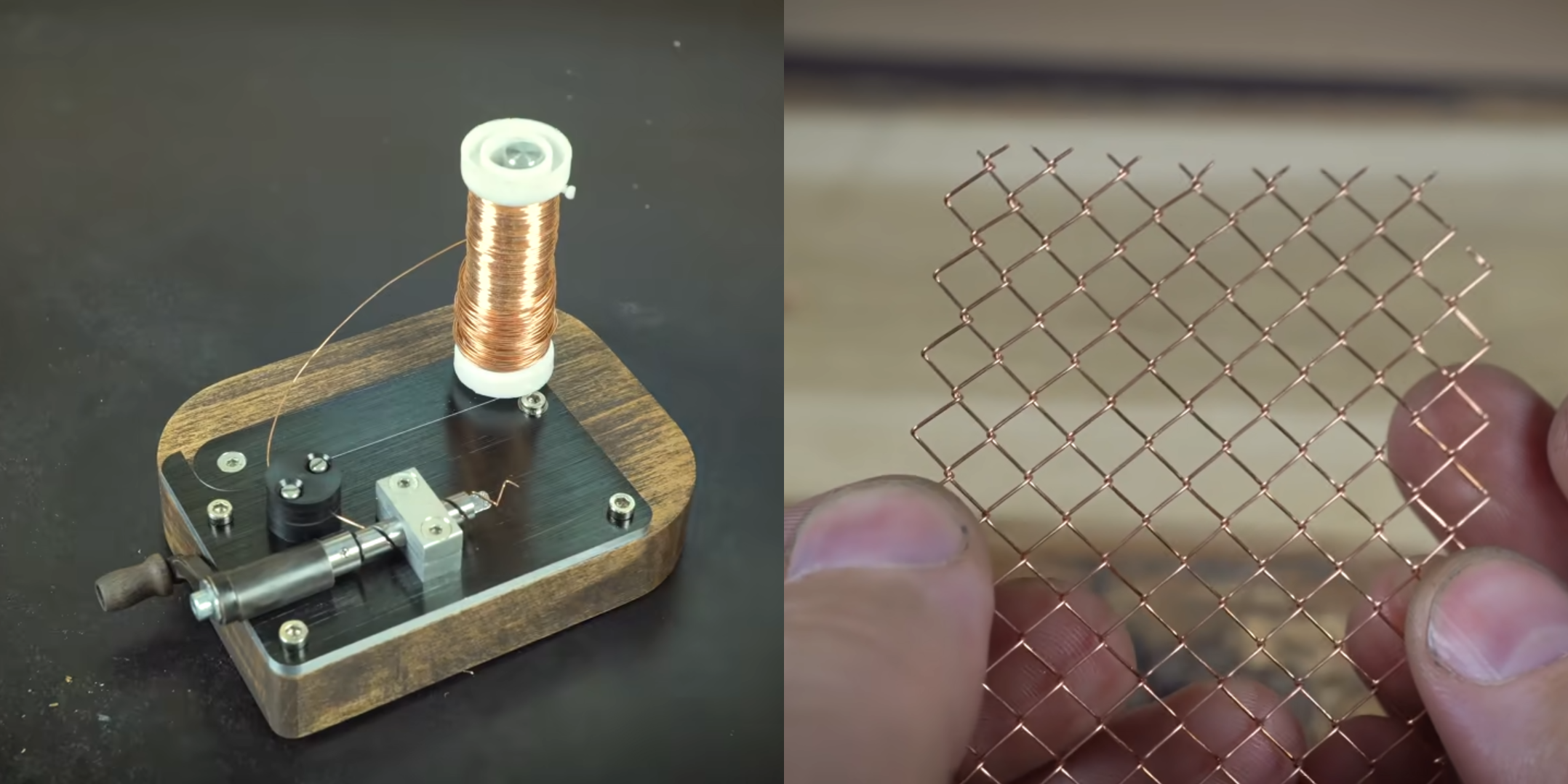
Some machines earn attention by moving tons of steel, producing thousands of parts per hour, or making noises that require hearing protection and a respectful distance. Others sit quietly on a wooden base, turn with a hand crank, and manufacture fencing for a property roughly the size of a sandwich.
The tiny chain-link fence machine created by maker Levsha belongs proudly to the second category. Built at approximately one-tenth the scale of industrial equipment, the tabletop device transforms thin copper wire into the familiar zigzag strands used in chain-link mesh. It does not operate at factory speed, it will not secure a warehouse, and no neighborhood association is likely to approve a fence only a few inches tall. Nevertheless, it is an outstanding demonstration of mechanical design, precision machining, material selection, and wonderfully unnecessary craftsmanship.
More importantly, the project reveals how an everyday object is actually made. Chain-link fencing looks simple because we see it everywhere. Yet its diamond pattern depends on controlled wire forming, accurate spacing, continuous rotation, and careful interweaving. Shrinking that process into a hand-cranked machine makes every part of the mechanism visibleand strangely hypnotic.
What Makes This Tiny Chain-Link Fence Machine Special?
At first glance, the finished device resembles an antique scientific instrument. Machined metal components sit neatly on a polished wooden base. A compact crank drives the forming mechanism, while a specially cut tube guides the wire. Nothing appears oversized or improvised. Even though the machine performs a playful task, it has been finished with the care normally reserved for a precision workshop tool.
The machine creates individual lengths of formed wire rather than producing a complete roll of fence automatically. As the operator turns the handle, straight wire enters the forming assembly and emerges as a uniform zigzag spiral. Each new strand must then be rotated through the previous one by hand to create the interlocking diamond pattern.
That limitation is not really a flaw. It is part of the machine’s charm. The design isolates the most interesting operationthe transformation of straight wire into a repeating shapewithout adding a large collection of feed rollers, cutters, sensors, and automatic weaving equipment. It is mechanical minimalism with a tiny industrial accent.
How Real Chain-Link Fence Is Woven
Chain-link fencing is not made by welding wires at every intersection. Instead, individual wires are formed into matching helical zigzags and woven into one another. In industry terminology, these formed strands may be called pickets. When one picket rotates into the open loops of the previous picket, the two become linked without knots or welded joints.
Repeating the process produces a flexible sheet of diamond-shaped mesh. The finished fabric can be rolled for transportation because the links remain movable relative to one another. That flexibility is one reason chain-link fencing can follow slightly uneven ground and absorb modest impacts without behaving like a rigid metal panel.
The Spiral Guide Controls the Pattern
The heart of Levsha’s miniature machine is a stationary cylindrical guide with a spiral slot cut through its wall. Inside that guide, a flat metal forming blade rotates with the crank. Wire is fed into the slot and forced to wrap around the turning blade.
The flat blade determines the basic width of the bends, while the spiral groove controls how quickly the shaped wire advances through the tube. Together, those parts establish the pitch, alignment, and approximate dimensions of the repeating pattern.
Imagine wrapping wire around a ruler while steadily sliding it sideways. The result would resemble a long flattened coil. The machine performs a controlled version of that action, preventing the wire from wandering and keeping each bend reasonably consistent. The spiral tube acts like a mechanical instruction manual that the wire is physically unable to ignore.
Why the Strands Interlock
Once two identically formed strands are placed beside each other, one can be twisted through the openings of the other. Every rotation advances it by one section. When the spacing is accurate, the strands meet at alternating points and create the recognizable diamond mesh.
This method is elegant because every wire is doing two jobs. It contributes part of the visible pattern while also connecting the neighboring strands. There are no separate fasteners hidden in the mesh. The geometry itself performs the assembly.
Precision Machining Behind a Playful Project
The machine may be small, but manufacturing it was not a small challenge. Its metal components were produced with tools including a lathe and CNC router. Shafts had to rotate smoothly, parts needed to remain aligned, and the forming blade had to fit inside the guide without excessive friction.
The spiral-slotted tube was reportedly the most difficult component to perfect. That makes sense. A straight slot is easy to visualize and relatively easy to machine. A consistent spiral around a small cylinder is less forgiving. Any sudden change in pitch, rough edge, or narrow section can pinch the wire and stop production.
Several attempts were needed before the guide worked properly. This is one of the most valuable details in the project. Beautiful finished machines can create the illusion that their makers simply drew a perfect design, pressed a button, and watched success fall gently onto the workbench. Real fabrication usually involves rejected parts, revised dimensions, mysterious binding, and at least one period of staring at the machine as though disappointment alone might fix it.
Tolerances Matter More at Small Scale
Miniaturization does not automatically make a mechanism easier. In many cases, it does the opposite. A burr that would be insignificant on a full-size industrial guide can become a serious obstruction when the wire is only a fraction of a millimeter thick. Minor shaft misalignment can create enough resistance to distort soft wire or lock the crank.
The small machine also has less rotational momentum than powered industrial equipment. A factory motor may push through modest changes in resistance, but a hand crank immediately tells the operator when something is wrong. That direct feedback is useful: stiffness can signal a snag before the wire is crushed or the mechanism is damaged.
Why 0.4 Millimeter Copper Wire Won
The first material considered for the miniature fence was steel wire, an obvious choice because full-size chain-link fabric is commonly produced from metallic-coated steel, aluminum-coated steel, or polymer-coated wire. At this scale, however, the steel proved too stiff. Resistance increased until the forming mechanism jammed.
Soft copper wire provided a better balance. Copper is ductile, meaning it can undergo substantial permanent deformation before breaking. Thin copper wire bends and twists more easily than comparably sized hard steel wire, allowing it to follow the tight path around the forming blade without demanding excessive crank force.
The successful wire diameter was approximately 0.4 millimeter. That is thin enough to form delicate mesh while remaining visible and manageable. It also gives the tiny fence an attractive metallic finish. Fresh copper looks warm and polished; over time, an unfinished surface may darken or develop a patina, adding character to a miniature industrial scene.
Material temper matters as much as material type. Annealed or soft copper generally forms more easily than work-hardened wire. Repeated bending can harden copper, so a strand that has been straightened, reused, and reshaped several times may become less cooperative. Tiny machinery, like tiny pets, appreciates being given the correct food.
What Could a Miniature Chain-Link Fence Be Used For?
The machine was initially described as having little practical purpose, but makers and model builders quickly identified several possibilities. Its output may be too small for property security, yet it is well suited to projects where realistic metal texture matters.
Model Railroad Layouts and Dioramas
Miniature chain-link fencing is ideal for model railroads, architectural models, military dioramas, industrial scenes, and scale construction sites. It can surround a rail yard, utility station, loading dock, sports court, warehouse, or suspiciously well-guarded miniature dumpster.
Commercial scale mesh is available, but handmade material can be customized. A builder can vary the wire diameter, opening size, fence height, surface finish, and amount of weathering. Real woven wire also behaves more naturally around corners and damaged sections than printed plastic pretending to be wire.
Speaker Grilles and Fan Guards
Fine metallic mesh can serve as a decorative grille for a small speaker enclosure, ventilation opening, or electronics project. The woven pattern allows air and sound to pass while providing some physical protection. Whether it is suitable for a specific fan or speaker depends on the opening size, rigidity, mounting method, and required airflow.
A copper version would normally need a supporting frame because the fine wire is relatively soft. It is better suited to a carefully designed enclosure than to guarding a fast-moving blade where certified protective hardware is required.
Decorative Metalwork and Jewelry
The machine could also produce textured sheets for jewelry, miniature baskets, ornaments, lampshades, sculpture, or mixed-media artwork. Changing the former dimensions could create narrower or wider diamonds. Different soft metals might provide contrasting colors, provided they bend without overloading the mechanism.
Experimental Electromagnetic Shielding
Conductive mesh can be used in electromagnetic shielding experiments, but a tiny copper fence should not automatically be treated as a guaranteed Faraday cage. Shielding performance depends on electrical continuity, grounding, mesh opening size, enclosure geometry, and the wavelengths involved. A decorative mesh cylinder around a gadget may look scientifically impressive while doing little more than giving radio waves an attractive view.
Lessons for Makers and Machine Designers
Let Geometry Replace Complexity
The spiral groove is a strong example of encoding motion into a fixed mechanical part. Instead of using electronics to measure wire travel and coordinate a feed motor, the shape of the guide controls the advance. One rotation naturally produces a predictable amount of movement.
This approach appears throughout mechanical design. Lead screws convert rotation into linear travel. Cams create programmed movement. Threads control advancement and clamping. In this machine, the spiral guide acts as both a track and a timing system.
Prototype the Difficult Part First
The guide tube was the component most likely to determine whether the entire concept worked. Testing that element early would expose problems with groove pitch, internal clearance, friction, and wire choice before too much effort was spent polishing the base or refining the handle.
This is a useful rule for almost any workshop project: identify the part carrying the most technical uncertainty and prototype it before decorating everything else. A polished failure is still a failure, although it does photograph beautifully.
Design Around the Material
The switch from steel to copper shows that a machine and its material form one system. A mechanism can be dimensionally accurate yet fail because the wire is too stiff, too thick, poorly lubricated, or prone to springback. Material substitutions should be treated as engineering changes, not merely shopping decisions.
Wire springback is especially important. After a metal is bent, it tends to recover slightly toward its original shape. A forming blade may therefore need to bend the wire beyond the desired final angle. The amount depends on alloy, temper, diameter, and bend radius.
Manual Power Is an Engineering Feature
A hand crank offers low speed, immediate feedback, simple control, and an emergency stop system known technically as “stop turning the handle.” For a delicate prototype, those qualities can be more useful than automation.
Manual operation also makes the mechanism easier to study. The operator can pause at any point, observe the wire entering the guide, and feel changes in load. Once the process is reliable, a motor could be added, but power should not be used to bully an unresolved jam into becoming a more expensive jam.
Practical Considerations for Building a Similar Machine
A home-built version does not have to duplicate Levsha’s finely machined design, but it must preserve the same basic relationships: a rigid frame, a rotating flat former, a smooth spiral guide, controlled wire entry, and enough clearance for the shaped strand to exit without scraping.
The guide should be deburred carefully. Sharp internal edges can shave, score, or trap the wire. The crankshaft should remain concentric, and the forming blade should not wobble inside the tube. Adjustable supports can help during experimentation because small changes in alignment may significantly affect performance.
Wire should feed from a spool with modest, consistent tension. Too little control allows tangles; too much tension makes forming unnecessarily difficult. A simple eyelet or smooth guide can help position the incoming wire without scratching it.
Safety still matters, even when the finished fence could fit in a coffee mug. Cut wire ends are sharp and can spring unexpectedly. Eye protection is sensible whenever wire is cut, formed, or released under tension. Loose sleeves, jewelry, hair, and gloves should be kept away from rotating parts. Cut-resistant gloves may help when handling finished mesh, but only after the machine has stopped and the work is clear of the rotating mechanism.
Workshop Experience: What Making Tiny Chain-Link Mesh Teaches You
The first surprise when recreating a mechanism like this is how quickly a simple sketch becomes a tolerance problem. On paper, the process requires only a tube, a spiral slot, a flat blade, and a crank. At the workbench, every one of those nouns arrives with questions. How wide should the slot be? How much clearance does the wire need? Should the former have square edges or slightly rounded corners? How tightly must the shaft fit before smooth rotation turns into friction?
The early test pieces are rarely attractive. One strand may emerge with uneven bends. Another may twist sideways instead of lying flat. A third may look promising until it jams halfway through the guide and leaves the crank frozen in place. These failures are not wasted material. Each ugly copper squiggle is a physical diagnostic report.
Crank feedback becomes one of the most useful tools. A smooth rotation suggests that the wire is following the intended path. A rhythmic increase in resistance may indicate an off-center former or an inconsistent spiral. A sudden hard stop usually means the wire has crossed an edge, folded, or become trapped. Because the machine is manually powered, the operator can stop before the problem becomes destructive.
Wire preparation also changes the experience. Copper pulled carelessly from a spool may arrive with curves and kinks that affect the final pattern. Allowing the spool to rotate freely and guiding the wire into the machine produces more consistent results. Excessive back-tension, however, makes the crank feel heavier and may stretch or distort the emerging strand.
Once the first clean zigzag appears, the project becomes far more satisfying. The wire seems to grow from the machine already aware of its assignment. Linking two strands together is slower than forming them, but it provides another lesson in geometry. The second strand does not need to be forced through every opening individually; it can be rotated into the first in a continuous motion, much like threading a long screw through a matching shape.
The process rewards consistency more than speed. If one strand has a slightly different pitch, it may begin linking correctly and then drift out of alignment. That makes quality control easy to understand: repeated geometry is not merely cosmetic but necessary for assembly.
Finishing the mesh creates another set of choices. Untreated copper can be left bright, polished, darkened chemically, painted, or weathered for a model scene. Flattening the completed sheet gently between smooth surfaces can improve its appearance, but too much pressure may distort the diamonds. Mounting it to miniature posts also requires restraint; pulling too hard can narrow the mesh and change its dimensions.
Perhaps the best part of the experience is that the finished fence makes the machine understandable. Before seeing it operate, chain-link fabric is simply familiar background material. After shaping and interweaving several strands, every full-size fence becomes evidence of repeating helical motion. The ordinary object has not changed, but the observer has acquired the ability to read how it was made.
That is why tiny machines can be more memorable than highly practical ones. They reduce an industrial process to a scale where a person can watch, touch, adjust, and understand it. The output may be small, but the lesson is full size.
Conclusion: Small Fence, Big Mechanical Idea
The tiny hand-cranked chain-link fence machine succeeds because it makes a familiar manufacturing process visible. Its spiral guide, rotating former, soft copper wire, and manual crank work together to turn a straight strand into a precise repeating structure.
The project also celebrates a particular kind of maker brilliance: building something not because the world urgently needs it, but because the mechanism is interesting enough to deserve a miniature monument. It combines machining, experimentation, material science, and visual delight in a device capable of protecting a model railroad from the world’s least ambitious trespassers.
Whether used for dioramas, decorative grilles, metal art, or pure mechanical curiosity, the machine proves that scale does not determine ingenuity. Sometimes the smallest workshop projects reveal the biggest ideasone careful turn of the crank at a time.
Note: This article is an original editorial synthesis based on documented chain-link manufacturing principles, wire-forming practices, material properties, workshop safety guidance, and the publicly demonstrated miniature machine.