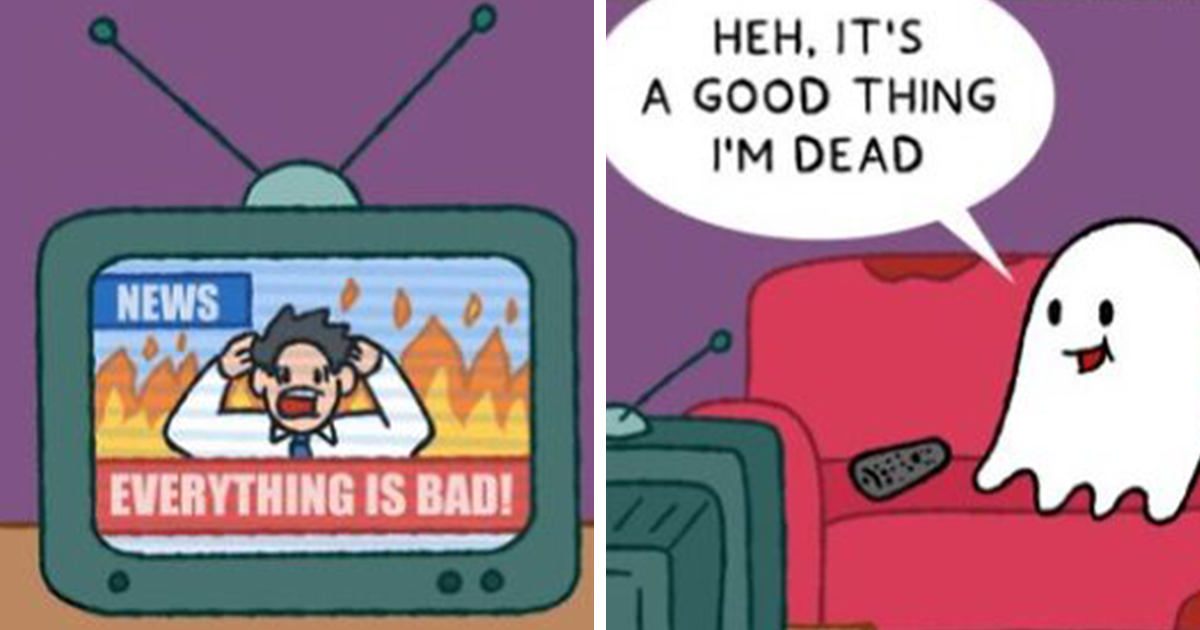
Death is usually treated like the final boss of serious topics: dim lighting, dramatic music, and everyone suddenly speaking in whispers. Then along comes Pavel, the creator behind the webcomic series Almost 100 Ghosts, and politely asks, “But what if the afterlife also had awkward small talk, crowded housing, weird hobbies, and ghosts who are just trying their best?” That is exactly why his adorable comics have become such a charming little haunted mansion on the internet.
The series, featured in Bored Panda’s “23 New Pics” collection, turns the afterlife into something strangely cozy. Instead of leaning on horror, gore, or cheap jump scares, Pavel builds a world where ghosts are funny, expressive, and suspiciously relatable. They may float through walls, but emotionally, they are stuck in the same group chat as the rest of us.
At its heart, Almost 100 Ghosts is a supernatural comedy about ordinary problems in an extraordinary setting. The characters live in an old abandoned house, share space with nearly one hundred spirits, and somehow still manage to run into the kind of social confusion, boredom, curiosity, and tiny daily disasters that make human life funny. It is spooky, yes, but in the same way a marshmallow wearing a bedsheet is spooky.
Who Is Pavel, The Artist Behind Almost 100 Ghosts?
Pavel is the creative force behind Almost 100 Ghosts, a webcomic series that mixes cute ghost characters, simple visual design, and short-form punchlines. One of the most interesting things about his work is that he is self-taught. His path did not begin with a grand art-school montage, dramatic charcoal sketches, and a professor saying, “You have the gift.” Instead, he developed his drawing skills through practice, starting with basic sketches and gradually moving into digital tools.
That journey matters because it helps explain the style of the comic. The drawings are intentionally simple, but not lazy. There is a big difference. Pavel keeps the visuals clean so the jokes can breathe. The ghosts are easy to recognize, their expressions are readable, and the panels move quickly. In online comics, that kind of clarity is gold. Readers often scroll while drinking coffee, waiting for class to start, avoiding laundry, or pretending they are “just checking one thing” before bed. A comic has seconds to land. Pavel’s work understands that rhythm.
The artist has also explained in interviews that drawing can take a lot of time, while inventing jokes and plots is the part that gives him the most energy. So he shaped the series around his strengths: fast visual communication, playful scenarios, and a cast flexible enough to handle almost any absurd situation. In other words, he did not fight his process. He built a haunted house around it.
What Is Almost 100 Ghosts About?
Almost 100 Ghosts takes place in an old abandoned house filled with spirits. That premise sounds like the opening of a horror movie, but the mood is closer to a sitcom with transparent roommates. The ghosts do not spend all day rattling chains or trying to scare innocent visitors. Most of the time, they are dealing with everyday afterlife problems: boredom, confusion, misunderstandings, weird neighbors, strange rules, and the eternal question of what to do when you technically have forever.
The title itself is part of the fun. Why “almost” one hundred ghosts? Why not exactly one hundred? Is someone missing? Is the count unreliable? Did one ghost leave for snacks in 1847 and never come back? Readers have developed theories, and that mystery gives the series a gentle narrative hook beyond the punchlines. It invites people to keep reading not just for the joke, but for the possibility that there is a bigger story hiding behind those tiny floating faces.
The comic also separates characters into recurring figures and one-off visitors. The regular ghosts help create familiarity, while episodic characters allow Pavel to add fresh jokes without overloading the main cast. This structure is perfect for webcomics. A reader can enjoy a single strip without knowing the entire backstory, but loyal fans still get the pleasure of recognizing patterns, personalities, and running themes.
Why These Funny Afterlife Comics Work So Well
Humor about the afterlife can be tricky. Make it too dark, and it becomes uncomfortable. Make it too soft, and it loses its bite. Pavel finds the sweet spot by treating the afterlife less like a scary destination and more like a strange apartment complex with no rent, no privacy, and very questionable management.
1. The Ghosts Are Cute, Not Creepy
The characters in Almost 100 Ghosts are designed to be approachable. Their rounded shapes, simple expressions, and playful body language make them feel more like shy neighbors than supernatural threats. This is important because it lowers the emotional temperature of the topic. Readers are not being asked to stare into the abyss. They are being asked to watch a ghost have a tiny existential inconvenience.
That cuteness creates contrast. Ghosts usually belong to haunted mansions, campfire stories, and Halloween decorations. Pavel keeps the haunted mansion but swaps dread for charm. The result is a comic world where the supernatural becomes a mirror for normal life. The joke is not “ghosts are terrifying.” The joke is “ghosts are just as awkward as we are.” Honestly, that feels more believable.
2. The Art Style Serves The Joke
Minimalist comic art can be incredibly powerful when it is done with intention. In Pavel’s case, the simple style keeps attention on timing, dialogue, and character reactions. The backgrounds are not overloaded. The ghosts are not buried under unnecessary detail. Every panel has one job: set up the moment and let the punchline land.
This matters because webcomics live in a fast-reading environment. A joke that takes too much effort to decode can lose its spark. Pavel’s clean compositions let readers understand the scene immediately, which makes the humor feel effortless. Of course, “effortless” is usually where the effort is hiding, wearing a little ghost costume and hoping nobody notices.
3. The Afterlife Feels Weirdly Domestic
One of the funniest parts of the series is how ordinary the supernatural becomes. Instead of focusing only on big cosmic questions, the comics often explore little social situations. What do ghosts do when they are not haunting? How do they pass time? Do they get annoyed? Do they gossip? Do they misunderstand each other? Do they have hobbies, rivalries, or dramatic reactions to tiny problems?
By making the afterlife domestic, Pavel makes it funny. Eternity is a huge idea, but sharing a house with dozens of personalities is instantly understandable. Anyone who has lived with siblings, roommates, classmates, or one very opinionated family pet can appreciate the chaos of limited space and unlimited personalities.
The “23 New Pics” Collection: What Makes It Worth Reading?
The “23 New Pics” collection continues the core appeal of Almost 100 Ghosts: short, charming comics that imagine what spirits might do when humans are not watching. The collection is not built around one long dramatic plot. Instead, it offers a series of quick scenes, each with its own comic turn. Some jokes are silly. Some are surprisingly thoughtful. Some feel like the kind of idea you would only have at 1:17 a.m. while staring at the ceiling and wondering whether ghosts have schedules.
The new strips also show how flexible Pavel’s world has become. A haunted house full of ghosts can support jokes about friendship, boredom, fear, curiosity, identity, and the strange logic of being invisible, floating, or already beyond ordinary human concerns. The setting is specific enough to feel recognizable, but broad enough to keep generating new ideas.
That is why the series has lasted across multiple collections and platforms. The concept is simple, but it is not narrow. “Ghosts in a house” could become repetitive in the wrong hands. Pavel avoids that by treating each ghost not as a prop, but as a tiny personality with a possible problem. The afterlife becomes a stage, and every spirit gets a chance to walk on, deliver a line, and float away with dignity. Well, dignity-ish.
Why Readers Love Wholesome Ghost Comics
The internet is not exactly starving for dark content. Open any app and within five minutes you may encounter a disaster headline, a celebrity argument, three angry comments, and someone explaining why your favorite childhood snack is morally complicated. In that environment, a wholesome ghost comic can feel like a warm blanket with eye holes.
Almost 100 Ghosts gives readers a safe way to laugh at a topic that is usually treated as heavy. The humor does not mock grief or suffering. Instead, it plays with imagination. What if ghosts had daily routines? What if being spooky was just one part of the job? What if the afterlife had the same small confusions as life, only with more floating?
This kind of humor works because it creates distance. When a big subject is filtered through cute characters and absurd situations, readers can approach it without feeling overwhelmed. Laughter has long been connected with stress relief and social bonding, and Pavel’s comics tap into that gentle effect. They do not try to solve life’s biggest mysteries. They simply make those mysteries less stiff and more smile-shaped.
The Role Of Webcomics In Pavel’s Success
Almost 100 Ghosts fits naturally into the modern webcomic ecosystem. Platforms like WEBTOON and Tapas have made it easier for independent creators to publish episodic comics, build audiences, and update regularly without needing a traditional newspaper strip or print publisher. This matters for artists like Pavel because short comics thrive online. A clever ghost joke can travel quickly, whether someone discovers it on a webcomic platform, a social feed, or a curated feature.
Webcomics also reward consistency. Readers return when they know a creator has a clear voice. Pavel’s voice is playful, slightly weird, and warm. The series is supernatural without being harsh, cute without being empty, and funny without needing to shout. That balance makes the comics easy to share. A reader can send one strip to a friend with the message, “This is us,” even if neither of them is a ghost. Probably.
Another strength of webcomics is direct audience reaction. Comments, likes, shares, and reader theories can all become part of the creative atmosphere around a series. Pavel has noted that he enjoys seeing readers build theories about the characters and the meaning of the title. That kind of engagement turns a simple comic into a small community puzzle. People are not just consuming the jokes; they are watching the haunted house expand room by room.
Specific Examples Of Humor In The Series
The best way to understand Almost 100 Ghosts is to think about its comic formula. A normal concern gets dropped into an abnormal world. A ghost may worry about something that would be ordinary for a human, but the supernatural context twists the joke. A spirit might face a social problem, a logic problem, or a personal crisis that becomes funny precisely because the character is already a ghost.
For example, the series often plays with the idea that ghosts can pass through walls, hover, or avoid normal physical limits. But instead of using those powers for grand horror, Pavel uses them for awkward comedy. If walls are meaningless, personal space becomes complicated. If time stretches strangely, boredom becomes heroic. If everyone is already a ghost, then being “scary” becomes less of a terrifying power and more of a personality trait, like being the roommate who labels leftovers.
The comics also use contrast. A ghost may look adorable while discussing something deeply strange. A haunted house may contain a conversation that feels like office break-room gossip. A supernatural creature may have a problem so mundane that the reader forgets the character is technically beyond the usual rules of life. That contrast is the engine of the comedy.
Why The Series Feels Bigger Than A One-Panel Joke
Many webcomics are built for quick laughs, and there is nothing wrong with that. A good quick laugh is a public service. But Almost 100 Ghosts has another layer: worldbuilding. The abandoned house is not just a backdrop. It feels like a place with history, hidden rules, and secrets waiting under the floorboards. The recurring ghosts suggest relationships. The title suggests a mystery. The repeated setting suggests that the afterlife has structure, even if that structure is delightfully ridiculous.
This is where Pavel’s series becomes especially appealing. Readers can enjoy the punchline and still wonder what comes next. Are there exactly ninety-nine ghosts? Are the ghosts connected by a shared story? Will the house reveal something unexpected? The comic does not need to answer everything immediately. In fact, part of the charm comes from not answering too quickly. A little mystery keeps the door creaking open.
Experiences Related To Reading These Funny Afterlife Comics
Reading Almost 100 Ghosts feels a little like walking into a haunted house and discovering that the ghosts are not trying to scare you; they are trying to explain the Wi-Fi password. That is the experience that makes the series memorable. It takes a subject people often approach with nervousness and turns it into something light, clever, and oddly comforting.
One relatable experience is the feeling of finding humor in uncomfortable topics. Everyone has moments when a joke helps loosen the knot in a tense conversation. Pavel’s comics operate in that same emotional zone. They do not make the afterlife realistic; they make it approachable. The reader gets to laugh at the imaginary logistics of ghosthood: crowded rooms, strange conversations, confusing abilities, and the hilarious possibility that eternity might include boredom. Somehow, that makes the unknown feel less cold.
Another experience is recognizing human behavior in nonhuman characters. The ghosts may float, but their personalities are grounded. They misunderstand things. They react dramatically. They have questions. They seem to want connection, entertainment, and meaning. That is why the comic does not feel like a random collection of spooky jokes. It feels like a tiny society. Readers see themselves in the ghosts, which is both sweet and mildly concerning. If a bedsheet-shaped spirit understands your social life, it may be time to hydrate and go outside.
The series also captures the comfort of small, repeatable humor. Not every comic needs to change your worldview. Some are there to give your brain a snack. A short ghost comic can act like a tiny reset button during a stressful day. You scroll, smile, and move on feeling a bit lighter. That is one of the quiet strengths of webcomics: they fit into the cracks of daily life. They do not demand an entire evening. They just ask for a few seconds and reward you with a small laugh.
For artists and creative readers, Pavel’s work offers another experience: encouragement. His self-taught path and intentionally simple style show that a memorable comic does not need to begin with perfection. It needs a strong idea, consistent tone, and characters people want to revisit. The drawings are charming because they serve the concept. The jokes work because the world is clear. That can be inspiring for anyone who has ever thought, “I have ideas, but my art is not fancy enough.” Fancy is nice. Funny is better. Funny with ghosts? Now we are talking.
Finally, the comics offer the experience of community. When readers comment, theorize, and choose favorite strips, the series becomes more than a private laugh. It becomes a shared haunted room where everyone points at the same ghost and says, “That one is me.” In a digital world that can feel loud and divided, a gentle comic about adorable spirits is a surprisingly effective meeting place.
Conclusion: A Haunted House With A Heart
This Artist Makes Adorable Comics Showing The Funny Side Of The Afterlife (23 New Pics) is more than a catchy title. It describes exactly why Pavel’s Almost 100 Ghosts works: it makes the afterlife funny without making it cruel, spooky without making it unpleasant, and cute without draining away the weirdness. The series succeeds because it understands that ghosts do not have to be terrifying to be interesting. Sometimes, they just need good timing, expressive eyes, and a housing situation that would make any roommate nervous.
Pavel’s comics remind us that humor can sneak into the strangest places. A haunted house can become a sitcom. A ghost can become a friend. A mystery can become a running joke. And the afterlife, at least in this charming webcomic universe, might be less about eternal dread and more about eternal awkwardness. Honestly, that sounds much more on-brand for humanity.
Note: This article is an original SEO-friendly rewrite based on publicly available information about Pavel, Almost 100 Ghosts, webcomic platforms, and general research on comics, ghost folklore, and humor. No source links or unnecessary reference elements are included in the article body.