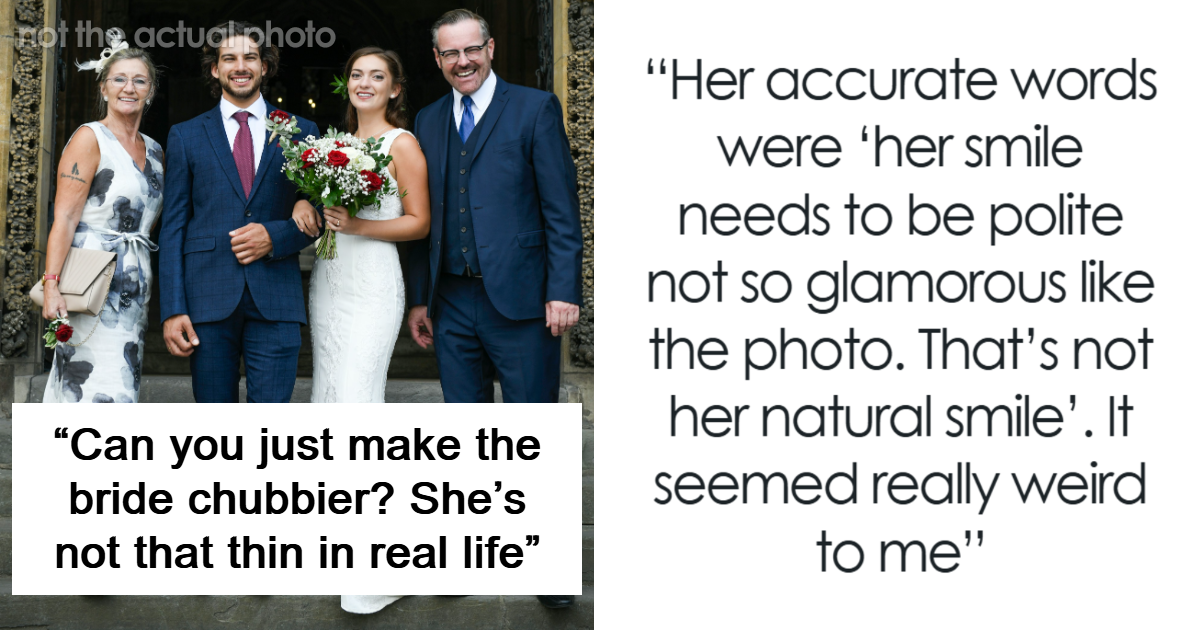
Christmas gifts are supposed to say, “I thought of you.” They are not supposed to say, “I hired an artist to quietly insult you in high resolution.” Yet that is exactly why one viral family drama grabbed the internet by the collar: a mother-in-law reportedly commissioned a custom wedding portrait as a holiday gift, then began asking the artist to alter the bride’s appearance in ways that felt less like artistic direction and more like emotional sabotage wearing a festive sweater.
The request that made readers collectively blink was simple, loaded, and spectacularly inappropriate: make the bride “chubbier.” Not because the photo called for accuracy. Not because the couple had asked for a playful caricature. But, according to the story, because the mother-in-law seemed determined to make her daughter-in-law look worse in a sentimental portrait meant to celebrate love, family, and the kind of memories people hang in their living rooms instead of burying in a group chat.
The artist, thankfully, did not play along. Instead of turning a wedding illustration into a decorative little grudge, she noticed the pattern, questioned the changes, and refused to help create a gift that would embarrass the bride. That refusal is the heart of the storyand the reason so many people cheered.
When A “Thoughtful Gift” Starts Looking Suspicious
At first glance, a custom wedding portrait sounds lovely. Personalized gifts often feel more meaningful than generic presents because they show time, attention, and emotional effort. A portrait of newlyweds can become a keepsake, a reminder of a major milestone, and a sweet way to honor the joining of two families.
But the problem was not the gift idea. The problem was the intention behind the edits. The mother-in-law allegedly asked for subtle but pointed changes to the bride’s appearance: less polish, less beauty, a different face, a softer jawline, a bigger body, and other adjustments that pushed the drawing away from resemblance and toward humiliation. One odd request might be a misunderstanding. Several requests moving in the same direction? That starts to smell like a casserole of jealousy, control, and unresolved family drama.
The artist was placed in a tricky professional position. Clients do request revisions. That is normal. Maybe the flowers are the wrong shade. Maybe Uncle Bob’s glasses are missing. Maybe the dog needs to look less like a haunted mop. But asking an artist to make one person in a family portrait look noticeably less attractive crosses a line. A wedding illustration should not become a stealth attack.
Why The Internet Immediately Took The Bride’s Side
Online readers did not need a forensic lab to detect the problem. Most people understood the emotional cruelty right away. A wedding portrait is not just decoration; it is a public symbol. It tells a story about how the couple is seen by their family. If one family member secretly tries to distort the bride’s image, the message is not just, “I dislike this photo.” It is, “I want control over how you are remembered.”
That is why the “make the bride chubbier” request landed so badly. Commenting on someone’s body is already a social minefield. Turning that comment into a permanent artwork is somehow worse. It is like taking a rude Thanksgiving remark, framing it, and wrapping it in Christmas paper.
The public reaction also reflects a larger cultural shift. Many people are more aware now that body-focused criticism can be harmful, even when disguised as honesty, concern, humor, or “just a suggestion.” A person’s size, face, hair, makeup, smile, or features should not be treated as family property. The bride’s body was not a Photoshop playground. Her wedding portrait was not an open invitation for another woman’s insecurity to grab a paintbrush.
The Real Issue: Control, Not Art
It would be easy to reduce the story to a cartoonish “monster-in-law” moment, but the deeper issue is control. A difficult in-law relationship often becomes most visible during major transitions: engagements, weddings, holidays, pregnancies, moves, and the creation of new traditions. These moments shift the family structure. A parent who was once the central figure in an adult child’s life may suddenly feel less important, less consulted, or less powerful.
Healthy parents adjust. They may feel emotional, but they respect the couple’s independence. Unhealthy relatives compete. They may turn small decisions into loyalty tests, insert themselves into private matters, or disguise criticism as help. In this case, the portrait became a battlefield. The mother-in-law was not merely choosing a background color. She was trying to shape how the daughter-in-law appeared in a family memory.
That is why the artist’s refusal mattered. She did not just protect a drawing. She protected the subject of the drawing from being quietly mocked by someone who should have been welcoming her.
Why Artists Need Boundaries Too
Custom artists often deal with emotional projects: wedding portraits, memorial pieces, pet illustrations, family keepsakes, anniversary gifts, and holiday commissions. These jobs can be beautiful, but they can also become complicated because clients bring feelings, expectations, and occasionally enough unresolved family tension to power a small suburban generator.
A professional artist is not a vending machine for someone else’s bad intentions. If a client asks for edits that feel cruel, deceptive, discriminatory, or designed to embarrass another person, the artist has every right to pause or refuse. In fact, refusing may protect the artist’s reputation. Imagine the bride receiving the portrait, recognizing the changes, and asking, “Who made me look like this?” The artist’s name would be attached to the harm, even if the idea came from the client.
This is also a reminder for freelancers: clear commission policies matter. Revision limits, approval stages, written communication, deposits, cancellation terms, and ethical boundaries can save a creative professional from chaos. A contract cannot prevent every strange request, but it can give the artist a sturdy umbrella when the family drama starts raining indoors.
The Groom’s Role: This Is Where The Spouse Must Step Up
One of the biggest questions in any in-law conflict is simple: where is the spouse? When a parent mistreats a partner, the adult child cannot stay comfortably neutral forever. Neutrality may look peaceful from a distance, but up close it often feels like abandonment.
If a mother-in-law tries to undermine a daughter-in-law’s appearance, the groom’s response matters. He does not need to start a dramatic holiday courtroom scene beside the mashed potatoes. But he does need to make it clear that disrespecting his spouse is not acceptable. A strong marriage requires the couple to act like a team, especially when outside relatives test boundaries.
A useful response might sound calm but firm: “Mom, we appreciate the idea of a portrait, but I will not accept a gift that changes my wife’s appearance to make her look worse. That is hurtful, and it needs to stop.” No shouting. No twenty-seven-page family manifesto. Just a clear line in the snow.
Why Body-Based Insults Are Never “Just A Joke”
Some people defend appearance-based comments by saying they were joking. But a joke that relies on making someone feel ashamed of their body is not harmless. It is social camouflage. The person making the comment gets to throw the dart, then act surprised when someone mentions the dartboard.
Weight-related insults are especially loaded because people often attach moral judgments to body size. They may imply laziness, lack of discipline, unattractiveness, or inferiority, none of which can be measured by looking at a portrait. In this story, the issue was not whether the bride was thin, curvy, petite, tall, glamorous, natural, or anything else. The issue was that someone allegedly wanted her altered in a negative way without her consent.
Body-neutral respect is the better standard. That means people do not need to praise every feature or pretend appearance never exists. It simply means a person’s worth is not up for family debate. A wedding portrait should capture joy, not turn someone’s face or body into a committee project led by the least supportive person in the room.
Holiday Gifts Should Not Come With Hidden Daggers
Christmas has a special talent for magnifying family issues. The season is wrapped in expectations: be generous, be cheerful, be grateful, wear the sweater, eat the pie, smile for the photo, ignore the comment, keep the peace. But “keeping the peace” often means asking the wrong person to be quiet. The person being hurt is told to be polite, while the person causing the hurt gets to hide behind tradition.
A gift with a cruel intention is not generous. It is a performance. It allows the giver to appear thoughtful while delivering a private insult. That is why this portrait story bothered so many people. The mother-in-law could have chosen a neutral present. She could have ordered a faithful illustration. She could have given a candle and spared everyone the emotional gymnastics. Instead, the alleged plan turned a holiday gesture into a power move.
The artist’s refusal interrupted that plan. In a way, she became the unexpected adult in the roomarmed not with a lecture, but with common sense and a working moral compass.
What Couples Can Learn From This Story
1. Do Not Ignore Small Signs Of Disrespect
Family conflict rarely begins with the biggest incident. It often starts with little digs: a comment about makeup, a joke about weight, a comparison to an ex, a complaint about traditions, or a “helpful” suggestion that feels oddly sharp. Small moments matter because they show patterns. If someone repeatedly targets your partner’s confidence, it is worth addressing early.
2. Put Boundaries In Plain Language
Boundaries work best when they are specific. “Please be nicer” is vague. “Do not comment on my wife’s body, clothing, or appearance” is clearer. The goal is not to control another adult’s thoughts; it is to define what behavior will not be welcomed in your home, marriage, or holiday celebrations.
3. Keep Records When A Situation Gets Weird
For artists, vendors, and couples, written communication can be extremely useful. If a client requests questionable edits, emails and messages create clarity. They also prevent someone from later claiming, “That is not what I meant.” Documentation is not dramatic. It is practical. Think of it as emotional seatbelts.
4. Choose The Marriage Over The Performance
Many families care deeply about appearances. They want the happy photo, the perfect dinner, the smiling holiday card. But a healthy marriage is more important than a smooth-looking family performance. If a relative disrespects one spouse, the couple should deal with the truth rather than decorate around it.
What Artists Can Learn From The Portrait Drama
The artist in this story handled a difficult situation with impressive instincts. She noticed that the requested revisions were not about accuracy. They were about making one person look worse. That distinction is crucial for creative professionals.
Artists should feel empowered to ask questions when a revision seems suspicious. For example: “Can you explain why this change is needed?” or “The reference photo shows her differently; would you like me to preserve likeness instead?” If the client’s answers reveal an unkind motive, the artist can refuse the edit, cancel the commission according to policy, or offer a version that stays respectful.
Commissioned art is collaborative, but collaboration does not require moral surrender. A client pays for skill, not ownership of the artist’s ethics. The best artists understand not only proportion, color, and composition, but also context. They know when a request will turn a meaningful keepsake into a visual insult.
The Bigger Conversation: Why This Story Went Viral
This story went viral because it contains several ingredients the internet cannot resist: a wedding, a mother-in-law, a holiday gift, a suspicious commission, and an artist who said, “Absolutely not,” without needing a dramatic cape. But beyond the entertainment value, people recognized something real.
Many readers have experienced a version of this behavior. Maybe it was not a portrait. Maybe it was a relative choosing an unflattering photo for a family album. Maybe it was a comment about weight at dinner. Maybe it was a mother-in-law insisting the bride looked “better before” or suggesting changes that were not actually suggestions. The details vary, but the emotional pattern is familiar: one person tries to shrink another person’s confidence while pretending to help.
That familiarity is why the artist’s refusal felt satisfying. She did what many people wish someone had done for them. She noticed. She named the problem. She did not cooperate.
Experiences Related To This Topic: When Gifts Reveal The Relationship
Anyone who has ever navigated family gift-giving knows that presents can carry messages far beyond the price tag. A great gift says, “I see you.” A lazy gift says, “I stopped at a pharmacy on the way here.” A hostile gift says, “I see you, and I have notes.” The portrait drama belongs firmly in that third category.
Consider a common real-life scenario: a newly married couple receives a framed family photo from a relative. Everyone looks cheerful, except the bride was caught mid-blink and the groom’s mother insists it is “the best one.” Technically, it is a gift. Emotionally, it feels like a tiny museum exhibit titled, “Welcome To The Family, Sort Of.” The issue is not vanity. The issue is being singled out in a way that feels intentional.
Another familiar experience happens during weddings themselves. A parent may push for traditions the couple does not want, then frame resistance as disrespect. “I only want what is best,” they say, while steamrolling the guest list, the seating chart, the menu, the music, and possibly the oxygen supply. When the couple finally says no, the parent acts wounded. This is why boundaries can feel uncomfortable but necessary. They interrupt patterns that have been running unchecked for years.
Artists and vendors see these tensions from a unique angle. A photographer may notice one family member repeatedly requesting photos without the bride. A makeup artist may hear a relative suggest the bride needs “more coverage” or “less drama.” A stationery designer may be asked to list divorced parents in a way that creates a new war before dessert is served. Vendors are not therapists, but they often become witnesses to family dynamics that the couple has been trying to manage quietly.
The best response in these situations is not revenge. It is clarity. If a gift feels insulting, the couple can acknowledge the gesture without accepting the disrespect: “Thank you for thinking of us, but we are not comfortable displaying something that changes my appearance.” If a relative claims innocence, the couple does not need to argue for three business days. They can repeat the boundary and move forward.
For brides and daughters-in-law, the emotional lesson is especially important: you are not required to laugh at a joke that hurts you. You are not required to be grateful for a gift that humiliates you. You are not required to shrink yourself so someone else can feel bigger in the family. Politeness is lovely, but self-respect is not rude.
For mothers-in-law, the lesson is equally clear. If you want a strong relationship with your child’s spouse, do not compete with them. Do not test them. Do not turn holidays into loyalty exams. Welcome them as a person, not as an intruder. A family expands through respect, not through little acts of sabotage disguised as tradition.
And for everyone ordering custom art: choose kindness. Ask for accurate, joyful, respectful details. Make the flowers brighter. Add the dog. Fix the tie. But do not ask an artist to make someone look worse because your feelings are wearing tap shoes. That is not a revision. That is a red flag with a tracking number.
Conclusion: The Artist Refused, And That Is The Point
The story of the mother-in-law who allegedly tried to make the bride look “chubbier” in a Christmas gift portrait is more than a strange internet tale. It is a reminder that disrespect often hides inside ordinary moments: a gift, a joke, a suggestion, a revision request. What made this story powerful was not just the cruelty of the request, but the artist’s decision to stop it.
A wedding portrait should celebrate love. It should not become a family member’s secret attempt to rewrite someone’s beauty, dignity, or place in the family. The bride deserved to be represented with respect. The artist understood that. The internet understood it too.
In the end, the best holiday gift in this story was not the portrait. It was the refusal to turn art into an insult. Sometimes the most beautiful line an artist can draw is a boundary.
Note: This article is written as an original SEO-friendly analysis based on publicly reported details of the viral story and broader expert guidance on family boundaries, body image, wedding etiquette, and professional art commissions.