Some speakers simply play sound. A Leslie speaker throws sound into a tiny indoor weather system, spins it around the room, bends the pitch, shakes the air, and then politely asks your guitar, organ, or keyboard if it would like to sound ten times more dramatic. That is why a modern version of this famous, classic speaker still gets musicians excited decades after Donald Leslie first chased the dream of making an electric organ feel more like a living, breathing pipe organ.
The phrase “modern version of a famous, classic speaker” could point to several retro-inspired audio products, but in the world of musical instruments, one legend spins louder than the rest: the Leslie rotating speaker. Originally associated with the Hammond organ, the Leslie became a defining sound in gospel, jazz, soul, blues, psychedelic rock, and classic rock. Today, builders, pedal makers, keyboard companies, and curious DIY tinkerers are still trying to capture its magic without needing a moving truck, a repair manual, and a very forgiving lower back.
This article explores how the classic Leslie speaker works, why modern musicians still crave it, what a newer DIY recreation brings to the table, and why no software menu quite replaces the odd joy of hearing actual air swirl around a room.
What Is the Famous Classic Speaker?
The Leslie speaker is not just a loudspeaker cabinet. It is an electro-mechanical sound machine. In a traditional Leslie design, the audio signal is split between high and low frequencies. The treble portion is sent to a horn assembly, while the bass frequencies are projected through a rotating drum or baffle. As these parts spin, the listener hears changes in loudness, pitch, phase, and space. In plain English: the sound wobbles, blooms, breathes, and moves as if the room itself joined the band.
Donald Leslie developed the concept after hearing that a Hammond organ sounded less grand at home than it did in a larger showroom. His goal was not merely to make the organ louder. He wanted movement, dimension, and the illusion of sound arriving from different places, much like a pipe organ filling a church. That ambition led to a rotating speaker system that used the Doppler effect, the same basic phenomenon that makes a siren seem to change pitch as it moves past you.
It is important to understand that the Leslie was never meant to be a neutral hi-fi speaker. Nobody bought one because it reproduced sound with monk-like accuracy. The Leslie is loved because it colors sound beautifully. It is a speaker, amplifier, modulation effect, room interaction device, and vintage furniture workout program all in one.
Why the Leslie Sound Became Legendary
The Hammond organ and Leslie speaker became one of music’s great accidental marriages. They were not originally created as a package deal, but once musicians heard the combination, it was hard to separate them. The Hammond organ supplied the tonewheel voice: bold, reedy, warm, and harmonically rich. The Leslie added motion and drama. Together they could whisper in a smoky jazz club, shout in a gospel church, or roar through a rock stage like a very sophisticated tornado.
Classic Leslie cabinets such as the 122 and 147 became favorites because they had a musical balance of tube warmth, mechanical movement, and cabinet resonance. When players switched between slow and fast rotor speeds, the transition itself became part of the performance. The acceleration and deceleration were not instant. They ramped up and down, creating that famous swelling effect that feels emotional before you even analyze it.
Guitarists eventually discovered the Leslie too. While it was built for organs, the rotary speaker effect became a secret weapon for electric guitar, vocals, and studio experimentation. The sound can be dreamy, syrupy, ghostly, chewy, or downright wild. Yes, “chewy” is a technical term if you say it with enough confidence near a pedalboard.
How a Leslie Speaker Actually Works
The Treble Horn
In many classic models, high frequencies are sent through a compression driver into a rotating horn assembly. The horn spins, pushing the sound around the room. Interestingly, many Leslie horn assemblies have two horn shapes, but only one actually produces sound. The other is often there for balance, like a silent dance partner who still deserves credit.
The Bass Rotor or Drum
Lower frequencies usually come from a woofer that fires into a rotating drum or baffle. The drum has an opening that throws sound outward as it spins. Because bass frequencies are longer and less directional than treble, the low rotor produces a different kind of movement: more pulse, throb, and body than sparkle.
The Speed Switch
The classic Leslie experience often depends on switching between slow and fast speeds. The slow setting is commonly called chorale, while the fast setting is often called tremolo. The real fun happens during the ramp between the two. A good rotary sound does not just click from one speed to another; it surges, hesitates, catches momentum, and arrives with theatrical flair.
A Modern DIY Version: Old Soul, New Hands
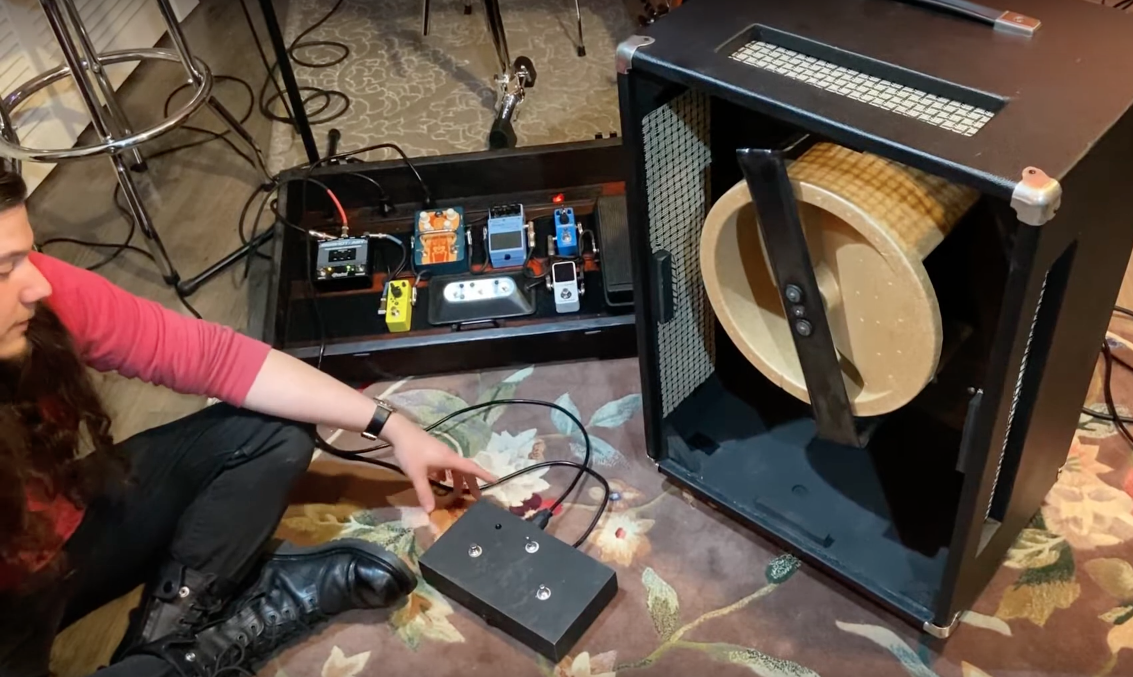
A recent modern recreation shows why the Leslie idea refuses to retire quietly. Instead of simply loading a digital plug-in and calling it a day, a builder created a compact, modern Leslie-style speaker using an original Leslie drum, a 100-watt speaker, a single-speed Leslie motor, and a custom-built foot switch for more expressive speed control. That combination matters because it keeps the physical part of the sound alive while making the cabinet more approachable for modern players.
This kind of project sits in a sweet spot between restoration, invention, and practical musicianship. It is not a museum-perfect replica, and that is part of the charm. A modern version of a classic speaker does not have to copy every screw and scar. It has to respect the original idea: move the air for real, make the sound feel three-dimensional, and give the player control over motion.
The use of an original Leslie drum is especially important. Many digital tools can imitate pitch modulation and stereo movement, but a rotating physical part interacts with the room in unpredictable ways. Reflections bounce differently. Microphones hear different angles. The cabinet adds its own resonant personality. That is why musicians often describe real rotary speakers as having a “feel” that is hard to fake.
Why Build a Modern Leslie-Style Speaker?
First, vintage Leslie cabinets can be expensive. Depending on model, condition, and local market, original units can cost serious money. Then comes maintenance. Motors, belts, bearings, amplifiers, connectors, tubes, wiring, rotors, and cabinets all age. A Leslie is musical gear, but it is also a small mechanical ecosystem with opinions.
Second, vintage cabinets are heavy. Some models approach the weight of a small refrigerator with better tone. That is fine if the speaker lives in a studio. It is less charming if the gig is upstairs and the venue’s elevator has “temporarily” been broken since 1998.
Third, modern players want flexibility. They may use guitar, keyboard, synth, electric piano, or vocals. They may need a line input, footswitch control, stereo recording options, or a cabinet that can fit in a home studio without causing a domestic negotiation. A modern recreation can borrow the soul of the Leslie while adapting the format to real contemporary needs.
Modern Alternatives: Reissues, Pedals, and Plug-ins
Official Leslie Reissues
Hammond still offers modern Leslie speaker models that preserve key elements of the classic design. Some units follow the traditional two-speed cabinet format with tube amplification, horn drivers, and bass rotors. These are the closest route for players who want the real thing without hunting the vintage market. They also offer modern connections that make them easier to pair with current Hammond organs and compatible instruments.
Rotary Speaker Pedals
Pedals are the most practical solution for many guitarists and keyboard players. A good rotary speaker pedal can fit on a pedalboard, run in mono or stereo, provide slow and fast speed control, simulate tube drive, and allow players to adjust virtual microphone distance or rotor balance. Modern units from companies such as BOSS, Hammond, Neo Instruments, Keeley, Tech 21, and others show how far digital signal processing has come.
For example, the BOSS RT-2 Rotary Ensemble condenses rotary speaker behavior into a compact pedal with multiple modes, fast and slow controls, rise and fall timing, stereo operation, drive, and a visual rotor display. That last feature is more useful than it sounds. On a dark stage, watching the virtual rotor lights can help a player understand what the effect is doing without kneeling down like a nervous raccoon.
Software and DAW Plug-ins
For producers, rotary speaker plug-ins are convenient, recallable, and easy to automate. In a digital audio workstation, you can place a rotary effect on organ, guitar, vocals, synth pads, or even drums for creative texture. Plug-ins are excellent when speed, budget, and repeatability matter. Still, they do not move actual air in the same way a rotating cabinet does, which is why many studios still treat a real Leslie like a beloved, slightly troublesome pet.
Physical Rotation vs. Digital Modeling
The debate between real rotary speakers and digital emulations is not about one being “good” and the other being “bad.” It is about use case. A real rotating speaker creates sound through movement, distance changes, cabinet reflections, and mechanical inertia. It is wonderfully imperfect. It can be mic’d in different ways, placed in different rooms, and pushed until the amplifier adds grit. It also requires space, maintenance, and patience.
Digital modeling, by contrast, offers consistency and portability. A pedal can give you a convincing Leslie-style sound at a club gig, in a bedroom studio, or through a silent recording setup. You can adjust parameters instantly. You can save settings. You can avoid explaining to your drummer why half the van is occupied by a wooden box with spinning parts.
The best modern approach may be hybrid thinking. Use a real or DIY rotary speaker when the room, recording session, or performance benefits from physical movement. Use a pedal or plug-in when portability, control, and reliability matter most. Great tone is not a purity contest. It is a practical love story between sound and situation.
What Makes a Modern Version Successful?
It Keeps the Motion
A modern version of the Leslie speaker should preserve the sense of movement. Whether physical or digital, the sound must feel like it is traveling, not merely wobbling in place. Cheap rotary effects can sound like a chorus pedal wearing a fake mustache. Good ones create depth.
It Gets the Ramp Right
The transition between slow and fast speeds is central to the Leslie personality. A realistic ramp gives the player emotional control. It can make a chord swell like a sunrise or make a guitar line suddenly step into a psychedelic elevator.
It Balances Warmth and Clarity
Classic Leslie tone is warm, but too much warmth can disappear in a dense mix. Modern designs often add more definition, wider frequency response, or adjustable rotor balance so the effect can work with guitar pedals, synthesizers, modern keyboards, and recording chains.
It Respects the Original Without Freezing It in Amber
The best modern classic speaker designs do not treat the past as a museum display. They treat it as a conversation. A compact DIY Leslie-style cabinet, a modern tube reissue, or a high-quality rotary pedal can all be valid if they capture the musical reason people loved the original.
Who Should Use a Modern Leslie-Style Speaker?
Keyboard players are the obvious audience. If you play Hammond-style organ sounds, a rotary effect is not optional decoration; it is part of the instrument’s vocabulary. Slow speed can add gospel warmth and jazz shimmer. Fast speed can push rock lines into glorious overdrive. The switch between them is practically punctuation.
Guitarists should also pay attention. A rotary speaker sound can make simple chords feel cinematic and make single-note lines sound wider without relying on ordinary chorus or delay. It works beautifully with blues, soul, psychedelic rock, indie, ambient, funk, and experimental music. It can also rescue a boring part faster than coffee rescues a Monday morning.
Producers can use rotary textures on vocals, electric piano, synth pads, harmonica, percussion loops, and even background effects. The trick is restraint. A little rotary movement can add depth and mystery. Too much can make the mix sound like it is trapped in a washing machine during the spin cycle.
Buying or Building: Which Path Makes Sense?
If you want authenticity and have the budget, space, and patience, a real Leslie or official modern Leslie cabinet is hard to beat. It gives you the mechanical sound, the cabinet resonance, and the performance feel that made the design famous.
If you enjoy hands-on projects, a DIY modern Leslie-style speaker can be deeply rewarding. Using salvaged parts, a modern driver, a custom cabinet, and a practical footswitch can create a personalized instrument rather than a simple effect box. Just remember that motors, mains voltage, rotating parts, and amplifiers are not casual toys. Safety matters. So does careful wiring. A spinning drum is fun; an electrical surprise is less fun.
If you need portability, a modern rotary pedal is the sensible choice. The newest pedals are impressively musical and often include stereo outputs, drive controls, speed ramp settings, expression pedal support, and multiple voicings. For many working musicians, that is the best balance of tone and convenience.
Real-World Experience: Living With a Modern Version Of Famous, Classic Speaker
The first time you use a modern Leslie-style speaker or a convincing rotary pedal, the temptation is to turn everything up and make every chord sound like it is being beamed in from a velvet spaceship. This is understandable. It is also how perfectly decent songs become dizzy. The best experience comes from learning how the rotary effect behaves at different speeds and intensities.
On slow settings, a modern rotary speaker sound can act like a classy chorus with more personality. It thickens clean guitar chords, gives electric piano a liquid shimmer, and makes organ pads feel alive. In a small room, a physical rotating speaker can seem almost magical because the reflections change as you move. Stand in one corner and the sound pulses gently. Move closer and the horn seems to flicker past your ears. It is less like listening to an effect and more like standing near a musical machine that has learned to breathe.
Fast settings are more dramatic. On organ, fast rotary speed can create that familiar gospel and rock urgency. On guitar, it can push a lead line into psychedelic territory without needing a stack of other effects. The trick is to use the fast speed as an event. Switch into it for a chorus, a solo peak, or the end of a phrase. Then return to slow speed so the listener has somewhere to land. Constant fast rotary can be thrilling, but it can also make the arrangement feel like it drank three espressos and forgot its shoes.
In recording, placement matters. A pedal or plug-in gives immediate control, but a real cabinet rewards experimentation. Try close microphones for detail, room microphones for swirl, and blended positions for depth. If you are recording a DIY modern Leslie-style cabinet, do not assume there is one correct setup. The cabinet, the room, the rotor speed, and the source instrument all interact. That is the fun. It is also the part that makes engineers stare thoughtfully at microphones while pretending they planned everything.
For live use, practicality becomes king. A compact pedal wins when setup time is short. A physical cabinet wins when the performance is built around that unmistakable movement. The best modern experience is not about proving that old gear is better or that new gear is smarter. It is about choosing the tool that makes the music feel more alive.
After spending time with the concept, one lesson becomes clear: the famous classic speaker survived because it solved an emotional problem, not just a technical one. It made electronic sound feel physical. A modern version succeeds when it keeps that emotional movement intact. Whether it uses a real spinning drum, advanced DSP, or a clever mix of old parts and new controls, the goal remains the same: make sound move in a way that makes people look up and smile.
Conclusion
A modern version of the famous Leslie speaker is more than nostalgia with knobs. It is proof that some inventions stay relevant because they touch something deeper than specifications. Donald Leslie wanted an electric organ to feel spacious, animated, and alive. Decades later, musicians are still chasing that same feeling through restored cabinets, official reissues, boutique pedals, digital modeling, and DIY builds that combine vintage parts with modern practicality.
The classic Leslie sound remains special because it is physical, imperfect, expressive, and slightly theatrical. It turns sustained notes into motion. It turns simple chords into atmosphere. It turns a speaker cabinet into a performer. In a music world full of clean presets and instant downloads, that kind of mechanical soul still matters.
So whether you are a keyboard player, guitarist, producer, builder, or tone nerd with a dangerous fondness for spinning objects, the modern Leslie-style speaker deserves your attention. It is old technology with fresh relevance, vintage magic with modern manners, and quite possibly the only speaker that can make “rotating furniture” sound like a compliment.