Note: This article is written for web publication and synthesizes real information about miniature RC hydraulics, proportional valves, spool control, sersion machining, and scale construction models.
Miniature RC hydraulics may sound like something invented by a hobbyist who looked at a full-size excavator and said, “Cute, but what if it fit on my workbench?” Yet that is exactly the magic. In the world of scale construction models, a tiny hydraulic cylinder can lift a boom, curl a bucket, steer a loader, or raise a dump bed with a smoothness that gears and linkages often struggle to match. At the center of that miniature muscle is one deceptively small hero: the finely machined valve.
A finely machined valve controls miniature RC hydraulics by directing pressurized oil from a pump to one side of a hydraulic cylinder while letting oil return from the other side. In a well-designed system, the valve does more than turn motion on and off. It meters flow, holds loads, prevents leaks, and gives the operator proportional control. That means a model excavator arm can creep forward like a cautious cat instead of launching itself like a caffeinated trebuchet.
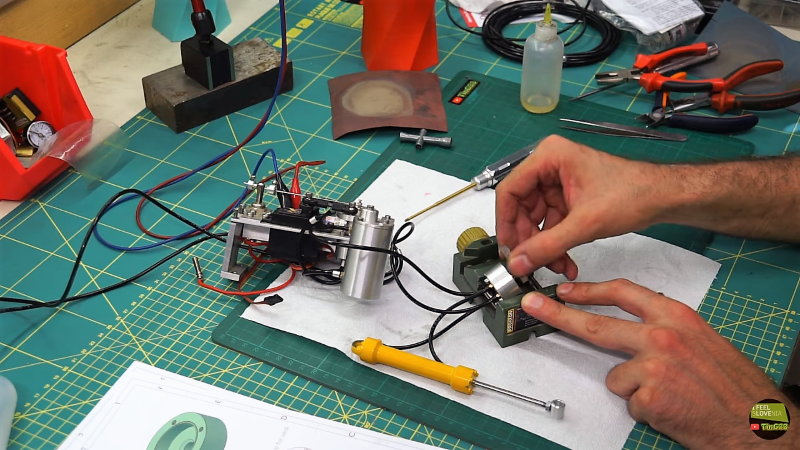
The topic became especially interesting among makers after a hand-built rotary dual-action proportional valve demonstrated how much performance can be squeezed from aluminum, brass, careful lathe work, and patient assembly. The result was not just a tiny part; it was a miniature hydraulic control system with real mechanical elegance. For RC builders, machinists, and anyone who enjoys watching small parts do big jobs, this kind of valve is a beautiful reminder that precision is not showing off. Precision is the whole game.
What Makes Miniature RC Hydraulics So Fascinating?
Hydraulics work by using pressurized fluid to transfer force. In full-size machines, hydraulic systems power excavators, skid steers, cranes, dump trucks, forklifts, and industrial equipment. In miniature RC models, the same principle is scaled down. A pump pushes hydraulic oil through small hoses, a valve directs the oil, and a cylinder converts fluid pressure into motion.
The appeal is obvious once you see it. A scale excavator with real hydraulics does not merely “look” like a machine. It behaves like one. The boom rises with authority. The bucket curls under load. The arm can pause mid-stroke instead of flopping around like a loose drawer handle. The model gains realism, power, and that satisfying slow-motion mechanical drama usually reserved for job sites and very serious YouTube videos.
But miniaturization is brutal. A full-size hydraulic valve has room for robust ports, large seals, roomy passages, and forgiving tolerances. A miniature RC hydraulic valve has to perform similar duties with tiny bores, small O-rings, narrow grooves, tiny fittings, and low-flow oil passages. There is less room for error, less room for debris, and absolutely no room for “close enough, probably.”
How a Finely Machined Valve Controls Hydraulic Motion
At its simplest, a valve decides where the oil goes. In a double-acting hydraulic cylinder, oil can be sent to either side of the piston. Send oil to one side and the rod extends. Send oil to the other side and the rod retracts. Block both sides and the cylinder should hold its position. That “should” is important, because poor machining, loose fits, bad seals, or scratched surfaces can let oil sneak through internal leakage paths.
A directional control valve usually contains internal passages and a moving control element. That element may be a spool, rotary shaft, sliding piston, or plug. As it moves, it opens and closes different flow paths. A proportional valve goes further by allowing intermediate positions. Instead of being fully open or fully closed, it can open a little, a lot, or somewhere in between. This is what gives RC hydraulics the silky control needed for delicate operations.
In miniature RC hydraulics, proportional control is often created by connecting a servo to the valve. Move the transmitter stick slightly, and the servo nudges the valve slightly. Move the stick farther, and the valve opens more. The hydraulic cylinder then moves faster because more oil can flow. The goal is simple: the model should respond like a real machine, not like a light switch with tracks.
Why Machining Quality Matters
A finely machined valve is not just pretty metal jewelry for engineers. Its performance depends on the accuracy of every bore, groove, face, port, and sealing surface. If the valve body is misaligned, the spool or rotor may bind. If clearances are too loose, oil leaks internally. If surfaces are rough, seals wear quickly. If tiny holes contain burrs, flow becomes unpredictable, and the system may behave as if it has a personal grudge against the operator.
Aluminum is often used for valve bodies because it is lightweight and easy to machine. Brass is popular for rotating or sliding components because it machines cleanly, resists corrosion, and can run smoothly against other metals. Stainless steel may be used for shafts, fasteners, or wear-prone parts. The best material choice depends on pressure, fluid, size, manufacturing tools, and budget.
The challenge is not simply making small parts. It is making small parts that seal under pressure, move smoothly, and repeat the same action hundreds or thousands of times. A miniature valve might need precisely drilled cross holes, carefully polished shafts, matching ports, tiny O-ring grooves, and threaded connections for 2 mm, 3 mm, or 4 mm hose. One microscopic burr can turn a graceful hydraulic system into an oil-spraying modern art installation.
Rotary Valves vs. Spool Valves in RC Hydraulics
Many hydraulic systems use spool valves. In a spool valve, a cylindrical spool slides inside a valve body. Grooves and lands on the spool connect or block ports as the spool shifts. Spool valves are common because they are versatile and can be designed for many flow paths. In RC models, commercial valve blocks often use servo-driven spools to control multiple hydraulic functions.
A rotary valve uses rotational movement instead. Instead of sliding back and forth, the control element turns. Internal ports line up as the rotor rotates, directing oil to the cylinder. A rotary dual-action proportional valve can be especially appealing in compact handmade projects because rotation can be controlled neatly by a servo arm, linkage, or direct shaft connection.
Neither design is automatically superior. Spool valves are familiar, scalable, and widely used. Rotary valves can be compact and mechanically elegant. Both require excellent sealing and careful alignment. In miniature RC hydraulics, the “best” design is often the one that the builder can machine accurately, seal reliably, and tune without inventing new swear words.
The Role of Servos and Proportional Control
Radio-controlled hydraulics rely on the transmitter, receiver, servo, pump, valve, and cylinder working together. The operator moves a stick on the transmitter. The receiver sends a signal to a servo. The servo moves the valve. The valve meters hydraulic oil. The cylinder moves. It sounds simple when written in one paragraph. In practice, every part of that chain affects the final feel.
A good servo must have enough torque to move the valve under operating conditions. It must also center accurately. If the servo does not return to neutral, the cylinder may creep. That is not charming. A boom slowly lowering itself after the stick is released is only acceptable if the model is pretending to be tired.
Proportional response depends on both mechanical and electronic tuning. Servo travel, linkage geometry, valve port shape, pump flow, pressure relief setting, oil viscosity, and cylinder size all matter. A tiny movement at the valve may produce a slow crawl or a sudden jump depending on the size and shape of the opening. That is why fine machining and thoughtful design are inseparable.
Pumps, Pressure, Flow, and the Small-System Balancing Act
A miniature hydraulic pump provides the pressure and flow needed to move cylinders. Many RC hydraulic systems use compact gear pumps driven by brushed or brushless motors. Small model hydraulic pumps commonly operate around the low double-digit bar range, with flow rates measured in hundreds of milliliters per minute rather than gallons per minute. That scale is tiny compared with industrial equipment, but for a model excavator, it can be plenty powerful.
Pressure affects force. Flow affects speed. A hydraulic cylinder with a larger bore can produce more force at the same pressure, but it also needs more oil to move, which can slow it down. A smaller cylinder moves faster with the same pump flow but produces less force. This is the classic engineering trade-off: you may have power, speed, compact size, low cost, and long runtime, but please do not expect all of them to show up at the same party wearing matching jackets.
The valve must be matched to the rest of the system. If the valve passages are too restrictive, pressure drop increases and movement may become sluggish. If the valve opens too aggressively, the cylinder may jerk. If the relief valve is set too high, hoses, seals, or fittings may be stressed. If it is set too low, the model may struggle to lift loads. Balance is everything.
Why Load Holding Is a Big Deal
One of the most impressive features of a well-made miniature hydraulic valve is load holding. When the operator releases the control stick, the cylinder should stop and stay where it is. This matters in an RC excavator boom, loader arm, dump bed, crane, or forklift mast. If the valve leaks internally, the load may slowly drift. In a full-size machine, drift can be dangerous. In a scale model, it is less dangerous but still deeply annoying, especially after hours of machining and assembly.
Good load holding comes from tight internal fits, smooth sealing surfaces, proper O-ring compression, correct valve geometry, and clean hydraulic oil. It also depends on the cylinder seals and fittings. A perfect valve cannot compensate for a cylinder that leaks like a submarine screen door.
This is where precision machining earns its applause. A finely machined valve can block flow effectively without excessive friction. It can hold position without requiring clumsy mechanical locks. For RC builders who want realism, this is huge. Real machines hold their arms in place. A high-quality model should do the same.
Common Problems in Miniature RC Hydraulic Valves
Internal Leakage
Internal leakage happens when oil bypasses the intended flow path inside the valve. The system may still move, but the cylinder may drift, feel weak, or fail to hold a load. Causes include excessive clearance, scratched surfaces, worn seals, poor bore alignment, or contamination.
External Leakage
External leakage is easier to see because the oil escapes the system. It may appear around fittings, shaft seals, O-rings, plugs, or hose connections. In miniature systems, even a tiny leak looks dramatic because there is not much oil in the tank to begin with.
Sticky Motion
Sticky motion can come from rough machining, misalignment, swelling seals, side-loaded servo linkages, or dirt in the oil. A valve should move smoothly through its range. If it takes a heroic servo to move it, something is wrong.
Jerky Cylinder Response
Jerky movement often means the valve opens too suddenly, the servo linkage is too aggressive, air is trapped in the system, the pump flow is too high, or the oil is too thick for the passage size. Bleeding air and adjusting servo travel can make a big difference.
Design Lessons from a Finely Machined Valve
The most important lesson is that miniature hydraulics punish shortcuts. Every port must be clean. Every passage must line up. Every seal must be chosen for the groove and pressure. Every moving surface must be smooth enough to reduce wear but not so loose that it leaks. The valve must be easy enough for a servo to move, yet tight enough to control oil under pressure.
Another lesson is that scale does not reduce complexity. It often increases it. When parts shrink, tolerances become proportionally more important. A slight offset in a full-size valve may be manageable; the same offset in a miniature valve may block half the passage. Tiny systems magnify tiny mistakes.
Good design also considers serviceability. RC models are used outdoors, in dirt, sand, sawdust, and occasionally in the mysterious debris field known as “the hobby bench.” A valve that cannot be cleaned, inspected, or rebuilt may become frustrating. Builders should think about access to fittings, seal replacement, oil changes, and filtration.
Best Practices for Builders
If you are building or tuning miniature RC hydraulics, start with cleanliness. Hydraulic systems hate dirt. Clean parts before assembly. Flush hoses when needed. Keep the reservoir covered. Use clean oil. A particle that would be irrelevant in a garden hose can be a system-wrecking boulder inside a miniature valve.
Second, test at low pressure before pushing the system. Watch for leaks. Check servo centering. Move each function slowly. Make sure the relief valve works. Do not immediately load the bucket with wet gravel and demand greatness. Even tiny hydraulics appreciate a warm-up act.
Third, tune servo endpoints. Many RC transmitters allow travel adjustment, curves, and mixing. Use those tools. If a valve only needs a small amount of rotation to reach full flow, reduce servo travel. If the first half of stick movement does almost nothing, adjust the linkage or curve. The goal is predictable control, not a surprise hydraulic rodeo.
Fourth, pay attention to heat. Small systems have small oil volumes. Heat can build quickly if the pump runs constantly against a relief valve or if flow is restricted. Warm oil changes viscosity, which changes system response. If motion gets sloppy after several minutes, heat may be part of the story.
Real-World Example: A Scale Excavator Boom
Imagine a 1:14 scale RC excavator with a hydraulic boom cylinder. The pump sends pressurized oil to a valve block. A servo connected to the boom channel moves the valve. When the operator raises the stick, the valve sends oil to the base end of the cylinder, extending it and raising the boom. Oil from the rod end returns to the tank. When the stick is moved the opposite way, the valve reverses flow and the boom lowers.
If the valve is crude, the boom may jump, drift, or fail to hold position with a full bucket. If the valve is finely machined and properly tuned, the boom rises smoothly, stops cleanly, and stays put. The difference is not just technical; it changes how the model feels. The operator can feather the boom while curling the bucket and moving the stick, creating realistic compound motion. Suddenly, the model is not a toy pretending to be equipment. It is equipment, just small enough to make your coffee mug look like a storage tank.
Experience Notes: What Working With Miniature RC Hydraulics Teaches You
Anyone who spends time with miniature RC hydraulics quickly learns that the smallest parts often create the biggest lessons. The first lesson is patience. A hydraulic valve may look simple from the outside, but inside it is a tiny traffic controller for oil under pressure. If a passage is slightly misaligned or a seal is pinched during assembly, the entire system can misbehave. The fix is rarely brute force. It is careful inspection, measured adjustment, and the humility to admit that a tiny O-ring has defeated you today.
The second lesson is that smooth control feels better than raw power. Beginners often want more pressure, a bigger pump, or faster cylinder movement. Those upgrades can help, but they can also make the model harder to operate. A fast boom that cannot be feathered is less realistic than a slower boom that moves with precision. In miniature RC construction models, realism comes from controllability. The best systems let you move slowly when needed and speed up when the task allows it.
The third lesson is that good plumbing matters. Hose routing should avoid sharp bends, rubbing points, and unnecessary length. Tiny hoses can kink, restrict flow, or pull on fittings as the model moves. It is worth cycling the machine through its full range of motion while watching every hose. A line that looks perfect at rest may become stressed when the boom is fully raised or the bucket is curled. Hydraulic oil is sneaky; it waits until you are confident before finding a way out.
The fourth lesson is that machining discipline pays off. Deburring, polishing, test fitting, and cleaning may not be glamorous, but they are the difference between a valve that works once and a valve that works reliably. Builders who make their own valve bodies often discover that drilling a straight hole is only part of the job. The intersection of holes must be clean. Threads must seal. Shafts must rotate without wobble. O-ring grooves must be sized correctly. Surface finish matters because seals are not magic; they need a good surface to work against.
The fifth lesson is that troubleshooting should be systematic. If a cylinder drifts, do not immediately blame the pump, the moon phase, or the cat. Isolate the problem. Check whether the valve is centered. Inspect the cylinder. Look for external leaks. Verify the relief setting. Bleed the system. Swap lines if needed. A miniature hydraulic system is a chain of small dependencies, and guessing can waste hours. A calm checklist beats panic every time.
The final lesson is appreciation. A finely machined valve controlling miniature RC hydraulics is a tiny celebration of engineering. It combines fluid dynamics, machining, sealing technology, servo control, and scale modeling into one compact part. When it works, the payoff is delightful: a small machine moves with the confidence of a large one. The bucket curls. The boom holds. The operator grins. Somewhere, a full-size excavator feels oddly proud.
Conclusion
A finely machined valve is the heart of miniature RC hydraulics because it transforms pump pressure into controlled, realistic motion. It directs oil, meters flow, holds loads, and gives the operator the ability to move a tiny cylinder with impressive finesse. Whether the design uses a rotary valve, a spool valve, a commercial servo valve block, or a custom hand-machined assembly, the principles remain the same: clean passages, accurate geometry, proper sealing, smooth motion, and balanced system design.
For RC builders, this is where the hobby becomes engineering in miniature. The best hydraulic models are not merely powerful; they are controllable. They lift without jerking, hold without creeping, and move with the satisfying confidence of real machinery. That kind of performance does not happen by accident. It is machined, assembled, tested, tuned, and occasionally encouraged with a few polite words spoken directly to the valve block.
In the end, miniature RC hydraulics prove that small machines can have big personalities. And when a finely machined valve is doing its job, every smooth boom lift and perfectly controlled bucket curl feels like a tiny mechanical victory.