Note: This article is written for web publication in standard American English. It is based on real developments in 3D printing, soft robotics, pneumatic actuation, tendon-driven mechanisms, embedded sensing, and additive manufacturing research.
Introduction: When a Robot Learns to Flex
A 3D-printed robot actuator may sound like something a sci-fi engineer would casually make during lunch, right between reheating coffee and accidentally inventing a moon rover. In reality, it is one of the most exciting pieces of modern robotics: a printed component that converts energy into motion. That motion might be a bend, twist, grip, contraction, extension, or a surprisingly lifelike wiggle that makes a robot look less like a metal filing cabinet and more like a helpful creature from the future.
In robotics, the actuator is the muscle. Sensors are the nerves, controllers are the brain, and the frame is the skeleton. Without actuators, even the smartest robot is basically an expensive statue with Wi-Fi. Traditional actuators often rely on motors, gears, pistons, hydraulic cylinders, and rigid assemblies. Those systems are powerful, but they can be heavy, costly, difficult to customize, and occasionally about as gentle as a shopping cart with a bad wheel.
That is where 3D printing changes the conversation. Additive manufacturing allows engineers to build complex shapes layer by layer, including internal channels, flexible joints, lattice structures, tendon guides, soft chambers, and integrated sensor pathways. A 3D-printed robot actuator can be designed for a specific task instead of being forced into a one-size-fits-all mechanical compromise. Need a gripper that can pick up a strawberry without turning it into jam? Print a soft pneumatic actuator. Need a low-cost robot hand that bends around irregular objects? Print an underactuated tendon-driven mechanism. Need a flexible tentacle-like structure for inspection, surgery, or underwater sampling? Print the geometry directly and let the actuator do the squiggly magic.
What Is a 3D-Printed Robot Actuator?
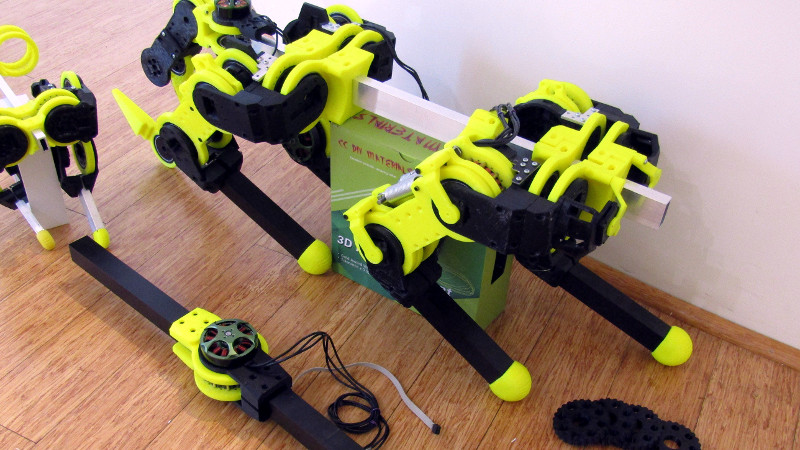
A 3D-printed robot actuator is a motion-producing robotic component made partly or entirely through 3D printing. It may be rigid, soft, flexible, pneumatic, hydraulic, cable-driven, electroactive, or a hybrid of several designs. The key idea is simple: the printed part is not just a bracket that holds the actuator; it can be the actuator itself.
For example, a soft pneumatic actuator may include hollow internal chambers printed into a flexible material. When air pressure fills those chambers, one side expands more than another, causing the part to bend. A tendon-driven actuator may use printed finger segments, joints, pulleys, and cable-routing channels. Pull the tendon, and the printed structure curls like a hand. A sensorized actuator may include conductive materials or embedded sensing layers so the robot can estimate how much it has bent, stretched, or touched.
This matters because robots are moving beyond factory cages. They are entering hospitals, farms, warehouses, homes, laboratories, disaster zones, and even space research. In those environments, robots often need motion that is adaptable, lightweight, safe around people, and easy to customize. A 3D-printed actuator gives engineers more freedom to design the movement around the job instead of designing the job around a catalog part.
Why 3D Printing Is a Big Deal for Robot Actuators
1. Complex Shapes Become Practical
Traditional manufacturing loves straight lines, drillable holes, and parts that can be machined without making a machinist mutter into the void. Robotics, however, often benefits from organic shapes, curved channels, compliant joints, and internal cavities. 3D printing handles those features much more naturally.
In a pneumatic soft actuator, the internal geometry controls motion. A row of air chambers can create bending. A spiral channel can create twisting. A carefully varied wall thickness can guide expansion in a predictable direction. These details are difficult to make with conventional tools but can be produced directly with modern additive manufacturing.
2. Faster Prototyping Means Faster Learning
Robotic actuator design is an experiment-heavy process. Engineers test stiffness, stroke, force output, response time, durability, pressure limits, and control behavior. With 3D printing, a design can be changed in software and printed again quickly. That shortens the loop between “I have an idea” and “Well, that idea just flopped dramatically across the lab bench.”
Rapid prototyping is especially valuable in soft robotics because small geometry changes can produce large motion differences. A thicker wall might reduce bending. A longer chamber might increase stroke. A different infill pattern might improve flexibility. Instead of waiting weeks for tooling, teams can print, test, revise, and repeat.
3. Customization Becomes Affordable
Robots increasingly need custom end effectors, grippers, limbs, and wearable assistive devices. A fruit-picking robot does not need the same actuator as a surgical robot, and a wearable rehabilitation glove does not need the same actuator as a deep-sea gripper. 3D printing allows designs to be tailored for size, strength, softness, shape, and motion profile.
This is especially important for prosthetics and assistive robotics. A printed actuator or actuator housing can be adjusted for a specific user’s anatomy, comfort needs, and functional goals. Instead of forcing humans to adapt to machines, the machines can finally show a little manners.
Common Types of 3D-Printed Robot Actuators
Soft Pneumatic Actuators
Soft pneumatic actuators are among the most popular 3D-printed actuator designs. They use air pressure to inflate internal chambers, causing a flexible structure to bend, extend, contract, or twist. These actuators are attractive because they are lightweight, compliant, and safer for direct interaction with humans or delicate objects.
A soft pneumatic gripper can wrap around objects instead of pinching them with rigid claws. That makes it useful for handling produce, fragile lab samples, irregular parts, or underwater specimens. The downside is that pneumatic systems often require pumps, valves, tubing, and pressure control. In other words, the actuator may be soft and elegant, while the support system sometimes looks like a tiny plumbing convention.
Tendon-Driven Actuators
Tendon-driven actuators imitate the way biological fingers move. A motor or servo pulls a cable, thread, or flexible tendon routed through a printed structure. This movement bends joints or compliant segments. Many low-cost 3D-printed robot hands use tendon-driven actuation because it allows one motor to coordinate several joints.
These systems can be underactuated, meaning they use fewer motors than joints. Underactuation is not laziness; it is clever mechanical teamwork. When a tendon pulls, the fingers naturally conform to the object’s shape. This reduces complexity and can improve grasping reliability, especially when the robot does not know the exact geometry of the object in advance.
Electrohydraulic and Electroactive Actuators
Electrohydraulic actuators use electrical energy to move a fluid or deform a flexible pouch-like structure. Some research systems, including HASEL-style actuators, combine soft materials, liquid dielectrics, and electric fields to create muscle-like motion. These actuators can be fast, compact, and powerful for their size, although they require careful material selection and electrical safety considerations.
Dielectric elastomer actuators are another promising class. They deform when voltage is applied across flexible electrodes. Researchers are exploring ways to print more of these systems directly, including the elastomer, electrodes, and supporting structures. The long-term dream is a printed artificial muscle that is light, responsive, efficient, and manufacturable without needing a heroic amount of hand assembly.
Sensorized 3D-Printed Actuators
A robot actuator becomes much more useful when it can sense itself. Sensorized actuators may include conductive filaments, flexible strain sensors, capacitive layers, or embedded channels that measure deformation. This gives the robot proprioception, which is the ability to estimate its own position and movement.
For a soft robot, proprioception is a big deal. Soft bodies can bend in many ways, making them harder to control than rigid links. A sensorized 3D-printed actuator can help the robot understand whether it has curled enough, touched an object, slipped, or reached a safe limit. That feedback turns soft motion from adorable flailing into controlled behavior.
Materials Used in 3D-Printed Robot Actuators
The material determines whether an actuator behaves like a spring, a hinge, a muscle, or a sad noodle. Common materials include thermoplastic polyurethane (TPU), silicone-like resins, flexible photopolymers, nylon, PLA, PETG, conductive composites, hydrogels, and multi-material combinations.
TPU is popular for flexible parts because it is durable, elastic, and printable on many fused deposition modeling printers. Photopolymer resins are useful for high-resolution soft structures, especially when fine channels and detailed surfaces are needed. Conductive filaments can support sensing or simple circuitry. Hydrogels can help create soft, tissue-like behavior, though they may require more careful environmental control.
Multi-material printing is especially powerful. One region of a part can be flexible, another stiff, and another conductive. This lets engineers print structures with built-in mechanical programming. The actuator’s movement is not controlled only by motors or software; it is shaped by the material layout itself. That is a major reason researchers are excited about rotational multimaterial printing and other advanced fabrication methods.
How a 3D-Printed Pneumatic Actuator Works
Imagine a printed strip made from flexible material. Inside the strip are several hollow chambers. One side of the strip is designed to stretch more easily, while the other side is reinforced or thicker. When air enters the chambers, the stretchy side expands. The reinforced side resists expansion. The result is bending.
This simple principle can produce surprisingly sophisticated motion. By changing chamber shape, wall thickness, material stiffness, fiber reinforcement, or internal patterns, designers can create actuators that curl, grip, twist, elongate, or contract. In some cases, a robot can combine multiple actuators to create complex movement, such as a soft hand closing around an object or a tentacle moving in three-dimensional space.
The actuator’s performance depends on pressure, geometry, material fatigue, sealing quality, and control. Too little pressure, and it barely moves. Too much pressure, and it may burst like a tiny engineering balloon. A good design balances flexibility with strength and motion range with reliability.
Real-World Applications
Soft Grippers for Delicate Handling
One of the strongest use cases for a 3D-printed robot actuator is the soft gripper. In agriculture, logistics, food handling, and laboratory automation, objects are often fragile, irregular, slippery, or annoyingly unpredictable. Soft printed actuators can conform around these items instead of forcing them into rigid jaws.
Medical and Assistive Robotics
Wearable robots, rehabilitation gloves, prosthetic devices, and surgical tools can all benefit from lightweight customized actuators. A soft actuator can help support a hand movement, guide therapy exercises, or create safer interaction with tissue. Medical applications demand biocompatibility, sterilization planning, reliability, and strict testing, but the design potential is enormous.
Space and Hazardous Environments
NASA and other research groups have explored soft robotic systems because compliant robots may be useful in uncertain environments. A soft actuator can absorb impacts, squeeze through tight spaces, or handle objects with unusual shapes. For space missions, lightweight and compact fabrication methods are especially attractive because every gram and spare part matters.
Education and Low-Cost Robotics
3D-printed actuators make robotics more accessible. Students and makers can print grippers, hands, walking mechanisms, and soft robots without needing a full industrial machine shop. That does not mean every print will work perfectly. Some will leak, jam, peel, snap, or produce motion best described as “interpretive dance.” But each failure teaches design, materials, controls, and manufacturing in a hands-on way.
Design Challenges Engineers Still Face
Although 3D-printed robot actuators are promising, they are not magic. Flexible materials can fatigue over time. Printed layers may create weak points. Pneumatic actuators can leak. Tendons can stretch or fray. Soft sensors can drift. Electroactive materials may require high voltages. Multi-material printing can be expensive or difficult to calibrate.
Control is another challenge. Rigid robots are usually easier to model because their joints move in predictable ways. Soft actuators deform continuously, which creates many possible shapes. That makes feedback sensing and control algorithms essential. A soft robot needs to know not only that it moved, but how it moved.
Scaling production is also difficult. A prototype that works once in a lab is not the same as a product that works thousands of times in a warehouse, clinic, or field environment. Real-world deployment requires repeatable printing, quality control, material consistency, safety testing, and repair strategies.
What Makes a Great 3D-Printed Robot Actuator?
A strong actuator design begins with the task. Before choosing a material or printer, engineers should ask: What movement is needed? How much force? How fast? How many cycles? What object will it touch? Will humans be nearby? Does it need sensing? Can it tolerate dust, water, heat, chemicals, or repeated bending?
A great 3D-printed robot actuator usually has a clear motion profile, reliable energy transfer, minimal unnecessary complexity, and a design that is easy to print repeatedly. It also respects the limits of the printing process. Layer orientation, support material, wall thickness, infill, curing, sealing, and post-processing all affect performance.
The best designs often look simple after they work. That simplicity is deceptive. Behind a smooth bending finger or soft gripping pad may be dozens of failed prints, pressure tests, material swaps, and late-night design revisions fueled by determination and snacks of questionable nutritional value.
The Future of 3D-Printed Robot Actuators
The future points toward smarter, more integrated actuators. Instead of printing a soft part and then manually attaching sensors, wires, valves, and reinforcements, researchers are moving toward printing more functions into the structure itself. A future actuator may include its body, sensing, routing, stiffness gradients, and motion logic in one manufacturing process.
Artificial muscles are another major frontier. Engineers want actuators that are light, quiet, efficient, flexible, strong, and easy to manufacture. Nature already solved many motion problems with muscle, tendon, skin, and feedback. Robotics is now borrowing those ideas and translating them into printable materials and programmable structures.
As printers improve, materials diversify, and design software becomes more powerful, 3D-printed actuators will likely become more common in custom robots, wearable systems, prosthetics, research platforms, inspection tools, and adaptive grippers. The biggest shift may be cultural: robotics design will become less about assembling standard parts and more about printing behavior directly into matter.
Practical Experiences With a 3D-Printed Robot Actuator
Working with a 3D-printed robot actuator teaches one lesson very quickly: the printer is only the beginning. The first printed version often looks promising on the build plate, especially if the surface finish is clean and the geometry matches the CAD model. Then the testing begins, and reality politely removes its sunglasses. A pneumatic actuator may bend beautifully for three cycles and then reveal a tiny leak. A tendon-driven finger may curl nicely until friction inside the cable channel steals half the motion. A soft gripper may handle a foam ball perfectly but fail the moment it meets a smooth plastic bottle.
The most useful experience is learning to treat the actuator as a complete system. Material, geometry, printer settings, control method, and load all interact. For a flexible pneumatic actuator, wall thickness is not just a dimension; it is a tuning knob. A thin wall gives larger motion but may reduce durability. A thick wall improves strength but may require higher pressure. Chamber spacing changes how smoothly the part bends. Reinforcement changes whether it curls like a finger or bulges like bread dough with ambition.
For tendon-driven designs, routing is everything. A cable that rubs against a sharp printed edge can create inconsistent motion and early wear. A slightly larger channel, smoother curve, or small printed guide can make the actuator feel dramatically better. Tensioning also matters. Too loose, and the finger responds late. Too tight, and the mechanism binds before doing useful work. The sweet spot is usually found through testing, not wishful thinking.
Another practical lesson is that repeatability deserves respect. One successful print does not mean the design is ready. Print orientation, filament moisture, resin curing, support removal, and even room temperature can change performance. Flexible materials can be especially moody. TPU may absorb moisture and print with stringing. Resin parts may need careful post-curing to avoid brittleness. Sealing pneumatic parts may require coatings, inserts, or redesigned walls.
Testing should be simple at first. Measure how far the actuator bends under known pressure. Track how much force it produces. Count cycles before performance changes. Record failures without taking them personally. A failed actuator is not an insult; it is a very specific memo from physics.
The most satisfying moment comes when the actuator finally performs the intended motion reliably. A printed finger wraps around an object. A soft chamber bends smoothly. A gripper adjusts to a strange shape without crushing it. That moment feels small, but it represents the promise of 3D-printed robotics: motion designed, fabricated, tested, and improved with unusual speed. It turns the robot from a pile of parts into something that can act on the world.
Conclusion
A 3D-printed robot actuator is more than a clever printed part. It is a sign of where robotics is heading: toward machines that are lighter, softer, more customizable, and better integrated with sensing and control. Whether the design uses air pressure, tendons, electroactive materials, flexible lattices, or embedded sensors, additive manufacturing gives engineers a powerful way to shape motion from the inside out.
The technology still faces challenges in durability, repeatability, material performance, and control. But the progress is real. From soft grippers and assistive wearables to robotic hands, tentacles, artificial muscles, and space-ready systems, 3D-printed actuators are helping robots become more adaptable and less clunky. In plain English: the robots are finally learning to move with a little grace. And thankfully, most of them still need us to press “print.”