Every so often, a wireless experiment strolls into the room, drops a number on the table, and makes every hobbyist within earshot quietly hide their tiny antenna behind a coffee mug. The LoRa distance record of 71,572 kilometers is one of those numbers. It sounds like something created by an overexcited spreadsheet, a typo with hiking boots, or a claim made by someone who accidentally measured in enthusiasm instead of kilometers.
But the record is real in the most interesting way: not as a normal hilltop-to-hilltop LoRaWAN experiment, not as a miraculous sensor node shouting across oceans on AA batteries, and definitely not as a weekend project involving a breadboard, hope, and a suspiciously warm power bank. The famous 71,572 km LoRa transmission involved a satellite path: up from Earth, through space, and back down to a receiver. That makes it both technically impressive and wonderfully unfair, like entering a soapbox derby with a rocket engine and a polite smile.
So why does this record matter? Because it highlights what makes LoRa technology special: long-range communication, extreme receiver sensitivity, low data rates, clever modulation, and the ability to move small amounts of data where Wi-Fi would simply cough, fall over, and ask for a router reboot.
What Is LoRa, Really?
LoRa stands for “Long Range,” which is refreshingly honest naming in a world where tech products often sound like protein powders. At the technical level, LoRa is a radio modulation method based on chirp spread spectrum. Instead of blasting data like a loudspeaker in a quiet library, LoRa spreads a signal across time and frequency using chirps. These chirps make the signal more resistant to noise and easier to detect at very low power levels.
That is why LoRa is popular in Internet of Things applications. It is not designed to stream movies, host video calls, or let your smart cow upload a 4K vlog from the pasture. It is designed for small messages: soil moisture readings, water meter updates, environmental sensors, asset trackers, parking sensors, weather stations, industrial alerts, and other tiny packets of useful information.
LoRaWAN, meanwhile, is the networking protocol built on top of LoRa. LoRa is the radio voice; LoRaWAN is the organized conversation. A LoRa node sends data, a gateway hears it, and the network routes that data to an application server. In normal deployments, this creates low-power wide-area networks that can cover farms, campuses, factories, cities, ports, and remote infrastructure.
The 71,572 KM Record: Why It Sounds Impossible
A typical LoRa project might cover a few kilometers in a city, much farther in open rural terrain, and spectacular distances from high-altitude balloons or mountaintop locations. But 71,572 kilometers? That is not “long range.” That is “please notify the space agency” range.
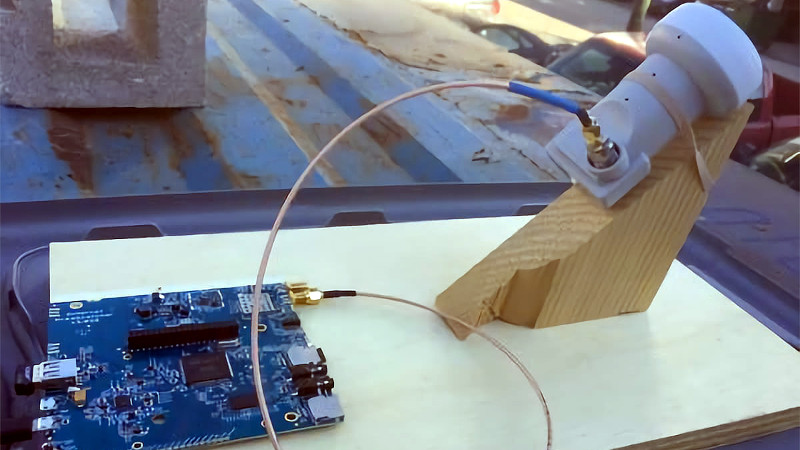
The trick is that the record was not a normal ground-based LoRaWAN packet traveling through the 915 MHz band in the United States or the 868 MHz band in Europe. The famous experiment used LoRa modulation in a satellite communication system associated with Outernet, later known as Othernet, a project built around broadcasting data from satellites to low-cost receivers. The signal path went from an uplink facility to a geostationary satellite and then back down to Earth, creating a total round-trip distance of about 71,572 km.
That is why the record is both legitimate and cheeky. It used LoRa modulation, but it had help from serious satellite infrastructure, a high-powered uplink, Ku-band transmission, and a geostationary relay. In other words, your garage node did not suddenly become lazy. It simply does not have a satellite transponder as a workout partner.
LoRa vs. LoRaWAN: The Difference Matters
One reason this record often causes confusion is that people use “LoRa” and “LoRaWAN” as if they are interchangeable. They are related, but not the same.
LoRa Is the Modulation
LoRa describes the physical radio technique. It is how bits become radio energy and how receivers detect those bits even when the signal is faint. This is the magic that lets LoRa work well in noisy environments and over long distances.
LoRaWAN Is the Network Layer
LoRaWAN defines how devices join networks, how gateways forward packets, how security keys are handled, and how applications receive messages. It is the structure that turns individual LoRa radios into a scalable IoT network.
The Record Used LoRa in a Special Context
The 71,572 km case is best understood as a LoRa-modulated satellite link, not a normal community LoRaWAN gateway hearing a battery-powered sensor from another continent. That distinction does not make the record less fun. It just keeps our expectations from leaving Earth without a flight plan.
Why LoRa Can Go So Far
LoRa’s range comes from several technical choices working together. The most important is chirp spread spectrum modulation, which gives the receiver a better chance of detecting weak signals below the noise floor. Another factor is spreading factor, often abbreviated as SF. A higher spreading factor can improve range and sensitivity, but it also increases airtime and reduces data rate. In plain English: the message travels farther, but it speaks more slowly, like a wise old radio turtle.
Bandwidth, coding rate, antenna gain, receiver sensitivity, terrain, interference, frequency, and transmit power all matter. Put a LoRa node in a basement behind concrete and steel, and it may struggle. Put it on a high-altitude balloon with line of sight over hundreds of kilometers, and suddenly the little radio starts acting like it has been training for the Olympics.
This is why practical LoRa range claims vary so much. A dense urban deployment might prioritize reliability over bragging rights. A rural gateway on a tower can cover impressive distances. A balloon experiment can shatter normal expectations. A satellite link can make everyone else look like they brought a spoon to a laser fight.
Real-World LoRa Distance Records Before and After
Before the satellite-assisted 71,572 km claim became famous, the LoRaWAN community had already celebrated remarkable ground-and-air records. One widely discussed milestone was a LoRaWAN packet received at more than 700 km from a high-altitude balloon. Later balloon projects pushed the record farther, including distances in the 741 km and 766 km range. These are extraordinary because they are closer to what most people imagine when they think about LoRaWAN distance records: small radios, clever antennas, elevation, line of sight, and a lot of engineering patience.
Those balloon records are more relevant to everyday experimenters than the satellite number. They show what is possible when LoRa devices escape the clutter of buildings, trees, hills, and the neighbor’s questionable LED grow light. The satellite record, meanwhile, shows that LoRa modulation can be used creatively outside the usual IoT sensor scenario.
Why the Satellite Trick Worked
Satellite communication changes the entire link budget. A link budget is basically the radio engineer’s financial statement: how much signal you start with, how much you lose, how much antenna gain you add, and whether there is enough left for the receiver to understand the message without bursting into tears.
In the 71,572 km case, the system had advantages that ordinary LoRa nodes do not. A satellite relay provided an enormous coverage footprint. Ku-band hardware handled the space link. A serious uplink antenna and amplifier helped get the signal where it needed to go. The receiving side used specialized hardware designed for the broadcast service.
This matters because LoRa’s normal superpower is not raw speed or raw power. Its superpower is sensitivity and resilience. When placed inside a carefully designed system, that sensitivity can be used in surprising ways.
What This Record Does Not Mean
The 71,572 km LoRa record does not mean you can buy a cheap LoRa module, tape it to a broom handle, and send sensor data to the Moon. It does not mean LoRaWAN gateways can ignore Earth curvature. It does not mean regulations vanish because your antenna has a dream. It also does not mean higher transmit power is always the answer.
In the United States, LoRa deployments commonly use the 902–928 MHz ISM band under FCC Part 15 rules. Devices must comply with applicable power, bandwidth, and emission requirements. Other regions use different frequency plans, such as EU868 or AS923. A LoRa device configured for one region may not be legal or effective in another. The radio does not care about borders, but regulators definitely do.
For normal users, the lesson is simple: choose the right regional band, use a good antenna, place gateways high and clear, keep payloads small, and do not confuse a satellite-assisted record with a driveway test.
What LoRa Is Actually Great At
LoRa is not trying to replace cellular networks, fiber internet, Wi-Fi, or your home router’s sacred blinking lights. It shines when devices need to send tiny messages over long distances while using very little power.
Smart Agriculture
Farmers can use LoRa sensors to monitor soil moisture, water tanks, weather conditions, gates, pumps, and livestock movement. A sensor in a field does not need Netflix. It needs to say, “The soil is dry,” and then go back to sleep like a responsible little robot.
Smart Cities
LoRaWAN networks can support parking sensors, streetlight monitoring, waste-bin fill levels, air-quality sensors, and water infrastructure. These applications need coverage and battery life more than speed.
Industrial Monitoring
Factories, warehouses, mines, ports, and utilities use LoRa for condition monitoring, asset tracking, leak detection, and remote alerts. In industrial environments, wiring every sensor can be expensive. LoRa gives engineers another option before someone suggests “just run a cable” through three walls, a loading dock, and a mild existential crisis.
Disaster and Remote Communication
Low-power radio systems are valuable when infrastructure is damaged or unavailable. LoRa can support remote sensors and simple messaging networks, especially when paired with gateways, solar power, and thoughtful planning.
The Engineering Lesson: Range Is Not One Thing
People love range numbers because they are easy to compare. Ten kilometers sounds better than five. Seven hundred kilometers sounds legendary. Seventy-one thousand kilometers sounds like a radio signal with a passport. But range is not a single universal feature. It is a result.
Range depends on terrain, antenna height, frequency, receiver quality, spreading factor, transmit power, interference, weather, cable loss, antenna tuning, gateway placement, and whether the universe is feeling cooperative that day. A badly installed antenna can turn a powerful radio into an expensive paperweight. A carefully placed gateway can make modest hardware perform beautifully.
This is where many LoRa beginners make mistakes. They buy a module, use the tiny included antenna, place it next to a laptop, test it through several walls, and then conclude the technology is overrated. That is like testing a fishing rod in a bathtub and complaining about the lack of tuna.
Practical Tips for Better LoRa Range
If you want better LoRa performance, start with line of sight. Height is your friend. A gateway on a roof, tower, hill, or mast can dramatically outperform one sitting on a desk next to a coffee cup and emotional support USB cable.
Use the correct antenna for your frequency band. A 915 MHz antenna is not automatically ideal for 868 MHz, and a random wire is not a strategy. Keep coaxial cable runs short or use low-loss cable. Match your spreading factor to your actual needs. Higher spreading factors increase range but also increase airtime, which can reduce network capacity and battery life.
Keep payloads small. LoRa is happiest when sending compact data. If your sensor packet reads like a novel, the network will judge you quietly. Send what matters: temperature, humidity, voltage, GPS coordinates, status flags, or alerts. Save the dramatic monologue for the dashboard.
Why the Record Still Inspires Makers
The 71,572 km LoRa record is inspiring because it reminds us that technologies are not locked into one use case. LoRa began as a long-range, low-power radio technology for IoT, but creative engineers found a way to use its properties in a satellite broadcast system. That kind of thinking is what makes hardware culture exciting.
It also shows the value of asking strange questions. What happens if we use LoRa modulation outside the usual band? What if we pair it with a satellite relay? What if a low-cost receiver can decode a broadcast from space? Those questions lead to experiments, and experiments lead to records, products, tools, and occasionally a comment section full of people arguing with the passion normally reserved for sports finals.
Experience Section: What Working Around LoRa Teaches You
Anyone who has spent time experimenting with LoRa learns the same humbling lesson: radio is part science, part craft, and part invisible gremlin management. On paper, LoRa looks wonderfully simple. Connect a module, load a library, attach an antenna, send a packet, and bask in the glory of long-range wireless communication. In practice, the first test often involves moving the antenna three inches, refreshing a serial monitor, and wondering whether the device is broken or whether the building is secretly made of radio-absorbing sadness.
The most useful experience comes from testing in real environments. A LoRa link across an open field can feel magical. The same hardware inside a building full of concrete, metal shelving, elevator shafts, and electrical noise may behave like it has stage fright. That contrast teaches a core truth: specifications describe potential, not guarantees.
A good LoRa experiment starts with modest expectations and careful notes. Record the spreading factor, bandwidth, coding rate, transmit power, antenna type, antenna height, gateway location, distance, packet loss, and environment. Change one variable at a time. If you change the antenna, gateway location, spreading factor, and power all at once, you may get a better result, but you will not know why. That is not engineering. That is seasoning soup while blindfolded.
Antenna placement is often the biggest surprise. Beginners focus on the radio module, but the antenna system frequently decides success or failure. A tuned antenna mounted high and clear can outperform a more expensive radio connected to a poor antenna. Even small details matter: nearby metal, cable quality, connector loss, antenna orientation, and waterproofing. Outdoor LoRa gear also needs protection from moisture, heat, UV exposure, insects, and the mysterious ability of weather to find every tiny design flaw.
Another lesson is that longer range is not always better. In real LoRaWAN networks, every long-airtime packet uses shared spectrum and can increase congestion. A responsible deployment uses the lowest spreading factor that provides reliable communication. That improves battery life, reduces airtime, and helps the whole network breathe. In other words, do not force every device to shout slowly across the county when a normal indoor voice would do.
LoRa also teaches patience. Debugging wireless systems is rarely instant. You may need to walk test routes, compare RSSI and SNR values, check gateway logs, inspect regional settings, update firmware, and verify that your device is actually transmitting on the channel plan your network expects. Many “range problems” are really configuration problems wearing a fake mustache.
The 71,572 km record adds a bigger lesson: context is everything. A satellite-assisted LoRa-modulated link is not the same as a battery sensor talking to a city gateway. Both are fascinating, but they belong in different categories. The record should motivate experimenters, not mislead them. It says, “Look what clever system design can do,” not “Your mailbox sensor should reach another continent by Tuesday.”
For makers, students, engineers, and IoT builders, LoRa remains one of the most satisfying wireless technologies to explore. It rewards good planning, clean installation, careful measurement, and curiosity. It also punishes lazy assumptions, bad antennas, and the phrase “it should work” when spoken too confidently. That is part of the fun. LoRa turns invisible radio behavior into a practical puzzle, and every successful packet feels like a tiny victory traveling through the air.
Conclusion: A Record Worth Admiring, Not Misunderstanding
At 71,572 km, the famous LoRa record is probably not something you will beat with a weekend kit, a rooftop antenna, and heroic optimism. It was achieved through a satellite-assisted path that stretched from Earth to space and back again. Still, the achievement matters because it shows how flexible and powerful LoRa modulation can be when engineers place it inside a clever system.
For everyday IoT builders, the more useful takeaway is not the number itself. It is the thinking behind it. LoRa works because it accepts trade-offs: low data rate in exchange for long range, small payloads in exchange for battery life, careful network design in exchange for dependable coverage. Whether you are monitoring a farm, a factory, a weather station, or a water tank, LoRa gives you a practical way to move small data across big distances.
The 71,572 km record may remain unbeatable for ordinary users, but that is fine. Records are not always instructions. Sometimes they are invitationsto understand the technology better, design smarter systems, and appreciate the delightful absurdity of a tiny data packet taking the scenic route through space.
Note: This article is written as original web-ready content based on real LoRa, LoRaWAN, satellite communication, and IoT networking information, with no source links inserted into the publishable body.