A Charlie Brown Thanksgiving is only about 25 minutes long, yet somehow it contains more holiday energy than a dining room full of relatives debating cranberry sauce. First aired in 1973, this Peanuts classic has become one of America’s most comforting Thanksgiving traditions: a wobbly backyard table, a menu made mostly of snacks, a philosophical speech from Linus, and Snoopy doing more kitchen labor than most adults on Thanksgiving morning.
But behind the toast, popcorn, pretzels, jelly beans, and emotional damage caused by Peppermint Patty’s poor manners, there is a surprisingly rich production story. The special connects Charles M. Schulz’s comic-strip philosophy, Vince Guaraldi’s jazz, Bill Melendez’s animation style, child voice actors, network television history, and one very awkward question: should Woodstock eat turkey?
Below are 10 fun, real, and surprisingly meaningful facts you probably don’t know about A Charlie Brown Thanksgiving. Whether you watch it every November or just remember Snoopy wrestling that lawn chair like it owes him money, these behind-the-scenes details make the special even more charming.
1. It Originally Aired Two Days Before Thanksgiving in 1973
A Charlie Brown Thanksgiving first aired on CBS on November 20, 1973, just two days before Thanksgiving Day that year. The timing was perfect. Families were already thinking about turkey, travel, relatives, and table settings, and then along came Charlie Brown with a backyard feast that said, “What if Thanksgiving dinner were planned by a nervous child and a beagle?”
The special was written by Peanuts creator Charles M. Schulz and produced by Lee Mendelson and Bill Melendez, the same creative team that helped turn Peanuts from a beloved comic strip into a television institution. Bill Melendez and Phil Roman directed the special, while Vince Guaraldi supplied the music that gives the story its warm, jazzy heartbeat.
What makes the premiere especially interesting is that the special arrived after A Charlie Brown Christmas and It’s the Great Pumpkin, Charlie Brown had already established Peanuts as holiday television royalty. Viewers came in expecting dry humor, kid-sized wisdom, Snoopy chaos, and at least one moment that made adults suddenly pretend they had something in their eye. The Thanksgiving special delivered all of that, plus toast.
2. Charlie Brown Was Never Supposed to Host Thanksgiving Dinner
The entire plot is built on one hilarious social disaster: Peppermint Patty invites herself to Charlie Brown’s house for Thanksgiving. Then she invites Marcie and Franklin too. The only tiny problem? Charlie Brown is already supposed to go to his grandmother’s house for Thanksgiving dinner, and he has absolutely no cooking skills beyond cold cereal and maybe toast.
This is classic Charlie Brown storytelling. He is not trying to be a hero. He is trying to avoid disappointing people, which, unfortunately, is how many disasters begin. His anxiety is relatable because nearly everyone has experienced a version of it: someone assumes you can host, cook, organize, fix, lead, or emotionally manage a situation you did not volunteer for.
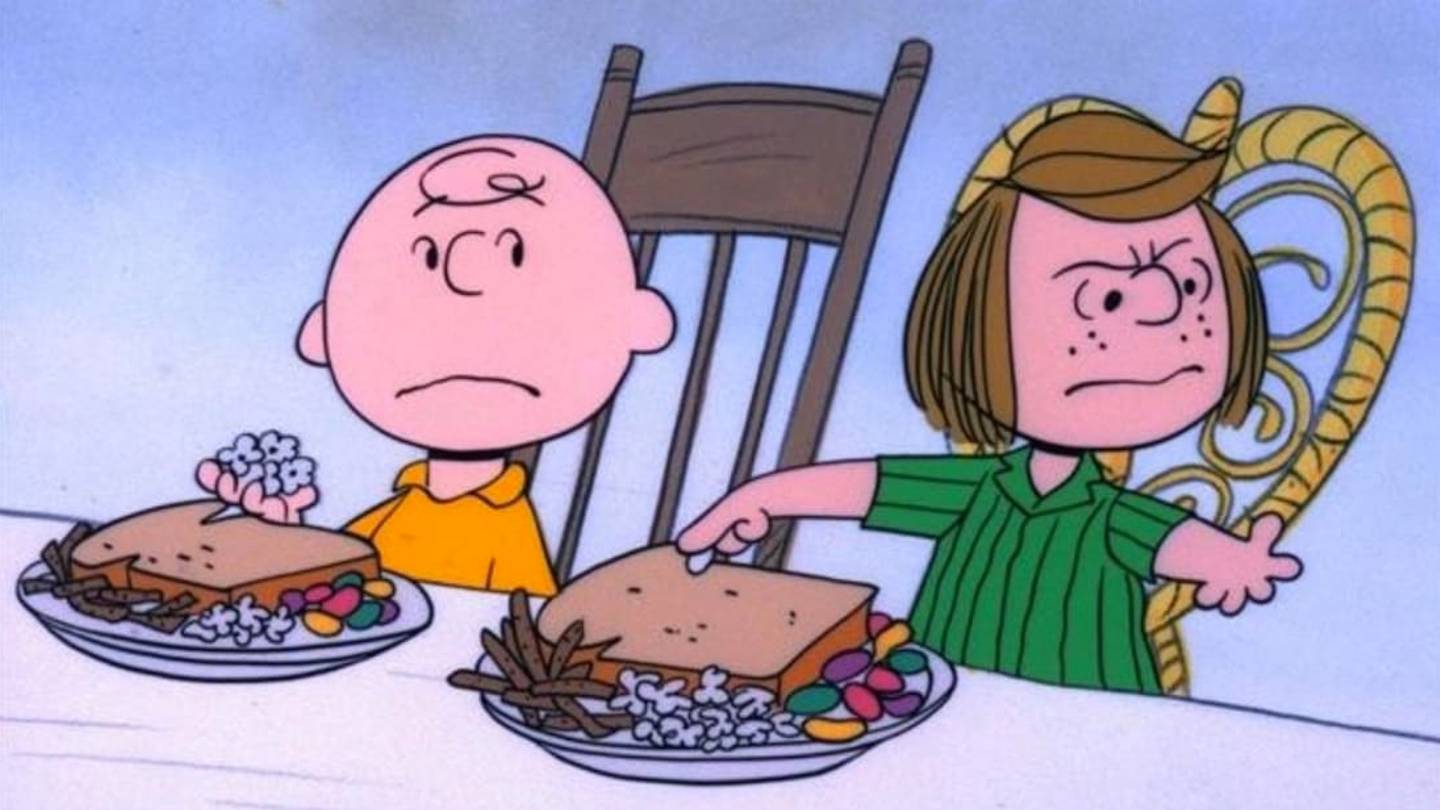
Instead of a grand turkey dinner, Charlie Brown, Linus, Snoopy, and Woodstock assemble the now-famous snack meal: buttered toast, popcorn, pretzel sticks, jelly beans, and ice cream. It is nutritionally questionable, visually iconic, and honestly not the worst emergency meal ever served by children under pressure.
3. The Menu Became More Famous Than Many Real Thanksgiving Dinners
One of the funniest facts about A Charlie Brown Thanksgiving is that its ridiculous meal became a cultural tradition of its own. Across the United States, fans recreate the “Charlie Brown Thanksgiving dinner” with toast, popcorn, pretzels, jelly beans, and sometimes sundaes or ice cream. It is part snack board, part nostalgia machine, and part gentle reminder that Thanksgiving does not need to be perfect to be memorable.
The meal works because it is so visibly childlike. No roasted turkey. No mashed potatoes. No casserole wearing a crunchy onion hat. Just foods a kid might actually think to serve if suddenly trapped in a hosting crisis. That makes the scene funny, but it also gives the special its emotional logic. Charlie Brown’s meal is not impressive, but it is sincere.
Peppermint Patty, however, does not immediately appreciate this. She complains loudly that the feast does not look like Thanksgiving. Her frustration creates one of the special’s best lessons: expectations can ruin gratitude faster than cold gravy. Marcie eventually helps Patty understand that Charlie Brown never invited anyone in the first place and still tried his best. Good grief, indeed.
4. It Was the First Peanuts Special to Feature a Real Adult Voice
Peanuts specials famously avoid adult voices. Teachers and grown-ups are usually represented by the famous muted trombone-style “wah-wah” sound, preserving Schulz’s child-centered world. But A Charlie Brown Thanksgiving quietly broke that pattern.
The special includes a real adult voice in the song “Little Birdie,” performed by composer Vince Guaraldi. That does not mean an adult character appears and starts giving instructions about oven temperatures. The adult voice arrives through music, not dialogue, which keeps the Peanuts universe intact while adding a playful surprise.
Guaraldi’s voice gives “Little Birdie” a loose, quirky charm. It is not polished in the way a Broadway number might be polished. It feels casual, jazzy, and slightly mischievous, exactly the right sound for Woodstock fluttering through the story. The song also shows how much creative freedom the Peanuts team had. They could take a small moment involving a tiny yellow bird and turn it into something viewers remembered for decades.
5. Vince Guaraldi’s Music Does More Than Fill the Background
Vince Guaraldi’s music is one of the secret ingredients in every classic Peanuts special. In A Charlie Brown Thanksgiving, the score does not merely decorate the action; it shapes the mood. His “Thanksgiving Theme” gives the special a mellow autumn feeling without needing falling leaves in every frame.
Guaraldi’s jazz has always matched Peanuts because it sounds both grown-up and childlike. It can be playful, lonely, funny, and thoughtful within the same few measures. That is exactly what Charlie Brown needs. He is a kid, but his worries are oddly adult. He is anxious about obligations, hospitality, disappointment, friendship, and whether he is about to fail at yet another holiday.
For the special’s 50th anniversary, an expanded soundtrack highlighted just how much musical detail lived inside the production. Restored and remastered tracks revealed alternate takes and performances that helped fans hear the special in a fresh way. For many viewers, the music is not just nostalgia. It is the sound of November itself.
6. Lucy Is Barely in the Special, But She Still Makes Her Moment Count
Lucy van Pelt is one of the most unforgettable Peanuts characters, but in A Charlie Brown Thanksgiving, she appears mainly at the beginning. Naturally, she uses her limited screen time to pull the football away from Charlie Brown. Some people make pie. Lucy makes trauma.
The football gag is one of the most famous recurring jokes in Peanuts history. Charlie Brown convinces himself that this time will be different. Lucy gives a persuasive argument. He runs. She yanks the ball. He flies through the air. The universe remains consistent.
Her small role actually helps the Thanksgiving story move in a different direction. Instead of focusing on Lucy and Charlie Brown’s rivalry, the special gives more space to Peppermint Patty, Marcie, Franklin, Linus, Snoopy, and Woodstock. Lucy’s quick appearance works like a signature at the top of the episode: yes, this is Peanuts, and yes, Charlie Brown’s dignity is still in danger.
7. Real Kids Voiced the Main Characters
One reason the classic Peanuts specials still feel special is that the children sound like children. The voice cast of A Charlie Brown Thanksgiving included Todd Barbee as Charlie Brown, Stephen Shea as Linus, Hilary Momberger as Sally, Christopher DeFaria as Peppermint Patty, Jimmy Ahrens as Marcie, Robin Reed as Franklin, and Robin Kohn as Lucy. Bill Melendez voiced Snoopy and Woodstock, proving once again that a talented adult can build an entire emotional performance out of beagle noises.
Using child actors gave the dialogue a natural rhythm. The lines sometimes feel slightly uneven, gentle, or unpolished, and that is part of the magic. These are not cartoon kids talking like tiny professional comedians. They sound like real children trying to express big feelings.
Todd Barbee, who voiced Charlie Brown, was still young when he took on the role. Behind-the-scenes accounts describe how challenging it could be to create Charlie Brown’s famous frustrated yell. That makes sense. There is an art to sounding like a boy who has just been betrayed by both physics and Lucy van Pelt.
8. Linus Turns a Snack Disaster Into a History Lesson
Linus is the Peanuts character most likely to turn a backyard crisis into a reflective seminar, and A Charlie Brown Thanksgiving gives him one of his signature moments. When the group needs perspective, Linus explains the meaning and history of Thanksgiving, moving the special beyond jokes about toast and table manners.
His speech gives the story emotional balance. Without Linus, the special might be only a comedy about an accidental party. With him, it becomes a gentle reminder that Thanksgiving is about gratitude, fellowship, memory, and humility. The historical framing is brief, but it gives the episode its traditional holiday weight.
The speech also helped inspire a later Peanuts project, This Is America, Charlie Brown: The Mayflower Voyagers, which explored the Mayflower story in greater detail. In other words, Linus did not just save the dinner conversation. He helped open the door to another educational Peanuts special.
9. Snoopy’s Fight With the Lawn Chair Is Classic Slapstick
Before Thanksgiving dinner can happen, Snoopy must set up the backyard table. This leads to one of the special’s funniest sequences: Snoopy battling a folding lawn chair. The chair snaps, flips, collapses, resists, and generally behaves like it was manufactured by Lucy’s psychiatric booth.
The gag stands out because Peanuts humor is often quiet, verbal, or philosophical. Snoopy versus the chair is pure physical comedy. It has the energy of silent film slapstick, where a simple object becomes an enemy with a personal grudge.
That scene also reveals why Snoopy is so important to the animated specials. Charlie Brown carries the emotional story, but Snoopy brings movement, imagination, and chaos. He can be a chef, a pilot, a novelist, a dancer, or a home-improvement victim. In A Charlie Brown Thanksgiving, he is all-purpose holiday staff, and frankly, he deserves overtime pay.
10. Woodstock Eating Turkey Created a Funny Behind-the-Scenes Debate
One of the strangest little details in A Charlie Brown Thanksgiving comes near the end, when Snoopy and Woodstock enjoy a traditional turkey meal of their own. Cute, right? Well, maybe. Some viewers and members of the production team noticed the uncomfortable implication: Woodstock is a bird eating another bird.
Producer Lee Mendelson later discussed his unease with the gag, while Charles M. Schulz wanted it to stay. The moment became a minor behind-the-scenes debate about cartoon logic, character humor, and whether audiences would think too hard about bird-on-bird dining. Spoiler alert: audiences absolutely thought about it.
The scene was reportedly removed in some shortened broadcasts and later restored when the special returned to its fuller running time. Today, the turkey moment remains one of those tiny details that fans love to mention because it is funny, odd, and deeply Peanuts. The world may be confusing, but at least Woodstock has excellent table manners.
Why ‘A Charlie Brown Thanksgiving’ Still Works After More Than 50 Years
The reason A Charlie Brown Thanksgiving still connects with viewers is not that it presents the perfect holiday. In fact, almost everything goes wrong. Charlie Brown is pressured into hosting. The menu is absurd. Peppermint Patty is rude. Snoopy does most of the labor. The chairs are dangerous. The table looks unstable enough to qualify as a character.
And yet the special understands Thanksgiving better than many polished holiday movies. It knows that real gatherings are messy. Plans change. Guests arrive with expectations. Someone says the wrong thing. Someone else quietly fixes it. The food may not be ideal, but the feeling can still be real.
Charlie Brown’s accidental dinner is not about abundance. It is about effort. He does not have the right ingredients, but he has the right instinct: try to be kind. That is why the snack meal has lasted in pop culture. It represents the gap between what we wish we could offer and what we actually can offer, which is often where the most honest hospitality lives.
Viewing Experience: What It Feels Like to Rewatch ‘A Charlie Brown Thanksgiving’ Today
Watching A Charlie Brown Thanksgiving today feels different depending on your age. As a child, you may focus on Snoopy, Woodstock, the funny food, and the football gag. The whole thing feels like a cozy cartoon where kids run the world and adults are mysteriously absent. As an adult, the special becomes funnier in a new way because Charlie Brown’s problem is painfully familiar: someone has created an obligation for him, and now he is trying to survive it politely.
That is one reason the special remains so rewatchable. It grows with the audience. Children enjoy the silliness of a Thanksgiving dinner made of snack foods. Adults recognize the social anxiety under the surface. Charlie Brown is not just worried about food; he is worried about disappointing friends. He wants to do the right thing, but he has no resources, no plan, and no emotional escape hatch. Many adults call that “the holidays.”
The best way to experience the special is to watch it without multitasking. Put down the phone, make a small bowl of popcorn, toast a slice of bread, and let the slow rhythm do its work. Modern animation often moves quickly, filling every second with jokes, action, or bright visual noise. A Charlie Brown Thanksgiving breathes. It lets Snoopy set a table. It lets music carry a scene. It lets Linus speak without rushing him offscreen. That slower pace is part of its charm.
Families can also turn the viewing into a simple tradition. Some people recreate the backyard meal before or after the real Thanksgiving dinner. Others watch it while cooking, using Snoopy’s kitchen confidence as moral support. The special is especially fun for kids because the food is easy to prepare. No complicated recipe is required. Popcorn, pretzels, jelly beans, and toast are enough to create the mood. Add paper plates and a wobbly card table, and suddenly your living room has entered Peanuts territory.
There is also a useful conversation starter inside the story. Peppermint Patty’s reaction to the meal is funny, but it opens the door to talk about gratitude, expectations, and apologies. She expects a traditional dinner and responds badly when she does not get it. Marcie gently points out that Charlie Brown never promised such a meal. That moment is small, but it is one of the special’s most valuable lessons: before criticizing what someone gives, consider what they were able to give.
For longtime fans, the special also delivers a comforting sense of continuity. The animation is simple, the voices are sincere, and the humor is never cruel for long. Even Lucy’s football trick feels like a seasonal ritual rather than a plot device. We know Charlie Brown will fall. We know Snoopy will steal the show. We know Linus will say something wise. The pleasure comes not from surprise, but from returning to a world that behaves exactly as expected.
In that sense, A Charlie Brown Thanksgiving is a perfect holiday special. Thanksgiving itself is built on repetition: familiar dishes, familiar stories, familiar people, familiar chaos. The Peanuts version simply shrinks all of that down to a backyard table and a group of kids figuring out how to be thankful together. It may not teach anyone how to roast a turkey, but it does teach something better: a holiday does not have to be flawless to be worth remembering.
Conclusion
A Charlie Brown Thanksgiving remains beloved because it combines humor, sincerity, music, and imperfection in a way that still feels fresh more than five decades after its debut. Its facts are fun: Vince Guaraldi’s adult voice, Lucy’s tiny role, Woodstock’s controversial turkey dinner, real child actors, and the famous snack-food feast all make the special richer than it first appears.
But the deeper reason it lasts is simple. Charlie Brown does not host a perfect Thanksgiving. He hosts a human one. He is nervous, underprepared, and surrounded by strong personalities. Still, he tries. That effort, wrapped in jazz music and Snoopy slapstick, is why viewers keep coming back every November.
Note: This article is an original, fully rewritten synthesis based on verified entertainment, television-history, and Peanuts-related information. It is written for web publication without inserted source links or unnecessary citation placeholders.