Ancient architecture is humanity’s oldest group project, except with fewer emails and much heavier stones. Long before cranes, laser levels, concrete trucks, and construction apps that still somehow crash at the worst possible moment, ancient builders raised pyramids, temples, cities, walls, and sacred complexes that continue to make modern visitors stop mid-sentence.
The world’s most impressive ancient architecture is not impressive simply because it is old. Plenty of things are old: jokes about airline food, lost socks, and that one jar in the back of your refrigerator. These monuments matter because they solved problems of engineering, power, religion, astronomy, defense, beauty, and community with tools that look almost laughably simple by today’s standards. Yet the results are anything but simple.
From the Great Pyramid of Giza to Machu Picchu, from the carved cliffs of Petra to the cosmic symmetry of Angkor Wat, these sites show how ancient civilizations turned stone, earth, wood, and imagination into messages that could outlive empires. Some were tombs. Some were temples. Some were cities. Some were political billboards in architectural form, politely reminding everyone, “Yes, our ruler is extremely important.”
Below are 20 of the world’s most impressive pieces of ancient architecture, selected for their scale, design, cultural influence, engineering difficulty, and ability to make visitors whisper, “How on earth did they build that?”
Why Ancient Architecture Still Matters
Ancient buildings are not just piles of beautiful stone. They are evidence. They tell us what people valued, feared, celebrated, and hoped would last forever. A pyramid can reveal beliefs about the afterlife. A temple can show how rulers connected themselves to the gods. A city plan can expose social organization, trade networks, and astronomical knowledge. Even a wall can say a lot, especially when it stretches across mountains and deserts like the Great Wall of China.
These monuments also remind us that innovation did not begin with modern technology. Ancient engineers understood weight distribution, drainage, acoustics, orientation, urban planning, and visual drama. They may not have had steel beams or GPS, but they knew how to make architecture feel powerful. In many cases, they were not just building structures. They were building worlds.
The World’s 20 Most Impressive Pieces of Ancient Architecture
1. The Great Pyramid of Giza, Egypt
The Great Pyramid of Giza is the heavyweight champion of ancient architecture. Built for Pharaoh Khufu around the 26th century B.C.E., it was originally about 481 feet tall and remained the tallest human-made structure on Earth for thousands of years. Its millions of stone blocks were cut, transported, lifted, and arranged with such precision that the pyramid still feels less like a tomb and more like a mathematical dare.
Its clean geometry, massive scale, and alignment with cardinal directions reveal a civilization that combined religious belief, centralized labor, and technical planning at an astonishing level. The pyramid was not merely a royal burial place. It was a stone statement about cosmic order, kingship, and eternity.
2. Stonehenge, England
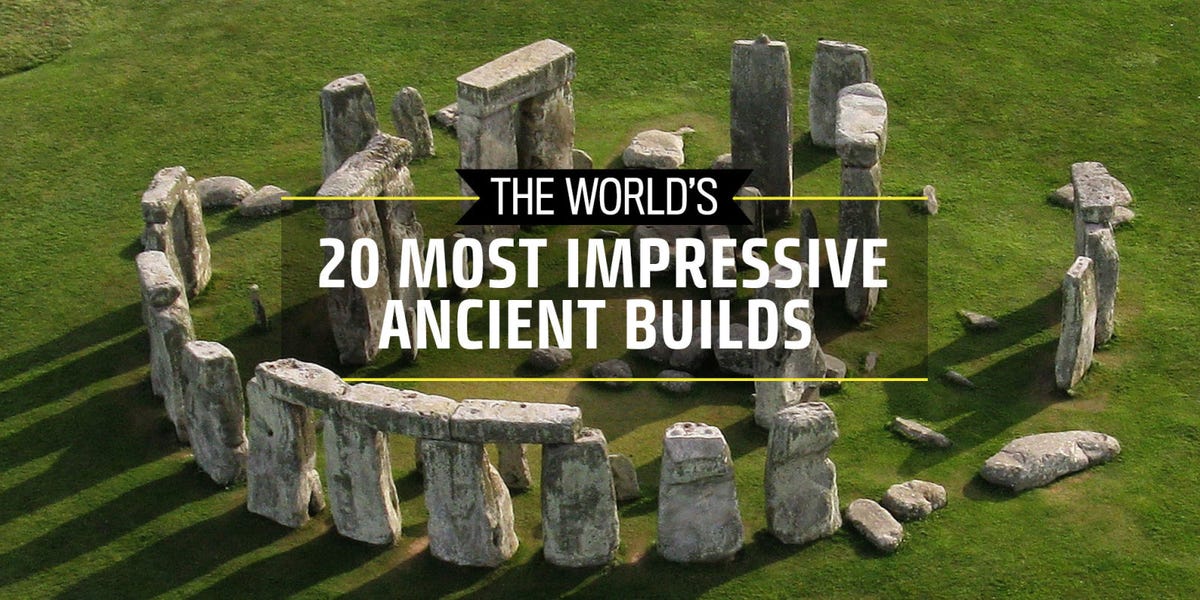
Stonehenge proves that mystery is excellent branding. Built in stages over many centuries, this prehistoric stone circle in southern England continues to puzzle archaeologists and delight visitors. Its massive sarsen stones and smaller bluestones were transported, shaped, and arranged long before written records explained the project.
The monument is famously aligned with solar events, especially the midsummer sunrise and midwinter sunset. Whether it served as a ceremonial site, burial ground, astronomical marker, healing center, or all of the above, Stonehenge remains one of the most haunting achievements of Neolithic architecture.
3. Göbekli Tepe, Turkey
Göbekli Tepe is so old that it makes Stonehenge look like a recent renovation. Dating back more than 11,000 years, this site in southeastern Turkey includes circular enclosures with huge T-shaped limestone pillars, many carved with animals such as foxes, snakes, birds, and scorpions.
What makes Göbekli Tepe extraordinary is not just its age, but what it suggests about early human society. The people who built it were likely hunter-gatherers, yet they organized labor, carved monumental stones, and created a ritual landscape of remarkable complexity. It challenges the old assumption that large-scale architecture only came after farming and permanent cities.
4. The Parthenon, Greece
The Parthenon in Athens is the architectural equivalent of a perfectly tailored suit: elegant, balanced, and quietly showing off. Built in the 5th century B.C.E. on the Acropolis, it honored Athena, the city’s patron goddess, while also celebrating the power and confidence of classical Athens.
Its Doric columns, sculptural program, and subtle optical refinements create an impression of harmony that has influenced architecture for more than two thousand years. The Parthenon is not just a temple. It is one of the most important visual arguments ever made for proportion, civic identity, and cultural ambition.
5. The Colosseum, Italy
The Colosseum in Rome is proof that ancient entertainment venues could be both brilliant and brutal. Completed in the 1st century C.E., this enormous amphitheater could hold tens of thousands of spectators for gladiatorial games, animal hunts, public spectacles, and imperial pageantry.
Its system of arches, vaults, corridors, stairways, seating tiers, and underground chambers shows Roman engineering at full volume. The Colosseum was designed to move crowds efficiently, control spectacle, and turn architecture into political theater. Modern stadiums still borrow from its basic logic, thankfully with fewer lions.
6. The Pantheon, Italy
The Pantheon in Rome may be the most breathtaking room ancient builders ever created. Rebuilt under Emperor Hadrian in the 2nd century C.E., it features a massive concrete dome with a central oculus that opens directly to the sky.
The genius of the Pantheon lies in its combination of simplicity and engineering daring. The dome’s weight decreases toward the top through lighter materials and coffering, while the oculus provides light, drama, and structural relief. Step inside, and the building feels less like a temple than a conversation between Earth and heaven.
7. Petra, Jordan
Petra is what happens when architecture and geology decide to collaborate. Created by the Nabataeans, this ancient city in modern Jordan is famous for its rock-cut façades, especially Al-Khazneh, often called the Treasury. Its rose-colored sandstone cliffs make the entire place look as if sunset got trapped in stone.
Petra was also a sophisticated trade hub with tombs, temples, water channels, cisterns, and urban planning adapted to a desert environment. The Nabataeans blended local traditions with Hellenistic and Near Eastern influences, creating a city that was practical, theatrical, and unforgettable.
8. The Great Wall of China, China
The Great Wall of China is not one wall but a vast series of walls, watchtowers, fortifications, and defensive systems built and rebuilt across many dynasties. Its earliest sections began in ancient periods, while many of the best-known surviving portions date to later imperial construction.
What makes it impressive is not only its length, but its relationship with the landscape. It climbs ridges, cuts across deserts, and follows mountain lines with stubborn determination. As military architecture, it controlled movement and communication. As a symbol, it remains one of the most recognizable human-made structures in history.
9. Angkor Wat, Cambodia
Angkor Wat is one of the greatest religious monuments ever built. Constructed in the 12th century during the Khmer Empire, it was originally dedicated to Vishnu and later became associated with Buddhism. Its towers, galleries, moats, and carved reliefs were designed as a symbolic model of the universe.
The central towers represent Mount Meru, the mythical home of the gods, while the surrounding layout evokes cosmic oceans and mountain ranges. Angkor Wat is both a temple and a worldview built in stone. It shows how architecture can transform theology into geography.
10. Machu Picchu, Peru
Machu Picchu sits high in the Andes like a city that climbed a mountain and decided to stay there. Built by the Inca in the 15th century, it is famous for its terraces, temples, residences, and precisely fitted stone walls.
Inca masons shaped stones so carefully that many walls fit together without mortar. This dry-stone technique helped the structures endure in a region prone to earthquakes and heavy rain. Machu Picchu’s brilliance lies in how naturally it seems to belong to its dramatic setting. The architecture does not conquer the mountain; it negotiates with it.
11. Chichén Itzá, Mexico
Chichén Itzá was one of the most important cities of the Maya world, and El Castillo, also known as the Temple of Kukulcán, is its star performer. This stepped pyramid rises in nine levels and is closely associated with astronomical symbolism.
During equinox periods, light and shadow can create the appearance of a serpent descending the pyramid’s staircase, linking architecture, calendar knowledge, and religious imagery. Chichén Itzá also includes ball courts, temples, platforms, and an observatory-like structure known as El Caracol, making it a masterpiece of urban and ceremonial design.
12. Teotihuacan, Mexico
Teotihuacan was one of the largest and most influential cities in the ancient Americas. Its planned layout, Avenue of the Dead, Pyramid of the Sun, Pyramid of the Moon, and Feathered Serpent Pyramid reveal a highly organized urban civilization.
The city’s monuments were carefully integrated with surrounding mountains and sacred geography. Its scale is astonishing, but its order is even more impressive. Teotihuacan shows that ancient urban planning could be monumental, symbolic, and systematic all at once.
13. Persepolis, Iran
Persepolis, the ceremonial capital of the Achaemenid Persian Empire, was built to impress visitors from across a vast imperial world. Its grand staircases, audience halls, columns, gateways, and relief carvings turned architecture into diplomacy.
The Apadana stairway reliefs show delegations from many subject peoples bringing tribute, a visual performance of imperial order. Persepolis was not just a palace complex; it was a carefully staged message that the empire was diverse, wealthy, and organized under royal power.
14. Borobudur, Indonesia
Borobudur, built around the 8th or 9th century in Java, is one of the greatest Buddhist monuments in the world. Its design combines terraces, stupas, relief panels, and symbolic geometry to guide visitors through a spiritual journey.
The monument functions like a three-dimensional mandala. As visitors move upward, the architecture reflects a path from earthly desire toward enlightenment. Borobudur is impressive not only because of its size, but because its structure teaches a religious idea through movement, space, and carved stone.
15. The Temple Complex of Karnak, Egypt
Karnak is not a single temple but a vast sacred complex expanded by generations of pharaohs. Located near Luxor, it includes pylons, courts, obelisks, chapels, sacred lakes, and the famous Great Hypostyle Hall.
The columns of the Hypostyle Hall are so massive that walking among them feels like entering a stone forest designed by giants with excellent taste. Karnak’s long construction history makes it a layered record of Egyptian religion, kingship, and artistic power.
16. The Ziggurat of Ur, Iraq
The Ziggurat of Ur is one of ancient Mesopotamia’s most famous temple platforms. Built in the city of Ur, it rose in massive stepped levels and supported a shrine dedicated to the moon god Nanna.
Ziggurats were not pyramids in the Egyptian sense. They were elevated sacred platforms, creating a symbolic bridge between city and deity. Their baked brick construction, monumental stairways, and imposing height made them landmarks of political and religious authority in the world’s early urban civilizations.
17. Great Zimbabwe, Zimbabwe
Great Zimbabwe is one of Africa’s most remarkable stone-built sites. Flourishing between roughly the 11th and 15th centuries, it includes massive dry-stone walls, enclosures, towers, and elite residential areas built without mortar.
The Great Enclosure is especially impressive, with high curving walls and a conical tower that may have symbolized wealth, authority, or grain storage. Great Zimbabwe stands as powerful evidence of complex urban life, long-distance trade, and sophisticated local engineering in southern Africa.
18. Chaco Canyon, United States
Chaco Canyon in New Mexico preserves the remains of an extraordinary ancestral Puebloan center. Between about 850 and 1150 C.E., builders constructed great houses such as Pueblo Bonito, Chetro Ketl, and Una Vida using advanced masonry techniques and careful planning.
Many Chacoan buildings align with solar, lunar, and cardinal directions. Roads connected the canyon to a wider regional network of great houses, making Chaco a ceremonial, administrative, and trade center. It is one of North America’s most important ancient architectural landscapes.
19. Tikal, Guatemala
Tikal was one of the great cities of the ancient Maya world. Rising above the rainforest canopy, its steep pyramids, plazas, palaces, and causeways show the ambition of Classic Maya architecture.
The city’s temples served religious, political, and commemorative purposes. Their height made them visible across the surrounding landscape, while their placement organized public space and royal ceremony. Tikal reminds us that ancient architecture was often designed not only to be used, but to be seen from far away.
20. The Moai of Rapa Nui, Chile
The moai statues of Rapa Nui, also known as Easter Island, are not buildings in the usual sense, but they belong in any serious discussion of ancient monumental architecture. These enormous stone figures were carved, transported, and erected on ceremonial platforms called ahu.
The moai represented ancestral presence and community identity. Their scale, placement, and cultural meaning transformed the island’s landscape into a sacred architectural environment. They prove that architecture does not always need walls or roofs to shape human experience.
What These Ancient Wonders Have in Common
Although these 20 monuments come from different continents, climates, religions, and political systems, they share several important traits. First, they required organized labor. Whether the builders were quarrying limestone, carving sandstone cliffs, stacking granite blocks, or laying out ceremonial avenues, these projects demanded planning and cooperation.
Second, many of them connect architecture with the cosmos. Stonehenge, Chichén Itzá, Angkor Wat, Chaco Canyon, and the Egyptian pyramids all show relationships between built form and celestial observation. Ancient people looked up, then built down here on Earth in response.
Third, these structures communicated authority. Temples honored gods, but they also honored the rulers who sponsored them. Walls protected borders, but they also projected state power. Palaces hosted ceremonies, but they also staged hierarchy. Ancient architecture was rarely neutral. It had a job to do, and often that job was to make people feel small, respectful, or politically convinced.
Experiences Inspired by the World’s Most Impressive Ancient Architecture
Visiting ancient architecture is different from seeing it in a textbook or on a screen. A photograph can show the Great Pyramid, but it cannot fully explain the feeling of standing beside a structure so large that your brain briefly gives up and says, “Nope, I need a minute.” Ancient monuments work through scale, texture, silence, heat, shadow, and distance. They are physical experiences before they are historical facts.
One of the most powerful experiences these places offer is perspective. At Machu Picchu, the terraces step down the mountain with such confidence that the landscape feels designed and natural at the same time. At Petra, the narrow passage of the Siq builds suspense until the Treasury appears like a theatrical reveal carved by geology itself. At the Colosseum, the seating levels and underground corridors make you imagine not just emperors and gladiators, but snack vendors, shouting crowds, nervous performers, and the ordinary chaos of a big event.
Ancient architecture also teaches patience. Modern travel often encourages speed: take the photo, check the box, move on. But these sites reward slow looking. The more time you spend at Angkor Wat, the more the relief carvings begin to feel like pages in a stone library. The longer you stand at Stonehenge, the more you notice the horizon, the wind, and the deliberate placement of the stones. At Chaco Canyon, the quiet desert setting helps you understand that architecture can organize not only buildings, but also sky, road, memory, and ritual.
Another unforgettable experience is recognizing human effort. Every stone was moved by someone. Every carving required hands, tools, skill, and time. The dry-stone walls of Great Zimbabwe and Machu Picchu are not impressive because they are perfect in a machine-made way. They are impressive because they show human intelligence patiently negotiating with irregular material. Each stone had to belong exactly where it was placed. That kind of craftsmanship feels almost personal.
There is also humility in visiting ancient monuments. Empires that once seemed permanent are gone, yet their buildings remain. Kings, priests, merchants, and workers vanished into history, but their cities and sacred places still speak. The lesson is not simply that humans can build big things. It is that buildings can carry memory long after languages change, borders move, and rulers become footnotes.
For travelers, students, history lovers, and architecture fans, ancient monuments offer a rare combination of wonder and evidence. They are beautiful, but they are also practical records of engineering, belief, labor, and imagination. They remind us that the past was not primitive. It was inventive, ambitious, and sometimes astonishingly bold. The world’s most impressive ancient architecture still matters because it keeps asking us a very useful question: if people could do this thousands of years ago, what exactly are we doing with all our modern tools besides losing phone chargers?
Conclusion: Ancient Architecture Is Humanity’s Longest-Lasting Story
The world’s 20 most impressive pieces of ancient architecture prove that buildings can be more than shelter. They can be calendars, prayers, tombs, theaters, maps, political statements, and acts of collective memory. From Egypt’s pyramids to Cambodia’s Angkor Wat, from the Andes to the American Southwest, ancient builders created structures that still shape how we understand civilization.
Their tools were limited, but their ambition was enormous. They mastered stone, space, alignment, symbolism, and spectacle. Most importantly, they built for meaning. That is why these monuments continue to attract scholars, travelers, photographers, and curious people who simply want to stand in front of something ancient and feel the delightful shock of human possibility.