Good guitar posture sounds like the kind of advice people ignore until their neck starts filing formal complaints. Then suddenly posture becomes very interesting. The truth is that posture is not some fussy, classical-only rule invented to ruin your fun. It is one of the easiest ways to make guitar playing feel smoother, sound cleaner, and hurt less.
Whether you play acoustic on the couch, electric in a rehearsal room, or sing while strumming in front of friends who swear they “totally know this song,” your body is part of your technique. If your shoulders creep upward, your wrists bend like question marks, or your guitar sits in a different zip code every time you play, your hands have to work harder than they should. Good posture helps you build consistency, reduce unnecessary tension, and stay comfortable long enough to actually enjoy practicing.
In simple terms, good guitar posture means creating a stable setup that lets your head stay balanced, your shoulders stay relaxed, your spine stay long, and your hands reach the instrument without wrestling it into place. It also means adjusting the guitar to fit your body instead of folding your body around the guitar like a lawn chair in a windstorm.
This article breaks down three practical ways to use good guitar posture: to create a better seated position, to make standing feel natural, and to practice longer with less fatigue. Along the way, we will cover strap height, chair choice, body alignment, common mistakes, and what real players often notice once they stop slouching over their instrument like they are protecting a secret treasure map.
Why Good Guitar Posture Matters More Than Most Players Think
Before getting into the three ways to use it, it helps to understand why posture matters in the first place. The goal is not to look elegant for the guitar police. The goal is efficiency. When your guitar sits in a stable, repeatable position and your body stays closer to neutral, your hands can focus on timing, tone, fretting accuracy, and rhythm instead of compensating for tension.
That matters for beginners because posture becomes habit fast. If you spend months practicing with a collapsed chest, craned neck, and a guitar that keeps slipping away from you, that awkward setup starts to feel normal. Then you hit a wall. Chords buzz, stretches feel harder than they should, strumming gets stiff, and standing up suddenly feels like learning a second instrument.
It matters for experienced players, too. Even skilled guitarists can slowly drift into bad positions when they are tired, distracted, or trying to power through long sessions. Medical and ergonomics guidance is pretty consistent on the basics: keep your head from jutting forward, keep shoulders from rounding and rising, support the lower back, keep feet grounded when seated, and avoid staying in one position for too long. Guitar instruction sources echo that same idea in more musical language: relax, keep the instrument stable, and use a strap so the guitar stays in the same place whether you sit or stand.
Once you connect those dots, good posture stops being abstract. It becomes a tool you can use for better technique, better endurance, and fewer “why does my shoulder feel weird today?” moments.
1. Use Good Guitar Posture to Build a Stable Seated Position
The first and most useful way to use good guitar posture is to create a seated position that feels balanced from the start. This is where most players learn, most players practice, and most bad habits quietly move in and unpack their boxes.
Start with the chair, not the chord chart
A lot of posture problems begin before you even touch the guitar. If you sit on a soft couch, the edge of a bed, or a chair with bulky armrests, your body has to compensate immediately. A firm chair or stool without armrests is usually the safest bet because it gives your arms room to move and encourages a more upright position.
Your feet should be supported, ideally flat on the floor. Your knees should feel easy, not jammed up under you or stretched awkwardly downward. Your lower back should feel supported rather than collapsed. If the seat is too high, too low, or too deep, your posture will start improvising long before you do.
For many players, a simple adjustment like sitting on a flatter chair or using a small foot support makes a bigger difference than any fancy accessory. That is because the body likes stable contact points. When your feet are planted and your pelvis is not tipping all over the place, your upper body can relax instead of bracing.
Put the guitar where your hands can find it easily
Once seated, place the guitar so it rests on your thigh and lightly against your body instead of floating somewhere uncertain. Martin’s beginner guidance recommends keeping the low E string closest to the ceiling, resting the body on your thigh, angling the neck slightly upward, and keeping your back straight. Berklee also points out that a slightly slanted guitar position can feel natural and reduce strain, especially when paired with a strap.
The important principle is this: do not hunch your torso down to meet the instrument. Bring the instrument to you. If your fretting shoulder has to reach way out, or your strumming arm is lifted too high because the guitar body is too large or too deep, the setup is fighting you. A comfortable body size matters more than people realize, especially on acoustic guitars, where depth and lower-bout width affect how your picking arm sits.
That is why smaller or shallower-bodied guitars often feel easier for long seated sessions. It is not because they are “less serious.” It is because comfort changes mechanics. If your arm can rest more naturally and your shoulders stay level, you waste less energy and keep cleaner control.
Use a few smart supports
Seated posture gets much easier when you stop making your arms hold the guitar in place. A strap can help even when you are sitting because it stabilizes the instrument and keeps it from wandering. That means your forearms can focus on playing instead of acting like emergency furniture clamps.
A music stand also helps more than players think. When your music, tabs, or lesson notes sit too low, your neck folds forward and your shoulders follow. Raise the material closer to eye level and your head instantly has less work to do. Suddenly, you are practicing guitar instead of auditioning for the role of Human Shrimp.
Use a mirror or quick phone video to check yourself. Look for these signs: shoulders relaxed, head not poking forward, guitar neck slightly upward, and hands able to move without lifting the whole shoulder girdle. If you can breathe easily and your hands are not overreaching, you are in the right neighborhood.
2. Use Good Guitar Posture to Make Standing Feel Natural Instead of Chaotic
The second way to use good guitar posture is to make the transition from sitting to standing almost boring. That is a compliment. If standing feels wildly different, your setup is probably inconsistent.
Match your standing position to your sitting position
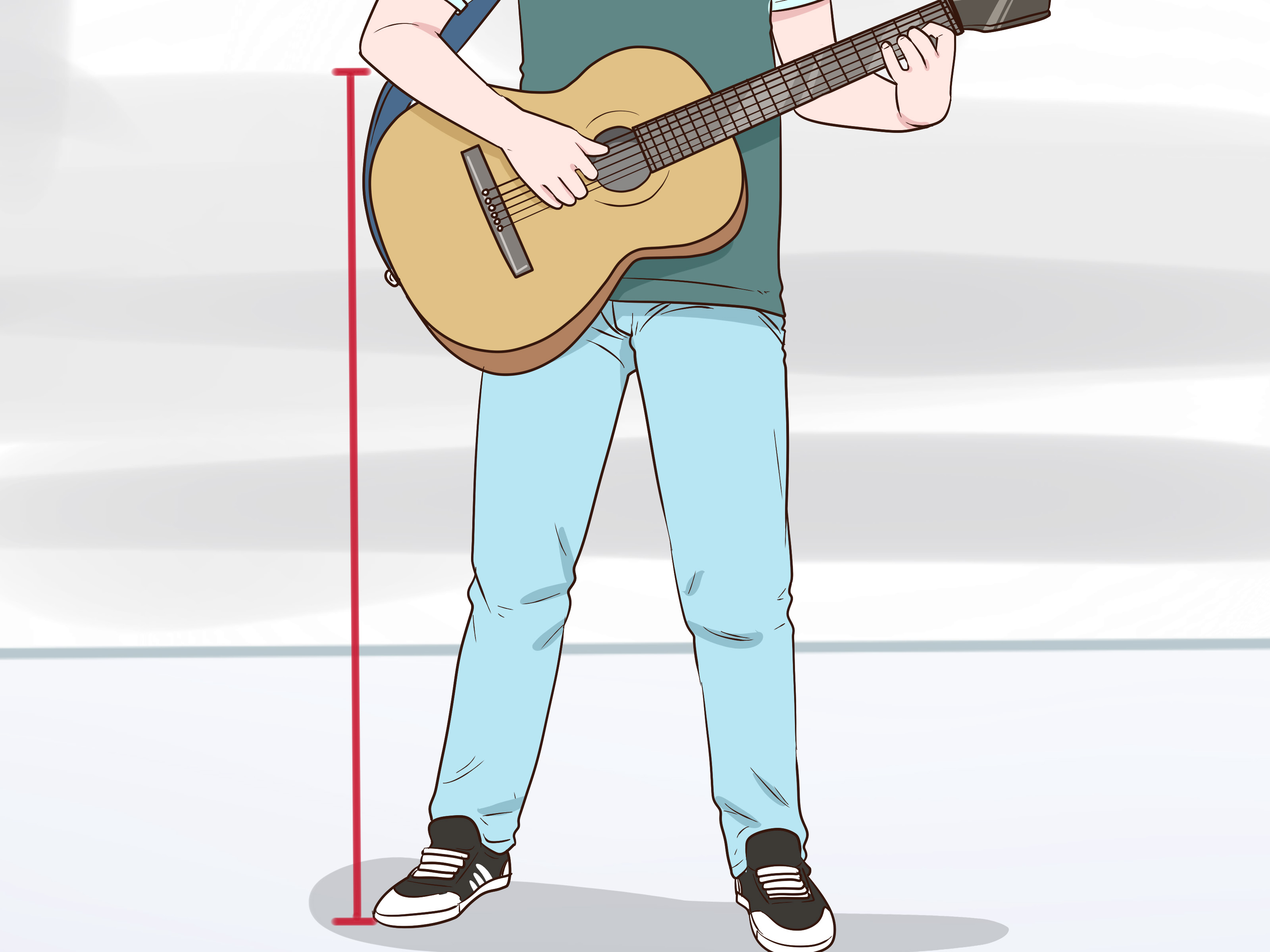
One of the smartest pieces of guitar advice from multiple U.S. sources is also one of the simplest: adjust your strap so the guitar sits in roughly the same place when you stand as it does when you sit. Martin says this directly for acoustic players, and Berklee says always use a strap to keep the guitar in the same position whether seated or standing.
This matters because consistency reduces guesswork. Your fretting hand learns where the neck is. Your picking hand learns where the strings are. Your eyes no longer need to supervise every movement like nervous middle management. When the guitar hangs too low, you usually end up bending the wrist more, elevating the shoulder, or leaning your body around the instrument to reach familiar shapes. It may look dramatic, but technique often gets clumsier and fatigue shows up earlier.
A better approach is to set the strap, stand up, and check whether first-position chords, simple scale shapes, and your normal strumming motion still feel familiar. If everything suddenly feels farther away, raise the guitar. If your shoulders are lifting to compensate, raise it again. You are not losing cool points. You are gaining control.
Let the strap support the instrument, not your hands
Fender notes that a strap stabilizes the guitar against your body and can help prevent your arms from aching. Guitar World makes a related point: a strap takes some of the guitar’s weight off your arms so you do not create extra tension by constantly holding the instrument in place.
That is a big deal in real playing situations. If you sing, move, or switch between rhythm and lead parts, a stable guitar frees up attention. You can focus on the music instead of micro-managing posture every eight seconds. A wider, comfortable strap can also reduce pressure on the neck and shoulder area, which matters during longer rehearsals and gigs.
Your standing stance matters, too. Keep your feet under you instead of locking your knees or leaning everything onto one hip. School of Rock recommends a grounded, feet-apart stance for stage presence. That kind of stance is not just visual. It also gives you a better base, which helps the upper body stay relaxed and responsive.
Use posture to improve performance, not just comfort
Good standing posture is useful beyond injury prevention. It can make you look more confident, breathe more easily, and connect better with an audience. When you are not folded over the instrument, your chest is less collapsed, your head is up, and you can actually look at the room instead of staring at the twelfth fret like it owes you money.
This is especially helpful for singer-guitarists. A more balanced upper body makes breathing feel easier and reduces the tendency to choke off tone when you are nervous. Even if you are only playing in your bedroom today, practicing in a standing position with a sensible strap height prepares you for tomorrow’s rehearsal, open mic, worship set, garage band, or school performance.
3. Use Good Guitar Posture to Practice Longer With Less Fatigue and Better Technique
The third way to use good guitar posture is as an endurance tool. Not a superhero cape. Just a smart, boring, effective endurance tool.
Neutral usually beats dramatic
From a technique standpoint, the best posture is usually the one that keeps your movements efficient. That means relaxed shoulders, a long spine, wrists that are as straight as the music allows, and a thumb that supports instead of crushing the neck like it is trying to win an arm-wrestling contest.
Berklee recommends keeping the thumb flatter behind the neck and using the fingers more efficiently on the fretboard. Martin advises keeping the neck slightly upward and the back straight. General ergonomics guidance from Mayo Clinic, Cleveland Clinic, AAOS, and Johns Hopkins all reinforces the same body logic: neutral positions reduce strain, while forward head posture, rounded shoulders, and staying fixed in one position for too long can lead to fatigue and pain.
In practice, this means your fast passages get cleaner, your chord changes feel less frantic, and your hands have a better chance of moving economically. Good posture will not magically turn you into a shred wizard by Tuesday, but it removes some of the extra friction that slows progress.
Take breaks before your body begs for them
Johns Hopkins advises getting up about every 30 minutes to stretch and move, while AAOS recommends standing and stretching at least once an hour when sitting for long periods. Guitar World likewise recommends regular breaks in the practice room. In other words, the body is voting very clearly here.
If you practice for an hour, try a brief reset halfway through. Stand up. Roll the shoulders. Walk for a minute. Let the hands rest. Then come back. Those tiny breaks help prevent the slow creep of tension that makes players grip harder, hunch more, and sound worse without noticing.
Warmups help, too. Easy scales, simple chord changes, slow picking patterns, and low-effort finger motion are better openers than launching straight into your most heroic riff at full speed. Sweetwater and Guitar World both emphasize warming up and paying attention to pain. And that last part matters: sharp pain, tingling, numbness, or discomfort that keeps getting worse is not a badge of honor. It is a sign to stop, adjust, and get professional advice if needed.
Set up your practice space to fit you
One of the best ergonomics principles says the environment should fit the person, not the other way around. That applies beautifully to guitar practice. Raise your music stand. Choose a chair that suits your height. Use a strap that feels supportive. Pick a guitar body size that does not force your strumming shoulder into an awkward angle. Keep frequently used gear within reach so you are not twisting and reaching every few minutes.
Players sometimes obsess over pedals, picks, and pickup height while ignoring the fact that their whole practice routine happens in a setup that invites slouching. Fix the setup and technique often improves faster than expected.
Common Guitar Posture Mistakes
- Letting the head drift forward so the neck has to support extra strain.
- Rounding the shoulders and collapsing the chest over the guitar.
- Using a strap so low that the wrists and shoulders have to compensate.
- Sitting on a couch or bed for long practice sessions instead of a supportive chair.
- Holding the guitar in place with the forearms instead of letting the strap or thigh support it.
- Ignoring guitar body size and depth, especially for smaller players or long acoustic sessions.
- Playing through fatigue without breaks until form falls apart.
- Treating pain like proof of dedication instead of a signal to adjust.
A 60-Second Guitar Posture Reset
- Sit or stand tall without stiffening up.
- Let your shoulders drop away from your ears.
- Keep your head over your shoulders instead of in front of them.
- Place the guitar so the neck angles slightly upward.
- Adjust the strap so the instrument feels stable.
- Plant your feet and take one slow breath.
- Play one easy chord and check whether your hands feel free instead of stretched.
If that quick reset makes your playing feel easier, congratulations: posture was doing more work than you thought.
Experience Section: What Players Often Notice After Fixing Their Guitar Posture
Many guitarists do not realize how much their posture affects the entire playing experience until they make a few small changes and live with them for a week or two. The first thing they usually notice is not some magical leap in talent. It is comfort. Their shoulders stop feeling like they have been secretly doing desk work all day. Their neck feels less stiff after practice. Their fretting hand stops getting tired as quickly during simple chord progressions. That alone can be a huge win, because the easiest way to improve on guitar is still to practice consistently, and it is much easier to practice consistently when your body is not irritated every time you pick up the instrument.
Beginners often report a different kind of improvement: the instrument feels less slippery and confusing. When the guitar sits in the same position every time, the hands begin to trust where the strings and frets are. Chord changes feel less random. Strumming lands more cleanly. They stop looking down every second because the guitar is no longer drifting around. That creates a subtle boost in confidence. Suddenly, basic songs feel more playable, not because the music changed, but because the setup became predictable.
Intermediate players often notice that difficult passages become less dramatic. Bar chords, scale runs, string skipping, and longer rhythm patterns can feel smoother because the body is not spending extra energy fighting tension. Some players discover that their wrist angle improves simply by raising the strap or tilting the neck slightly upward. Others realize their old chair was part of the problem the whole time. A better seat, a music stand, and a more consistent strap height can make practice feel unexpectedly professional, even in a small bedroom.
Singer-guitarists tend to notice another benefit: breathing gets easier. When the chest is less collapsed and the neck is not craned downward, singing while playing feels more natural. Projection improves. Timing can feel steadier. Even stage presence changes. A player who is balanced and comfortable tends to look more relaxed, more engaged, and less like someone trying to survive a furniture assembly challenge on stage.
Perhaps the most useful experience players describe is this: better posture lowers the amount of physical noise in the system. There are fewer little aches, fewer tension spikes, fewer moments where the body distracts from the music. That does not mean good posture solves everything. You still need practice, patience, and the occasional sense of humor when your fingers refuse to cooperate. But it does create a friendlier environment for growth. Over time, that matters a lot. Guitar becomes easier to return to day after day, and that steady return is where real progress lives.
Conclusion
Good guitar posture is not about looking fancy, copying a concert photo, or obeying some dusty rulebook. It is about giving your body a setup it can actually work with. Use it first to build a stable seated position. Use it next to make standing feel familiar. Then use it to practice longer with less fatigue and better control. Those three uses cover most of what players really need: comfort, consistency, and endurance.
If your guitar life currently involves slouching, shrugging, and wondering why your shoulder feels annoyed after twenty minutes, do not panic. You probably do not need a dramatic overhaul. Start with the chair. Then the guitar angle. Then the strap. Then your break schedule. Small adjustments add up fast. And unlike buying another pedal, this upgrade follows you everywhere.