Note: This article is based on publicly available information from official Star Wars materials, box office databases, film reviews, interviews, and entertainment industry reporting.
Solo: A Star Wars Story is one of the strangest cases in modern franchise filmmaking: a perfectly enjoyable space adventure that somehow arrived wearing the emotional baggage of a tax audit. Released in 2018, the film had everything a Star Wars fan could reasonably want: Han Solo, Chewbacca, Lando Calrissian, the Millennium Falcon, criminal underworld chaos, a train heist, a card game, and Donald Glover dressed like he had personally invented capes.
And yet, despite all that shiny galactic merchandise-ready goodness, Solo: A Star Wars Story never quite made the jump from “pretty fun” to “great.” It is not a disaster. It is not the cinematic equivalent of stepping barefoot on a LEGO brick. In fact, it is often charming, fast-moving, and more rewatchable than its troubled reputation suggests. But it also feels like a movie that was so busy explaining Han Solo that it forgot the most important thing about Han Solo: mystery is part of the magic.
This is the central tension of Solo: A Star Wars Story review discussions even years later. The movie works as an energetic heist film, but it struggles as an origin story. It gives us answers, but not always the answers we needed. It has a strong cast, but not always enough room for its best characters. It has style, but occasionally looks like someone forgot to pay the light bill on half the galaxy.
What Works in ‘Solo: A Star Wars Story’
Alden Ehrenreich Does Better Than He Was Allowed Credit For
Let’s start with the obvious asteroid in the room: recasting Han Solo was always going to be an impossible mission. Harrison Ford did not merely play Han Solo; he practically smuggled the character into pop culture with a crooked grin and a blaster. Asking another actor to step into that role is like asking someone to repaint the Mona Lisa, but make her smirk more.
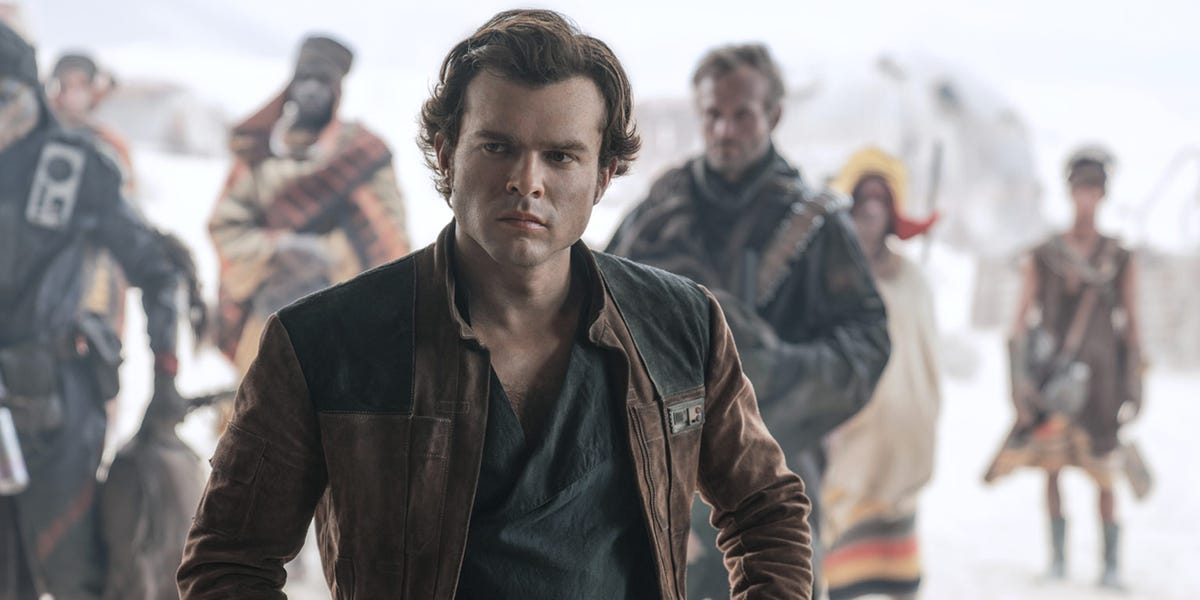
Alden Ehrenreich wisely does not deliver a full Harrison Ford impersonation. He captures the broad outline: the swagger, the impatience, the impulsive confidence, and the desperate need to act like he has a plan even when the plan is currently on fire. His Han is younger, softer, more openly hopeful. That actually makes sense. This is not the cynical smuggler from A New Hope yet. This is the guy before betrayal, disappointment, and years of debt turned his idealism into sarcasm with a vest.
The problem is not Ehrenreich. The problem is that the script keeps forcing the film to wink at the audience. Here is how Han got his name. Here is how Han met Chewbacca. Here is how Han got his blaster. Here is the Kessel Run. Here are the dice. Here is the Falcon. At a certain point, the movie starts to feel less like a story and more like a galactic checklist with excellent production design.
Donald Glover’s Lando Is Pure Star Wars Electricity
If Solo: A Star Wars Story has one universally agreed-upon highlight, it is Donald Glover as Lando Calrissian. Glover does not just understand Lando; he understands that Lando is a lifestyle. Every cape, every pause, every self-satisfied smile feels like a man who would lose a spaceship in a card game and still somehow make you apologize to him.
Lando brings the movie a dose of elegance and absurdity that it badly needs. His scenes with L3-37, voiced by Phoebe Waller-Bridge, add comic flavor and a hint of weirdness that feels genuinely fresh. In a better version of Solo, Lando might have had more screen time, more emotional complexity, and perhaps an entire subplot about how he became the galaxy’s most stylish professional liar. Honestly, Disney could have released Lando Organizes His Cape Closet and fans would have shown up with popcorn.
The Heist Movie Structure Is a Smart Choice
One of the best ideas in Solo: A Star Wars Story is making it a crime caper instead of another galaxy-ending epic. Star Wars does not always need a planet-destroying weapon, a prophecy, or a hooded villain whispering about destiny like he’s hosting a haunted podcast. Sometimes, a Star Wars movie can simply be about thieves, double-crosses, fuel, debts, and bad decisions made in cool jackets.
The train heist on Vandor is a standout sequence. It has motion, danger, geography, and a pulpy Western energy that fits Han Solo perfectly. The Kessel Run, while more CGI-heavy, gives the Millennium Falcon a thrilling early showcase. These scenes suggest the movie that Solo could have been at its absolute best: a scrappy underworld adventure where morality is blurry, alliances are temporary, and every character is one bad deal away from disaster.
Where ‘Solo: A Star Wars Story’ Falls Short
It Explains Too Much
Origin stories are tricky because they often confuse explanation with drama. We do not always need to know how every iconic detail began. Some legends are stronger when they remain partly legendary. Han Solo did not become beloved because audiences were desperate to learn the administrative process behind his surname. He became beloved because he felt like he had lived a hundred stories before walking into the Mos Eisley cantina.
Solo: A Star Wars Story sometimes shrinks Han by over-defining him. Instead of making the galaxy feel larger, the film makes Han’s life feel oddly compact. In one adventure, he meets Chewbacca, meets Lando, boards the Falcon, makes the Kessel Run, gets his famous dice back into focus, and moves closer to becoming the smuggler we know. That is a lot of mythology packed into one film. It is less “young man slowly becomes a legend” and more “congratulations, your Han Solo starter kit has shipped.”
The Film Plays It Too Safe
For a movie about criminals, Solo is surprisingly cautious. It flirts with danger, but rarely lets the audience feel truly uncertain. Tobias Beckett, played by Woody Harrelson, is a solid mentor figure, but his betrayal is exactly the kind of betrayal the movie trains us to expect. Dryden Vos, played by Paul Bettany, has menace, but not enough screen time to become unforgettable. The Crimson Dawn crime syndicate is intriguing, yet the film only opens that door near the end.
The most exciting material is often just outside the frame. Qi’ra’s survival inside Crimson Dawn sounds like a darker, richer story. Enfys Nest and the Cloud-Riders hint at early rebellion politics. Maul’s cameo points toward a larger underworld saga. Lando clearly has enough charisma to power a small moon. But Solo keeps returning to the safest version of itself: a likable Han-centered adventure that refuses to get too strange.
Qi’ra Deserved a Stronger Emotional Center
Emilia Clarke’s Qi’ra is one of the film’s most fascinating characters because she represents the road Han does not understand. Han believes in escape. Qi’ra understands survival. She has made compromises he cannot fully see, and that difference could have powered the entire film.
Instead, Qi’ra often feels like a great character waiting for a greater script. Her final choice is compelling because it reveals that she is not simply Han’s lost love or moral opposite. She is a strategist. She is trapped, but not helpless. She cares about Han, but she is not willing to become a passenger in his story. That is excellent dramatic material. The movie simply reaches it too late.
A stronger version of Solo: A Star Wars Story might have made Qi’ra the co-lead. Imagine the film cutting between Han’s reckless optimism and Qi’ra’s rise through Crimson Dawn. Imagine the audience watching both characters learn opposite lessons from the same brutal galaxy. Han learns to bluff. Qi’ra learns to rule. That movie could have had real emotional bite.
The Behind-the-Scenes Turbulence Shows
No discussion of Solo: A Star Wars Story is complete without mentioning its famous production shake-up. Original directors Phil Lord and Christopher Miller left the project during production, and Ron Howard came in to finish the film. Howard is a skilled, steady filmmaker, and to his credit, Solo does not feel like a complete mess. It is coherent, polished, and often entertaining.
But it does feel sanded down. Lord and Miller are known for playful, self-aware, high-energy storytelling, while Howard brings classical studio craftsmanship. The final movie sometimes feels caught between those instincts. It wants to be loose, funny, and mischievous, but it also wants to be a proper, brand-safe Star Wars chapter. The result is a film that smiles at rebellion while keeping both hands on the corporate steering wheel.
That tension is visible in the tone. Some scenes have comic looseness. Others feel like traditional adventure beats. Some characters seem designed for a weirder movie, especially L3-37. Others belong to a straightforward Western. None of this ruins the film, but it does keep it from feeling fully alive.
The Release Timing Did ‘Solo’ No Favors
Solo: A Star Wars Story also had the misfortune of arriving at a complicated moment for the franchise. It opened only months after Star Wars: The Last Jedi, a film that generated intense debate among fans. Instead of feeling like an event, Solo felt like another product in a rapidly moving release schedule. Even the Millennium Falcon needs maintenance between flights.
The box office reflected that fatigue. Despite the power of the Star Wars brand, Solo became the lowest-grossing live-action Star Wars film. Its worldwide gross was respectable by normal movie standards, but Star Wars does not live by normal standards. When your franchise has Death Stars, lightsabers, and theme park lands, “respectable” can still look like a disappointed accountant staring into space.
Marketing also faced a difficult challenge. The film had to convince audiences that a Han Solo movie without Harrison Ford was not only acceptable, but necessary. That is a tall order. The trailers promised adventure, but they did not fully answer the bigger question: why does this story need to exist?
How ‘Solo’ Could Have Been Great
Make It Less About Answers and More About Character
The best version of Solo: A Star Wars Story would not worry so much about explaining famous details. It would focus on the emotional transformation of Han Solo. How does a hopeful runaway become a self-protective smuggler? What does he lose? Who teaches him not to trust? What parts of himself does he bury?
The film gestures toward these questions, especially through Beckett and Qi’ra, but it rushes past them. Greatness would have required more patience. Let Han fail in ways that matter. Let his charm cost him something. Let his belief in people be wounded deeply enough that his later cynicism feels earned.
Lean Harder Into the Criminal Underworld
The underworld is the most exciting corner of Solo. Crimson Dawn, smugglers, pirates, corrupt deals, dangerous fuel, and shifting loyalties all feel perfect for a Han Solo movie. The film should have gone deeper into that world. Less franchise homework, more dirty cantinas. Less destiny, more debt.
A truly great Star Wars heist movie could have played like a space Western mixed with a noir crime thriller. Han would not be saving the galaxy. He would be trying to survive it. That smaller scale is not a weakness. In fact, it is exactly what makes Solo refreshing when it works.
Give Lando, Qi’ra, and Enfys Nest More Room
The supporting characters are strong enough to suggest a richer ensemble film. Lando adds style and comic rhythm. Qi’ra adds emotional complication. Enfys Nest adds political surprise and a link to rebellion. Chewbacca adds heart, loyalty, and the invaluable ability to improve any scene by growling at nonsense.
Instead of treating these characters as stops on Han’s origin tour, the movie could have woven them into a broader story about different responses to oppression. Han runs. Qi’ra adapts. Enfys resists. Lando performs independence while protecting his own interests. Beckett gives up on ideals entirely. That is a fascinating dramatic map. The film has all the pieces; it just does not arrange them into the strongest possible shape.
Why ‘Solo’ Has Aged Better Than Its Reputation
Here is the funny thing: Solo: A Star Wars Story may be better now than it felt in 2018. Removed from the noise of production drama, fan arguments, and box office analysis, it plays as a breezy, well-made adventure with several terrific moments. It is not trying to rewrite the mythology of the Force. It is not asking viewers to debate prophecy, bloodlines, or the ethics of space wizard mentorship. It mostly wants to show Han and Chewie getting into trouble. That is a noble cause.
The movie’s strengths are easier to appreciate on rewatch. Ehrenreich’s performance feels warmer. Glover’s Lando remains delightful. The practical sets and creature designs give the world texture. John Powell’s score brings energy while honoring classic Star Wars musical language. The final act, especially Qi’ra’s decision and the Crimson Dawn reveal, leaves behind a more interesting aftertaste than the film’s early reputation suggested.
In some ways, Solo suffered because it was judged not only as a movie, but as a referendum on Disney’s Star Wars strategy. That is a heavy backpack for one space heist to carry. Viewed on its own terms, it is good. Viewed as the missed opportunity for a bold underworld saga, it becomes frustrating. Both things can be true. In Star Wars, as in life, two truths can sit together awkwardly like droids in a crowded cockpit.
Experience: Rewatching ‘Solo’ With Fresh Eyes
Rewatching Solo: A Star Wars Story today is a very different experience from watching it during its theatrical release. Back then, the conversation around the film was almost louder than the film itself. People were talking about the director change, the budget, the marketing, the release date, and whether anyone should dare play young Han Solo without asking Harrison Ford’s eyebrows for permission.
With that noise turned down, the movie becomes easier to enjoy. The opening on Corellia has a grimy, industrial energy that immediately separates it from the cleaner heroic spaces of the saga. Han and Qi’ra’s escape attempt gives the story a simple emotional engine. The Mimban sequence, while brief, shows a muddy, ugly side of the Empire that feels closer to war-film imagery than typical space opera gloss. Then Chewbacca appears, and suddenly the movie remembers that Star Wars is always better when a giant walking carpet can become your best friend.
The experience is also a reminder that expectations can be unfair little goblins. If a viewer enters Solo expecting a legendary origin that redefines Han Solo forever, disappointment is almost guaranteed. If the viewer enters expecting a fast, slightly messy adventure about smugglers, betrayals, and one very famous ship, the film becomes much more satisfying. It is a popcorn movie with occasional flashes of something deeper.
The most enjoyable part of the rewatch is noticing how much potential lives in the corners. Lando’s ship feels like it has hosted better parties than most planets. Qi’ra’s calm under pressure suggests years of stories we never saw. Enfys Nest changes the moral direction of the film in just a few scenes. Even Beckett, familiar as the cynical mentor, helps define the lesson Han spends the rest of his life pretending he learned too well: trust nobody, unless that nobody is Chewbacca.
There is also a cozy pleasure in watching a Star Wars film that does not require a flowchart of Jedi history. Solo is accessible. It is a side quest, and side quests can be fun. Not every trip to the galaxy far, far away needs to shake the foundations of existence. Sometimes, it is enough to steal fuel, gamble badly, fly recklessly, and escape with your dignity only lightly dented.
Still, the rewatch also sharpens the sense of what might have been. The movie keeps approaching greatness, tapping it on the shoulder, and then running away before things get too interesting. It could have been darker. It could have been stranger. It could have trusted its supporting characters more. It could have allowed Han to remain a little less explained and a little more mythic.
That is why ‘Solo: A Star Wars Story’ is good, but it could’ve been great remains such a fair conclusion. It is a charming film trapped inside a cautious one. It has the bones of a terrific underworld adventure, the cast of a memorable ensemble piece, and the emotional setup for a sharper character study. What it lacks is the courage to stop being an origin-story checklist and become its own dangerous, stylish, unpredictable thing.
Conclusion
Solo: A Star Wars Story deserves more affection than it often gets. It is fun, handsomely made, and filled with performances that range from solid to scene-stealing. It gives Han and Chewbacca a warm beginning, brings Lando back with spectacular flair, and opens a window into the criminal underworld of Star Wars.
But it also demonstrates the danger of over-explaining beloved characters. Han Solo did not need every accessory, friendship, and personality trait explained in one movie. He needed a story that made his transformation feel surprising, painful, and inevitable. Solo gives us a good ride. A bolder film could have given us a great one.