Improper fractions can look a little dramatic at first. A number like 17/5 walks into your math homework wearing a tiny disguise, pretending to be more complicated than it really is. Good news: it is not. Once you understand the simple relationship between division, remainders, and fractions, learning how to turn an improper fraction into a mixed number becomes one of the most satisfying math tricks in the notebook.
An improper fraction is a fraction where the numerator, the top number, is greater than or equal to the denominator, the bottom number. A mixed number combines a whole number and a proper fraction, like 3 2/5. Both forms can describe the same value, but mixed numbers are often easier to picture in real life. After all, most people would rather say they ate 2 1/2 pizzas than 5/2 pizzas, unless they are trying to sound like a math wizard at lunch.
In this guide, you will learn the full process in 11 clear steps, with examples, tips, common mistakes, and practical experience notes to help the method stick. Whether you are helping a fourth grader, reviewing for a test, or secretly trying to win back your dignity after a fraction worksheet attacked you, this lesson has your back.
What Is an Improper Fraction?
An improper fraction is a fraction whose numerator is greater than or equal to its denominator. For example:
- 7/4 is improper because 7 is greater than 4.
- 12/5 is improper because 12 is greater than 5.
- 8/8 is also improper because the numerator equals the denominator.
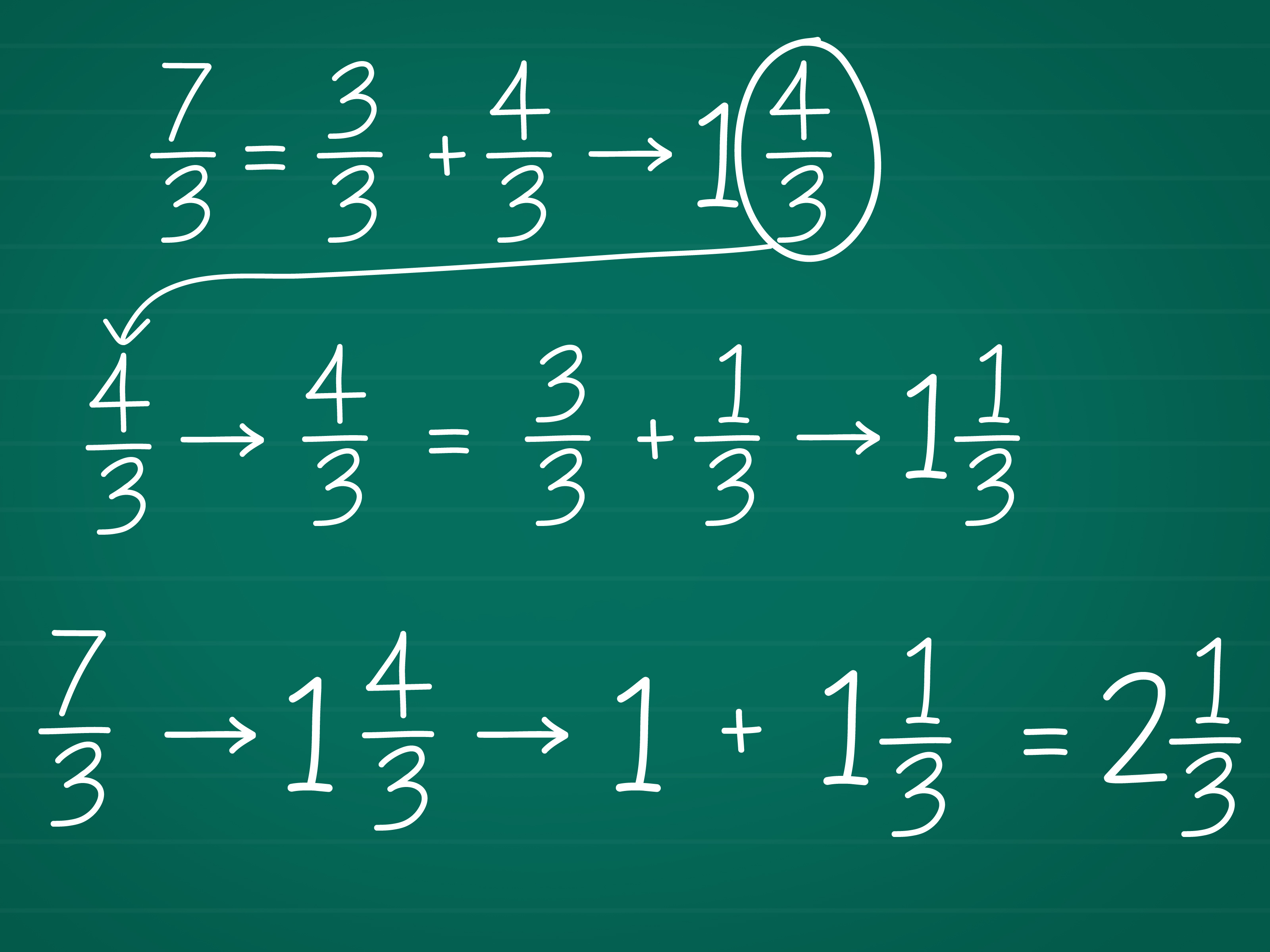
Improper fractions represent values that are equal to or greater than one whole. That is the key idea. If the denominator tells you how many equal parts make one whole, then the numerator tells you how many parts you have. If you have more parts than one whole needs, you can group those parts into whole numbers plus leftovers.
What Is a Mixed Number?
A mixed number has two parts: a whole number and a fraction. For example, 2 3/4 means 2 whole units plus 3 out of 4 equal parts of another unit. Mixed numbers are useful because they make size easier to understand. Instead of saying 11/4, you can say 2 3/4, which immediately tells you there are 2 complete wholes and 3 fourths left over.
The magic behind the conversion is division. A fraction is another way to show division, so 11/4 means 11 ÷ 4. Once you divide, the quotient becomes the whole number, the remainder becomes the new numerator, and the original denominator stays exactly where it is.
How to Turn an Improper Fraction Into a Mixed Number: 11 Steps
Step 1: Identify the numerator
Look at the top number of the fraction. This is the numerator. In 17/5, the numerator is 17. It tells you how many parts you have in total.
Step 2: Identify the denominator
Now look at the bottom number. This is the denominator. In 17/5, the denominator is 5. It tells you how many equal parts make one whole.
Step 3: Make sure the fraction is improper
Before converting, check whether the numerator is greater than or equal to the denominator. If it is, you have an improper fraction. If the numerator is smaller, the fraction is already proper and cannot be written as a mixed number greater than one.
Step 4: Divide the numerator by the denominator
Take the numerator and divide it by the denominator. For 17/5, calculate:
17 ÷ 5 = 3 remainder 2
This tells you that 5 fits into 17 three full times, with 2 left over.
Step 5: Use the quotient as the whole number
The quotient is the whole-number answer from division. In 17 ÷ 5, the quotient is 3. That means the mixed number will begin with:
3
Step 6: Use the remainder as the new numerator
The remainder becomes the numerator of the fractional part. Since the remainder is 2, the fraction part begins with:
2/
Step 7: Keep the original denominator
The denominator does not change. If the original fraction was in fifths, the leftover part is still in fifths. So the denominator remains 5.
That gives you:
3 2/5
Step 8: Put the whole number and fraction together
Now combine the whole number and the fractional part. The improper fraction 17/5 becomes:
17/5 = 3 2/5
Translation: 17 fifths equal 3 wholes and 2 fifths. The fraction did not change value; it simply changed outfits.
Step 9: Simplify the fractional part if needed
Sometimes the leftover fraction can be reduced. For example, convert 18/6:
18 ÷ 6 = 3 remainder 0
There is no fraction left over, so the answer is simply 3, not 3 0/6. Now try 14/6:
14 ÷ 6 = 2 remainder 2
That gives 2 2/6. But 2/6 simplifies to 1/3, so the final answer is:
14/6 = 2 1/3
Step 10: Check your answer by converting back
To make sure your mixed number is correct, convert it back into an improper fraction. Multiply the whole number by the denominator, then add the numerator.
For 3 2/5:
3 × 5 = 15
15 + 2 = 17
17/5
You returned to the original improper fraction, which means your answer is correct. Congratulations: the math boomerang came back.
Step 11: Practice with different examples
The best way to master converting improper fractions to mixed numbers is to practice with several types of numbers. Start with easy examples, then move to larger numerators and fractions that need simplifying.
- 9/4: 9 ÷ 4 = 2 remainder 1, so 9/4 = 2 1/4.
- 22/7: 22 ÷ 7 = 3 remainder 1, so 22/7 = 3 1/7.
- 31/8: 31 ÷ 8 = 3 remainder 7, so 31/8 = 3 7/8.
- 45/10: 45 ÷ 10 = 4 remainder 5, so 45/10 = 4 5/10 = 4 1/2.
The Simple Formula
Here is the process in one compact formula-style explanation:
Improper fraction = numerator ÷ denominator
The answer becomes:
Quotient remainder/original denominator
For example:
29/6
29 ÷ 6 = 4 remainder 5
29/6 = 4 5/6
The quotient is 4, the remainder is 5, and the denominator stays 6. That is the whole conversion in three moving parts.
Why This Method Works
Turning an improper fraction into a mixed number works because fractions are division. The denominator tells how many pieces make one whole. When you divide the numerator by the denominator, you are asking, “How many whole groups can I make?” The quotient gives you the complete groups, and the remainder gives you the extra pieces that do not make a full group.
Imagine you have 13 slices of cake, and each whole cake has 4 slices. That is 13/4. You can make 3 whole cakes from 12 slices, and 1 slice remains. So 13/4 = 3 1/4. Also, please do not eat 13 slices of cake unless you have a plan and stretchy pants.
Common Mistakes to Avoid
Mistake 1: Changing the denominator
The original denominator stays the same. If you start with 19/6, your mixed number will still have sixths in the fraction part.
Mistake 2: Using the quotient as the numerator
The quotient becomes the whole number, not the numerator. The remainder becomes the numerator.
Mistake 3: Forgetting to simplify
If your leftover fraction can be reduced, simplify it. For example, 20/8 = 2 4/8, but 4/8 simplifies to 1/2, so the best answer is 2 1/2.
Mistake 4: Writing a mixed number when there is no remainder
If the remainder is zero, the answer is a whole number. For example, 24/6 = 4, not 4 0/6.
More Worked Examples
Example 1: Convert 16/3
Divide 16 by 3:
16 ÷ 3 = 5 remainder 1
The quotient is 5. The remainder is 1. Keep the denominator 3.
16/3 = 5 1/3
Example 2: Convert 37/9
Divide 37 by 9:
37 ÷ 9 = 4 remainder 1
So:
37/9 = 4 1/9
Example 3: Convert 50/12
Divide 50 by 12:
50 ÷ 12 = 4 remainder 2
That gives:
50/12 = 4 2/12
Simplify 2/12 to 1/6:
50/12 = 4 1/6
When Should You Use Mixed Numbers?
Mixed numbers are especially useful when you want a value to feel more natural. Recipes, measurements, construction, time, distance, and everyday sharing often use mixed numbers. Saying 1 3/4 cups of flour feels clearer than saying 7/4 cups of flour. Saying a shelf is 5 1/2 feet long feels friendlier than saying it is 11/2 feet long.
Improper fractions are still useful, especially in algebra and fraction operations. But mixed numbers help people visualize quantities. Think of improper fractions as the backstage math form and mixed numbers as the public-facing form that does not scare the audience.
Quick Practice Problems
Try these before checking the answers:
- Convert 11/4 to a mixed number.
- Convert 25/6 to a mixed number.
- Convert 39/10 to a mixed number.
- Convert 28/7 to a mixed number.
- Convert 41/8 to a mixed number.
Answers
- 11/4 = 2 3/4
- 25/6 = 4 1/6
- 39/10 = 3 9/10
- 28/7 = 4
- 41/8 = 5 1/8
Helpful Experience Notes: What Makes This Topic Finally Click
From real classroom-style practice, tutoring sessions, and everyday math use, one thing becomes clear: students usually do not struggle with the idea of improper fractions because they are incapable of division. They struggle because the symbols feel detached from real objects. The moment you connect 17/5 to something physical, like 17 brownie pieces where 5 pieces make one tray, the process becomes much easier. You are not “doing fraction magic.” You are simply grouping pieces into wholes.
One practical experience that helps is drawing circles, rectangles, or number lines. For example, if a student sees 9/4, they can draw three rectangles divided into fourths. Then they shade 9 fourths. Two whole rectangles get filled, and one fourth of the next rectangle is shaded. Suddenly 9/4 = 2 1/4 is not just an answer; it is visible. Visual models are especially helpful for younger learners because they turn the abstract into something the brain can grab.
Another useful trick is to say the fraction out loud as division. Instead of reading 23/6 as “twenty-three sixths” only, say, “twenty-three divided by six.” This tiny language shift helps students remember the first step. The numerator goes inside the division problem, and the denominator does the dividing. If someone keeps reversing the numbers, this phrase can save the day: top divided by bottom. It is short, memorable, and much less annoying than redoing the same problem five times.
In practice, the biggest mistake is often forgetting what to do with the remainder. Many learners correctly divide, find the quotient, and then freeze as if the remainder has wandered into the room uninvited. The remainder is not extra clutter; it is the numerator of the fraction part. If 26 ÷ 5 = 5 remainder 1, the answer is 5 1/5. The denominator remains 5 because the size of the pieces has not changed.
Experience also shows that checking the answer builds confidence. Converting back from a mixed number to an improper fraction is like proofreading a sentence before publishing it. For 6 3/7, multiply 6 × 7 = 42, then add 3 to get 45/7. If that matches the original improper fraction, the answer is solid. This check is especially useful during tests, where one tiny remainder error can sneak into an otherwise perfect solution.
Finally, repetition matters, but not the boring kind. Mix easy examples with funny real-life ones: slices of pizza, cups of sugar, yards of fabric, game tokens, or cookies. Fractions become less intimidating when they are attached to things people actually understand. A worksheet full of 43/8 and 29/6 may look like math soup, but a story about dividing 43 stickers into groups of 8 makes the same skill feel natural. The more learners practice seeing improper fractions as “whole groups plus leftovers,” the faster they turn them into mixed numbers without panic, guesswork, or dramatic sighing.
Conclusion
Learning how to turn an improper fraction into a mixed number is easier than it looks. The whole process comes down to division: divide the numerator by the denominator, use the quotient as the whole number, use the remainder as the new numerator, and keep the same denominator. If the fractional part can be simplified, reduce it. If there is no remainder, the answer is a whole number.
Once you practice a few examples, improper fractions stop looking like trouble and start looking like simple division problems wearing fraction hats. Whether you are solving homework, teaching a child, preparing for a test, or measuring ingredients for a recipe, this skill is practical, quick, and surprisingly satisfying.