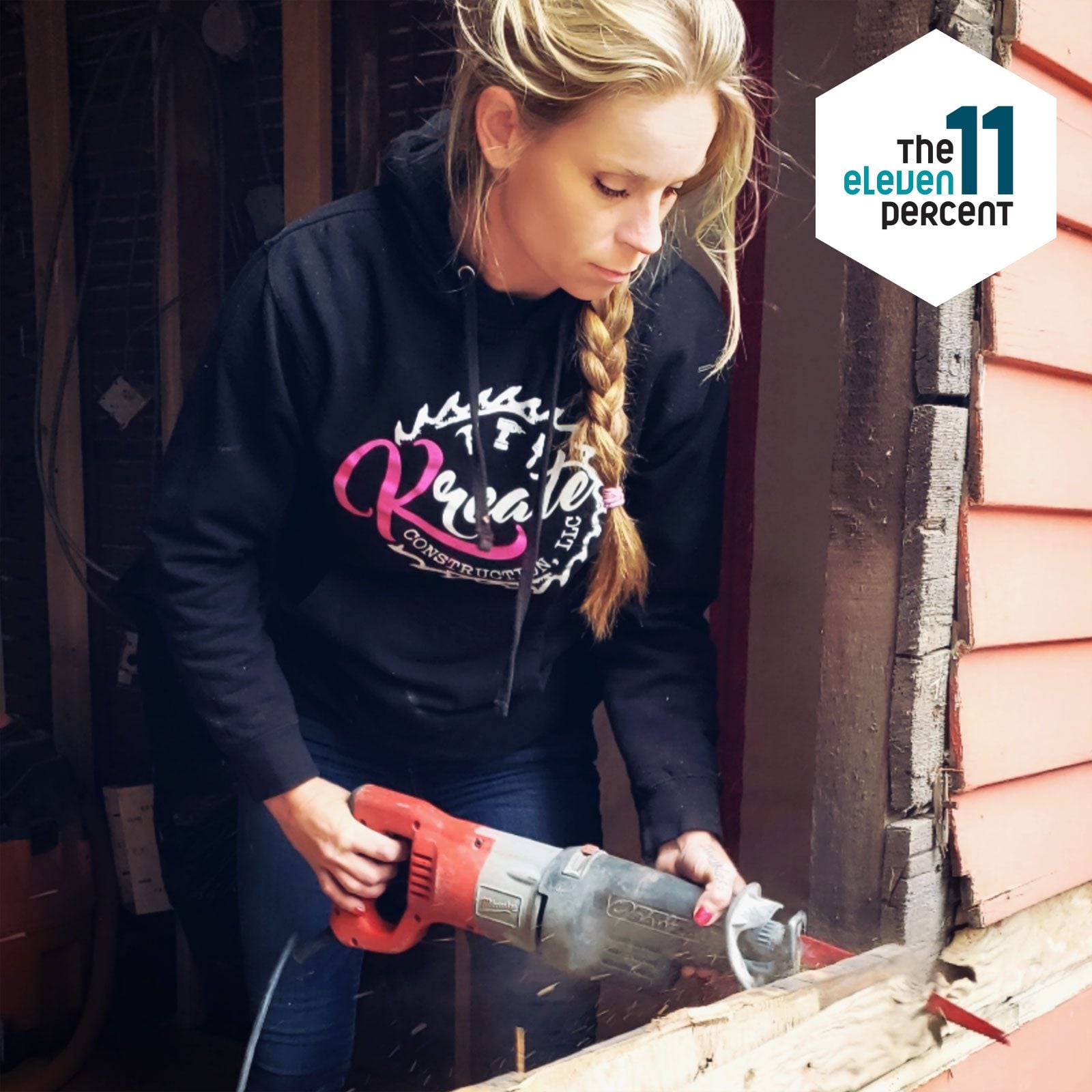
Walk onto a residential construction site and there is still a pretty good chance the person holding the circular saw, checking the framing, solving the mysterious leak and explaining why the wall is definitely not supposed to lean that way will be a man. Kelly Gannon has spent more than two decades helping change that picture.
Gannon is a New England general contractor, carpenter and founder of Kreate Construction, a woman-owned residential construction company serving northeastern Massachusetts and surrounding areas. Her career did not begin with a polished business plan, a construction-management degree or a dramatic television makeover montage. It began much more practically: she learned that being good with her hands could become a way to earn a living.
Her story fits naturally into the conversation around women in construction. Women have historically represented only about one-tenth of the overall U.S. construction workforce, and their share of hands-on construction trades has been considerably smaller. Yet people such as Gannon demonstrate why those statistics do not tell the whole story. Behind the percentage are carpenters, electricians, plumbers, welders, project managers and contractors building careers one project at a time.
Research basis:
Who Is Kelly Gannon?
Kelly Gannon is the owner and a hands-on worker at Kreate Construction, a general contracting and remodeling business established in Massachusetts in 2016. Public business records identify her as the company’s owner, while Kreate’s own materials describe a small operation capable of tackling everything from repairs and structural work to kitchens, bathrooms, decks, roofing, siding and larger residential renovations.
Gannon’s connection to construction goes back much further than the company’s founding. She grew up as the daughter of a carpenter. Interestingly, she has explained that she was not formally trained as her father’s apprentice. Instead, she watched. She paid attention. She figured things out.
That distinction matters because construction is full of knowledge that can be taught in a classroom, but it is also full of knowledge absorbed by watching experienced people work: how a carpenter approaches a crooked old house, how water really travels through a roof assembly, how to anticipate the next step in a remodel and how to recognize when a supposedly simple repair is preparing to ruin your afternoon.
Accounts of Gannon’s career describe her beginning with roofing work as a teenager and gradually learning additional parts of residential construction. Over the following decades, she worked under male contractors, accumulated broad practical experience and ultimately launched her own company.
Research basis:
From Learning on the Job to Running Kreate Construction
Becoming a competent tradesperson is difficult. Becoming a contractor adds several more layers of difficulty just for fun.
A working contractor may have to estimate a project, order materials, coordinate subcontractors, understand permitting requirements, manage schedules, talk clients through unexpected discoveries and still know enough about the physical work to recognize whether something has been installed correctly. On a small residential project, several of those responsibilities may belong to the same person before lunch.
Gannon built her business around that hands-on approach. Kreate Construction describes its work as ranging from relatively small repairs to full renovations. Its service list includes structural repairs, door and window installation, porches, decks, stairs, kitchen and bathroom remodeling, basement work, painting, roofing and siding.
That breadth helps explain an important part of Gannon’s professional identity: she is not merely the owner whose name happens to appear on the paperwork. She has described herself specifically as an owner and hands-on worker.
For homeowners, that distinction can matter. Residential remodeling is full of surprises. Open a wall in a new house and you may find insulation. Open a wall in a century-old New England house and you may find three generations of repairs, mystery wiring, evidence of a leak from 1974 and perhaps a newspaper somebody used as insulation. Experience with multiple trades helps a contractor understand how one repair affects everything around it.
Why “The Eleven Percent” Matters
The phrase The Eleven Percent reflects a statistic long associated with women in the American construction workforce. A CDC-supported data bulletin examining 2021 employment found that women represented about 11 percent of the broader construction workforce, despite accounting for nearly half of workers across the economy.
There is an important catch, however. “Construction workforce” includes far more than people swinging hammers. It also includes professionals working in areas such as administration, finance, design, engineering, management and sales.
When researchers narrow the lens to skilled construction and extraction occupations, women’s representation drops sharply. Recent research from the Institute for Women’s Policy Research estimated that women represented about 4.3 percent of construction trade workers in 2025. In several major trades, including carpentry, plumbing and electrical work, the proportions remained in the low single digits.
In other words, the Eleven Percent is useful as a symbol, but it should not be mistaken for a universal number. Depending on which construction jobs are being counted and which year is examined, the percentage changes substantially.
For a carpenter and contractor such as Kelly Gannon, that makes the story even more relevant. She works in precisely the hands-on side of construction where women remain least represented.
Workforce research:
A Career Built on Capability Rather Than Stereotypes
One of the most interesting themes in Gannon’s story is the gap between what someone is assumed to be able to do and what that person can actually learn to do.
She has spoken about growing up around old-fashioned ideas regarding women and construction. Instead of accepting those expectations, she developed practical skills and kept working.
That is not a small issue. Industry organizations continue to identify stereotypes and weak recruitment efforts as barriers preventing women from considering construction careers in the first place. If girls rarely see female carpenters, builders or general contractors, the occupation can appear closed to them long before anybody actually tells them it is.
Visibility changes that equation. Seeing a woman running a remodeling company makes the career less theoretical. Suddenly “contractor” becomes an occupation someone can picture herself doing.
Gannon’s advice has reflected this idea: people often underestimate what they are capable of doing. Construction rewards the opposite attitude. Nobody begins knowing how to frame a wall, flash a window or diagnose a structural problem. Skills are accumulated through training, repetition, mistakes, observation and the occasional project that teaches a lesson with approximately the subtlety of a falling sheet of plywood.
Industry context:
Being a Woman on the Jobsite Is Not the Only Challenge
It would be easy to tell Gannon’s story entirely as a tale about gender. That would miss much of what makes her career interesting.
She also built a business while raising two sons as a young single mother, according to a long-form trades interview featuring her career. That adds another dimension familiar to many small-business owners: construction does not politely stop because family life exists.
Running a contracting company can mean early mornings, late estimates, supply runs, unexpected client calls and schedules determined partly by weather, inspectors, subcontractors and whether the delivery truck actually contains what the invoice claims it contains.
Research into retaining women in construction increasingly emphasizes work-life balance alongside training and career advancement. In one major NCCER study, women identified leadership opportunities, professional development and sustainable working conditions as important factors in remaining in the industry.
Those concerns apply to men as well, of course, but they can become especially significant in an industry trying to recruit from a population it historically overlooked.
Career and retention research:
Construction Safety Has Had to Catch Up Too
Some barriers facing women in construction are cultural. Others are surprisingly physical.
For years, female tradespeople reported difficulties obtaining protective equipment designed to fit smaller or differently proportioned bodies. Oversized gloves can interfere with tool control. Excessively long sleeves can snag. An improperly fitting fall-protection harness is not simply annoying; it can compromise safety.
OSHA addressed the broader problem directly with a construction PPE rule that became effective in January 2025. The rule explicitly requires employers to ensure personal protective equipment properly fits each affected worker. OSHA specifically noted that improper sizing had historically affected some women and other workers whose bodies did not fit standard equipment dimensions.
This may sound like a technical side issue, but it illustrates something larger. If the construction industry wants a broader workforce, the workplace itself has to accommodate that workforcefrom equipment and training to leadership and jobsite culture.
Safety research:
Why Contractors Like Kelly Gannon Matter to the Industry
America’s construction industry has spent years discussing skilled-labor shortages. Contractors frequently report difficulty finding enough qualified craft professionals, while demand remains strong across housing, infrastructure, manufacturing and renovation.
At the same time, women remain dramatically underrepresented in the trades. Put those two facts next to each other and the opportunity becomes difficult to ignore.
Organizations including the National Association of Home Builders, Associated General Contractors and NCCER have increasingly emphasized recruiting and retaining women. Federal initiatives have also sought to expand pathways for women into construction and support women-owned companies competing for contracts.
The Small Business Administration, for example, operates a Women-Owned Small Business contracting program, while federal policy sets a goal of directing at least five percent of federal contracting dollars toward women-owned small businesses.
Programs matter, but examples matter too. A person considering the skilled trades may never read a workforce development report. She might, however, see someone such as Kelly Gannon building decks, repairing homes, managing renovations and running a company and think, “Maybe I could do that.”
Industry and business context:
What Makes Gannon’s Approach Stand Out?
She Treats Construction as Both Craft and Business
Gannon has emphasized pride in workmanship rather than viewing projects exclusively as financial transactions. That philosophy is particularly relevant in remodeling, where shortcuts often hide beautifully until water, gravity or winter discovers them.
A successful contractor has to balance price, schedule and quality without pretending those three factors never conflict. The temptation to finish faster or use the cheapest possible solution exists on every job. Long-term reputation, however, is built on what remains after the invoice has been paid.
She Values the Creative Side of Building
Gannon has also described herself as an artist and creative person. That may sound unusual until you watch a good carpenter work.
Construction is highly technical, but remodeling often requires improvisation. Existing buildings are imperfect. Rooms are rarely perfectly square. Homeowners want modern functionality inside structures built for another era. Solving those conflicts requires visual judgment as well as technical knowledge.
The best solution is not always the first solution or the most obvious one. Sometimes a contractor has to understand what the homeowner wants emotionally as well as what the building requires structurally.
She Stayed Hands-On
Some contractors eventually move almost entirely into management. Gannon has maintained a strong identity as a builder as well as a business owner.
That hands-on experience can sharpen decision-making because the person estimating a repair understands what it feels like to perform the repair. Materials, access, sequencing and hidden conditions are not abstract spreadsheet categories when you have dealt with them personally.
Experiences and Practical Lessons Inspired by Kelly Gannon’s Story
For anyone considering a career as a contractor, carpenter or remodeler, Gannon’s path offers several practical lessons that extend well beyond gender.
Experience Lesson 1: Start With One Skill, Then Expand
Very few excellent contractors begin as experts in everything. A more realistic path is to become useful at one thing and then widen your capabilities.
Imagine someone starting on a roofing crew. At first, the job may involve moving materials, cleaning debris and learning safe ladder practices. Soon that worker begins understanding underlayment, flashing, ventilation and water management. Those lessons connect naturally to siding, windows and exterior carpentry. Exterior work leads to framing. Framing creates an interest in structural repairs. Before long, individual tasks begin forming a system.
That pattern resembles Gannon’s development from early roofing experience into broader residential construction. The lesson is simple: do not wait until you know everything before entering the trades. Nobody knows everything. The house will eventually provide a new problem just to keep everyone humble.
Experience Lesson 2: Observation Is a Serious Form of Learning
Formal apprenticeships and trade education are enormously valuable, but observation remains one of construction’s most powerful teachers.
Watch an experienced carpenter approach a difficult cut and notice that the learning begins before the saw starts. Why did she measure from that reference point? Why was the material positioned that way? Why did she check the opening twice before cutting?
Gannon’s childhood experience watching her carpenter father illustrates the value of paying attention even without formal instruction. People who become skilled tradespeople often develop a habit of studying how things are assembledand, equally important, how they fail.
Experience Lesson 3: Learn the Business Before You Need the Business Skills
Being the best carpenter on a crew does not automatically make someone the best contractor.
A contractor must understand estimating, scheduling, contracts, insurance, licensing, customer communication, cash flow and subcontractor coordination. A beautifully executed bathroom remodel can still become a terrible business project if the estimate ignores three weeks of labor.
Future business owners should learn how projects are priced while they are still working for other contractors. Study change orders. Watch material purchasing. Notice how experienced managers communicate delays. Technical ability gets the project built; business discipline keeps the company alive long enough to build the next one.
Experience Lesson 4: Reputation Is Built in Uncomfortable Moments
Every construction project eventually produces a surprise. Materials arrive late. Existing framing is worse than expected. A client changes the design. Something costs more than anyone hoped.
The contractor’s response to those moments often matters more than how smoothly the first week went. Good communication means explaining the problem, presenting realistic alternatives and documenting decisions before proceeding.
Residential contractors work inside people’s most personal spaces. A kitchen remodel is not simply a project schedule; it may mean a family living without a functional kitchen for weeks. Professionalism therefore includes understanding the disruption construction causes and communicating accordingly.
Experience Lesson 5: Confidence Usually Comes After Doing the Work
Perhaps the most transferable lesson from Gannon’s career is that capability often grows before confidence catches up.
Someone looking at an experienced general contractor sees the finished version: licenses, tools, years of knowledge and a portfolio of completed projects. That person may forget that every professional once stood on a jobsite not knowing the answer.
The trades reward curiosity. Ask questions. Practice. Learn safety. Accept correction. Study building science. Become excellent at fundamentals. Then repeat the process for years.
For women specifically, visible examples such as Kelly Gannon help challenge the assumption that construction expertise has a particular gender. A level does not care who holds it. Water does not change direction because the contractor is female. A properly installed beam carries its load regardless of who calculated, cut or installed it.
Competence remains wonderfully unimpressed by stereotypes.
Conclusion: More Than a Percentage
Kelly Gannon’s career is compelling because it is both unusual and remarkably ordinary.
It is unusual because women are still a small minority of America’s carpenters and construction tradespeople. It is ordinary because her development follows the same pattern familiar to generations of skilled builders: start working, pay attention, learn from experienced people, make mistakes, improve, take on greater responsibility and eventually discover just how much you are capable of doing.
From early roofing work to more than two decades in construction and the creation of Kreate Construction, Gannon has built a career around hands-on problem solving, creativity and independence. Her story helps put a human face on statistics about women in construction, female contractors and women-owned construction companies.
The future of construction will require more skilled people. Recruiting women is not merely a diversity talking point; it is a practical workforce opportunity. But recruitment alone will not solve the problem. Women also need access to training, properly fitting safety equipment, supportive workplaces, leadership opportunities and clear paths toward business ownership.
Contractors such as Kelly Gannon show what happens when talent gets the chance to develop. The Eleven Percent may describe a statistic from one chapter in the industry’s history. The more interesting question is what that percentage will become next.
Note: Workforce percentages vary among reports because researchers distinguish between the entire construction industry and hands-on construction and extraction occupations. “The Eleven Percent” is therefore best understood as a snapshot of broader industry representation rather than a fixed percentage for every construction trade.
Additional research synthesis: