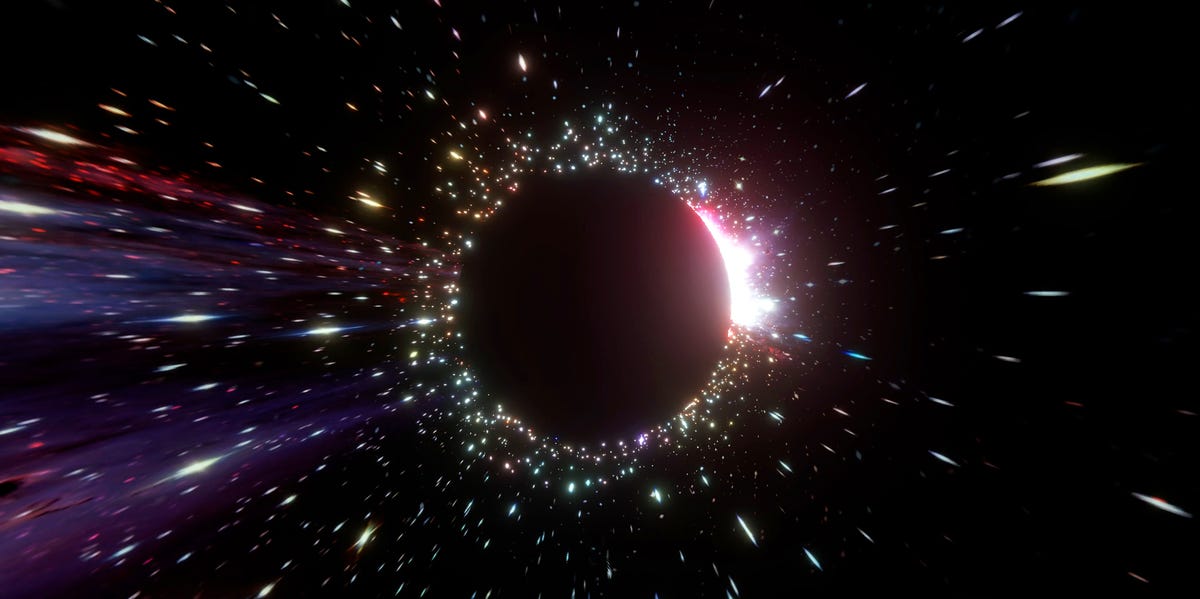
Imagine the most extreme version of a family tree. Stars produce black holes. Black holes produce universes. Those universes produce stars, which produce more black holes, which produce more universes. Suddenly, the cosmos looks less like a single beginning and more like a spectacularly complicated set of Russian nesting dolls.
This idea, usually discussed under labels such as black hole cosmology, baby universes, or the black hole universe theory, sounds suspiciously like something invented during a late-night science-fiction marathon. Yet versions of it have appeared in serious theoretical physics for decades.
Recent peer-reviewed work has given the concept fresh attention by exploring whether gravitational collapse could avoid an infinitely dense singularity, bounce at extremely high density, and generate an expanding region of spacetime resembling our universe.
So, was our universe actually created by a black hole in another universe? The scientifically responsible answer is: possibly, but we have no evidence strong enough to say that it was. The hypothesis is fascinating precisely because it sits on the border between established general relativity, unresolved quantum gravity, and testable cosmology.
The Short Answer: It Is a Real Hypothesis, Not an Established Fact
The standard cosmological model says that the observable universe evolved from an extraordinarily hot and dense early state about 13.8 billion years ago. The Big Bang model successfully explains major observations including cosmic expansion, the cosmic microwave background, primordial element abundances, and the growth of large-scale structure.
Importantly, the Big Bang theory does not necessarily tell us what happened at an absolute beginning. If classical general relativity is extrapolated backward far enough, densities and spacetime curvature appear to become infinite. That produces a cosmological singularity, where the equations stop providing a useful physical description.
Black holes create a suspiciously similar headache. General relativity predicts that matter collapsing inside a black hole can also end at a singularity.
Two of physics’ biggest “we have no idea what happens next” signs therefore appear in surprisingly similar places: the earliest universe and the deepest interior of a black hole.
That similarity motivates an intriguing possibility: perhaps the two problems are actually connected.
How Could a Black Hole Create an Entire Universe?
Start With an Event Horizon
A black hole forms when enough mass becomes concentrated within a sufficiently small region. An event horizon surrounds it, marking the boundary beyond which signals cannot return to an external observer.
Crossing the horizon does not necessarily mean hitting a physical wall. For a sufficiently large black hole, an observer could theoretically cross the horizon without noticing anything dramatic at that exact moment. The real trouble arrives deeper inside.
In classical general relativity, continued collapse eventually leads toward a singularity. But physicists generally regard infinities in density and spacetime curvature as warning signs that the classical theory has been pushed beyond its domain of validity.
Quantum mechanics should become important under such extreme conditions. Unfortunately, physicists still lack a universally accepted theory of quantum gravity capable of describing exactly what happens.
Replace the Singularity With a Bounce
Here is where black hole universe models become interesting.
Instead of allowing matter to collapse forever, some theoretical frameworks introduce mechanisms that generate powerful effects at extreme densities. Collapse slows, reaches a minimum size, and reverses.
From the perspective of the collapsing region, this reversal could resemble a Big Bounce: contraction followed by rapid expansion.
If the expanding spacetime remains causally separated from the parent universe by the original black hole’s horizon, observers living in the new region might experience it as an independent universe.
To an observer in the parent universe: black hole.
To an observer in the expanding interior: potentially an entire cosmos.
Physics rarely offers ideas this delightfully rude to common sense.
The Einstein-Cartan Version of the Black Hole Universe Theory
One influential version has been developed by physicist Nikodem Popławski using the Einstein-Cartan theory of gravity.
Einstein’s standard general relativity describes gravity through spacetime curvature. Einstein-Cartan gravity extends this picture by allowing spacetime to possess another geometric property called torsion. The intrinsic spin of particles can interact with this torsion.
Under ordinary conditions, any torsion effect would be incredibly small. During extreme gravitational collapse, however, the density of fermions could become so enormous that spin-related effects become important.
In Popławski’s models, these effects generate an effective gravitational repulsion at enormous densities. Rather than forming an infinite-density singularity, collapsing matter rebounds.
The result can be a new expanding universe hidden beyond the event horizon of its parent black hole.
This produces a remarkable possibility: every sufficiently appropriate black hole could contain a baby universe, while our own universe could be inside a black hole belonging to a larger parent cosmos.
That does not mean physicists have demonstrated that real astrophysical black holes behave this way. Einstein-Cartan gravity remains an extension of the standard theory rather than the experimentally established description of gravity.
A Newer Idea: Quantum Exclusion Could Trigger the Bounce
The black-hole-universe discussion gained renewed attention in 2025 when Enrique Gaztañaga, K. Sravan Kumar, Swaraj Pradhan, and Michael Gabler published a peer-reviewed study in Physical Review D investigating gravitational collapse without a final singularity.
The researchers modeled a collapsing spherical region and explored what happens when matter reaches extremely high density. Their mechanism is motivated by quantum physics, particularly the exclusion behavior of fermions.
In the model, collapse can reach a high-density ground state rather than continuing to infinite density. The system then undergoes a gravitational bounce.
Even more intriguingly, the post-bounce phase can produce rapid expansion. The authors argue that this framework could potentially connect several phenomena normally treated separately, including early cosmic expansion and late-time acceleration.
The model also makes an important scientific contribution that separates physics from cosmic storytelling: it predicts potentially observable consequences. One proposed signature is a universe with a small but nonzero positive spatial curvature, conventionally represented by a negative value of the cosmological curvature parameter Omega_k.
Future measurements could therefore challenge or constrain the model.
That is exactly what a speculative cosmological theory needs. A theory that explains everything but can never be tested is a fantastic conversation starter and a terrible scientific employee.
Why Physicists Take the Possibility Seriously
1. Singularities Probably Signal Missing Physics
General relativity has passed an extraordinary collection of observational tests. Gravitational-wave measurements of merging black holes continue to agree remarkably well with Einstein’s predictions.
Nevertheless, general relativity is a classical theory. Quantum mechanics governs nature on microscopic scales, and the two frameworks become extremely difficult to reconcile where enormous mass is compressed into extraordinarily small regions.
A black hole singularity is exactly such a place.
Replacing singularities with quantum regions or bounces therefore appears in several approaches to quantum gravity, not only black hole cosmology.
2. The Big Bang Singularity Has the Same Fundamental Problem
Running the universe backward using classical equations eventually leads to conditions where quantum gravity should matter.
Consequently, saying “the universe began at a singularity” may be less meaningful than it initially sounds. The singularity could represent the failure of our equations rather than an actual physical point with infinite density.
A pre-Big-Bang contracting state followed by a bounce is one possible alternative.
3. Baby Universes Appear in Modern Theoretical Research
Baby universes are not limited to one niche theory. They arise in research involving quantum gravity, wormholes, holography, black hole information, and related mathematical models.
For example, theoretical work published in 2026 continues to investigate how closed baby-universe regions can appear in simplified holographic descriptions of black holes.
These studies do not demonstrate that our universe emerged from an astrophysical black hole. They do show that physicists can construct mathematical frameworks in which the concepts of black holes and disconnected universe-like regions are meaningfully related.
What Evidence Do We Actually Have?
This is where enthusiasm needs its seat belt.
We have excellent evidence that black holes exist. The Event Horizon Telescope has imaged the shadow regions surrounding the supermassive black holes in M87 and at the center of the Milky Way. Gravitational-wave observatories have detected large populations of merging black holes. Stellar motions, X-ray binaries, accretion disks, and relativistic jets provide additional evidence.
We also have excellent evidence for an expanding universe that was hotter and denser in the past.
What we do not have is observational evidence showing that the interior of a black hole produces a new universe.
No telescope has detected a baby universe inside Sagittarius A*. No gravitational-wave observation has revealed a message saying, “Congratulations, it’s a cosmos.”
The event horizon itself creates a fundamental difficulty. If a new universe forms behind an event horizon, information from it cannot simply return to observers outside in the normal classical description.
Major Problems the Black Hole Universe Hypothesis Must Solve
Our Universe Is Not Simply an Ordinary Schwarzschild Black Hole
A popular internet argument goes something like this: calculate the Schwarzschild radius associated with the mass of the observable universe, notice a suspicious numerical similarity with cosmic scales, and conclude that the universe must be a black hole.
Unfortunately, cosmology is not that cooperative.
The Schwarzschild solution describes an isolated, nonrotating mass embedded in an otherwise empty spacetime. The universe is not a giant ball of matter sitting inside external empty space in the standard cosmological description. Space itself is expanding, and matter is distributed approximately homogeneously on sufficiently large scales.
Therefore, simply applying the black hole radius formula to the observable universe does not prove anything.
Real Black Holes Rotate
Astrophysical black holes are expected to possess angular momentum. Rotating Kerr black holes have much more complicated interiors than idealized nonrotating ones.
Classical solutions contain inner horizons that can suffer severe instabilities. Any realistic universe-creation model therefore needs to explain what happens in rotating, dynamically evolving black holes rather than only perfectly symmetrical textbook versions.
The Standard Cosmological Model Already Works Extremely Well
Any rival origin story faces an intimidating competitor.
The Lambda Cold Dark Matter model, usually abbreviated Lambda-CDM, combined with early-universe inflationary ideas, successfully explains an enormous range of observations.
A black hole universe model cannot merely sound elegant. It must reproduce the cosmic microwave background, nucleosynthesis, galaxy clustering, gravitational lensing, expansion history, structure formation, and numerous other measurements at least as successfully as existing cosmology.
Preferably, it should also solve problems that the standard framework cannot and make new predictions that observations confirm.
Could Black Holes Be Giving Birth to Universes Right Now?
If the strongest versions of black hole cosmology are correct, perhaps.
Every black hole created by a collapsing star could potentially generate an expanding spacetime region inaccessible from our side of the horizon. Supermassive black holes might do the same.
This inspired physicist Lee Smolin’s idea of cosmological natural selection. In that speculative framework, universes create black holes, black holes create new universes, and physical parameters may change slightly from one generation to another.
Universes particularly good at producing black holes would consequently produce more descendants.
The concept resembles biological evolution without biology: cosmic reproduction with variations in physical constants.
It is intellectually provocative, but observationally difficult to verify.
What Would the Theory Mean for the Big Bang?
If our universe originated inside a parent black hole, the Big Bang would no longer represent the beginning of all existence.
Instead, it could represent a transition.
Before our expansion came gravitational collapse somewhere else. The collapse produced a black hole. Extreme physics prevented a singularity. Matter rebounded, and a new expanding spacetime emerged behind the horizon.
From our perspective, that bounce could lie at the beginning of cosmic history.
From the parent universe’s perspective, it could simply look like a black hole formed.
This distinction is one of the most fascinating consequences of general relativity: different regions of spacetime do not have to share the intuitive concepts of space, time, distance, and simultaneity that work in everyday life.
How Could Scientists Test the Black Hole Universe Theory?
Directly observing a parent universe may be impossible if an event horizon permanently separates us from it. That means researchers need indirect predictions.
One possibility is spatial curvature. Some recent black hole bounce models predict that our universe should be slightly closed rather than perfectly spatially flat. Increasingly precise cosmological surveys can test that prediction.
Another possibility involves relics from a pre-bounce era. Research published in 2026 has explored whether compact objects, primordial or pre-bounce black holes, or gravitational waves could survive a cosmological bounce and later reenter the observable universe.
If distinctive relic populations were discovered with exactly the predicted properties, black hole bounce cosmology would become much more interesting.
Gravitational-wave astronomy also offers increasingly powerful tests of strong-field gravity. By 2026, analyses of expanding catalogs of black hole mergers continue to find excellent agreement with general relativity. Any reliable deviation from Einstein’s predictions could provide clues about new gravitational physics, although such a deviation would not automatically prove the existence of baby universes.
Ultimately, a successful theory of quantum gravity may be required before physicists can confidently answer what happens at the deepest interior of black holes or at the earliest physically meaningful moment of cosmic history.
So, Was Our Universe Created by a Black Hole?
It remains possible within certain theoretical models, but there is currently no compelling observational evidence demonstrating that our universe was created by a black hole in another universe.
What makes the idea valuable is not simply its ability to produce excellent science-fiction plots. Black hole cosmology attacks a genuine weakness in our understanding: both black hole singularities and the classical Big Bang singularity represent places where known physics becomes incomplete.
If quantum effects replace gravitational singularities with bounces, then a collapsing region could conceivably become an expanding region. Under the right geometry, that expanding region might behave like a new universe.
The hypothesis therefore deserves neither instant dismissal nor breathless declarations that scientists have discovered “what came before the Big Bang.”
For now, it belongs to the most enjoyable category in theoretical physics: mathematically motivated, scientifically interesting, potentially testable, and very far from proven.
If future measurements reveal the predicted cosmic curvature, unusual primordial black holes, distinctive gravitational-wave relics, or other signatures of a pre-bounce era, the idea could move closer to the scientific mainstream.
Until then, our cosmic birth certificate still has a very large blank space under “parent.”
A 500-Word Experience: Imagining Life Inside a Black-Hole-Born Universe
There is a useful mental experience that comes with exploring the black hole universe hypothesis: after a while, the words “inside” and “outside” begin to feel much less reliable.
Picture yourself standing outside at night. Nothing appears unusual. Orion is still Orion. The Milky Way stretches across a dark sky. Earth continues orbiting the Sun, and the Sun continues orbiting the center of the galaxy. Your coffee still becomes mysteriously cold exactly three minutes before you remember drinking it.
Now suppose physicists announced tomorrow that overwhelming evidence showed our entire universe originated inside a black hole.
Practically speaking, nothing around you would change.
You would not suddenly feel a gravitational pull toward some giant cosmic drain. Galaxies would not begin falling toward a visible center. There would be no enormous black circle waiting beyond the observable universe.
The reason is that being the expanding interior descendant of a black hole would be very different from floating near a black hole inside our own universe.
Your experience of spacetime would still be determined by the geometry of the universe you inhabit.
The most dramatic change would happen in your understanding of cosmic history.
Instead of mentally rewinding the universe toward a mysterious first instant and stopping, you could imagine continuing the story through a bounce. Our hot early universe becomes the aftermath of gravitational collapse in a parent cosmos.
Then look at the black holes scattered through our own universe.
Sagittarius A*, sitting quietly at the center of the Milky Way, suddenly acquires a philosophical upgrade. Rather than merely being a four-million-solar-mass gravitational monster, perhaps somewhere beyond its horizon an entirely new arrow of cosmic time has begun.
Imagine a hypothetical civilization evolving billions of years inside that child universe. Its astronomers map galaxies, measure cosmic expansion, discover gravitational waves, argue about dark matter, and write papers asking what happened before their Big Bang.
They may never know that, from our perspective, their entire cosmic history began with matter collapsing into Sagittarius A*.
Then comes the truly dizzying part.
Perhaps the black holes in their universe generate still more universes.
Our universe would therefore be neither the first nor the last. It would simply occupy one branch of a potentially enormous cosmic genealogy.
The experience illustrates why black hole cosmology is so compelling even before it is proven. It transforms the Big Bang from a unique creation event into a physical process that might happen repeatedly.
At the same time, the thought experiment teaches an important scientific lesson. A beautiful explanation is not evidence.
The universe has no obligation to prefer the story humans find most elegant.
We therefore return from the imaginative journey to actual observations: cosmic microwave background measurements, gravitational waves, spatial curvature, black hole populations, galaxy surveys, and eventually whatever clues quantum gravity provides.
That tension between imagination and measurement is exactly where theoretical cosmology becomes most exciting. We are allowed to ask whether our universe was born inside a black hole. We are allowed to construct mathematics describing how it might happen.
But nature gets the final vote.
Final Thoughts
The possibility that our universe was created by a black hole in another universe is one of cosmology’s boldest ideas because it connects several unsolved problems at once: the Big Bang singularity, black hole interiors, quantum gravity, cosmic inflation, and perhaps even the structure of a larger multiverse.
The modern versions are more sophisticated than the simple claim that “the universe has lots of mass, therefore it must be a black hole.” They investigate gravitational collapse, quantum effects, spacetime geometry, and measurable predictions.
Yet the evidence remains insufficient to replace standard cosmology. The safest conclusion is therefore also the most interesting one: we genuinely do not know what happened at the deepest level before the hot early universe.
A parent black hole remains one candidate. Nature may ultimately choose something stranger.
Note: This article discusses speculative theoretical cosmology rather than an established description of cosmic origins. It was researched using peer-reviewed studies and scientific material from sources including NASA Science, the U.S. National Science Foundation, the American Physical Society and Physical Review D, the LIGO Scientific Collaboration, Stanford University, Princeton University, Columbia University, Cornell-hosted arXiv research, Scientific American, Quanta Magazine, Physics Today, Smithsonian Magazine, and established astronomy publications. Claims involving baby universes, gravitational bounces, or a parent universe should not be interpreted as observationally confirmed facts.