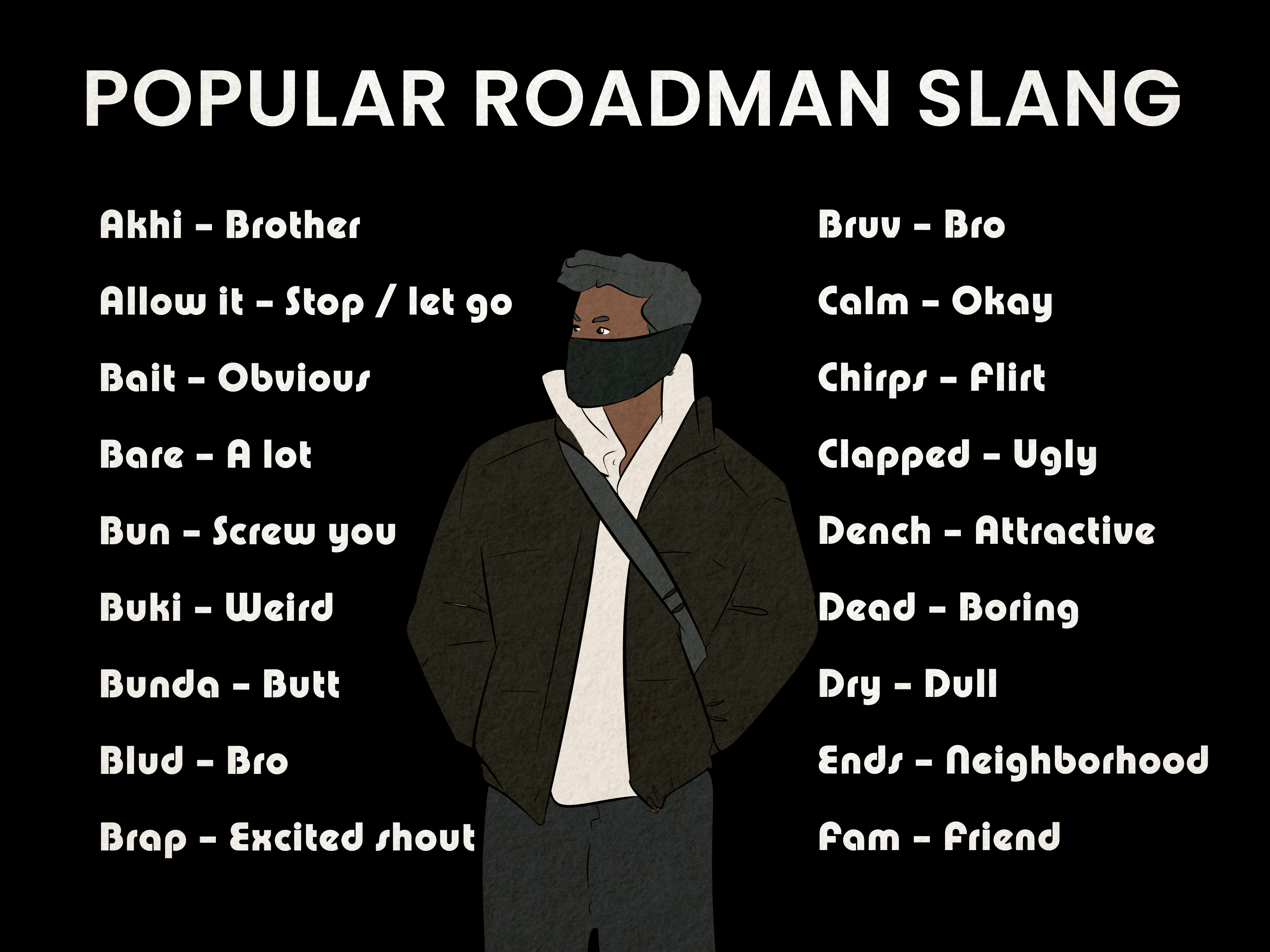
Turn on a British drill track, watch a few episodes of a London crime drama, or scroll through UK street interviews on social media, and you may suddenly feel as though English has downloaded an expansion pack without telling you. Someone is “gassed,” the food is “peng,” the situation is “peak,” and a friend has been instructed to “allow it.” The words are familiar enough to look harmless, yet the sentence can still land like a coded transmission.
Roadman slang is commonly used as a casual label for street-influenced vocabulary associated with young people in London and, increasingly, other parts of the United Kingdom. Much of it overlaps with Multicultural London English, or MLE, a London dialect that developed in highly multicultural neighborhoods from the late twentieth century onward. However, the terms are not interchangeable: MLE is a genuine language variety with its own pronunciation, grammar, and vocabulary, while “roadman” often describes a social persona, stereotype, or style. Not everyone who speaks MLE is a roadman, and not everyone borrowing a few slang terms actually speaks MLE.
This guide explains common roadman slang words, where the lingo comes from, how context changes meaning, and why sounding natural involves more than tossing “fam” into every sentence like verbal seasoning.
What Does “Roadman” Mean?
In literal street usage, a roadman is someone who is “on road,” meaning involved in neighborhood street life. Depending on the speaker and context, the term can suggest a young man who spends much of his time outside with friends, participates in a local scene, dresses in recognizable streetwear, or is connected to risky or illegal activity. Online, the meaning is often broader and more cartoonish: a tracksuit, a small crossbody bag, a puffer jacket, a certain London-style accent, and enough confidence to negotiate with a chicken-shop cashier as if closing an international trade agreement.
That comic stereotype should not be confused with the full reality of urban British speech. Linguistic research describes the “roadman” as a stylized social character associated with ideas about Black British culture, masculinity, class, and urban life. Because of that history, using the label carelessly can reinforce racial and class stereotypes. The safest approach is to treat “roadman slang” as a convenient search term while recognizing that the language itself comes from diverse communities and cannot be reduced to one costume or personality.
Where Roadman Slang Comes From
Roadman lingo did not appear because one bored Londoner woke up and decided standard English needed more plot twists. It grew through contact among communities. MLE developed in parts of London with substantial immigration and combines influences from local London English with Caribbean varieties, especially Jamaican Patois, as well as South Asian, West African, Arabic, Somali, and other linguistic sources. Researchers emphasize that it is a mixed, evolving dialect rather than “fake Jamaican,” an inaccurate label that ignores its many contributors.
Music accelerated the spread. Reggae and dancehall helped Caribbean vocabulary circulate in Britain; grime, UK hip-hop, and drill later carried MLE expressions far beyond their original neighborhoods. Television, streaming, street-interview videos, gaming, memes, and TikTok have pushed the vocabulary into suburbs and overseas audiences. Words such as bait, ends, ting, and gassed now appear in places where the speaker may never have visited London, let alone argued about whose turn it is to buy chips.
Essential Roadman Slang Words and Phrases
Greetings and People
- Wagwan
-
A greeting meaning “What is going on?” or simply “What’s up?” It comes from Jamaican Patois. Example: “Wagwan, you good?” The natural reply depends on the situation, but “Yeah, I’m good” is safer than attempting a five-minute improvised monologue in an accent you learned yesterday.
- Fam
-
Short for family, used for a close friend or trusted group. Example: “That’s my fam.” It can be warm, serious, playful, or mildly confrontational depending on tone. Dictionary sources define it as a term for close friendsyour peoplenot necessarily biological relatives.
- Bruv, Blud, and Bro
-
All can mean “brother” or “friend.” Bruv is a British pronunciation-based form of brother. Blud comes from blood, suggesting a bond like family. These terms can sound affectionate in one sentence and irritated in the next: “Bruv, that was amazing” is praise; “Bruv, what are you doing?” may indicate that your life choices are under review.
- Mandem
-
A group of male friends, one’s crew, or the guys. The word reflects Caribbean English structure, combining man with a form of them. Example: “I’m meeting the mandem later.” It already refers to a group, so “mandems” is often redundant, though real slang rarely waits for grammar police to approve its paperwork.
Descriptions, Reactions, and Opinions
- Bare
-
Means “a lot of,” “many,” or sometimes “very.” Example: “There were bare people outside” means there were many people outside. “That took bare long” means it took a very long time. To American ears, it can sound backward because standard English usually treats bare as “uncovered” or “minimal.” Slang looked at that definition and chose chaos.
- Peng
-
Attractive, excellent, or delicious. A person can be peng, but so can food: “That burger was peng.” Because the word may refer to someone’s appearance, consider the relationship and setting before using it. Complimenting lunch is low risk; loudly rating strangers on public transportation is not a personality.
- Peak
-
Bad, unfortunate, embarrassing, or difficult. Example: “You missed the last train? That’s peak.” This often confuses Americans, since peak usually suggests the highest or best point. In this usage, it means the situation has reached an unpleasant extreme.
- Bait
-
Obvious, exposed, or easy to notice. Example: “Don’t do that here; it’s too bait.” A lie can be bait, a hiding place can be bait, or someone’s attempt to act casual while carrying a six-foot cardboard cutout through a train station can be extremely bait.
- Gassed
-
Overexcited, hyped up, flattered, or overly proud. Example: “He got one compliment and now he’s gassed.” It may describe genuine excitement or mock someone whose ego has reached weather-balloon altitude.
- Safe
-
A flexible expression of approval, thanks, agreement, greeting, or farewell. “Safe, bro” might mean “thanks,” “good looking out,” “all right,” or “see you later.” Tone does most of the labor.
Actions and Situations
- Allow It
-
Means “stop it,” “leave it alone,” “forget it,” or “give it a rest.” Example: “Allow it, you’ve told that story three times.” The phrase appears to mean permission but usually communicates the exact opposite. Welcome to slang, where signs are occasionally installed facing backward.
- Pattern Up
-
Organize yourself, fix your behavior, improve a situation, or get something arranged. Example: “You need to pattern up and finish the assignment.” It may also refer to solving a practical problem: “I’ll pattern the tickets.”
- Move Mad
-
Act recklessly, strangely, aggressively, or out of character. Example: “Why are you moving mad over a parking space?” The phrase concerns behavior, not physical relocation.
Places, Clothes, and Everyday Life
- Ends
-
One’s neighborhood or local area. Example: “He’s from my ends.” It conveys more than geography; it can signal belonging, familiarity, and community identity.
- Yard
-
Home or house. Example: “I’m heading back to my yard.” This usage is strongly associated with Jamaican English and Caribbean influence in Britain.
- Creps
-
Sneakers or athletic shoes, called trainers in standard British English. Example: “Those creps are clean.” In American English, “clean” here means stylish or in excellent condition, not recently introduced to soap.
- Feds
-
The police. In the United States, the feds usually means federal law-enforcement agents. In UK street slang, it can refer more generally to police officers, so an American listener may imagine a much larger investigation than the speaker intended.
- Wasteman
-
A useless, foolish, or disreputable person. Example: “He borrowed money from everyone and disappearedwhat a wasteman.” It is an insult, not a cheerful synonym for “silly goose.”
How Context Changes the Meaning
Slang is not a simple substitution code. Replacing every standard word with a roadman equivalent will not produce natural speech; it will produce a linguistic costume party. Meaning depends on relationship, region, age, tone, facial expression, and what happened immediately before the sentence.
Consider “safe.” Said after someone lends you a charger, it means “thanks.” Said while leaving, it may mean “goodbye.” Said after a plan is proposed, it may mean “sounds good.” Likewise, “fam” can be affectionate, neutral, sarcastic, or threatening. The dictionary gives you the map, but tone tells you whether the road is open.
Regional variation matters too. London is central to MLE, but slang moves through Birmingham, Manchester, Liverpool, and other cities, where meanings, pronunciations, and preferred words may differ. Online lists often bundle all UK urban slang together, even when a term belongs more strongly to a particular city, generation, music scene, or friendship group. Research on slang more broadly confirms that meanings vary between communities and change over time.
How to Use Roadman Slang Without Sounding Forced
Listen Before You Copy
Pay attention to full conversations rather than isolated vocabulary lists. Notice who uses a term, whom they say it to, where it appears in the sentence, and whether the mood is friendly or tense. Ten seconds of context can teach more than ten definitions.
Use Only What Fits Your Natural Voice
Borrowing one widely understood term such as fam, bare, or peak may sound natural if your social group already uses it. Delivering an entire speech in stylized London slang when you normally sound like a weather presenter from Ohio will probably feel like an audition nobody announced.
Avoid Mimicking an Accent
Vocabulary can travel more easily than accent. Exaggerating pronunciation for laughs may turn a living dialect associated with Black and working-class communities into a caricature. Linguists have long documented how nonstandard language varieties are judged through social prejudices rather than linguistic quality. Every dialect has structure; prestige is social, not grammatical.
Know Which Terms Carry Real Aggression
Some roadman slang is connected to conflict, crime, weapons, or insults. Understanding those words may help with music, television, or conversation, but using them casually can create trouble. There is a major difference between recognizing a term and testing it on strangers like a newly unlocked video-game ability.
A Typical Learner’s Experience: From “Wagwan?” to Actually Understanding
Imagine an American visitor named Alex arriving in London with confidence, a transit card, and exactly three pieces of cultural preparation: tea is important, people stand on the right side of escalators, and everyone says “innit.” By lunchtime, all three assumptions are already under stress.
At a food counter, Alex hears one customer tell another, “That’s bare peng, fam.” The literal translation running through Alex’s head is “That is uncovered penguin family,” which seems unlikely but not impossible in a city with excellent museums. From context, however, the customer is clearly praising the meal. Alex quietly learns lesson one: do not translate slang word by word.
Later, a group of friends discusses plans. One says, “Link at mine, then we’ll touch road.” Another replies, “Safe.” Nobody appears to be touching asphalt, and no safety inspection follows. Alex realizes that link means meet, mine means my place, touch road means head out, and safe signals agreement. Lesson two arrives: several slang terms can work together, but the conversation remains perfectly logical to insiders.
The real challenge comes when Alex tries participating. After hearing fam repeatedly, Alex uses it with a hotel receptionist, a museum guard, and an elderly woman asking for directions. Nobody is offended, but each exchange develops the faint emotional atmosphere of a teacher watching a student use a semicolon in every sentence. Alex learns lesson three: understanding a word does not automatically grant social fluency.
Over the next few days, Alex stops performing and starts listening. The same speaker uses standard workplace English during a phone call, relaxed slang with friends, and more traditional British expressions with an older relative. This shifting is not confusion; it is skill. People adjust language to audience and setting constantly. Americans do it too, moving between professional speech, family talk, regional expressions, gaming language, and group jokes without preparing a formal linguistic strategy document.
By the end of the trip, Alex has not transformed into a London local and wisely does not try. Instead, television dialogue makes more sense, song lyrics reveal extra layers, and casual conversations no longer sound like encrypted audio. Alex occasionally says “That’s peak” when something goes wrong and uses “safe” with friends who already speak that way. The improvement is not a larger slang inventory; it is better judgment.
That is the most useful experience any learner can have with roadman slang. The goal is not to collect expressions like trading cards or force them into every conversation. It is to understand the culture, humor, relationships, and social signals carried by the language. Once that happens, the vocabulary stops looking random. It becomes what slang has always been: a fast, creative way for communities to signal identity, closeness, attitude, and belonging.
Conclusion
Roadman slang is lively, expressive, and constantly changing. Its vocabulary reflects the multicultural history of London, the influence of Caribbean and African diasporas, local British speech, and the global reach of music and social media. Learning terms such as wagwan, mandem, bare, peng, peak, and allow it can make UK entertainment and everyday conversation much easier to follow.
The bigger lesson is contextual. Roadman slang is not a phrasebook to be performed at full volume, and MLE is not simply an accent for jokes. Listen first, notice how meanings shift, avoid stereotypes, and use only the expressions that genuinely fit your setting. Do that, and you will sound informed rather than like someone who watched one drill video and immediately declared himself governor of the ends.
Note: Slang evolves quickly, and usage varies by city, age group, community, and social setting. The definitions in this guide describe common meanings, not permanent rules. This article synthesizes linguistic research, established dictionary entries, and reputable cultural reporting rather than treating viral slang lists as the final authority.